Sourcing Custom Brooches From RFQ to Bulk Shipment
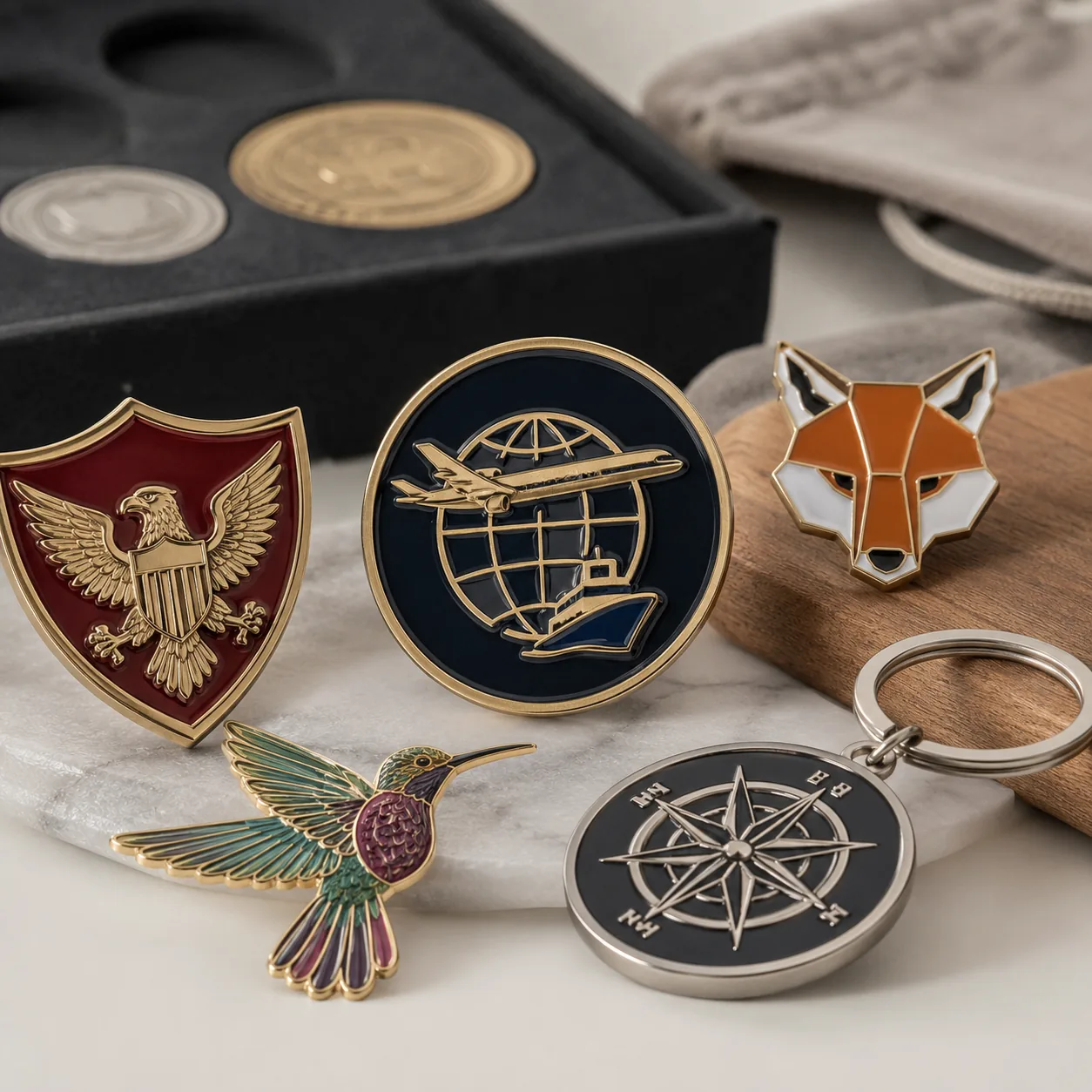
1. Classify the Item as a Brooch Before Quoting
Many sourcing errors start with the wrong label. A buyer requests a “pin” for a 50 mm decorative logo, the supplier prices a 25 mm lapel pin with one butterfly clutch, and the bulk product rotates, tilts forward or tears light fabric. A brooch is not just a larger lapel pin. It needs a different attachment system, weight target, solder area, plating coverage, packing protection and inspection plan.
For sourcing purposes, treat a brooch as a decorative wearable metal item usually 30 to 70 mm wide, 1.5 to 3.5 mm thick and 8 to 40 g depending on alloy, enamel, stones and backing. Designs with horizontal logos, chains, crystals, pearls, open cutouts, scarf use or uniform use should be specified as brooches. If the item must sit flat on a blazer, hotel uniform, airline scarf or coat, the attachment is a functional component, not a low-cost accessory.
| Product type | Typical size | Typical weight | Preferred attachment | Main sourcing risk |
|---|---|---|---|---|
| Lapel pin | 18-32 mm | 3-10 g | Butterfly clutch, rubber clutch or small magnet | Rotates or feels undersized when used as a brooch |
| Small brooch | 30-45 mm | 8-18 g | 20-25 mm safety brooch bar or dual posts | Single post may rotate above 35 mm width |
| Fashion brooch | 45-70 mm | 18-40 g | 25-35 mm locking brooch bar, sometimes with stabilizing post | Can sag on shirts or thin polyester |
| Badge-brooch hybrid | 35-60 mm | 12-30 g | Brooch bar plus anti-rotation pin or magnetic plate | Needs safety review for schools, children or public events |
Confirm the garment, user group and wear frequency before pushing for price reduction. A one-day event brooch on a card can use a lighter promotional standard. A daily uniform brooch for hotels, airlines or retail staff needs stronger attachment, more consistent plating and tighter AQL because field failures become visible and costly.
2. Build the RFQ Around Measurable Specs
Artwork alone is not a specification. A usable RFQ should state finished size, tolerance, target weight, base metal, process, plating finish, plating thickness, enamel type, attachment position, packing method, compliance requirement, inspection level and requested ship date. It should also identify the wearing surface: wool blazer, polyester uniform, cotton shirt, scarf, denim jacket, hat, lanyard strap or presentation box only.
Use dimensional tolerance of ±0.30 mm for stamped brass and ±0.50 mm for zinc alloy casting unless the design has deep relief, assembled layers or irregular pearls. Thickness tolerance is commonly ±0.20 mm. Weight should stay within ±10% of the approved sample; for shirt or uniform wear, even a 5 g increase can change how the item hangs. If the supplier cannot quote to these figures, ask for their achievable production tolerance before tooling starts.
- Size: specify width x height in mm, orientation and whether the artwork is true 1:1 scale.
- Base metal: use brass for sharper stamping and premium plating; use zinc alloy for thicker 3D forms and sculpted shapes.
- Thickness: specify 1.5-2.0 mm for small stamped brooches and 2.0-3.5 mm for cast or layered brooches.
- Weight target: keep below 12 g for shirts, 12-22 g for uniforms, and 22-40 g only for jackets, coats or boxed gift brooches.
- Plating: request 0.3-0.8 micron decorative gold, nickel, rose gold, black nickel, antique brass or antique silver over the agreed underlayer.
- Inspection: set AQL 2.5 for major defects and AQL 4.0 for minor defects; use AQL 1.5/2.5 for retail jewelry-grade programs.
- Packing: define polybag, backing card, velvet pouch, rigid box, barcode label, carton mark and quantity per inner carton.
State compliance early. Promotional brooches may still need lead, cadmium or nickel-release controls if sold at retail, distributed in the EU, handled by children or used by public-facing staff. Compliance can change the plating stack, solder choice, test cost and lead time.
3. Choose the Manufacturing Route Before Negotiating Price
Most cost variation comes from process choice, not supplier margin. A 50 mm brooch can be stamped in brass, die cast in zinc alloy, etched from brass or iron, or assembled from multiple parts. Each route affects tooling cost, edge definition, polishing time, plating stability, reject rate and perceived value.
Stamped brass is the most stable option for premium logo brooches with clean outlines, flat enamel and repeat orders. It gives sharp metal lines and consistent plating, but deep 3D relief is limited. Zinc alloy casting suits larger sculpted shapes, thick outlines, curves and raised relief, but it needs stronger polishing control to avoid pits, rounded details and visible gate marks. Etched brass or iron is economical for flat designs, but it feels lighter and less jewelry-like. Multi-part assembly is used for chains, charms, stones, moving parts and two-tone plating; labor cost and defect risk rise quickly.
| Process | Practical MOQ | Tooling range | Typical FOB China range | Sample lead time | Bulk lead time | Best use |
|---|---|---|---|---|---|---|
| Stamped brass with enamel | 100 pcs; 500 pcs economical | USD 45-120 | USD 1.20-3.80/pc | 5-9 days | 12-18 days | Premium logo brooches, sharp metal lines, repeat campaigns |
| Zinc alloy casting | 100 pcs; 500 pcs economical | USD 60-180 | USD 1.50-5.80/pc | 7-12 days | 14-22 days | 3D shapes, thick profiles, large fashion brooches |
| Etched brass or iron | 100 pcs; 500 pcs economical | USD 35-90 | USD 0.85-2.60/pc | 5-8 days | 10-16 days | Flat promotional designs and price-sensitive events |
| Multi-part assembled brooch | 200 pcs; 1,000 pcs economical | USD 90-280 | USD 2.80-9.50/pc | 9-14 days | 18-30 days | Chains, charms, stones, layered logos or dual finishes |
Use these FOB ranges as screening benchmarks, not fixed quotations. Final pricing depends on size, metal weight, enamel area, plating color, stone count, reject allowance, packaging and payment terms. A quote far below the range often means thinner metal, lighter plating, simplified attachment, excluded packing or limited inspection.
4. Quote MOQ Tiers, Lead Times and Inclusions
A professional quote should show quantity tiers because brooch cost does not fall in a straight line. At 100 pieces, tooling, sample handling and artwork setup dominate unit cost. At 500 to 1,000 pieces, plating rack efficiency and packing labor become more predictable. Above 3,000 pieces, material yield, polishing capacity, inspection time and carton packing can matter more than tooling.
Ask for 100, 300, 500, 1,000 and 3,000 piece tiers where practical. For simple stamped or etched brooches, 100 pieces is often possible, but 300-500 pieces is usually the first efficient tier. For assembled brooches with stones, chains or two plating colors, 200 pieces may be accepted, but the supplier may include extra reject allowance and hand labor. Retail card printing, velvet pouches and rigid boxes may carry separate MOQs of 500 or 1,000 pieces even when the brooch MOQ is lower.
The quote should separate tooling, sample cost, unit FOB price, packing cost, optional testing, mold modification charges and bank fees. FOB should name the port, typically Shenzhen, Guangzhou, Shanghai or Ningbo. Do not compare EXW, FOB and DDP prices as if they are factory-price equivalents; freight, duty, customs handling and last-mile delivery can hide major differences.
A realistic schedule is 1-2 days for engineering review, 1-2 days for revised artwork after comments, 5-12 days for sample production, and 10-30 days for bulk production after sample approval. Add 2-4 days for custom cards, barcoded bags or carton labels. Add 5-10 days for third-party lab testing. Before confirming the delivery date, check peak season, public holidays, stone-setting capacity and hand-polishing bottlenecks.
5. Approve Engineering Artwork, Not Sales Renders
The approval file must be a production drawing. It should show front view, back view, actual size, thickness, metal line widths, enamel zones, plating finish, Pantone references, attachment type, attachment coordinates, logo text height, stone size and packing layout. A glossy render can hide a 0.15 mm metal bridge, a cutout too narrow for polishing or a brooch bar placed too high for balance.
For hard enamel on stamped brass, keep raised metal dividers at 0.25 mm minimum. For soft enamel, use 0.30 mm minimum. On zinc alloy casting, use 0.35 mm or more for raised dividers, especially with antique plating because polishing removes high points. Recessed enamel-filled text should normally be at least 1.5 mm high; raised metal text can sometimes work at 1.2 mm if the font is bold. Cutouts should be at least 1.2 mm wide in stamped brass and 1.5 mm wide in zinc alloy to reduce burrs, trapped plating solution and rough edges.
Attachment placement must be dimensioned from fixed edges. Define the brooch bar centerline distance from the top and side edges. For horizontal designs above 45 mm, a 25-35 mm locking bar or dual stabilizing posts is safer than one short bar. For magnets, confirm magnet diameter, pull force by fabric type and user restrictions. Magnets may be unsuitable for children, medical environments, security-sensitive facilities or users with implanted devices.
- Request front and back drawings at 1:1 scale plus enlarged details for small text, stones and cutouts.
- Confirm minimum metal line width, text height and cutout width before tooling starts.
- Specify Pantone coated references and visual color checking under D65 light unless physical color chips are supplied.
- Mark antique recess darkness and polishing direction because antique finishes vary more than shiny nickel or gold.
- Dimension attachment location from fixed edges and confirm whether anti-rotation support is required.
- Require written approval for any engineering change that alters logo shape, weight, color or attachment.
6. Validate the Sample as a Wearable Product
Sample approval should test function, not only appearance. Wear the brooch on the intended garment or a comparable fabric swatch for at least 30 minutes. Check whether it tilts forward, rotates, pulls fabric, scratches the wearer, opens at the clasp or leaves an unacceptable hole after removal. A sample that looks acceptable on a table can fail on a polyester blouse or thin uniform jacket.
Measure width, height and thickness with calipers and compare them with the approved drawing. Normal acceptance is ±0.30 mm for stamped brass and ±0.50 mm for zinc alloy casting. Check weight with a 0.1 g scale and record it as the bulk reference. If the sample is approved at 18 g for a uniform, the factory should not ship a lot averaging 24 g without written confirmation.
Inspect the front at normal viewing distance first, then use magnification only for troubleshooting. Decorative plating for brooches is commonly 0.3-0.8 micron for gold, nickel, black nickel or rose gold, with thicker systems available for higher-wear use. For daily uniform programs, require plating adhesion tape testing, 20 clasp open-close cycles and a firm manual pull check on the soldered, riveted or glued attachment. For stones or pearls, check alignment, glue overflow and retention after light hand pressure.
Keep one signed physical sample as the control sample. Photograph the front, back, side profile, clasp and packaging. The sample record should list allowed deviations, such as slight antique tone variation or minor back-side polishing marks. Without this record, bulk inspection becomes subjective.
7. Control AQL, Packing and Shipment Release
Bulk inspection should separate functional failures from cosmetic variation. A broken clasp, loose solder joint, sharp burr, missing stone, wrong attachment, wrong plating color, exposed base metal or severe enamel overflow is a major defect. Tiny back-side polish marks, slight antique tone variation or very small enamel dimples may be minor if they are not visible at normal viewing distance and do not affect use.
| Inspection point | Suggested standard | Defect level |
|---|---|---|
| Finished size | Approved drawing; ±0.30 mm stamped brass or ±0.50 mm zinc alloy casting | Major if fit, pairing or packing is affected |
| Weight | Within ±10% of approved sample unless otherwise agreed | Major if wear performance changes |
| Attachment strength | No loosening under firm manual pull; solder, rivet or glue remains secure | Major |
| Clasp function | 20 open-close cycles on sampled pieces without sticking or failure | Major |
| Plating | Correct finish; no exposed base metal, burn marks, heavy pits or obvious tarnish on front | Major or minor by visibility |
| Enamel and stones | Correct color; no missing fill, severe overflow, large bubbles, loose stones or glue stains | Major |
| Packing | Correct card, bag, box, barcode, carton mark and quantity per carton | Major if retail sale or shipment handling is affected |
Use AQL 2.5 for major defects and AQL 4.0 for minor defects on most promotional brooches. For retail jewelry programs, tighten to AQL 1.5 for major and 2.5 for minor, especially where returns penalties apply. Inspection photos should show random carton selection, opened cartons, front and back closeups, caliper readings, weight readings, clasp tests and final carton marks.
Before shipment release, confirm carton quantity, gross weight, carton dimensions and export marks. Polybagged brooches are often packed 100-250 pieces per inner carton depending on size. Velvet-box or rigid-box packing may reduce this to 40-100 pieces per carton and raise air freight cost because chargeable volume increases faster than product value. Ask for carton data before final freight booking.
Save the reorder file before balance payment: final artwork, mold number, plating recipe name, enamel references, attachment specification, packing layout, carton label, inspection report and approved sample photos. This prevents drift when the same campaign needs another 500 or 5,000 pieces six months later.
Have a project? Send your artwork and target quantity and we’ll reply with a detailed quotation within 12 working hours.
Ready to get this made?
Send your sketch, target quantity and ship-date. Detailed quotation in 12 hours.



