Soft vs Hard Enamel Keychains: Specs That Change Cost
Why this comparison matters
Buyers usually ask for a custom keychain by shape, but the build choice is what determines cost, feel, and failure risk. Soft enamel and hard enamel can look similar at first glance, yet they differ in surface finish, fill height, polishing, and the amount of rework required after casting. If you are buying for a retail program, a corporate gift drop, or an event giveaway, that difference can move your landed cost by 10-30% and change how the product survives daily use. The wrong choice often shows up later as scratched color, uneven edges, or a keychain that feels too flimsy for its price tier.
At ZheCraft, we see the same pattern across keychains, badges, and pins: the buyer is not really choosing a decoration style, they are choosing a production path. Soft enamel suits lower price points and stronger texture contrast, while hard enamel suits flatter finishes and more polished presentation. The right answer depends on whether the customer will notice touch, gloss, and weight, or whether the item just needs to carry a logo cleanly. This article compares the two builds head-to-head so you can spec them with fewer surprises.
Spec table: what changes in production
The fastest way to compare these builds is to look at the specs that factories actually control. The table below reflects common production ranges for zinc alloy keychains with one-sided or double-sided enamel fill, excluding premium packaging and unusually complex attachments. Final numbers vary by artwork, size, and finishing load, but these ranges are realistic for quoting and RFQs.
| Spec | Soft enamel | Hard enamel |
|---|---|---|
| Minimum practical thickness | 1.2-1.5 mm | 1.5-2.0 mm |
| Typical edge profile | Raised metal lines, recessed color | Flat-to-slightly domed, polished smooth |
| Color fill height | Below metal line by 0.2-0.5 mm | Filled level with metal after polishing |
| Surface finish | Textured; metal lines remain tactile | Smooth; polishing removes most texture |
| Common plating thickness | 0.08-0.12 micron flash; 0.15 micron upgrade | 0.08-0.12 micron flash; 0.15-0.2 micron preferred |
| Typical MOQ | 300-500 pcs | 300-500 pcs |
| Sample lead time | 7-10 days | 10-14 days |
| Mass lead time | 15-20 days | 18-25 days |
| FOB price range at 500 pcs, 40-50 mm, simple art | USD 0.70-1.30 | USD 1.00-1.90 |
Surface feel and visual result
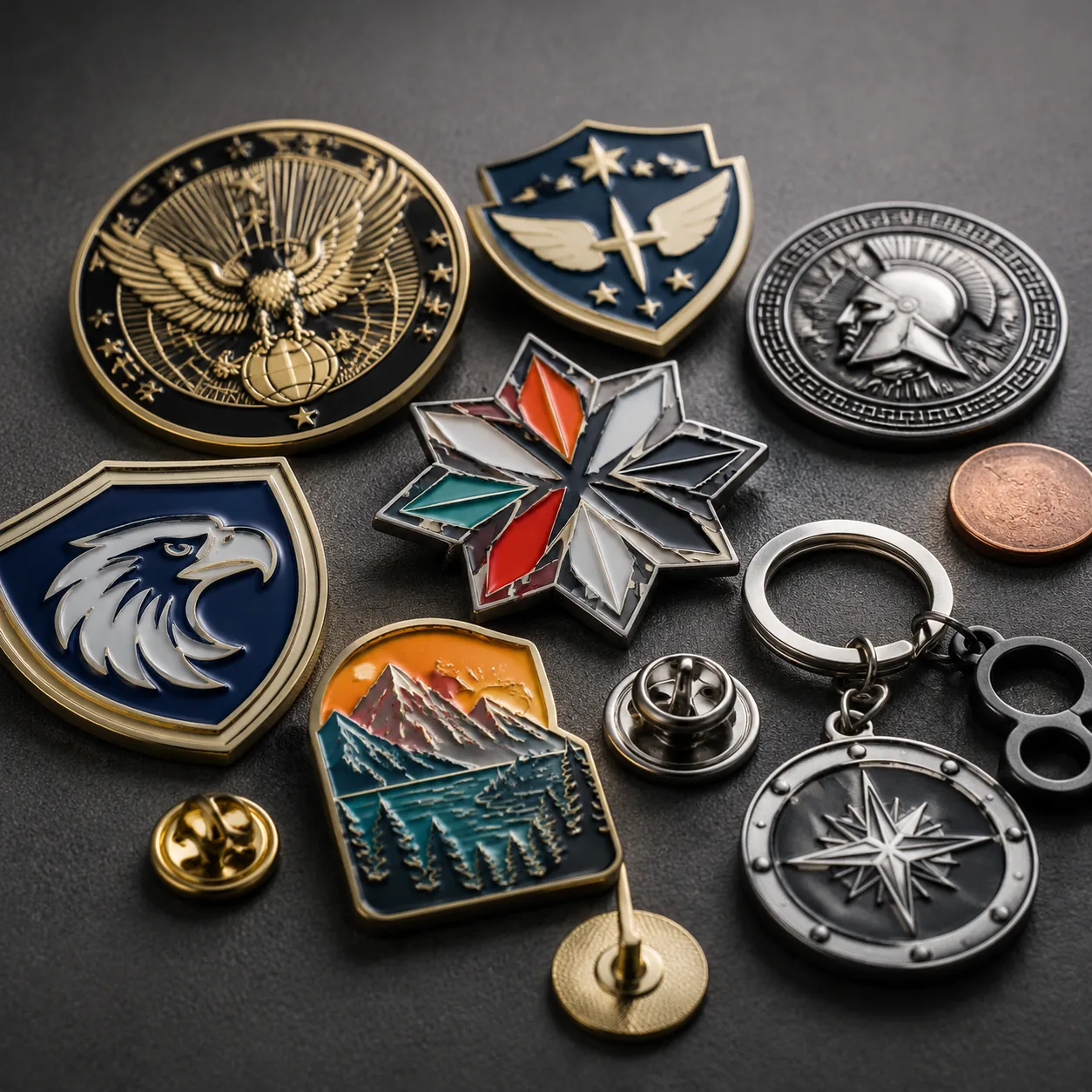
Soft enamel gives you visible relief. The raised metal lines create a stronger outline, so logos with separate color blocks tend to read clearly even from a distance. That texture also makes the product feel more dimensional in hand, which is useful for novelty programs, fandom merchandise, and price-sensitive promotions. The trade-off is that the color sits lower than the metal, so dust, edge wear, and scratch marks are more likely to show over time.
Hard enamel is built for a flatter, more finished appearance. The enamel is polished down after curing so the face becomes smoother and more like a small branded object than a textured trinket. It usually looks better for premium retail, formal corporate gifts, and designs with minimal typography, because the surface captures light evenly. The downside is cost and processing time, since polishing adds labor and can slightly soften very fine details if the artwork is not designed with enough line width.
Cost and MOQ: where the price gap comes from
The price difference is not mainly about the raw metal. It comes from process time, polishing labor, scrap risk, and how much finishing the factory must do by hand. Soft enamel usually stays cheaper because the recessed fill can be left as-is after curing, while hard enamel needs repeated sanding and polishing to level the surface. If the order includes complex plating, glitter, translucent color, or mixed finishes, both builds rise in cost, but hard enamel rises faster.
For standard zinc alloy keychains around 40-50 mm, a simple soft enamel quote often lands around USD 0.70-1.30 FOB at 500 pcs, while a comparable hard enamel version is often USD 1.00-1.90 FOB. At 1,000 pcs, the spread narrows slightly, but hard enamel still stays higher unless the artwork is extremely simple. MOQ is commonly 300-500 pcs for both, though factories may accept lower quantities if you pay a setup surcharge or accept a longer lead time. If your program needs rapid replenishment, soft enamel is usually easier to repeat because the process tolerates minor cosmetic variation better than a polished surface.
- Choose soft enamel when the design depends on bold color separation and a lower unit price.
- Choose hard enamel when the buyer expects a smooth, premium touch and a more formal finish.
- Avoid hard enamel for very thin lines, tiny text, or artwork with heavy internal detail.
- Avoid soft enamel when fingerprints, edge wear, or a textured look will be considered defects.
- Ask for one golden sample with the exact plating, fill colors, and attachment before mass production.
Durability, wear, and cleaning performance
Neither build is indestructible, and both can fail if the attachment, plating, or base alloy is weak. Soft enamel tends to show wear earlier because recessed color can trap dirt and the raised lines receive more abrasion during daily carry. That does not mean it is low quality; it simply means the visual aging is more visible. For event giveaways that may be used casually and replaced often, this is acceptable, especially when cost matters more than long-term cosmetic perfection.
Hard enamel performs better when the buyer wants a product to keep its face appearance longer under normal handling. The polished surface wipes clean more easily and resists dirt buildup in the color areas. However, the polished face can reveal pinholes, sink marks, and minor polishing waves if the cast quality is poor, so you need tighter process control. On both builds, ask the factory for an AQL plan; a typical incoming or final inspection target might be AQL 2.5 for major defects and 4.0 for minor cosmetic issues, with special attention to plating coverage, fill level, and attachment pull strength.
Artwork limits that change the decision
Artwork is where many buying teams make the wrong call. Soft enamel handles bolder outlines, stronger contrast, and more playful shapes because the metal boundaries stay visible and the fill does not need to be leveled. It also gives more forgiveness if your logo has multiple colors separated by wide borders. If your artwork contains ultra-fine type, tiny registration marks, or long continuous gradients, neither build is ideal; you may need a different decoration method altogether.
Hard enamel is better when the design must look cleaner and less toy-like. But it has stricter limits on line width and internal spacing, because polishing can blur narrow partitions. As a rule of thumb, lines under 0.25 mm and color gaps under 0.3 mm become risky on small keychains, especially below 35 mm overall size. For both builds, specify the final art size in millimeters, not just in pixels, and ask for a production-drawing check before tooling starts.
Plating, attachment, and tooling choices
The plating finish influences both appearance and durability, but it interacts differently with each build. For soft enamel, common choices are polished gold, nickel, black nickel, or antique brass, with plating thickness typically around 0.08-0.12 micron flash and a 0.15 micron upgrade when tarnish resistance matters. For hard enamel, a slightly heavier plating spec of 0.15-0.2 micron is often worth the extra cost because the polished face exposes more of the metal line and any dullness is easier to see. If the item will be used outdoors, carried on bags, or exposed to humidity, do not rely on decorative flash plating alone.
Attachment choice matters just as much as decoration. A split ring is common for standard promo keychains, but swivel clasps, lobster clasps, and chain-and-ring combinations change the perceived quality and the failure mode. For heavier pieces, ask for a tested pull load rather than assuming the hardware is adequate; a practical target for small promo keychains is often 3-5 kg pull resistance on the attachment point, depending on design geometry. If you are ordering from ZheCraft or any similar factory, request that the attachment be shown on the sample because hardware changes can alter the balance and swing of the finished piece.
When to choose each build
Soft enamel is the better answer when your priorities are price, texture, and bold branding at volume. It works well for seasonal promotions, fandom drops, school campaigns, and designs where tactile relief adds value. It is also the safer choice when the order deadline is tight, because the process is less dependent on polishing consistency and can tolerate a little more variation. If you need 500-5,000 pieces with controlled cost and reasonable cosmetic consistency, soft enamel usually gives the best return.
Hard enamel is the better answer when the client will judge the object as a premium accessory rather than a giveaway. It is the right build for retail merchandising, executive gifts, collector-style releases, and designs that must look smooth on camera or in product photography. If your team cares more about finish quality than about maximum dimensional texture, the higher unit price is often justified. But if the art is busy or the size is small, hard enamel can become an expensive way to hide limitations that a simpler design would solve more cleanly.
What to do next
Start by deciding what the item must do: sell at retail, support a brand launch, or simply carry a logo at a low cost. Then lock the key specs before asking for quotes: overall size, thickness, plating type, attachment, and whether you want soft or hard enamel. Ask every supplier for the same RFQ structure so you can compare apples to apples, and insist on a pre-production sample with visible fill level, edge finish, and hardware exactly as quoted. If the order is important, specify your acceptable defect limits and the inspection standard up front rather than negotiating after the sample arrives.
If you want a practical shortcut, use this rule: pick soft enamel when texture and price matter more, and pick hard enamel when smoothness and perceived value matter more. That one decision narrows the rest of the spec sheet quickly. From there, the factory can quote more accurately, the sample is more likely to match expectations, and the reorder path is easier to lock down. In most cases, that is the difference between a clean launch and a round of avoidable revisions.
Have a project? Send your artwork and target quantity and we’ll reply with a detailed quotation within 12 working hours.
Ready to get this made?
Send your sketch, target quantity and ship-date. Detailed quotation in 12 hours.



