Soft Enamel vs Printed Pins for Small MOQs
Why 100-500 Pieces Changes the Pin Decision
At 100-500 pieces, the expensive part is usually not the iron blank, zinc alloy casting, or enamel fill. It is fixed setup: mold cutting, print setup, artwork conversion, color proofing, pre-production sampling, and any delay caused by artwork that cannot be manufactured as drawn. A USD 75 mold adds USD 0.75 per pin at 100 pieces, USD 0.25 at 300 pieces, and USD 0.15 at 500 pieces before freight, duty, or local handling. A USD 35 print setup adds USD 0.35, USD 0.12, and USD 0.07 at the same tiers. That dilution is why the correct process can change as quantity moves from 100 to 500 pieces.
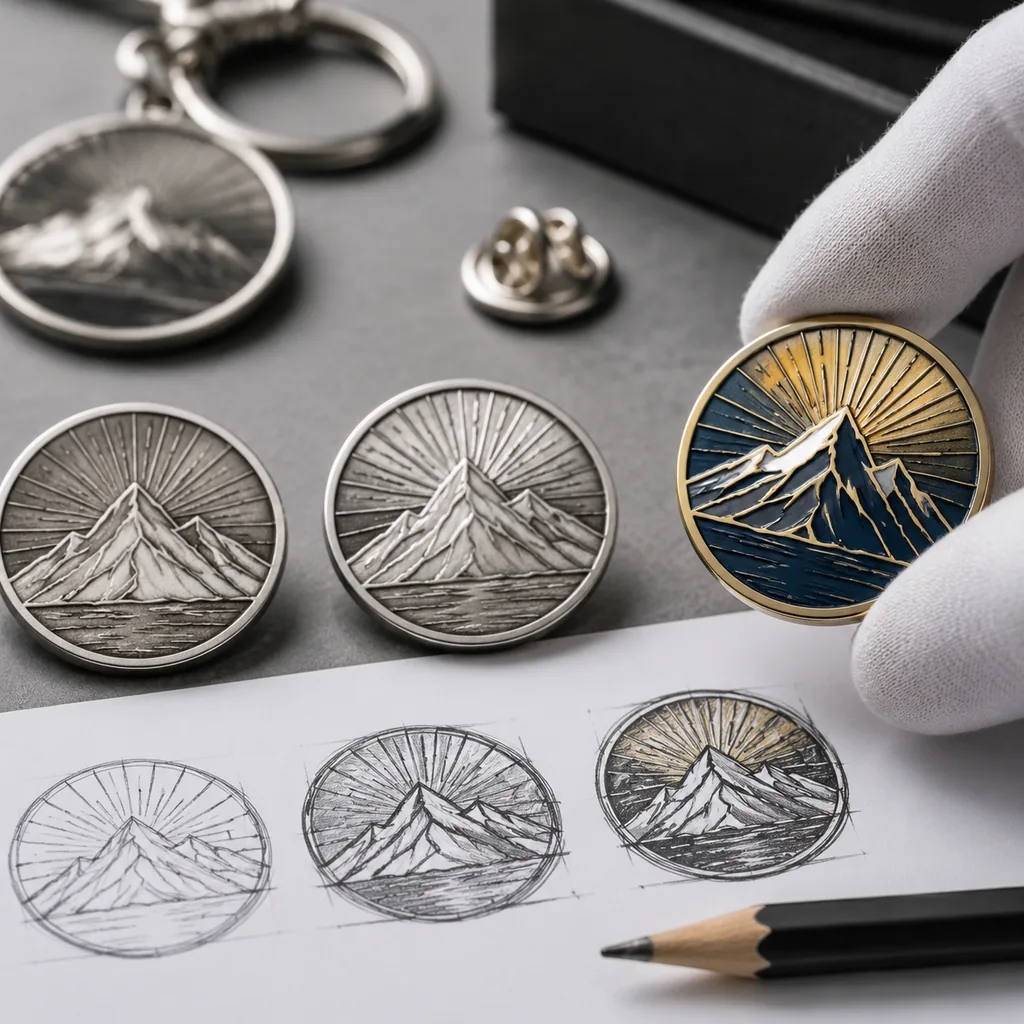
Soft enamel uses recessed enamel color separated by raised plated metal. It is best for crests, service awards, club marks, school pins, municipal seals, and program pins that may reorder. Printed pins use CMYK offset, UV digital, or screen/spot printing on a metal base, normally protected with clear coat or epoxy. They are better for gradients, photographs, shaded mascots, sponsor grids, small lettering, QR codes, and short-life campaign artwork.
The comparison only works when specifications are held equal. A soft enamel quote with 0.5 micron plating, individual OPP bags, and AQL inspection is not comparable with a printed pin quoted with flash plating, bulk packing, and visual sorting only. For a fair RFQ, lock finished size, base metal, plating finish, attachment, packing, surface coating, inspection level, and delivery deadline before judging the process price.
Small-MOQ Specification Benchmarks
The figures below are planning ranges for 25-35 mm lapel pins made in iron or zinc alloy with butterfly clutch, individual OPP bag, and standard export carton. Prices are FOB China in USD and should be used for budget screening, not as guaranteed offers. Final pricing changes with size, thickness, plating, color count, cut-outs, epoxy, backing cards, sample requirement, exchange rate, factory load, and freight mode.
| Spec Item | Soft Enamel Pin | Printed Pin |
|---|---|---|
| Best MOQ fit | 200-500 pcs for bold separated colors, metal outlines, and likely reorders | 100-500 pcs for detailed, color-heavy, photographic, QR-based, or one-time artwork |
| Typical FOB unit price at 300 pcs | USD 0.62-1.20 for 25-30 mm, excluding mold | USD 0.45-0.95 for 25-30 mm, excluding setup if charged |
| Fixed charge | USD 45-90 mold per design; complex cut-outs, thick zinc alloy, or 3D relief may run USD 100-180 | USD 15-45 print setup; standard round, square, rectangle, or oval bases may avoid custom cutting |
| Production lead time after artwork approval | 12-18 calendar days bulk; add 5-7 days for a physical pre-production sample | 8-14 calendar days bulk; add 3-5 days for printed or epoxy sample |
| Minimum practical order | 100 pcs is often accepted, but 200-300 pcs gives better unit economics | 100 pcs is common, especially on standard shapes |
| Line and pocket limits | 0.18-0.25 mm internal raised lines; 0.40-0.60 mm outer border; enamel pockets at least 0.30 mm clear width | No raised metal line required; keep critical print at least 0.50 mm from edge or rim |
| Small text and QR guidance | Tiny text should become raised metal, be enlarged, or be removed; fine lettering fills poorly | Positive text 0.8 mm high minimum; reversed text 1.0 mm; QR code 18-22 mm square if scanning matters |
| Color method | Pantone-matched soft enamel in recessed pockets; gradients must be converted to solid color steps | CMYK offset, UV digital, or spot print; gradients and photos are possible but require proof approval |
| Surface feel | Raised plated metal with recessed enamel; epoxy optional but changes the traditional texture | Flat printed face, usually protected by clear coat or 0.3-0.8 mm epoxy dome |
| Plating target | 0.3-0.5 microns for standard nickel, gold, rose gold, black nickel; 0.8 microns for higher-wear retail requests | 0.3-0.5 microns on plated rim and back; print life depends on clear coat or epoxy adhesion |
| Dimensional tolerance | Outer size +/-0.2 mm; critical line position about +/-0.10-0.15 mm when tooling allows | Cut shape +/-0.2 mm; print-to-edge registration +/-0.15-0.25 mm |
| QC focus | Enamel underfill, overflow, plating pits, broken lines, rough edges, weak post solder, off-center attachment | Color shift, blur, dust under coating, epoxy bubbles, scratches, edge lifting, registration drift |
| Recommended AQL | AQL 2.5 major / 4.0 minor for promotional work; tighten only for retail, licensed, or premium programs | AQL 2.5 major / 4.0 minor; classify QR, logo, face, sponsor-name, and post defects as major |
When Soft Enamel Is the Better Build
Choose soft enamel when metal definition is part of the value. A 30 mm recognition pin with a raised nickel border, three Pantone enamel fills, and a clear plated logo will usually look more substantial than the same design printed flat. It also tolerates repeated handling better because the color sits in recessed pockets and the raised metal takes much of the surface wear.
A manufacturable soft enamel drawing uses a 0.40-0.60 mm outside border, 0.18-0.25 mm internal metal lines, and enamel pockets no narrower than 0.30 mm. Thin islands below 0.25 mm tend to break, fill unevenly, or disappear after plating. Large enamel areas may show slight waviness because soft enamel is not polished flat like hard enamel. That is normal, but it should be acceptable for the intended use.
Soft enamel also improves repeat-order economics. If the supplier retains the mold, Pantone references, plating finish, post position, and packing record, a reorder can normally skip the mold fee and run in 10-15 calendar days after approval. For a staff recognition program, school club, or annual event, the first 300 pieces carry the tooling burden, while later orders become simpler and cheaper.
The tradeoff is that the mold fixes the geometry. A date change, sponsor swap, or small logo correction after tooling may require a new mold if raised lines or cut-outs move. Before approving tooling, ask the proof to call out finished size, metal line widths, enamel pocket widths, cut-out clearances, pin thickness, plating finish, and clutch post location. For pins wider than 30-32 mm, request two posts if rotation on fabric would be a problem.
When Printed Pins Are the Better Build
Choose printed pins when the artwork depends on detail rather than relief. A die-struck enamel mold cannot reproduce a 0.10 mm hairline, shaded face, photographic product image, smooth gradient, or dense sponsor grid. Printing can handle those elements if the supplier controls resolution, coating, and registration. Provide vector artwork for logos and type, and use raster images at 300 dpi or higher at finished size.
For 25-30 mm printed pins, set positive text at 0.8 mm high or larger and reversed text at 1.0 mm or larger. Review sponsor names at actual size, because type that looks clean on a monitor may become unreadable on a 28 mm pin. QR codes should be at least 18 mm square for basic scanning and 22 mm or larger if they sit under epoxy or will be scanned quickly at an event. Keep critical artwork 0.50 mm from the rim, or 1.0 mm when small text runs near the edge.
Printed pins are not automatically the cheapest finished product. A custom silhouette, polished gold rim, 0.6 mm epoxy dome, backing card, barcode label, and urgent air shipment can close much of the price gap with soft enamel. They also feel flatter and less permanent. That may be fine for a two-day conference giveaway, campaign pin, or limited artist drop, but it is weaker for membership badges or recognition pins expected to be worn for years.
Cost Math at 100, 300, and 500 Pieces
Small buyers should compare total order cost, not only unit price. The example below assumes one 30 mm design, standard nickel or gold plating, butterfly clutch, individual OPP bag, no backing card, no expedited freight, and normal production. It excludes international freight, duty, VAT, customs brokerage, and domestic delivery.
| Order Quantity | Soft Enamel Planning Cost | Printed Pin Planning Cost | Buying Implication |
|---|---|---|---|
| 100 pcs | USD 45-90 mold plus USD 0.85-1.60 per pc | USD 15-45 setup plus USD 0.65-1.25 per pc | Printed usually wins unless raised metal, durability, or reorder value is essential |
| 300 pcs | USD 45-90 mold plus USD 0.62-1.20 per pc | USD 15-45 setup plus USD 0.45-0.95 per pc | Decision depends on artwork detail, deadline, and likelihood of repeat orders |
| 500 pcs | USD 45-90 mold plus USD 0.48-0.95 per pc | USD 15-45 setup plus USD 0.38-0.82 per pc | Soft enamel becomes easier to justify for clean logos and program pins |
| 1,000 pcs reference | USD 45-90 mold plus USD 0.35-0.75 per pc | USD 15-45 setup plus USD 0.30-0.68 per pc | Tooling is diluted; visual result and durability should drive the choice |
A low quote often comes from reduced specifications rather than a more efficient process. Flash plating at 0.2 microns, bulk bag packing, no epoxy clarity standard, and loose visual sorting are not equivalent to 0.3-0.5 micron plating, individual bags, written defect limits, and AQL inspection. For distributor, employee, or retail use, paying USD 0.03-0.08 more per pin can be cheaper than sorting rejects after delivery or reprinting short units before an event.
Quality Risks and Acceptance Limits
Low quantity does not lower quality risk. It raises the operational impact of defects because the buyer may need every unit for a fixed guest list, launch kit, award ceremony, or event table. If 150 pins arrive with 12 rejects, the issue is not just an 8 percent defect rate. It may create a shortage on the delivery date.
Soft enamel defects usually come from the interaction of tooling, plating, and hand-filled color. Watch for enamel underfill, overflow onto raised metal, plating pits, rough edges, color contamination, broken thin lines, off-center posts, and weak solder. A normal outer-size tolerance is +/-0.2 mm. Critical line placement should be held around +/-0.10-0.15 mm where the tool permits. Standard visual inspection is typically at 30-40 cm under daylight-equivalent white light, without magnification unless the product is retail, licensed, or premium.
Printed pin defects are different. The main risks are color shift from the approved proof, fuzzy small text, dust under epoxy, bubbles near the edge, print misregistration, coating scratches, and edge lifting. Epoxy domes commonly range from 0.3-0.8 mm thick. State whether a small edge bubble is minor or major; otherwise the factory may treat tiny bubbles as normal promotional variance.
Attachment strength needs a separate check. Butterfly clutch posts should be straight, centered enough for use, and soldered securely enough to survive normal handling. For higher-value orders, request pull testing on 3-5 pieces per batch and confirm that the back stamp or post location does not interfere with the clutch. A pin can pass face inspection and still fail in use if the post bends or detaches.
Avoid the Wrong Process Choice
Do not choose soft enamel only because it sounds premium. If the artwork includes watercolor texture, a detailed mascot face, a sponsor grid, a miniature map, a QR code, thin script, or a subtle gradient, the mold will force simplification. That can add 2-4 calendar days of artwork revision before sampling and still produce a pin that does not match the campaign creative.
Do not choose printed pins only because the first quote is cheaper. If the item is merchandise, a membership badge, or a recognition pin worn repeatedly on bags, jackets, or uniforms, the flat printed look may underperform. Printed surfaces depend on clear coat or epoxy for protection. Scratching, yellowing, edge lifting, and UV exposure should be discussed for outdoor events and long-term use.
Also avoid overspecifying a low-risk internal order. Requirements such as 0.8 micron plating, custom backing cards, individual barcode labels, 100 percent inspection, carton drop testing, and retail master cartons may be justified for store-ready goods, but excessive for 150 internal event pins. Match plating, packing, and inspection to the cost of failure.
RFQ Checklist for Comparable Quotes
A fair comparison requires both builds to be quoted from the same commercial and technical baseline. Give the supplier enough detail to price accurately and flag manufacturability problems before the order is placed.
- Request quantity tiers at 100, 300, and 500 pieces, plus a soft enamel reorder price with no mold charge.
- Specify finished size in mm, such as 30 mm wide by 26 mm high, with outer-size tolerance of +/-0.2 mm.
- Send AI, PDF, EPS, or SVG vector files where possible; use high-resolution PNG only as visual reference.
- Ask for both soft enamel and printed options unless the artwork clearly rules one process out.
- State base material: iron for simple flat shapes, zinc alloy for complex cut-outs, thicker cast looks, or 3D relief.
- Specify plating finish and target thickness, normally 0.3-0.5 microns for standard promotional pins.
- Confirm attachment type: butterfly clutch, rubber clutch, magnet, safety pin, brooch back, deluxe clutch, or two posts for wider pins.
- Define surface protection: no epoxy, clear coat, or 0.3-0.8 mm epoxy dome, especially for printed pins.
- Set inspection at AQL 2.5 major and 4.0 minor, with logo, QR, face, sponsor-name, and post defects treated as major.
- Specify packing: individual OPP bag, backing card, barcode label, bulk bag, inner carton, and export carton.
- Ask for sample days, production days after approval, and the latest artwork approval date needed to meet delivery.
For very small runs, ask whether a standard shape can be used. A printed round, square, rectangle, or oval pin may avoid custom cutting and reduce cost and lead time by several days. That shortcut works for event badges and sponsor pins, but it is usually wrong when the silhouette is part of the brand mark.
Selection Rule for Small MOQs
Start with the artwork, then test the budget. Choose soft enamel when raised metal structure, tactile feel, durability, and reorder value are central to the product. Choose printed pins when the design depends on detail, gradients, photographs, QR scanning, fast turnaround, or lower fixed cost.
For a serious small-MOQ comparison, send one RFQ requesting both versions: soft enamel with mold and printed pin with setup. Ask for 100, 300, and 500 piece pricing, production lead time in calendar days after artwork approval, sample time, plating thickness, epoxy thickness if used, inspection level, and packing method. The supplier response will show whether the lower price comes from the process itself or from reduced specifications.
For most 100-200 piece one-time designs, printed pins are usually the efficient choice. For 300-500 piece designs with clean outlines, separated colors, and likely reorders, soft enamel often delivers better long-term value. The best choice is not the lowest first quote; it is the build that protects the artwork, delivery date, and acceptable defect rate at the quantity actually needed.
Have a project? Send your artwork and target quantity and we’ll reply with a detailed quotation within 12 working hours.
Ready to get this made?
Send your sketch, target quantity and ship-date. Detailed quotation in 12 hours.



