Small-MOQ Spec Sheets for Custom Metal Giveaways
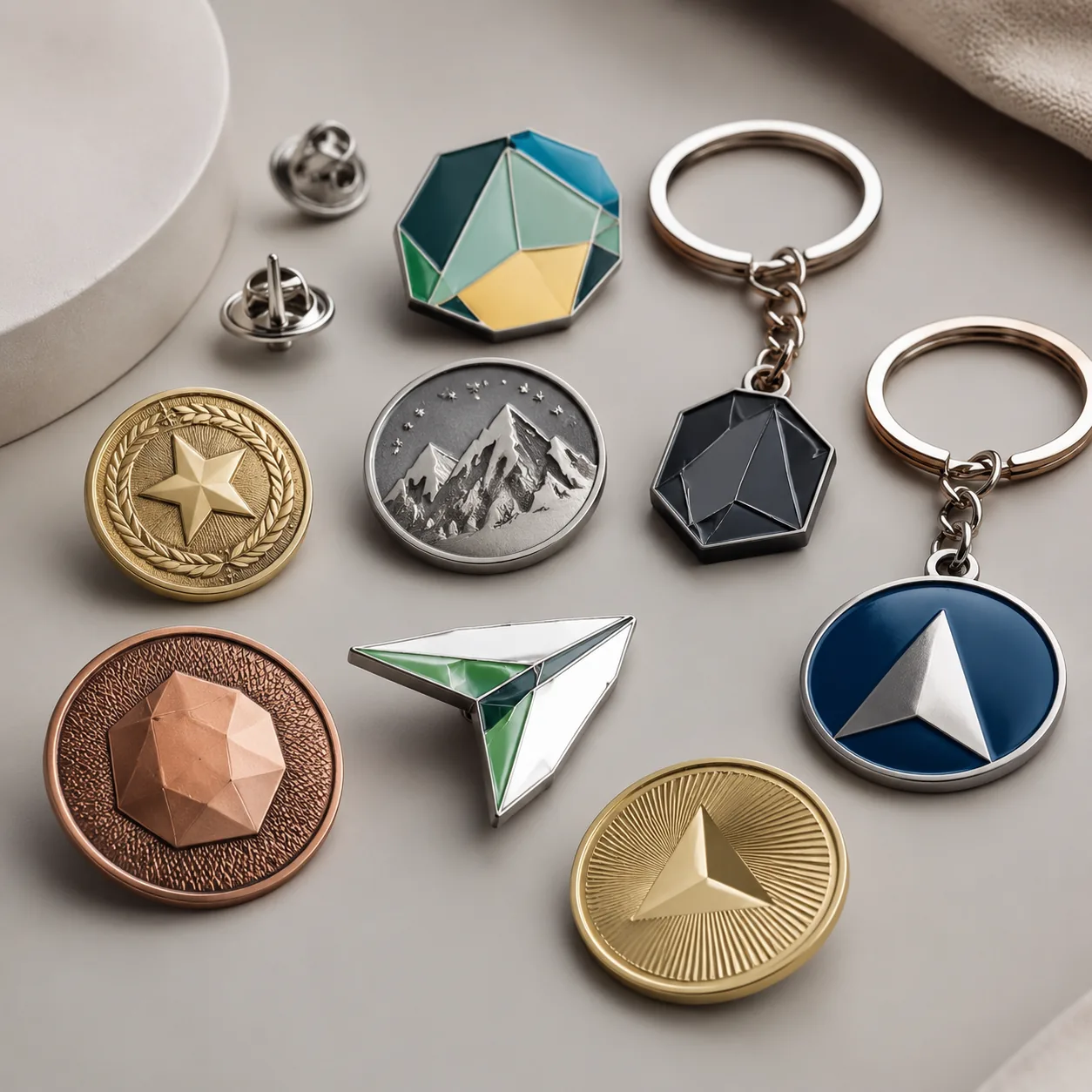
1. Set Quantity, SKUs and Quote Basis First
Small-MOQ metal programs fail when the quantity line is loose. A request for "100 pins, 100 keychains and 100 coins" can be priced as three unrelated setups, one bundled promotion kit, or a trading-company estimate that hides tooling, sample and freight assumptions. The RFQ should state pieces per SKU, number of designs, whether artwork can be mixed inside a production run, and which specifications are shared across the order.
For 2026 China sourcing, practical factory MOQs are 100 pcs per design for simple soft enamel pins, 100-200 pcs for zinc alloy keychains, 100 pcs for 40-50 mm challenge coins, 300 pcs for hard enamel with multiple colors, and 500 pcs for woven or printed lanyards. Orders below 100 pcs are possible, but mold, plating setup, artwork proofing and export handling often exceed product value. A 50 pc soft enamel pin may quote at USD 2.20-4.80 per unit FOB, while the same 30 mm design at 300 pcs often falls to USD 0.75-1.45 FOB.
State the launch plan. If the first order is a 150 pc event test and a 1,000 pc reorder may follow within 12 months, the factory can retain the mold, use the same plating rack settings and avoid packaging that cannot scale. Small-MOQ savings usually come from fewer setup variables, not from forcing an unrealistic unit price.
| Spec line | Clear small-MOQ wording | Typical 2026 range |
|---|---|---|
| Quantity | 150 pcs per design, 2 designs, no mixed artwork inside one SKU | 100-300 pcs per design for most metal giveaways |
| Consolidation | Same shiny nickel plating, rubber clutch and OPP bag across both designs | Can reduce handling and setup cost by 5-12% |
| MOQ tiers | Quote 100, 300, 500 and 1,000 pcs using the same tooling | Shows reorder breakpoints and labor dilution |
| Tooling retention | Supplier to retain mold for 24 months after shipment | Common for pins, coins and zinc alloy keychains |
| Quote basis | FOB Ningbo or Shanghai; sample, tooling, freight and duty shown separately | Prevents courier cost from distorting unit price |
2. Lock Finished Size, Thickness and Weight
Do not let the factory infer size from artwork proportions. A 25 mm lapel pin, 50 mm keychain and 45 mm coin use different tooling, polishing time, plating current and carton weight. Put product type, maximum width, maximum height and finished thickness in one line. Dimensions should mean finished size after plating and polishing, not artboard size from the vector file.
For enamel pins, 20-35 mm is the economical range at 100-300 pcs. Stamped iron pins are usually 1.2 mm thick; heavier badges are 1.5-2.0 mm. Zinc alloy keychains commonly run 35-55 mm at 2.0-2.5 mm. Challenge coins are usually 40-50 mm at 3.0 mm for small batches, with 3.5-4.0 mm reserved for premium commemorative coins where weight is part of the brief.
Extra thickness is not automatically better. Moving a 30 mm soft enamel pin from 1.2 mm to 2.0 mm can add 10-25% to metal, polishing and plating cost while making the pin pull on light fabric. Reserve heavier gauges for coins, bottle opener keychains, luggage tags and VIP badges. For freight planning, ask for estimated net weight and export carton size before confirming the price; a small order can still be expensive if it ships in oversized cartons.
- State finished dimensions as maximum width x maximum height in millimeters, for example 32 x 28 mm.
- Use tolerances of +/-0.30 mm for pin size, +/-0.50 mm for keychain or coin size, +/-0.15 mm for pin thickness and +/-0.25 mm for coin thickness.
- Keep 20-35 mm pins at 1.2-1.5 mm unless the brief requires a heavier hand feel.
- Confirm whether thickness includes raised relief or only base plate thickness.
- Ask for estimated unit weight, inner box count and export carton gross weight; keep cartons under 15 kg when possible for courier handling.
3. Match Metal to Production Method
The material name is not enough. Stamped iron is cost-effective for flat soft enamel pins with clean raised metal lines. Zinc alloy die casting is better for irregular outlines, cutouts, deep relief, bottle openers and thicker keychains, but mold cost is higher and fine text can soften. Brass stamping gives sharper edges and smoother plating, yet it is harder to justify at 100-300 pcs unless the item is a premium badge or hard enamel pin.
Stainless steel works for laser-engraved tags, nameplates and outdoor identifiers where corrosion resistance matters. It is a weak choice for detailed enamel fills because forming and color separation are limited. Aluminum suits lightweight printed tags, luggage charms and event credentials, but it dents more easily and feels less substantial than plated iron, brass or zinc alloy.
A complete spec line names both metal and process: stamped iron with soft enamel, zinc alloy die cast with soft enamel, stamped brass with imitation hard enamel, or stainless steel laser engraved. Changing from stamped iron to zinc alloy after sample approval usually means a new mold, revised artwork proof and 5-8 additional working days.
| Build | Best small-MOQ use | Typical FOB unit range at 100-300 pcs | Avoid when |
|---|---|---|---|
| Stamped iron, soft enamel | Flat pins, budget badges, campaign giveaways | USD 0.65-1.45 for 25-35 mm | Design needs deep 3D relief or large cutouts |
| Zinc alloy die cast | Keychains, thick badges, irregular shapes, coins | USD 1.20-3.80 for 35-55 mm | Text strokes are below 0.8 mm or edges must be razor sharp |
| Stamped brass, hard enamel | Premium lapel pins and corporate badges | USD 1.50-3.40 for 20-35 mm | Short-term promo budget is the main driver |
| Stainless steel engraved | Tags, labels, outdoor identifiers | USD 0.90-2.40 for 30-50 mm | Artwork needs multiple enamel colors |
| Aluminum printed tag | Event tags and lightweight bag charms | USD 0.55-1.30 for 30-50 mm | Dent resistance and premium feel matter |
4. Specify Plating, Coating and Nickel Controls
"Gold" or "silver" is not a plating specification. Low-volume orders are often batched with other goods to keep the plating line efficient, so the finish must be named clearly: shiny nickel, matte nickel, antique silver, antique brass, satin gold, black nickel, dyed black or painted metal. If the finish is brand-sensitive, approve a physical chip or pre-production sample, not a photo under unknown lighting.
For decorative giveaways, standard nickel plating is commonly 3-5 microns. Copper or brass underlayers are often 2-4 microns. Decorative flash gold may be only 0.03-0.10 micron unless thicker plating is specified and paid for. For high-touch keychains or badge backs, specify 5-8 microns nickel or copper underplating plus clear electrophoretic coating. For outdoor identifiers, stainless steel is usually more reliable than trying to make decorative plating behave like industrial hardware.
Nickel exposure needs its own line for items touching skin or entering markets with nickel restrictions. Do not assume "nickel-free" covers every component. The body, pin post, butterfly clutch, rubber clutch insert, jump ring, split ring, chain and clasp must be included or excluded by name. A practical instruction is: nickel-free visible body and nickel-free attachment hardware; supplier to confirm test method before production.
- Define finish by name and visual target: shiny nickel, matte nickel, antique silver, satin gold, black nickel or antique brass.
- Specify thickness when wear matters: 3-5 microns for standard nickel and 5-8 microns for higher handling resistance.
- State whether clear epoxy or electrophoretic coating is required and whether it covers the full front surface.
- For nickel-sensitive programs, list every metal contact part included in the nickel-free requirement.
- For antique finishes, approve darkness and polishing level on a physical sample because contrast varies by operator.
5. Control Enamel, Print and Artwork Limits
Small-MOQ pricing rises quickly when artwork has too many colors, tiny islands or thin metal lines. Each enamel color requires dispensing, curing and inspection, and labor does not shrink much at 150 pcs. For an event test, a 4-color soft enamel pin is usually more rational than a 9-color hard enamel design with many isolated pockets.
For stamped soft enamel, keep raised metal lines at 0.25 mm minimum, recessed enamel channels at 0.30 mm minimum and isolated enamel areas above 0.50 mm where possible. For hard enamel or imitation hard enamel, use 0.30 mm minimum metal lines and avoid narrow sharp corners that are difficult to polish cleanly. For QR codes or sponsor marks below 8 mm wide, use print plus epoxy rather than enamel.
Pantone references should be written as Solid Coated codes. A practical tolerance is visual match under D65 light for enamel, or Delta E below 3.0 for printed surfaces when instrument measurement is available. Exact brand colors may require a paid color sample because enamel is mixed from resin and pigment rather than printed as ink on paper.
| Color spec | Good small-MOQ use | Risk level | Practical limit |
|---|---|---|---|
| 1-4 enamel colors | Most pins, keychains and badges | Low | Fastest filling, curing and QC |
| 5-8 enamel colors | Character art, club badges, event icons | Medium | Allow 1-2 extra production days |
| 9+ enamel colors | Collector pins and detailed illustrations | High | Unit cost and reject rate rise noticeably |
| CMYK print plus epoxy | Gradients, photos, QR codes and sponsor logos | Medium | Requires bubble, dust and scratch checks |
| Glow, glitter or translucent enamel | Retail or collector editions | Medium-high | Confirm surcharge and physical sample before mass production |
6. Engineer Attachment and Function
A product can pass a photo check and still fail in use if the attachment is underspecified. A 30 mm lapel pin with one butterfly clutch is fine for light garment wear, but a 45 mm badge may rotate unless it uses two posts, two rubber clutches or a brooch bar. A keychain with a thin jump ring may open after a week on a backpack.
Write the attachment as a functional requirement. For pins, specify one post, two posts, magnetic back, safety brooch, rubber clutch or deluxe clutch, plus post length and position. For keychains, define split ring diameter, wire thickness, chain style, swivel hook or lobster clasp, and minimum pull strength. Standard promotional keychains should target 8-12 kg static pull; bottle opener keychains should target 15 kg on the ring assembly and a basic opening test without deformation.
Magnets require extra control because magnet grade and adhesive drive returns. Specify ferrite or neodymium, magnet diameter or sheet thickness, adhesive method and holding target on a clean vertical painted steel plate. A 30-40 mm metal magnet needs stronger backing than a lightweight PVC magnet because the plated body adds weight before packaging.
- Pins under 30 mm: one 8-10 mm post is usually acceptable.
- Pins 35-50 mm: use two posts, two rubber clutches or a brooch bar depending on garment use.
- Keychains: specify a 25-30 mm split ring with 1.8-2.2 mm wire for normal promotional use.
- Bottle opener keychains: require opening test plus 15 kg static pull target on the ring assembly.
- Magnets: request holding check after plating and assembly, not only before final packing.
- Lanyards: state hook type, safety breakaway, buckle and fabric width, usually 15, 20 or 25 mm.
7. Set Sampling, Lead Time and AQL
Skipping sampling saves days only when risk is low. For simple artwork, an order under USD 300 and a hard event deadline, a digital proof plus production photo approval may be acceptable. For hard enamel, moving parts, magnets, cutouts, QR codes, child-directed items or strict brand colors, a physical pre-production sample is usually cheaper than a wrong mass batch.
Typical 2026 timing is 2-3 working days for artwork proofing, 5-8 working days for mold and first sample, 8-15 working days for mass production after approval, and 3-7 calendar days for express freight to major US or EU cities. Air freight may take 5-10 days airport to airport. Sea freight rarely makes sense for 100-300 pcs unless the items move with another shipment. Rush production is possible, but rushed plating and enamel curing increase the risk of uneven surfaces, trapped dust and color variation.
Define inspection before production. A practical standard for small custom metal giveaways is general inspection level II, AQL 2.5 for major defects and AQL 4.0 for minor defects. Critical defects should be zero tolerance: sharp burrs, broken posts, wrong logo, exposed rust, unsafe loose parts on child-directed items, incorrect artwork or wrong plating color.
| Inspection item | Acceptable tolerance | Major defect example | Minor defect example |
|---|---|---|---|
| Finished size | +/-0.30 mm pins; +/-0.50 mm coins/keychains | Wrong size affecting packaging or function | Slight variation inside tolerance |
| Thickness | +/-0.15 mm pins; +/-0.25 mm coins | Too thin causing bending | Minor gauge variation |
| Enamel surface | No missing color; no front pits over 0.5 mm | Wrong Pantone family or exposed recess | Tiny dust dot visible only close-up |
| Plating | No peeling, rust, burnt areas or exposed base metal | Flaking at edge or post | Small polish mark on back |
| Attachment | Secure under agreed pull or rotation check | Loose post, weak ring, magnet detaches | Slight clutch shade difference |
| Packaging | Correct count, label and carton weight under agreed limit | Mixed designs or missing units | Wrinkled OPP bag without product damage |
8. Send a One-Page RFQ Spec Sheet
The next step is not to ask for the cheapest price. Send a compact spec sheet that removes factory guesswork, then compare quotes only after each supplier is pricing the same build. A serious factory will separate tooling, unit cost, sample cost, lead time and freight, or mark which lines need adjustment. A weak supplier will return only a vague unit price.
Use one page per product type when possible. For a mixed conference set, keep shared brand requirements together and separate each item's dimensions, material, plating, color and hardware. The fastest small-MOQ orders are the ones where the buyer supplies clean vector artwork, Pantone references and a complete spec before proofing begins.
A complete 2026 quote request for a small enamel pin should include these lines.
- Product and quantity: 200 pcs soft enamel pin, 1 design, quote optional 300 and 500 pc reorder tiers.
- Finished size and thickness: 30 x 26 mm, 1.2 mm thick, tolerance +/-0.30 mm size and +/-0.15 mm thickness.
- Material and method: stamped iron, raised metal lines, recessed soft enamel.
- Plating and coating: shiny nickel, 3-5 microns, no epoxy unless quoted as an option.
- Colors and artwork limits: 4 Pantone Solid Coated colors, minimum metal line 0.25 mm, minimum enamel channel 0.30 mm.
- Attachment: one 8 mm post with black rubber clutch, post centered unless artwork balance requires adjustment.
- Packaging: individual OPP bag, 100 pcs per inner bag, export carton under 15 kg gross weight.
- Sampling and timing: physical pre-production sample required, target sample 7 working days, mass production 12 working days after approval.
- Inspection: general level II, AQL 2.5 major, AQL 4.0 minor, zero tolerance for sharp burrs, broken posts, wrong logo, rust or wrong plating.
- Quote basis: FOB Ningbo or Shanghai, with separate express freight line to destination city.
Have a project? Send your artwork and target quantity and we’ll reply with a detailed quotation within 12 working hours.
Ready to get this made?
Send your sketch, target quantity and ship-date. Detailed quotation in 12 hours.



