Small-MOQ Promo Orders: Factory Sourcing Playbook for 2026
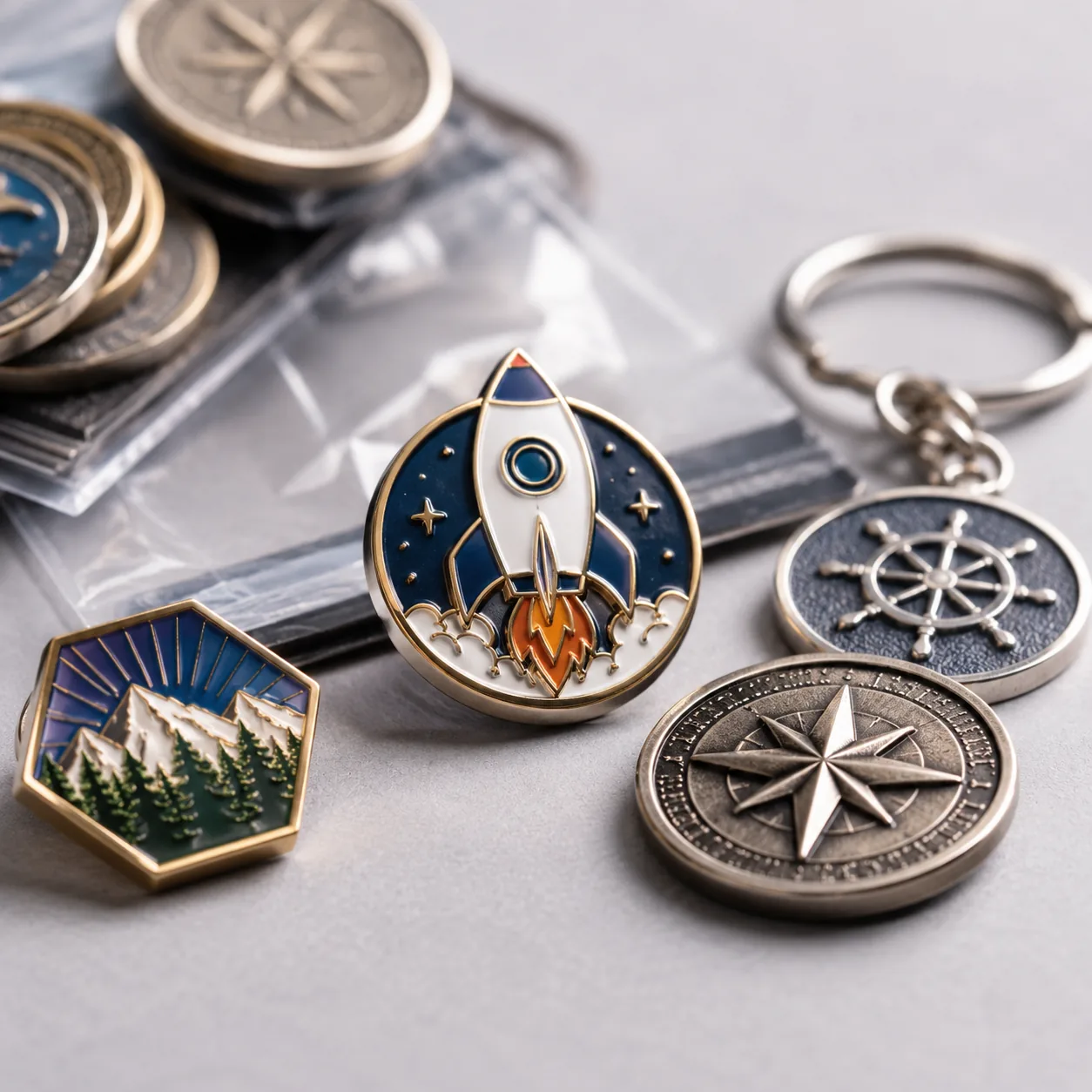
1. Match MOQ to the Real Production Process
Small-MOQ promo orders fail when buyers assume setup cost shrinks with quantity. It does not. Mold cutting, film output, plating rack loading, Pantone mixing, embroidery digitizing, hand polishing, backing-card printing, packing and carton marking all have minimum labor. In 2026, practical factory MOQs are usually 100 pieces for soft enamel pins, 100 to 300 pieces for zinc alloy keychains, 100 to 300 pieces for challenge coins, 50 to 100 pieces for embroidered or woven patches, and 100 to 300 pieces for printed polyester lanyards. Below those levels, the quote is mostly fixed setup divided by too few units.
For a first run, choose a construction the factory can tool, finish and inspect without special handling. Good starter specs are 25 to 35 mm soft enamel pins, 40 to 60 mm zinc alloy keychains, 40 to 45 mm one-sided challenge coins, merrow-border patches, and 15 to 20 mm screen-printed polyester lanyards. Hold back hard enamel, 3D relief, spinners, transparent enamel, large cutouts, glitter, epoxy doming, dual plating and rigid gift boxes until the reorder. Those options are valid, but they add process steps and more rejection points.
| Product | Practical small MOQ | USD FOB range at small MOQ | Clean first-run specification |
|---|---|---|---|
| Soft enamel pin | 100 to 300 pcs | USD 0.68 to 1.80 | 25 to 35 mm, 1.2 to 1.5 mm iron or zinc alloy, 1 to 5 enamel colors, rubber clutch |
| Hard enamel pin | 100 to 300 pcs | USD 0.95 to 2.80 | 25 to 35 mm, polished flat surface, simple outline, no large openwork |
| Metal keychain | 100 to 300 pcs | USD 1.10 to 3.40 | 40 to 60 mm zinc alloy, 2.0 to 3.0 mm thick, 25 mm split ring |
| Challenge coin | 100 to 300 pcs | USD 2.60 to 6.80 | 40 to 45 mm, 3.0 mm thick, one-sided enamel or antique finish |
| Embroidered patch | 50 to 200 pcs | USD 0.55 to 1.90 | 60 to 90 mm, merrow border, 50 to 75 percent embroidery coverage |
| Printed lanyard | 100 to 300 pcs | USD 0.45 to 1.40 | 15 to 20 mm polyester, one-side screen print, lobster clasp or J-hook |
2. Write the RFQ as a Production Brief
A small order should not take three days of clarification before pricing. A useful RFQ lets the factory quote, check feasibility and estimate lead time in one pass. Include product type, exact size in millimeters, quantity tiers, artwork file, base material, finish, color count, attachment, packing, delivery country, required in-hand date and Incoterm. For metal items, state whether size means longest dimension or width by height. A 35 mm round pin and a 35 by 35 mm irregular pin can differ in metal weight, mold area and polishing time.
Request quantity breaks instead of one target number. For pins, keychains and coins, ask for 100, 300 and 500 pieces. For patches, ask for 50, 100 and 300 pieces. For lanyards, ask for 100, 300, 500 and 1,000 pieces because webbing, printing setup and hardware purchasing often improve at higher breaks. If the unit price drops sharply from 100 to 300 pieces, tooling and setup are driving cost. If the price barely moves, the design is labor-heavy, so simplifying color count, edge shape, packing or hardware may help more than increasing volume.
- Artwork in AI, PDF, SVG or high-resolution PNG, with Pantone Solid Coated references for brand colors
- Exact size, thickness and tolerance, such as 35 mm long, 1.5 mm thick, plus or minus 0.2 mm
- Quantity tiers, such as 100, 300 and 500 pieces, with the expected order quantity marked
- Material and finish, such as iron with nickel plating or zinc alloy with antique brass finish
- Hardware, such as black rubber clutch, butterfly clutch, 25 mm split ring, lobster hook, safety pin backing or magnet
- Packing, such as one OPP bag per piece, backing card plus OPP bag, or 50 pieces per inner bag
- Inspection target, normally AQL 2.5 for major defects and AQL 4.0 for minor defects on standard promo orders
- Required proof date, sample date, bulk shipment date and trade term, usually EXW or FOB Ningbo or Shanghai for Yiwu-area production
3. Keep Sample, Tooling, Bulk and Freight Separate
Do not compare suppliers only by sample price. A custom sample spreads mold, film, jig setup, color mixing and finishing across one to five pieces. A pre-production sample for a soft enamel pin commonly costs USD 45 to 120. A challenge coin sample is often USD 80 to 180. A patch sample usually falls around USD 30 to 80. A lanyard sample is typically USD 35 to 100 depending on print method, hook, safety breakaway and whether the buyer needs a woven label or custom card.
Ask for sample charge, tooling charge, bulk unit price and freight as separate lines. Tooling for a small enamel pin is commonly USD 35 to 80. A larger zinc alloy keychain, bottle opener, 3D coin or multi-level mold can be USD 80 to 180. Embroidery digitizing is often USD 20 to 50 when charged separately. Screen-print film or fixture charges for lanyards are commonly USD 20 to 60. If tooling is hidden inside the unit price, the reorder price may not fall because the baseline was never documented. For repeat orders, confirm whether the mold or digitized file is retained, how long it is stored and whether remake fees apply after 12 to 24 months.
Use a physical sample when the item is client-facing, sold at retail, plated in a sensitive tone or tied to strict brand colors. For internal giveaways with flexible colors, a digital proof plus bulk production photos may be enough. Skipping the physical sample can save 5 to 10 calendar days, but it removes the best opportunity to check enamel level, plating shade, attachment strength, edge smoothness, magnet pull and packing fit before bulk production.
4. Make the Proof the Control Document
The proof is the factory instruction sheet, not a presentation graphic. Review size, metal line width, recessed enamel areas, Pantone callouts, plating, attachment location, backstamp, edge treatment and packing in one approval cycle. For enamel pins, raised metal lines should usually be at least 0.30 mm for soft enamel and 0.35 mm for hard enamel. Enamel cells should be at least 0.40 mm wide. Smaller cells are more likely to show fill breaks, polishing damage or trapped residue.
Small-MOQ jobs are sensitive to late artwork changes because there is little volume to absorb rework. If a 100-piece order needs a new mold after cutting, an added USD 40 to 150 increases cost by USD 0.40 to 1.50 per unit before delay is counted. Approve the proof only after the buyer, designer and end client are aligned on the same artwork revision, color list, backstamp and packing format.
| Proof control point | Practical specification | Why it matters |
|---|---|---|
| Size tolerance | Plus or minus 0.2 mm for pins and keychains; plus or minus 0.3 mm for coins | Keeps mold output, packing inserts and set dimensions consistent |
| Thickness tolerance | Plus or minus 0.2 mm for stamped or cast metal items | Controls weight, edge strength and freight estimate |
| Plating thickness | 3 to 5 microns for standard nickel, gold, black nickel or brass-color plating | Lower plating thickness increases wear, tarnish and color complaints |
| Enamel color | Pantone target with visual approval under D65 or neutral daylight | Manual color mixing needs a fixed viewing standard |
| Attachment placement | Centerline tolerance plus or minus 1.0 mm unless anti-rotation is required | Poor placement causes pins and brooches to sag or rotate |
| Patch border | Plus or minus 1.0 mm for merrow or laser-cut borders | Thread, fabric and heat cutting move more than metal molds |
5. Inspect the Sample Like First Production
When the sample arrives, measure it with calipers, weigh it, photograph both sides and compare the finish under neutral daylight. For pins and brooches, check that the post is perpendicular within about 5 degrees, the clutch holds after 10 attachment cycles, and front-face enamel defects are not visible at a 30 cm viewing distance. Reject sharp burrs, loose posts, missing enamel colors, unreadable logos and plating stains on the front face.
For keychains, test the split ring and jump ring manually and, when possible, with a simple hanging weight. A standard 25 mm split ring should not deform under a 3 to 5 kg static pull for normal promotional use. Heavier zinc alloy charms should use a stronger connector or a jump ring made from about 1.2 to 1.5 mm wire. For fridge magnets, test on a painted steel surface and confirm the item does not slide under its own weight when placed vertically.
For patches, check edge shape, loose threads, backing adhesion and color registration. Heat-seal backing should cover the patch evenly without bubbling or exposed adhesive at the edge. Hook-and-loop patches should have aligned hook backing and stitched edges. For lanyards, rub the print 20 times with a dry white cloth and check whether ink transfers heavily. Confirm the clasp opens cleanly, the safety breakaway separates without tearing the strap, and the finished adult length matches the approved spec, commonly 900 mm plus or minus 20 mm.
Document sample approval with measurements, photos and written exceptions. If the plating tone is approved but enamel fill needs to sit flatter, state that. If the backing card is approved but the OPP bag is too tight, record the revised bag size before bulk packing starts. A clear sample record gives the factory a bulk inspection standard and gives the buyer evidence if the delivered order deviates.
6. Use Photo Gates Before Carton Sealing
A small order can be packed before anyone notices the wrong clutch, ribbon hook, backstamp or backing card. Use three production gates: unfinished parts before finishing, first finished pieces before full assembly, and packed goods before carton sealing. These gates do not replace inspection, but they catch common small-order failures while correction is still inexpensive.
For metal items, the first gate confirms mold shape, line definition, deburring and cutout quality. The second gate confirms plating tone, enamel level, epoxy clarity if used, backstamp position and hardware. The third gate confirms individual packing, carton quantity, carton marks, gross weight and mixed-design separation. For patches, ask for stitched pieces before trimming, finished front and back before packing, then inner bag and carton photos. For lanyards, include webbing color, print repeat, clasp, breakaway and packed bundle count.
- Gate 1: unfinished metal, fabric, PVC or webbing part photographed with a ruler or caliper
- Gate 2: 5 to 10 finished pieces from different positions in the batch, showing front, back and edge
- Gate 3: attachment, backing card, OPP bag, inner bag count and export carton label
- Mixed-design orders: one photo set per design plus a packing list showing SKU, quantity and carton number
- Repeat orders: compare against the approved golden sample or prior-order photos before carton sealing
7. Set Inspection Rules That Fit the Lot
For standard custom promo items, AQL 2.5 for major defects and AQL 4.0 for minor defects is a practical baseline. Major defects include wrong size, wrong plating, broken attachment, missing enamel color, unreadable logo, sharp burrs, weak magnet, wrong packing or incorrect design count. Minor defects include tiny plating specks, light polishing marks, small enamel surface marks and slight shade variation within the approved standard.
On a 100-piece order, many buyers use factory-side 100 percent visual sorting plus a buyer-side check of 20 to 32 pieces after arrival. For 300 to 500 pieces, general inspection level II sampling is more efficient. Under ISO 2859-1 single normal sampling, a 500-piece lot at general inspection level II typically gives sample size code H, or 50 pieces, before applying the chosen AQL acceptance number. Confirm the sample size, defect definitions and acceptance numbers before production starts, because many promo factories otherwise rely on informal visual sorting during packing.
Avoid demanding zero minor defects unless the product is premium retail and the price supports that standard. A zero-minor-defect requirement on a USD 0.80 soft enamel pin can add 2 to 4 days of sorting and still create disputes over visibility. Be strict on unsafe edges, weak attachments, wrong branding, incorrect color placement and functional failure. Treat tiny cosmetic variation inside the approved range as controlled acceptance, not a production crisis.
8. Build the Calendar Around Proof, Sample and Freight
Small-MOQ orders are often shipped by express courier because carton count is low and deadlines are close. A 100-piece pin order may weigh 3 to 8 kg gross depending on size and packing. Three hundred 45 mm challenge coins can reach 25 to 45 kg. Express courier usually takes 3 to 7 days after pickup. Air freight with local delivery often takes 7 to 12 days. Sea freight is sensible only when the shipment is non-urgent, heavier or consolidated with other goods.
Ask for packed carton dimensions before choosing freight. Backing cards, gift boxes and mixed-set packing can double carton volume even when metal weight is unchanged. If the shipment is going to an event venue, confirm receiving hours, contact phone number, importer details, customs broker if needed, and whether duties are prepaid or billed to the recipient. For the United States, EU and UK, the commercial invoice should use specific descriptions such as zinc alloy enamel pin, embroidered polyester patch or polyester printed lanyard, not vague wording such as gift item.
| Shipping choice | Best for | Typical transit after pickup | Risk to control |
|---|---|---|---|
| Express courier | Samples and 1 to 5 small cartons | 3 to 7 days | High cost per kg, remote-area charges, duty billing delays |
| Air freight | Small-MOQ goods above roughly 45 kg | 7 to 12 days | Needs clearer customs paperwork and last-mile delivery plan |
| Sea freight | Non-urgent replenishment or combined cargo | 25 to 45 days to many markets | Too slow for events and poor value for very small volume |
| Consolidated shipment | Campaigns with multiple promo SKUs | Depends on the slowest item | One delayed SKU can hold the full shipment |
Before paying the deposit, reduce the job to one controlled specification sheet: artwork revision, size, thickness, material, plating thickness target, Pantone colors, attachment, packing, quantity, sample requirement, AQL level, delivery term and required shipment date. A realistic custom metal schedule is RFQ on day 1, proof confirmation by day 2 or 3, sample production in 7 to 12 days, sample review in 2 to 4 days after delivery, bulk production in 10 to 18 days, and express transit in 3 to 7 days. That puts a controlled small metal order at roughly 25 to 44 calendar days from clean RFQ to delivery. Patches and lanyards can often finish in 15 to 30 days when no mold and no physical sample are required.
ZheCraft's Yiwu team handles small controlled runs across pins, brooches, keychains, fridge magnets, challenge coins, patches and lanyards. The strongest results come when a 100-piece order is treated as production, not a sample exercise: simple first-run spec, measurable proof, documented sample approval, photo gates during bulk and a clean reorder file for the next run.
Have a project? Send your artwork and target quantity and we’ll reply with a detailed quotation within 12 working hours.
Ready to get this made?
Send your sketch, target quantity and ship-date. Detailed quotation in 12 hours.



