Small-MOQ Pin Orders: 7 Failure Modes That Waste Budget
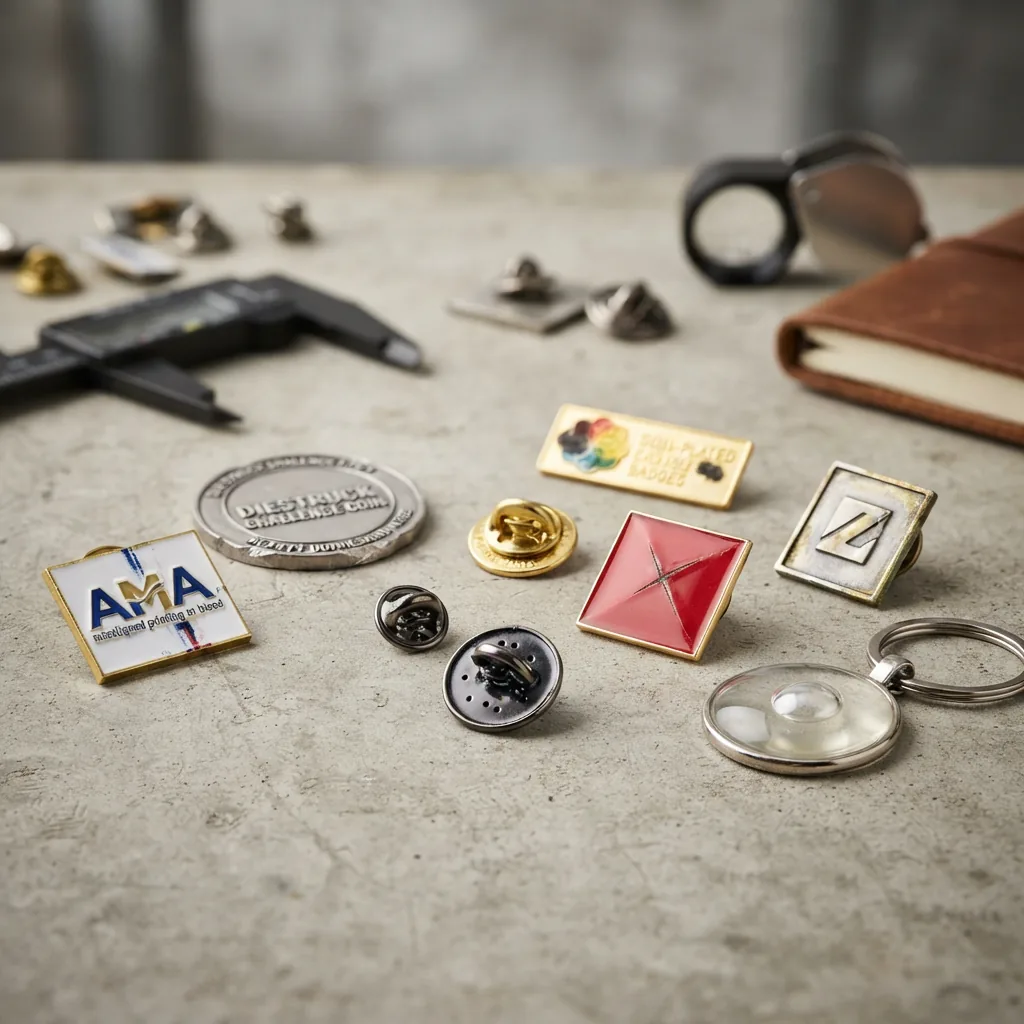
On a 100-300 piece pin run, process control matters more than saving USD 0.08 FOB
The biggest loss on a small custom pin order is rarely paying a slightly higher unit price. It is receiving 150 pins with front-face scuffs, bent posts, color drift on a logo fill, or packing damage with no spare stock to replace rejects before an event, launch, or retail reset. On a 3,000-5,000 piece order, a factory can often absorb more setup waste, extra sorting, or a partial remake across the total volume. On a 100-300 piece order, die cost, plating setup, enamel mixing, and hand packing are spread across too few units for that margin to exist.
For a typical 30 mm stamped iron or brass soft enamel pin in 2026, realistic FOB pricing is usually USD 0.78-1.40 at 100 pieces and USD 0.62-1.05 at 300 pieces, plus a one-time die charge of about USD 45-90 depending on outline complexity and cutouts. A comparable hard enamel pin is more often USD 1.00-1.75 at 100 pieces and USD 0.82-1.30 at 300 pieces, with die charges around USD 55-100 because polishing yield is tighter. Standard lead time after final artwork approval is commonly 12-18 calendar days for soft enamel and 14-21 days for hard enamel. A physical pre-production sample typically adds 4-7 days; photo approval usually adds 1-2 days. Air freight commonly adds 3-7 days airport-to-airport, not counting customs and local delivery.
That cost structure is why low-MOQ jobs need tighter written controls, not looser ones. There is less spare quantity, less room for subjective inspection, and little schedule buffer if the pins are for a museum restock, creator drop, club launch, fundraiser, or trade-show handout. The cleaner jobs are the ones that freeze process limits before tooling starts: metal type, thickness, minimum line width, enamel gap, plating reference, post layout, packing method, inspection standard, and acceptable overrun or underrun.
Failure mode 1: artwork is approved even though the detail is below process capability
Many buyers try to fit illustration-level detail into a 25-32 mm badge because the run is small and every piece must feel premium. A factory may still accept the file, but accepted art is not the same as production-safe art. During die engraving, stamping, filling, baking, and polishing, thin metal lines can close, narrow recessed channels can fill unevenly, and small isolated shapes can wash out. The order ships, but the design features that justified the pin get simplified or blurred.
For stamped soft enamel pins, a practical low-risk floor is 0.25 mm minimum raised metal line width, 0.30 mm minimum recessed enamel channel width, and 0.20-0.25 mm relief depth between raised metal and recessed fill. For hard enamel, 0.30-0.35 mm line width is safer because polishing rounds edges and visually narrows small recesses. Interior cutouts below 1.2 mm, isolated metal islands below 0.8 mm, and text below about 1.2 mm cap height on a 30 mm pin all carry higher reject risk, especially at 100-200 pieces where there is no yield cushion for redraws.
When the design genuinely requires gradients, tonal shading, thin serif text, halftones, or sub-millimeter details, the better answer is usually a different process rather than forcing stamped enamel to imitate printed work. Offset print with epoxy dome can hold finer art and small text. Die-struck metal without fill can preserve crisp relief. Increasing the finished size from 28 mm to 38 mm often fixes more than changing factories. The common mistake is keeping the familiar enamel process even when the art no longer suits it.
| Design element | Safer spec for 100-300 pcs | Higher-risk spec at low MOQ |
|---|---|---|
| Raised metal line width | 0.25 mm soft enamel; 0.30-0.35 mm hard enamel | Below 0.20 mm |
| Enamel recess width | 0.30 mm minimum | Below 0.25 mm |
| Raised/recessed depth | 0.20-0.25 mm | Below 0.15 mm |
| Small isolated metal island | 0.8 mm or larger | Below 0.6 mm |
| Interior cutout | 1.2 mm or larger | Below 1.0 mm |
| Text height on 30 mm pin | 1.2 mm caps or larger | Micro serif or script text |
| Dense artwork size | 35-40 mm preferred | 25-28 mm compressed layout |
Failure mode 2: the quote is optimized for cheapest metal, not stiffness, edge definition, or yield
A low-MOQ RFQ is often quoted in iron because the unit cost is lower than brass on simple stamped designs. That can be fine, but only when the geometry supports it. Thin iron with long spans, narrow necks, banner tails, or large open cutouts can flex during polishing, plating, or packing. The result is slight bowing, uneven posts, sharper burr-prone edges, or a finished pin that rocks on its backing card instead of sitting flat.
For most 30 mm lapel pins, 1.2 mm thickness is a realistic minimum for soft enamel if the outline is compact and the post is centered. For elongated shapes, wide horizontal logos, or retail-grade builds, 1.5 mm is safer and usually feels materially better in hand. Normal production tolerance is typically +/-0.10 mm on thickness and +/-0.15 to 0.20 mm on overall size for stamped parts. Brass usually stamps with cleaner edges and a denser feel than iron, which can matter on polished borders and small lettering. Cast zinc alloy is useful for deep 3D relief and irregular outlines, but edge definition is softer than stamped brass or iron at the same nominal size, so it is not automatically a premium upgrade for logo pins.
On a 100-300 piece run, switching to the cheapest base metal often saves only USD 0.05-0.15 per piece FOB. That saving disappears quickly if the pin feels light, bends in transit, or creates a 3-5% reject rate from distorted shapes or poor edge quality. For simple event giveaways, 1.0-1.2 mm iron may be acceptable. For retail merchandise, museum shops, branded programs, membership clubs, and limited drops, 1.2-1.5 mm stamped iron or brass is usually the better value because it lowers complaint rates and improves perceived quality on-card.
Failure mode 3: plating and color are described loosely, then drift in production
Small runs are especially vulnerable to visual inconsistency because setup is spread across fewer parts and finish expectations are often vague. Terms such as gold, silver, rose gold, and black nickel are not precise enough by themselves. A delivered order may be within the supplier's normal output while still missing the intended look: imitation gold reads too yellow, black nickel looks too bright, antique silver comes back too dark, or mixed platings vary between batches.
For bright finishes, specify plating by approved reference photo under neutral 5000K-6500K lighting and state whether nickel-free plating is required for destination compliance or channel policy. Decorative pin plating is thin compared with engineering plating, but ranges still matter. Bright nickel decorative thickness is commonly around 0.03-0.08 microns, often over a copper strike where used for leveling. Imitation gold is commonly around 0.03-0.05 microns decorative thickness. Black nickel is a decorative finish with wider visual variation than bright nickel and should not be treated as an outdoor corrosion-resistant finish. If the product may face humidity, long transit, or retail storage, specify a clear protective top coat and sealed dry packing with desiccant where practical.
Color control needs the same discipline. Use Pantone Solid Coated references where possible and note that soft enamel and hard enamel will not always read as the same shade because gloss and surface flatness differ. Very light pastels, low-opacity yellows, fluorescents, skin tones, and gray-beige neutrals show drift more readily than saturated dark colors. If those shades are critical, request approval photos under neutral light or a physical sample. Antique finishes need even tighter expectation management because recess darkening and wipe-off are manual operations; the target should be an approved visual range, not an exact digital mockup.
A practical example: if a brand mark uses a pale warm gray and a muted blush on a 30 mm hard enamel pin, photo approval from an RGB mockup is not enough. Ask for Pantone callouts, approve under 5000K light, and note that color variation beyond what is visible at 30 cm on the front face is a major defect. That level of specificity prevents the common argument that the factory matched the art 'closely enough'.
Failure mode 4: attachment is specified by clutch type only, so the pin rotates, sags, or wears poorly
Many low-MOQ orders define the back only as butterfly clutch, rubber clutch, locking clutch, or magnet. That misses the variables that actually control stability in use. Rotation and droop are usually caused by post count, post spacing, and placement, not the clutch style alone. A 38 mm wide pin with one centered post may technically close, but it will often rotate on a shirt placket, lean on a tote strap, or tilt on a cap brim.
A practical rule is one post for compact pins up to about 25 mm, and two posts for most pins above 30 mm wide or for any elongated shape. Standard post diameter is usually 0.9-1.0 mm, with post placement tolerance around +/-0.5 mm. On a 35-45 mm pin, spacing the posts as far apart as the design allows usually improves stability more than switching from butterfly to locking clutches. Locking clutches reduce accidental loss, but they do not fix poor geometry. Rubber clutches are gentler on fabric but can pull off more easily in repeated-wear use.
Magnetic backs avoid puncturing garments, but they increase unit cost, add thickness, and perform poorly on heavy jackets or moving fabrics. They can also create restrictions in children's, school, healthcare, or gift channels. On most small runs, the cheapest reliable upgrade is adding a second post. That typically increases FOB cost by only USD 0.03-0.08 per piece and prevents a disproportionate share of wear complaints.
For heavier builds, ask one more question: is post solder pull strength being checked? A reasonable shop-floor check is that soldered posts should not detach under normal hand pressure and should survive packing and carding without rotation. A loose post on a 200-piece run is not a minor cosmetic issue; it is a major defect because there is no easy field repair.
Failure mode 5: QC language is vague, so supplier and buyer inspect to different standards
Many small buyers inspect pins by instinct rather than against a written acceptance rule. The sales rep may treat a tiny front-face void as acceptable, production may sort loosely to protect schedule, and the end customer may reject the same piece because the flaw sits in the center of a logo. On a 200-piece lot, that mismatch is expensive because there is no common pass-fail definition and almost no spare quantity to absorb disagreement.
For custom pins, a workable default is AQL 2.5 for major defects and AQL 4.0 for minor defects, with critical defects at zero acceptance. Major defects usually include wrong size beyond tolerance, wrong plating, wrong attachment, bent or loose post, missing enamel, enamel overflow across a metal border, obvious front scratches visible at 30 cm, or detached clutch. Minor defects usually include light backside scratches, small non-focal specks under 0.2 mm, slight antique wipe variation outside the focal area, or mild packing rub that disappears when the item is mounted. If the design is text-heavy or brand-sensitive, require 100% front-side visual sorting even if final release still follows sampling.
On a sub-300-piece order, the labor premium for tighter sorting is usually worth paying. An extra USD 0.02-0.05 per piece for better visual control is cheaper than replacing a failed event batch or handling single-piece complaints after delivery. Also ask the supplier to state expected overrun or underrun in writing. A 1-3% overrun is helpful on small jobs, but it is not guaranteed unless included in the PO or proforma invoice.
- State AQL explicitly: critical 0, major 2.5, minor 4.0
- Define cosmetic inspection distance: 30 cm under normal indoor light at roughly 500-1000 lux
- List no-pass defects separately: wrong size, wrong plating, bent post, missing fill, loose clutch, front-face scratch, wrong carding hole position
- Set dimensional tolerances in writing: for example +/-0.15 mm size and +/-0.10 mm thickness
- Require 100% front-side visual sorting for logo-heavy, text-heavy, or retail orders
- Ask for spare quantity target: 1-3% overrun is useful but not contractual unless written
Failure mode 6: packing is treated as secondary, and the finished pins abrade each other in transit
Small orders are often packed in bulk polybags to save a few cents because the unit price looks low on paper. That can work for matte die-struck products or heavily textured antique finishes, but polished bright nickel, imitation gold, and dyed black finishes mark easily when posts and clutches rub against front faces during transit. Buyers then assume the plating is poor when the actual problem is post-production abrasion.
For face-sensitive plated pins, individual polybagging is the safest low-cost default. If the pins are carded, 300-350 gsm paper cards in sizes such as 55 x 85 mm or 90 x 50 mm are usually stiff enough for retail presentation and help keep posts from shifting. A card plus OPP sleeve commonly adds about USD 0.04-0.10 per piece FOB, which is usually cheaper than sorting scuffed goods after arrival. For export handling, inner packs of 25 or 50 carded pieces are easier to count and less likely to crush than large loose bundles.
Extra clutches should be packed separately from loose uncarded pins. Mixed metal accessories in the same bag act like abrasive hardware in transit. Also define carton count and weight limits. A practical export range is 500-1,000 pieces per carton with gross weight below 12 kg, depending on card stock, inserts, and accessory count. On small jobs, internal protection matters more than upgrading the outer master carton spec from 3-ply to 5-ply.
If the order is event-critical, ask the supplier to send one sealed packing photo set before dispatch: individual unit pack, inner pack count, carton label, and master carton condition. That takes minutes and catches a surprising number of preventable errors on low-volume jobs.
Failure mode 7: the sample is approved, but the production spec is never frozen
A common low-MOQ failure is treating the sample photo, or even the physical sample, as the full production record. Mass production then proceeds with a slightly different post position, thinner base metal, alternate clutch, revised card stock, or substituted bag because those details were never locked into the order confirmation. From the supplier's side, the result may still be considered functionally equivalent. From the buyer's side, it is an avoidable inconsistency.
For a 100-300 piece order, freeze the production spec on one page. It should state finished size in millimeters, base metal, process, thickness, plating finish, Pantone references where used, post count and placement if critical, clutch type, backing card size and paper weight, individual packing method, approved artwork revision, dimensional tolerances, AQL target, and sample reference date. If a physical sample exists, specify whether it is a golden sample for production reference or only an appearance sample. That level of detail may seem formal for a 150-piece job, but it is what keeps the first run and the reorder consistent.
This matters even more in 2026 because many buyers split demand into small event drops, seasonal launches, creator merchandise, and test-market SKUs. If the first 150 pieces are not documented tightly, the second 150-piece reorder 60 or 90 days later can look visibly different even from the same supplier because plating chemistry, enamel batch, or pack-out assumptions changed. A locked specification usually protects consistency more effectively than negotiating another few cents off the quote.
A practical RFQ spec for the next 100-300 piece pin order
Before requesting quotes, decide which priority matters most: fine detail, lowest cost, premium weight, or shortest lead time. On a 100-300 piece run, you usually cannot maximize all four. Then send a compact RFQ sheet that gives the supplier a manufacturable basis for pricing: finished size, thickness, base metal, process, plating, Pantone colors, post count, clutch type, packaging, AQL target, required ship date, and whether the lead time is counted from artwork approval or sample approval. That reduces quoting based on assumptions and surfaces process conflicts before tooling starts.
For many buyers, a dependable starting point is a 30 mm stamped soft enamel pin, 1.2-1.5 mm thick, iron or brass depending budget, bright nickel or imitation gold plating, two posts for widths above 30 mm, individual polybag or carded pack, AQL 2.5 major and 4.0 minor, and 12-16 production days after final approval. If the artwork is dense, ask the supplier to mark every feature below minimum line or gap width before die making. If the finish is visually sensitive, request a pre-production sample or at minimum high-resolution approval photos under neutral light. On event-critical jobs, spend the extra budget on better sorting, attachment layout, and packing before spending it on a larger size. On small-MOQ pin orders, the savings usually come from clearer specifications, not from ordering the absolute cheapest version of the design.
Have a project? Send your artwork and target quantity and we’ll reply with a detailed quotation within 12 working hours.
Ready to get this made?
Send your sketch, target quantity and ship-date. Detailed quotation in 12 hours.



