Small-MOQ Custom Promo Orders: RFQ to Bulk Without Surprises
1. Set the MOQ Around Real Setup Cost
A 100-piece custom promo order is not a smaller version of a 5,000-piece run. Artwork conversion, mold or tape setup, plating racks, enamel or print setup, curing, polishing, attachment assembly, packing and QC still happen. The fixed work is similar; only the variable material and labor shrink. The first sourcing decision is whether the design can absorb tooling, sample and inspection cost without pushing the landed unit price beyond the campaign value.
In 2026, the practical small-MOQ band is usually 100-300 pieces per design for enamel pins, die-cast keychains, fridge magnets and 45-55 mm challenge coins. Embroidered patches and standard printed lanyards can often start at 50-100 pieces if the edge, webbing, hook and packing are standard. Below those bands, suppliers may still accept the order, but mold, digitizing, color setup, carton handling and sample courier charges can exceed the product cost.
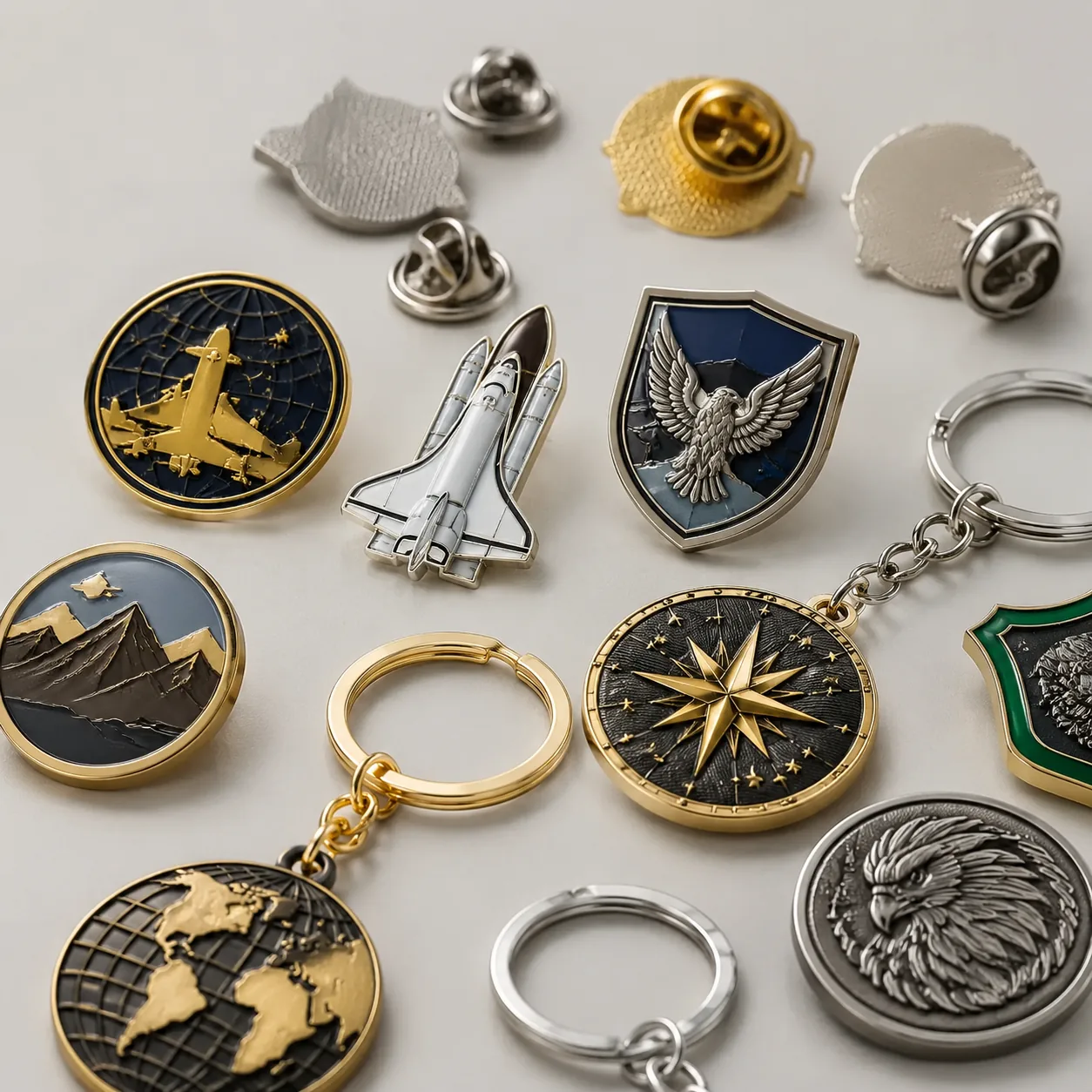
A 30 mm soft enamel pin with 4 colors, 1.5 mm iron base, bright nickel plating and butterfly clutch is realistic at 100 pieces. A 65 mm dual-plated 3D challenge coin with edge numbering, epoxy dome, antique finish and individual velvet box is also possible at 100 pieces, but it should be treated as a premium small batch. Tooling, polishing fixtures, plating racks, numbering, foam cutting and box packing are being spread across very few units.
| Product type | Practical small MOQ in 2026 | Typical FOB China price at small MOQ | Main small-MOQ risk |
|---|---|---|---|
| Soft enamel pins, 25-35 mm | 100-300 pcs per design | USD 0.85-2.20 each; mold USD 45-90 | Metal lines below 0.18 mm, more than 6 enamel colors, narrow cutouts |
| Hard enamel pins, 25-35 mm | 100-300 pcs per design | USD 1.20-2.90 each; mold USD 55-110 | Extra polishing loss, pale enamel shade variation, higher scrap rate |
| Metal keychains, 40-60 mm charm | 100-300 pcs per design | USD 1.40-3.80 each; mold USD 70-160 | Heavy 3D relief, weak chain spec, custom ring hardware |
| Challenge coins, 45-55 mm | 100-200 pcs per design | USD 2.80-7.50 each; mold USD 120-280 | Dual plating, 3D both sides, numbering, boxed packing weight |
| Embroidered patches, 70-90 mm | 50-200 pcs per design | USD 0.55-1.80 each; tape USD 25-60 | Text under 4 mm high, over 9 thread colors, irregular laser edge |
| Printed lanyards, 15-20 mm width | 100-300 pcs per design | USD 0.45-1.30 each; setup USD 20-50 | Fine text on narrow webbing, many attachments, barcode packing |
2. Build the RFQ as a Cost Breakdown
A vague RFQ produces a low first quote and a revised invoice later. On a 100-piece order, a USD 60 mold fee, USD 35 artwork redraw and USD 45 sample courier add USD 1.40 per piece before international freight, duty or local delivery. The RFQ should force the supplier to separate fixed cost from unit cost so the buyer can compare true landed cost at each quantity tier.
Request separate lines for tooling, digitizing or mold, digital proof, pre-production sample, bulk unit price, packing, export carton, third-party inspection support, export handling and freight. Ask for the same specification priced at 100, 200, 300 and 500 pieces. If the unit price barely changes between 100 and 500 pieces, the supplier may be padding the unit line instead of showing fixed cost. If the 100-piece unit price is extremely low but mold and packing are hidden, the final invoice is not yet controlled.
A usable RFQ states size in millimeters, thickness, base material, production process, plating or fabric finish, Pantone or thread colors, attachment, packing, target handover date, delivery country and reorder expectation. If construction is undecided, state the performance target: for example, 30 mm apparel pin, 1.5-1.8 mm thick, not bendable by hand, bright nickel finish, 4 Pantone C colors, butterfly clutch, individual backing card and polybag. That gives engineering enough data to recommend iron stamping, zinc alloy die casting, brass stamping, stainless etching, PVC molding, woven fabric or print-and-epoxy construction.
- Quote 100, 200, 300 and 500 pieces under the same drawing, attachment and packing specification.
- Confirm whether the mold fee is one-time, refundable above a volume threshold and valid only for exact reorders.
- Split lead time into proofing, sample production, sample courier, bulk production, inspection and bulk shipping.
- State the trade term: FOB Ningbo, FOB Shanghai, EXW Yiwu, FCA forwarder warehouse or courier DAP/DDU.
- Use controlled color references such as Pantone C/U, Madeira, DMC, PVC chip or approved printed proof.
- Define inspection as ANSI/ASQ Z1.4 general inspection level II unless a different sampling plan is agreed.
- Set default AQL at 2.5 major and 4.0 minor, with critical defects at 0.0 if safety or legal marks are involved.
3. Freeze Construction Before Premium Effects
Small-MOQ buyers often add decoration too early because they want the item to feel premium. The better sequence is construction first: clean outline, suitable thickness, stable attachment, controlled color system and protective packing. Premium effects should be added only when they improve visible value or solve a durability issue.
On a 30 mm pin, soft enamel instead of hard enamel can reduce the FOB unit price by about USD 0.25-0.80 at 100 pieces and shorten production by 2-4 days because there is less polishing. A custom backing card may cost USD 0.05-0.18 per piece and improve presentation more than upgrading from nickel to imitation gold. For a keychain, a 25-30 mm split ring with 1.2-1.5 mm wire is usually more useful than a second plating color.
Material choice has technical limits. Iron stamping is cost-efficient for flat pins and badges from 20-45 mm, typically 1.2-1.8 mm thick, but it is magnetic and unsuitable for thick 3D relief. Zinc alloy die casting suits keychains, magnets, 3D coins and larger badges, commonly 2.0-4.0 mm thick, with outline tolerance around +/-0.15-0.25 mm after polishing. Brass gives sharper stamped detail and a heavier hand feel, but at small MOQ it can add USD 0.20-0.70 per piece depending on size, thickness and metal price.
Specify plating by use environment. Indoor pins and presentation coins often use visible nickel, imitation gold, black nickel, copper or antique finish with a decorative layer around 0.10-0.30 microns over the base plating system. For items handled daily or attached to bags, mirror gold scratches quickly. Antique nickel, matte nickel, epoxy protection or recessed color fields usually hide wear better.
4. Approve Manufacturing Artwork, Not Brand Artwork
The proof must convert the logo into manufacturable geometry. It should show actual size, metal line width, recessed color areas, plating finish, cutouts, hole positions, attachment location, backstamp, edge treatment and packing orientation. A brand file may be visually correct but impossible to stamp, cast, fill with enamel or polish without losing detail.
For enamel pins and badges, raised metal lines should normally be at least 0.18 mm, with 0.20-0.25 mm safer for small-batch yield. Recessed enamel islands should generally be at least 0.35 mm wide after metal borders. Recessed text below about 5 pt equivalent height is high risk, especially in hard enamel because polishing can soften or close the detail. For lanyards, 15 mm webbing suits simple repeat logos; detailed text is safer on 20 mm or 25 mm webbing, especially for woven or jacquard output.
Reject effects that do not match the process. A gradient logo usually needs offset print with epoxy, UV print, acrylic or PVC instead of enamel. A 0.10 mm hairline must be thickened or converted to print. Large areas of pale hard enamel need a tolerance note because white, cream, pale yellow and light gray show dust, polishing marks and shade variation more clearly than black, red or dark blue.
For difficult artwork, ask for two proof routes: one closest to the original brand file and one adjusted for yield. The lowest-cost proof is not always the lowest-cost order if it creates rejects during plating, enamel filling or polishing.
5. Use the Sample to Lock the Specification
A pre-production sample should verify the approved route, not restart design work. Typical metal pin, coin and keychain samples take 7-10 days after artwork and mold approval, plus 3-7 days for courier delivery depending on destination. Embroidered and woven patch samples usually take 5-8 days. Printed lanyard samples are commonly 5-7 days when standard polyester webbing, hooks and safety breakaways are used.
Check the sample under working conditions. Measure size with calipers, confirm thickness, weigh one finished piece, inspect front and back plating, test the attachment and compare colors against the approved Pantone, thread card, PVC chip or physical reference. A common tolerance for small metal items is +/-0.2 mm on main size and +/-0.1 mm on thickness. If the item must fit a tray, holder, gift box foam insert or assembled kit, tighter tolerance must be written before bulk production.
- Confirm size, thickness, weight, plating finish and attachment against the approved proof.
- Inspect edges, recessed areas, ring holes, pin posts and magnet pockets for plating gaps, burrs or exposed base metal.
- Check enamel or print for underfill, overflow, bubbles, pinholes, dust and color bleeding.
- Open and close clutches, brooch pins, lobster clasps, split rings or safety pins 10-20 times.
- Verify backstamp spelling, logo orientation, legal marks and country-of-origin marking where required.
- Photograph the approved sample and label it as the golden sample with date, revision, supplier and PO quantity.
6. Put Tolerances, AQL and Timing Into the PO
After sample approval, the purchase order should define what can vary and what cannot. Small orders move quickly through sales, engineering, mold, plating, color filling, packing and shipping teams, so verbal changes are easy to miss. The PO should reference the artwork file name, revision number, approved sample date, quantity, packing method, carton mark, inspection standard, trade term and shipping method.
Quantity tolerance should be explicit. For custom production, overrun or underrun of +/-2-3 percent may be normal, but event kits often require exact counts. If exact quantity matters, state it and allow time for sorting or replacement. For color, define the reference: Pantone coated, Pantone uncoated, thread card, PVC chip, printed proof or golden sample. A screen image is not a controlled color standard.
Bulk lead time after sample approval is usually 10-18 days for simple enamel pins, 12-20 days for keychains and coins, 7-15 days for patches and 8-15 days for printed lanyards, excluding holiday congestion. Around Chinese New Year, Canton Fair periods and Q4 promotional peaks, add 7-14 days of buffer. Rush production is possible for simple designs, but plating, drying, epoxy curing and final packing still need physical time.
Use AQL terms even on small lots. A practical standard is AQL 2.5 for major defects such as wrong logo, wrong plating, missing color, broken attachment, sharp burrs or wrong packing, and AQL 4.0 for minor defects such as tiny hidden polishing marks, slight enamel dust or shade variation within the approved range. For a 100-piece lot, many buyers also require 100 percent visual sorting before final sampling inspection.
| Control point | Typical small-MOQ limit | Reject or rework trigger |
|---|---|---|
| Size and thickness | Main size within agreed tolerance, commonly +/-0.2 mm for metal badges and +/-0.1 mm on thickness | Does not fit backing card, tray, holder, foam insert or paired item |
| Plating appearance | Even visible finish; minor hidden rack marks acceptable on back or attachment areas | Peeling, exposed base metal, dark stain, wrong finish or sharp burr |
| Enamel or print | Color matches golden sample under D65 or daylight-equivalent light; no obvious missing areas | Wrong Pantone family, large bubbles, overflow on logo text or visible dust on front |
| Attachment | Sampled clutches, rings, clasps, magnets or brooch pins function normally | Loose post, weak magnet, split ring gap above 0.5 mm or broken stitching |
| Packing | Correct count, SKU, backing card, polybag or box and readable carton mark | Mixed designs, crushed retail box, missing barcode or incorrect warning label |
7. Choose Freight by Deadline and Packed Weight
Most small-MOQ buyers use courier because it is simple. For 100-300 pieces of pins, keychains, patches or lanyards, DHL, FedEx, UPS or comparable air courier is usually practical, with transit commonly 3-7 days after pickup. Heavy coins are different. Two hundred 50 mm zinc alloy coins can weigh 18-25 kg packed, and individual boxes can make freight a major share of the landed cost.
Ask for packed weight, carton dimensions and carton count before choosing freight. A 30 mm enamel pin with backing card and polybag may pack at 12-18 g per piece. A 55 mm coin may weigh 60-90 g before box. A 20 mm polyester lanyard with hook is often 25-40 g. If the launch date allows 30-45 days, sea freight or consolidated air-sea freight can be cheaper for heavy coins, magnets and boxed sets, but it is rarely worth the complexity for urgent event quantities.
For reorders, keep the sourcing file complete. Save the mold number, artwork revision, golden sample date, invoice description, carton label photo and one finished piece. The next PO should reference those details so the factory repeats the approved product instead of interpreting the artwork again. This matters when the reorder moves from 100 pieces to 500 or 1,000 pieces and production may be scheduled on a different line.
8. Run a Final Deposit Check
Before paying the deposit, reduce the order to a one-page production brief. It should state product type, size, material, thickness, finish, colors, attachment, packing, quantity, unit price, tooling cost, sample cost, lead time, trade term, inspection standard, tolerance and approved artwork revision. If any field is blank, the order still contains preventable risk.
The strongest 2026 sourcing path for small-MOQ custom promo products is not to force every supplier to match the lowest 100-piece price. Use manufacturable construction, approve production artwork, sample once, freeze the golden sample and inspect the batch against written limits. ZheCraft supports this process across enamel pins, brooches, keychains, fridge magnets, challenge coins, patches and lanyards, especially when buyers need several coordinated small batches under one brand system.
- Send the same RFQ specification to each supplier so quotes are comparable.
- Compare 100, 200, 300 and 500 piece pricing before choosing the MOQ.
- Approve manufacturing proof details before mold payment.
- Use the pre-production sample to lock specifications, not to redesign repeatedly.
- Write tolerances, AQL levels, packing method and shipping terms into the PO.
- Confirm packed weight and carton dimensions before selecting courier, air or consolidated freight.
- Keep the golden sample, mold number and revision number for any reorder.
Have a project? Send your artwork and target quantity and we’ll reply with a detailed quotation within 12 working hours.
Ready to get this made?
Send your sketch, target quantity and ship-date. Detailed quotation in 12 hours.



