Small-MOQ Custom Pins in 2026: When to Standardize or Customize
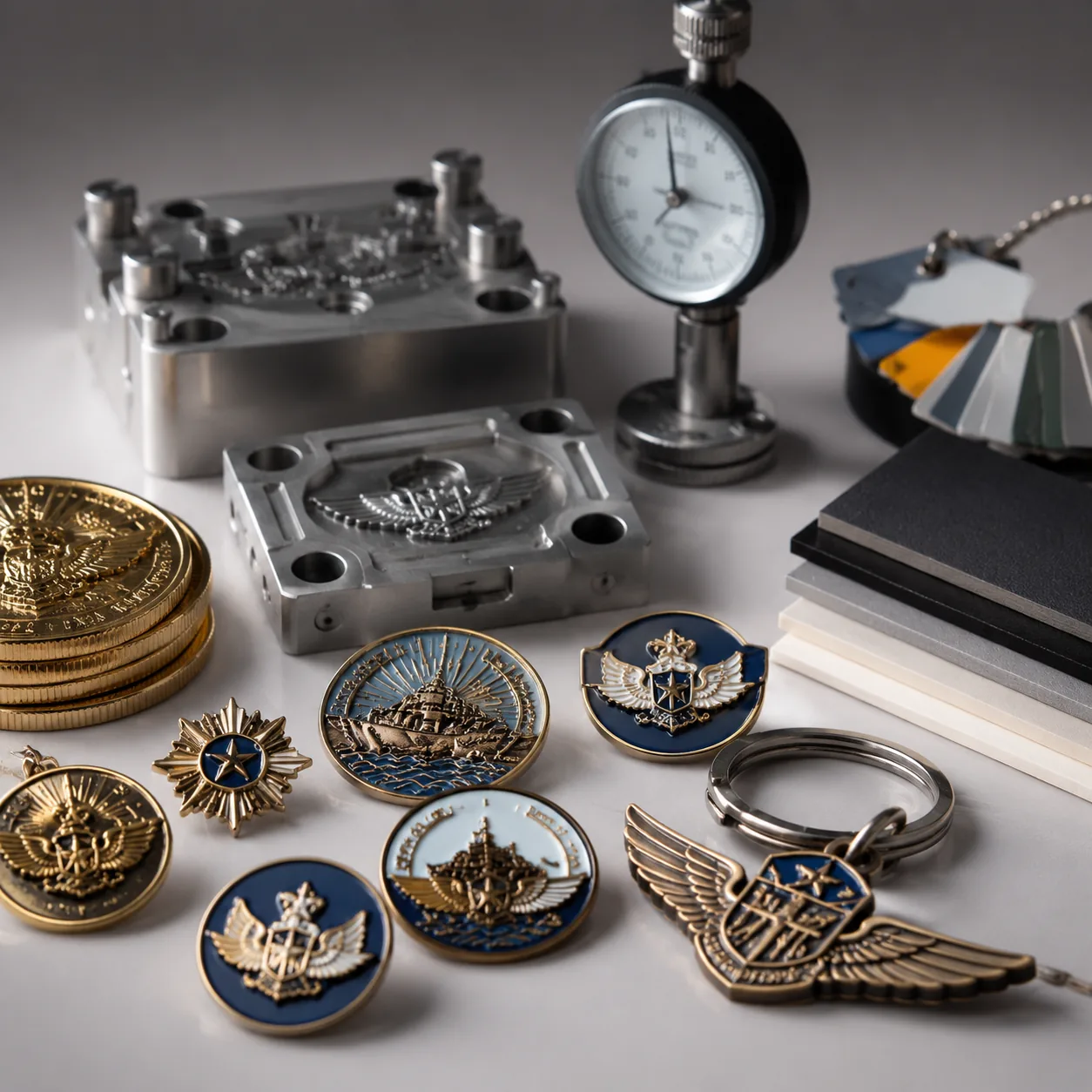
Why small-batch pin costs rise so quickly
At 100 to 300 pieces, custom pin economics are dominated by fixed and semi-fixed factory costs rather than raw material. The metal itself is cheap. What moves FOB is the combination of die making, plating setup, enamel filling labor, sample approval, soldering, assembly, and final inspection. On a basic 30 mm stamped iron soft enamel pin, the steel or iron body may represent well under 20 percent of ex-factory value; the rest is process cost.
That is why small-MOQ buying is mostly a specification discipline problem. A supplier can usually make the feature. The harder question is whether that feature is rational at 100 pieces. A second plating color, two attachment types, a printed backing card, and a custom box may each look minor in isolation, but together they create separate work instructions, split lots, extra handling, and more reject points.
In 2026, the cost curve still changes sharply below 300 pieces. A mold or die charge of USD 45 to 95 can represent 18 to 35 percent of total FOB on a 100-piece order, but more like 8 to 15 percent at 300 pieces. Sample courier cost, plating changeover, and manual packing do not dilute nearly as fast. The practical rule is simple: keep hidden build variables stable and spend only where the buyer can see, feel, or repeatedly reorder the result.
Choose the right manufacturing route first
Process choice should be settled before detailed artwork cleanup. If the route is wrong, later art edits will not recover wasted lead time or remake cost. For most first orders, the default remains stamped iron soft enamel: typically 20 to 40 mm, 1.2 to 1.5 mm thick, 1 to 6 spot colors, single plating finish, one post, and a butterfly clutch. Typical MOQ is still 100 pieces. A realistic timeline is 1 to 2 days for quote and digital proof, 4 to 7 days for a pre-production sample, and 10 to 15 production days after approval. A credible 2026 FOB range is USD 0.48 to 0.95 per piece at 100 to 300 pieces, usually plus mold.
Imitation hard enamel is the premium upgrade when the face must read smoother and more formal. It is usually made on brass or copper, then polished flush. Because the surface is flat, uneven fill, pinholes, and polishing defects are more visible than on soft enamel. At small lot size, FOB commonly runs USD 0.90 to 1.80 per piece, with tighter art and more careful polishing required. It suits award pins, premium retail souvenirs, and brand marks that benefit from a jewelry-like surface.
Die-cast zinc alloy is the better route when artwork needs interior cutouts, thicker body sections, or shallow 3D form. Zinc parts are commonly 2.0 to 3.0 mm thick and handle irregular silhouettes better than stamped iron. They are usually less economical than flat stamped pins when the art is simple, but they avoid forced compromises on bridge width and relief. Expect roughly USD 0.85 to 1.60 FOB per piece at 100 to 300 pieces for small-lot zinc alloy soft enamel builds.
Photo-etched brass has a narrower but important role. It handles finer linework and smaller text than stamping because the artwork is chemically etched rather than mechanically struck. If line widths are around 0.18 to 0.25 mm, text is small, or there are dense technical marks, etching often gives a cleaner result than trying to force the design through a stamped die. It is a technical choice, not an automatic cost saver.
| Build route | Best use at 100-300 pcs | Typical spec window | 2026 FOB range |
|---|---|---|---|
| Stamped iron soft enamel | Flat 2D logos, event pins, promo resale | 20-40 mm, 1.2-1.5 mm thick, 1-6 colors | USD 0.48-0.95/pc |
| Brass or copper imitation hard enamel | Premium gifts, recognition, formal brand marks | 20-35 mm, 1.2-1.5 mm thick, flush polished face | USD 0.90-1.80/pc |
| Die-cast zinc alloy soft enamel | Cutouts, irregular outlines, mild 3D relief | 25-50 mm, 2.0-3.0 mm thick, complex silhouette | USD 0.85-1.60/pc |
| Photo-etched brass | Fine text, thin lines, technical insignia | 20-35 mm, 0.8-1.0 mm thick, finer line capability | USD 0.70-1.30/pc |
A practical screening rule for pilot orders is this: if raised metal lines can stay at or above 0.25 mm, recessed channels at 0.30 to 0.35 mm or wider, small text above roughly 5 pt at final size, and internal bridges above 1.0 mm, stamped soft enamel is usually the lowest-risk option. If the design falls below those limits, move to zinc alloy or photo etch early instead of paying for avoidable rework.
Standardize the hidden specs first
The easiest savings on a 100-piece order usually come from locking the non-visible specifications. Buyers focus on the front face, but factories lose efficiency on mixed platings, mixed back hardware, nonstandard thickness, split packaging methods, and multiple SKU variants inside one order. Those decisions create manual sorting and separate inspection criteria, which are expensive at low quantity.
For first runs, a strong baseline is 25 to 35 mm size, 1.2 or 1.5 mm thickness for stamped builds, one post up to roughly 32 mm width, and one plating finish across the full lot. Standard plating choices are bright gold, bright nickel, black nickel, antique brass, and dyed black. Splitting a 100-piece order into 50 bright gold and 50 black nickel often triggers either separate production handling or a plating surcharge in the range of USD 30 to 80 total.
Attachment should also stay standard unless function requires otherwise. Butterfly clutch is still the lowest-cost default. Black rubber clutch typically adds USD 0.01 to 0.03 per piece and improves comfort for wearable pins. Deluxe locking clutches usually add USD 0.08 to 0.20 per piece. Magnet backs add about USD 0.12 to 0.35 per piece at low volume and should be specified carefully because added weight and adhesive performance matter more on thicker or larger parts. For pins wider than 40 mm, or for heavy zinc-alloy pieces, two posts can be justified to prevent rotation. Below that size, dual posts are often cost with little functional gain.
Packaging is a frequent small-order margin leak. Individual polybags remain the baseline. A printed paper backing card in the 250 to 400 gsm range usually adds USD 0.05 to 0.18 per set at 100 to 300 pieces, depending on card size, finish, and whether the pin is hand-mounted. A custom rigid gift box can add USD 0.60 to 1.50 per set, which means the box may cost more than the pin.
- Keep MOQ per SKU at 100, 200, or 300 pieces instead of splitting a pilot into several colorways
- Hold size in the 25 to 35 mm range unless the artwork genuinely needs more area
- Use one plating finish for the full order and avoid mixed-finish pilot runs
- Choose one standard attachment: butterfly clutch for cost or rubber clutch for comfort
- Delay custom retail packaging until reorder stage unless packaging is central to the product
Spend on visible customization, not decorative complexity
At low volume, customization pays only when it improves visible quality, handling, or brand recognition. From normal viewing distance, the buyer notices line definition, clean enamel boundaries, plating consistency, and overall finish. They do not notice the back side nearly as much as they notice muddy channels, weak outlines, or color contamination on the face.
That makes artwork engineering more valuable than novelty add-ons. For stamped soft enamel, raised metal lines should generally stay at or above 0.25 mm, with 0.30 mm safer for repeat production. Recessed enamel channels should usually be 0.30 to 0.35 mm minimum. Very small enclosed cells raise the chance of underfill, trapped dust, overflow, and inconsistent wipe quality. On a first run, limiting the palette to four colors or fewer is often the best discipline unless the design truly needs more.
Color should also be specified in manufacturing terms, not branding theory. Pantone references are useful, but most decorative pin factories match visually rather than to tight instrumented Delta E tolerances. The more reliable standard is an approved sample under normal daylight-equivalent lighting. For soft enamel, requesting fill slightly below the raised metal line is usually better than pushing for an overfull look, because it reduces wipe marks and edge contamination.
Epoxy is one of the few low-volume upgrades that often earns its cost. A clear epoxy dome usually adds USD 0.06 to 0.18 per piece depending on size, and it improves scratch resistance during packing and transit. It also gives a smoother hand feel. The tradeoff is optical: epoxy softens metallic contrast and can blur extremely fine linework, so it is better for event souvenirs, youth merchandise, and general promo pins than for highly technical insignia or polished premium pieces.
A good spend order for a 100-piece run is straightforward: first pay for cleaner art and one solid sample approval, second for a visible tactile upgrade such as epoxy or a better clutch, and only after that for hidden branding or premium packaging. That sequence aligns cost with customer perception.
Features that punish low-volume orders
Some features are technically easy to make but economically poor at 100 to 300 pieces. Moving parts, danglers, hinge elements, sequential numbering, glitter, glow enamel, translucent fills over texture, mixed platings, retail-ready cards, and rigid gift boxes all add handwork or process branching. They should be quoted as exceptions, not treated as standard decoration.
Moving components are the clearest example. A 35 mm spinner pin may require two molds or subcomponents, separate plating handling, riveting or loop assembly, and alignment checks. On a 100-piece order, that often adds USD 0.35 to 0.90 per piece and extends lead time by 3 to 7 production days. A dangler usually adds less, often USD 0.18 to 0.45 per piece, but still creates more assembly labor and more QC points.
Sequential numbering is another underestimated cost. Back-side laser numbering often adds USD 0.05 to 0.15 per piece. If the number must be front-facing, aligned visually, or matched to packaging, labor rises quickly because the task becomes both cosmetic and traceability-sensitive. Specialty enamels also carry hidden risk. Glitter and glow pigments may add only a few cents in material, but they increase fill variability and rejection rate, especially in narrow or enclosed cells.
Custom backstamps sit in the middle. They are useful for channel control, anti-copying, and repeat SKU management, but they make most sense when the design is likely to reorder. On a one-time 100-piece event pin, the backstamp may not justify its share of setup cost. On a branded program expected to repeat at 500 pieces or more, it becomes far more rational because the tooling and approval effort spread across future runs.
Set QC standards that fit decorative metal goods
Custom pins are handmade decorative metal products, not precision-machined components. QC should target visible defects and functional failures rather than microscopic variation that the process cannot economically eliminate. Trying to hold a 100-piece order to unrealistic cosmetic standards usually adds delay and remake cost without improving the sell-through result.
A practical baseline is AQL 2.5 for major defects and AQL 4.0 for minor defects, tied to an approved golden sample or approval photo set before mass production. Major defects should include wrong plating, wrong color family, exposed base metal on the front face, loose post, broken attachment, severe enamel contamination, or sharp burrs that affect handling. Minor defects can include slight back-side polish marks, small enamel depth variation, or modest tone shift that is not obvious at normal viewing distance.
Tolerance language should be explicit. For common 25 to 35 mm stamped pins, overall size tolerance of plus or minus 0.20 mm is realistic. Body thickness tolerance of plus or minus 0.15 mm is reasonable. Enamel depth variation of about plus or minus 0.10 mm in recessed areas is normal. For soldered posts, position tolerance of plus or minus 0.50 mm is usually acceptable unless the pin must fit a fixture card with tight hole spacing. Decorative plating is often controlled by appearance rather than a strict deposit guarantee, but when a number is required, buyers should confirm micron values in writing because many factories quote finish appearance instead of measured thickness.
| Spec point | Recommended small-MOQ standard | When to tighten it |
|---|---|---|
| Color control | Pantone reference plus approved visual sample | Retail programs with strict brand identity |
| Size tolerance | Within about +/-0.20 mm | Pins that must fit display recesses or fixture cards |
| Body thickness tolerance | Within about +/-0.15 mm | Magnet backs or mechanical mounting |
| Enamel fill level | Even overall, slightly below raised metal | Premium gift or recognition pieces |
| Cosmetic QC level | AQL 2.5 major, 4.0 minor | Higher-ticket resale channels |
For approvals, one pre-production sample is usually enough at small MOQ. If schedule is tight, high-resolution approval photos showing front, back, side profile, ruler reference, and clutch fit can replace an extra physical sample cycle. Requiring two or three sample rounds on a 100-piece order often destroys the economics through courier cost, remake time, and interrupted scheduling.
Quote by quantity tier and build the pilot like a repeat SKU
The right way to buy a first run is to quote a stable specification at 100, 200, and 300 pieces before discussing extra features. That reveals where the real unit-price drop occurs and whether a small increase in quantity is cheaper than adding visible complexity. For many 30 mm stamped soft enamel pins in 2026, FOB might look roughly like this: 100 pieces at USD 0.48 to 0.95 each, 200 pieces at USD 0.42 to 0.78 each, and 300 pieces at USD 0.38 to 0.68 each, with mold charged separately at about USD 45 to 90 depending on size and outline complexity.
The pilot should also be documented as if it were a repeatable SKU. That means keeping the final artwork revision, finished size, base metal, thickness, plating code, attachment type, post location, Pantone references, epoxy note, packaging method, approved sample photos, and accepted deviations in one technical record. Suppliers should also confirm tooling retention terms. In this segment, 2 to 5 years of mold retention is common if the account stays active and the tool remains usable.
This matters when a successful pilot moves from 100 pieces to 500 or 1,000 pieces. The second run should not reopen basic engineering questions about line width, post placement, enamel type, or plating finish. If those decisions are locked during the pilot, the reorder can move directly into scheduling and quantity pricing instead of another development cycle.
A practical 2026 small-MOQ spec template
For many first-run custom pins in 2026, the most economical baseline remains simple: 30 mm stamped iron soft enamel, 1.2 to 1.5 mm thickness, up to 4 colors, one bright nickel or black nickel finish, one butterfly or black rubber clutch, one polybag per piece, and one pre-production sample or approval photo set. That combination usually offers the best balance of speed, cosmetic consistency, and FOB control at 100 to 300 pieces.
Typical planning numbers for that baseline are straightforward: MOQ 100 pieces, mold charge about USD 45 to 90, sample lead time 4 to 7 days, mass production 10 to 15 days, and FOB unit pricing around USD 0.48 to 0.95 at 100 pieces. Common adders should be tested deliberately rather than adopted by default: epoxy USD 0.06 to 0.18, printed backing card USD 0.05 to 0.18, magnet back USD 0.12 to 0.35, spinner or dangler assembly USD 0.18 to 0.90 depending on structure, and rigid gift box USD 0.60 to 1.50.
The decision rule is direct. Customize what improves front-face perception, function, or reorder consistency. Standardize what only adds setup, handwork, split lots, or inspection burden. At small MOQ, disciplined specifications beat long feature lists. That is how a 100-piece custom pin order stays a commercial product instead of becoming an expensive prototype.
Have a project? Send your artwork and target quantity and we’ll reply with a detailed quotation within 12 working hours.
Ready to get this made?
Send your sketch, target quantity and ship-date. Detailed quotation in 12 hours.



