Small-MOQ Custom Pins in 2026: When Digital Proofs Are Enough
Q1: For a 100 to 300 piece order in 2026, when is a digital proof enough?
For most 2026 orders in the 100 to 300 piece range, a digital proof is enough only when the pin is technically ordinary and the factory is not being asked to interpret borderline details. The safest case is still a 2D stamped iron soft enamel pin, 25 to 35 mm, 1.2 to 1.5 mm thick, 1 to 4 fill colors, one plating finish, one standard butterfly clutch, and clean vector artwork with no moving parts or specialty fills. In that scenario, the proof can verify the items that matter most: finished dimensions, outline, post placement, metal lines, Pantone callouts, backstamp spelling, and packaging notes.
Skipping a physical sample saves meaningful time and money on small runs. A pre-production sample typically adds 7 to 12 calendar days for tooling and hand-finishing, plus 3 to 5 days if the sample must be couriered internationally. Sample charges commonly run USD 45 to USD 120 for standard stamped pins and USD 80 to USD 180 for assembled designs such as spinners or danglers. On a 100-piece order worth only USD 90 to USD 220 FOB, that can consume 20 to 50 percent of the merchandise value before production even starts.
Where digital approval fails is where appearance or function depends on the real object rather than the drawing. A flat proof cannot show whether translucent enamel reads muddy over black nickel, whether glitter density looks patchy in small cells, whether antique plating obscures recessed text, or whether a spinner rivet is too tight to rotate smoothly. It also cannot confirm edge feel, burr removal, dome height on epoxy, or whether two posts sit flush enough to prevent rocking on fabric.
A practical cutoff is this: use digital-only approval when the design stays well inside process limits. If the file includes recessed text below 1.2 mm high, metal strokes below 0.20 to 0.25 mm, bridges around an inner cutout narrower than 0.8 mm, transparent or glow enamel, mixed plating masks, or mechanical assemblies, the risk moves from graphic interpretation to production capability. That is usually where a physical sample becomes cheaper than a remake, a refund, or a missed event date.
Q2: Which pin constructions stay economical at low MOQ, and which escalate fastest?
The most economical low-MOQ construction remains the 2D stamped iron soft enamel pin. It uses relatively low-cost dies, most factories run it daily, and the yield is predictable when artwork has open fill areas, sensible line widths, and no complicated assembly. For club merch, staff recognition, event giveaways, and pilot runs, this build still offers the best balance of FOB cost, speed, and acceptable cosmetic consistency at 100 to 500 pieces.
Costs rise when the process needs flatter polishing, tighter edge control, more handwork, or a second assembly step. Brass imitation hard enamel gives a smoother, jewelry-like face but requires better polishing and color-fill leveling, so its reject sensitivity is higher than standard soft enamel. Zinc alloy casting is the better choice for inner cutouts, deep relief, irregular outlines, and mild 3D forms, but mold cost is usually higher than a stamped die and dimensional tolerance is often a little looser, especially on thin projecting features. Add-ons such as spinner rivets, danglers, chains, magnet backs, laser serial numbers, or rigid presentation boxes carry a disproportionate penalty at 100 pieces because setup and handling are spread across too few units.
| Build option | Best MOQ tier | Typical production lead time after approval | Typical 2026 FOB unit price | Notes |
|---|---|---|---|---|
| Stamped iron soft enamel, 30 mm, 2D, 1 post | 100 to 500 pcs | 10 to 14 days | USD 0.48 to 0.95 | Most stable low-MOQ option; usually 1.2 to 1.5 mm thick |
| Stamped iron soft enamel, 35 mm, 2 posts | 100 to 500 pcs | 10 to 15 days | USD 0.62 to 1.10 | Two posts reduce rotation on wider badges |
| Brass imitation hard enamel, 30 mm, 2D | 100 to 300 pcs | 12 to 18 days | USD 0.85 to 1.60 | Flatter face and cleaner edges; tighter polishing control needed |
| Zinc alloy cast, 35 mm, cutout or mild 3D | 100 to 300 pcs | 12 to 18 days | USD 0.90 to 1.80 | Better for cutouts and relief; avoid if a simple stamp can do the job |
| Soft enamel with epoxy dome, 30 mm | 100 to 500 pcs | 11 to 15 days | USD 0.58 to 1.05 | Adds scratch resistance; dome softens line crispness slightly |
| Spinner or dangler pin, 35 to 45 mm | 150 to 300 pcs | 16 to 24 days | USD 1.40 to 2.80 | Assembly risk is higher; sample usually justified |
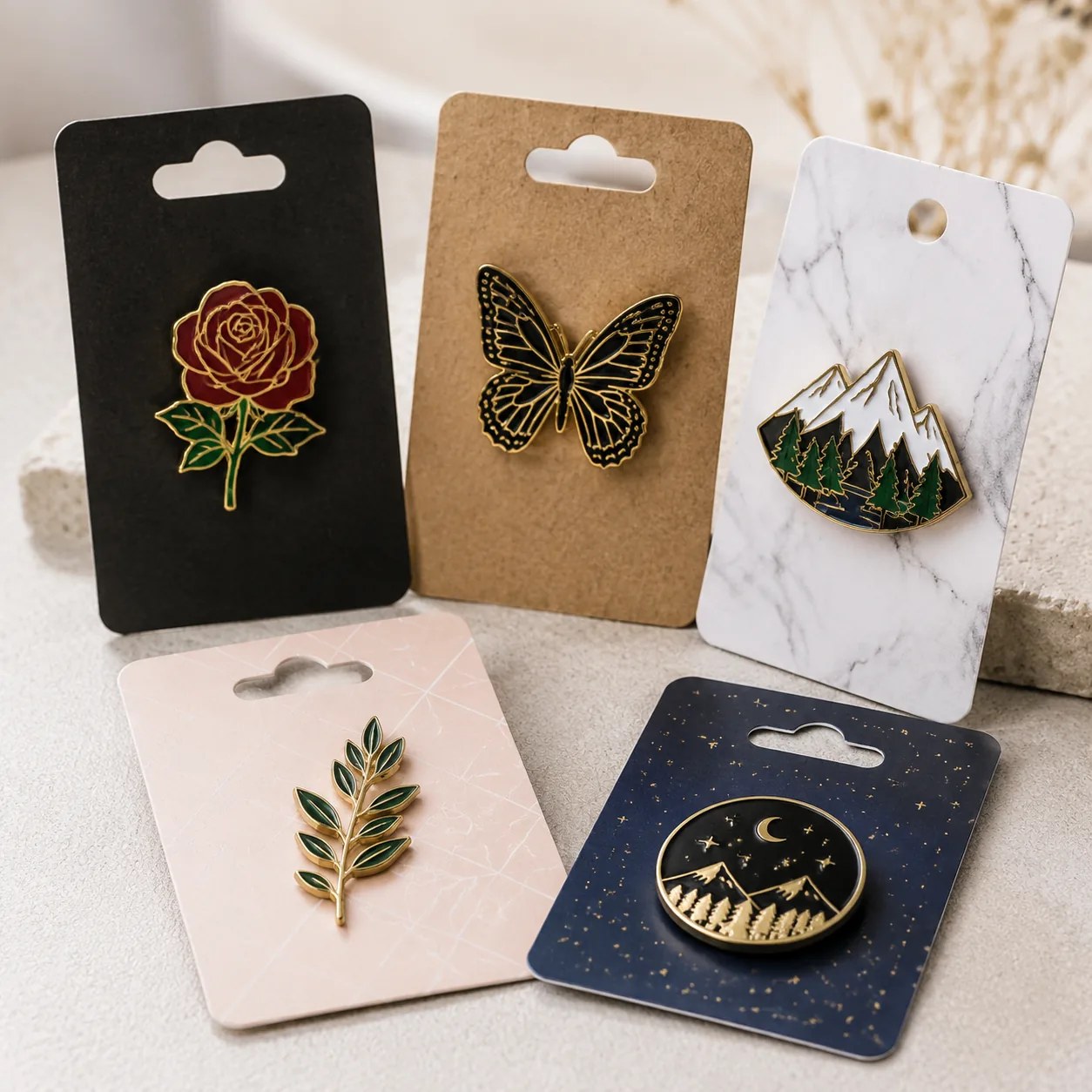
| Pin with custom backing card + polybag | 100 to 500 sets | Add 2 to 4 days | Add USD 0.08 to 0.25 per set | Best small-run branded packaging option |
| Pin with rigid gift box or velvet box | 200 pcs and up | Add 5 to 10 days | Add USD 0.35 to 1.50 per set | Often poor value for promo or event quantities |
At low quantity, the right construction should match the artwork instead of chasing a premium finish by default. If the art is flat and graphic, stamped iron soft enamel below about USD 1.00 FOB per piece is usually the most rational choice. Brass imitation hard enamel is defensible when a flatter face or more polished look matters to the brand. Zinc alloy earns its cost only when the design truly needs interior cutouts, curved relief, or cast geometry that a die-struck part cannot hold cleanly.
Q3: If you skip the sample, which specifications must be fixed in writing?
Once the sample step is removed, the specification sheet becomes the product definition. Many low-MOQ disputes do not come from bad factories; they come from buyers approving artwork without locking the manufacturing assumptions behind it. If the proof does not state otherwise, the supplier will usually default to house standards for thickness, post count, clutch style, plating brightness, packaging, and inspection tolerance.
At minimum, lock these items in writing: finished size in millimeters, nominal thickness, base metal, construction method, pin count and exact location, clutch type, plating finish, Pantone references, minimum line width, minimum readable text size, backstamp layout, packaging method, acceptable quantity tolerance, and inspection standard. For example, a 30 mm stamped iron pin may be quoted at 1.2 mm thickness by default; increasing it to 1.5 mm can improve perceived weight and edge feel, but may add USD 0.03 to USD 0.08 per piece depending on size and plating.
Tolerance language should also be explicit. A practical commercial tolerance for custom pins is typically plus or minus 0.15 mm to 0.25 mm on major dimensions, depending on process and size. Thickness tolerance is commonly around plus or minus 0.10 mm. Weight variation of plus or minus 8 to 12 percent is normal, especially on cast parts or antique finishes where polishing removes material unevenly. For readable branding, keep text at least 1.2 mm high with strokes no thinner than 0.20 mm; if the font is serifed or condensed, 1.5 mm high is a safer floor.
Color and finish expectations need the same discipline. If laboratory color control is unnecessary, say so directly: 'visual Pantone match acceptable under neutral office lighting or D65-equivalent light source.' That is more realistic than implying exact instrumental matching on a decorative metal product. For plating, specify the family precisely: bright nickel, imitation gold, black nickel, antique brass, matte gold, or dyed black. If corrosion resistance matters for souvenir, uniform, or resale channels, request a decorative plating target such as 24 to 48 hours neutral salt spray, recognizing that this is a screening benchmark rather than an industrial protective coating standard.
- Checklist: approve vector artwork in AI, EPS, or editable PDF format
- Checklist: state finished size in mm, nominal thickness, and allowed tolerances
- Checklist: define construction and base metal: stamped iron, brass, or zinc alloy
- Checklist: call out post quantity, clutch type, and exact post placement
- Checklist: specify plating finish and whether mixed plating is allowed
- Checklist: list Pantone references or state that visual match is acceptable
- Checklist: set minimum line width, minimum gap, and minimum readable text size
- Checklist: approve backstamp spelling, orientation, and any date mark
- Checklist: specify packaging method, carton count, and quantity tolerance
- Checklist: state inspection level such as AQL 2.5 major / 4.0 minor
Q4: Where do low-MOQ quotes hide cost, and how should you compare them?
The unit price alone is rarely the right comparison on a 100-piece pin order. One supplier may include die charge, standard butterfly clutches, polybagging, and export carton packing in the quoted unit price; another may separate tooling, carding, attachment upgrades, and local delivery to port. Unless every quote is normalized to the same scope and the same trade term, the cheapest number is often just the most incomplete offer.
For a clean comparison, request separate line items for tooling or mold charge, unit price by MOQ tier, plating surcharge if any, attachment upgrades, packaging cost, proof or sample charge, and shipping term such as EXW, FOB, or DDP. MOQ tiers matter more than many first-time buyers expect. A standard 30 mm soft enamel pin may quote around USD 0.92 FOB at 100 pieces, USD 0.68 FOB at 200 pieces, and USD 0.56 FOB at 300 pieces because tooling and setup are being spread across a broader run. That often makes 200 or 300 pieces the better value even when immediate need is only 120 pieces.
Freight terms can distort the decision even more. A quote of USD 0.62 EXW plus USD 55 tooling, local trucking, export docs, and handling is not directly comparable to USD 0.84 FOB with tooling included. For small runs shipping by courier, DDP air freight can exceed the manufacturing value of the goods, especially when presentation packaging increases dimensional weight. Buyers should first normalize all offers to one term and one packing method, then compare total landed cost rather than piece price alone.
Also check the revision policy after tooling starts. Some factories charge full new tooling for even a minor outline change; others charge a partial re-tool fee if the core shape remains usable. On a pilot run intended for annual reorders, tooling retention for 2 to 3 years and discounted revision charges may be worth more than saving USD 0.05 per unit on the first order. On low-MOQ custom products, reorder convenience is part of the price.
Q5: What quality level is realistic on a 100-piece run, and what counts as a real defect?
A 100-piece custom pin order should be judged as a commercial decorated metal product, not as fine jewelry. For most runs in this range, AQL 2.5 for major defects and 4.0 for minor defects is a realistic acceptance benchmark. Under that standard, some limited cosmetic variation is normal: slight enamel waviness in larger fill areas, tiny plating specks outside logo-critical zones, minor polish variation along edges, and small color spread within recessed cells where the line width is near the process minimum.
What should not be accepted is functional failure or obvious brand failure. That includes loose posts, crooked posts that make the pin rotate, clutches that do not hold, wrong plating family, unreadable logo text, misspelled backstamp, cracked or missing enamel, sharp burrs, exposed base metal on front-facing surfaces, count shortage beyond the agreed tolerance, or packaging that scratches the face during transit. Small orders usually have little overrun, so yield loss hurts more than on a 5,000-piece production. That is why 'minor cosmetic variance accepted' should never be used to excuse defects that affect function, safety, or brand legibility.
For difficult builds, targeted QC evidence is more useful than generic beauty photos. Ask for front, back, and edge images under neutral light, one photo with a ruler or caliper for size confirmation, and a short video showing clutch fit and final packing count. If the design uses two posts, the video should show both posts aligned and both clutches fully seated. If it is a spinner or dangler, the clip should show movement, rivet tension, and whether parts contact each other in motion. That level of evidence catches expensive mistakes without forcing a third-party inspection onto a USD 150 to USD 400 order.
Q6: Which cost-saving shortcuts work, and which ones backfire?
The best savings come from removing complexity that the end user will not miss. Use one standard butterfly clutch unless a locking back is functionally required. Stick to one plating finish. Keep enamel colors to four or fewer where practical. Avoid interior cutouts unless the artwork genuinely needs them. Use a standard backing card and polybag instead of a rigid box for event or promo use. Bulk pack inner bags in counts of 50 or 100 if presentation at receipt does not matter. These choices lower setup time, handling, and reject risk without weakening the product itself.
The shortcuts that backfire are the ones that force the factory past process limits. Shrinking a detail-heavy design below about 22 mm often saves little because the main costs are still tooling and handling, yet text becomes unreadable and metal lines become inconsistent. Removing the second post from a wide horizontal badge may save only USD 0.03 to USD 0.08 per piece, but often causes rotation complaints in wear. As a rule of thumb, use two posts when the pin is wider than about 35 mm, taller than 40 mm, or long and narrow enough to twist on fabric or bag straps.
Another false economy is sending raster artwork to avoid redrawing. That usually forces the factory to recreate production lines, which adds interpretation risk and can delay approval more than simply obtaining vector art first. If the design still feels too detailed after vector cleanup, the right correction is to increase the size, reduce internal detail, widen the metal lines, or change the construction. Low MOQ should mean simpler build decisions, not looser artwork control.
Q7: How should you manage supplier risk on a 100 to 200 piece order?
On a small order, documentation does more risk-control work than legal language. Most buyers will not negotiate a full manufacturing agreement for a USD 200 pin program, so the practical safeguard is one clean approval package containing the artwork file, dimensioned proof, plating callout, post map, packing note, acceptance standard, and agreed trade term. If the approvals are scattered across email threads, chat messages, and screenshots, it becomes much harder to prove what the supplier was actually authorized to make.
Before paying, ask three direct questions. First, what events trigger remake, rework, or credit: wrong plating, misspelled backstamp, out-of-tolerance size, missing attachment, or only major functional defects? Second, what color variance is considered acceptable: close visual match to Pantone, approximate match only, or no guarantee on transparent, pearl, glow, or glitter fills? Third, when does lead time begin: after deposit, after proof approval, or after sample approval if a sample is required? Clear answers usually indicate a defined production process rather than a factory trying to fit a small order around larger jobs.
Tooling retention policy also matters more than many buyers assume. Dies and molds are often held for 2 to 3 years, sometimes longer when repeat orders are regular, but the retention period and maintenance practice vary by supplier. If the first 100-piece run is a pilot for a recurring event or membership program, ask whether tooling is retained free of charge, whether maintenance or retrieval fees apply, and whether reorders will be made from the same tool revision. Over two or three repeats, that policy can matter more than the first invoice.
The practical next step is straightforward. Classify the design as low-risk or high-risk. Compare quotes only after normalizing the trade term and scope. Then replace the skipped sample with tighter written specifications and targeted pre-shipment QC evidence. Digital proofs are enough when the build is ordinary and the specification is not. On a small order, that is how buyers keep lead time short without trading away predictability.
Have a project? Send your artwork and target quantity and we’ll reply with a detailed quotation within 12 working hours.
Ready to get this made?
Send your sketch, target quantity and ship-date. Detailed quotation in 12 hours.



