Small-MOQ Custom Pins in 2026: The RFQ-to-Bulk Playbook
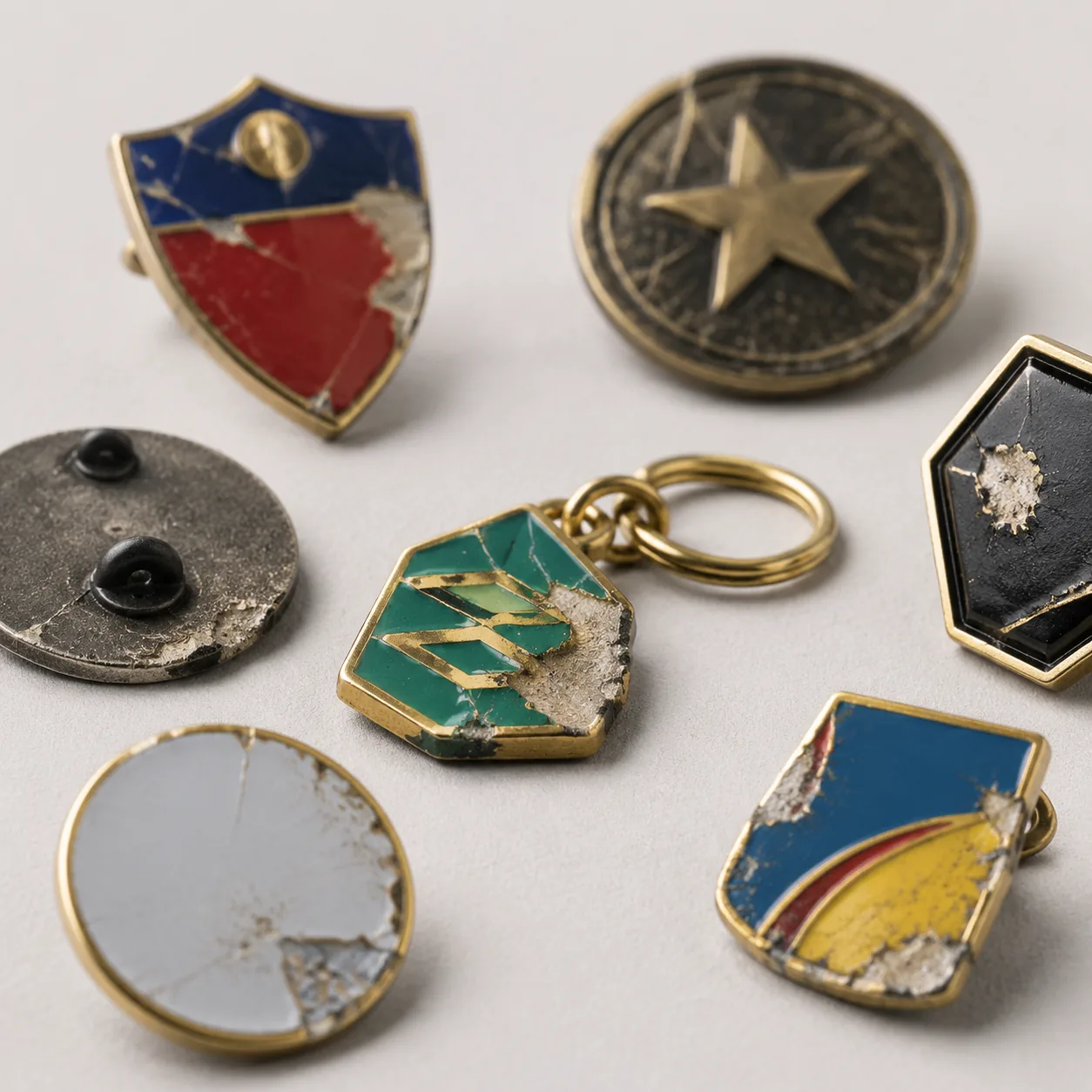
Choose a pin construction that survives a 50-300 piece run
At 50 to 300 pieces, the biggest cost driver is rarely raw metal weight. It is setup and handling: die tooling, mold prep, color-fill setup, polishing time, plating minimums, and packing labor. That is why two 35 mm pins with similar artwork can price 25% to 45% apart after factory review. Small cutouts, narrow bridges, extra posts, glitter fills, screen print passes, and retail packout all add labor that low-MOQ orders cannot spread over thousands of units.
For most small-batch programs, the safest starting specification is still straightforward: stamped iron for flat shapes or zinc alloy for irregular outlines, finished size 25 to 40 mm, one plating finish, one or two posts, and standard butterfly clutch. A stamped iron pin usually uses a 1.0 to 1.5 mm base thickness. Zinc alloy is more practical when the design has interior cutouts, compound curves, raised relief, or a thicker premium profile, typically 2.0 to 3.0 mm overall. If the art is mostly flat and geometric, stamped iron stays the lowest FOB-cost option.
True hard enamel is often specified when imitation hard enamel or soft enamel would be lower risk. True hard enamel gives a flush, polished face and good abrasion resistance, but it is less forgiving with text under about 0.8 mm height, metal borders under about 0.25 mm, or isolated color cells under about 0.30 mm wide. On a 100-piece run, that usually means more proof revisions, more polishing time, and higher rejection risk. For detailed logos, gradients, or fine lettering, offset print with epoxy dome is often more predictable than trying to force impossible metal separation into a hard-enamel build.
| Build option | Best use at low MOQ | Typical MOQ | Lead time after art approval | FOB unit price at 100 pcs | Main limitation |
|---|---|---|---|---|---|
| Stamped iron soft enamel | Event pins, staff pins, simple flat logos | 50 pcs | 10-14 calendar days | USD 0.55-1.15 | Very thin metal lines below about 0.25 mm may fill in or look uneven |
| Zinc alloy soft enamel | Cutout shapes, irregular outlines, thicker premium look | 50 pcs | 12-17 calendar days | USD 0.85-1.65 | Higher tooling and polishing cost than stamped iron |
| Imitation hard enamel | Retail-style flush surface without true hard enamel cost | 100 pcs | 14-18 calendar days | USD 0.95-1.95 | Requires tighter control on fill height, polishing, and face protection |
| Offset printed with epoxy dome | Gradients, photo art, QR codes, tiny text | 100 pcs | 8-12 calendar days | USD 0.65-1.35 | Less tactile metal definition; dome can scratch if packed face-to-face |
| Die-struck without color | Military-style, corporate award, classic antique finish | 50 pcs | 10-13 calendar days | USD 0.60-1.20 | Relies on relief detail; weak if artwork needs color separation |
Write RFQs around measurable cost drivers
A weak RFQ gets you five quotes for five different products. Phrases like about 1.5 inches, premium finish, or please advise force each supplier to make different assumptions. For custom pins, the RFQ should lock the exact finished size in mm, quantity per design, construction process, material, plating, attachment type, packout, and commercial term such as FOB Shenzhen or FOB Ningbo.
A usable line item is specific enough that a factory can quote without guessing: 32 mm W x 28 mm H, stamped iron, 1.2 mm thickness, soft enamel, bright nickel plating, two posts, butterfly clutches, individual OPP polybag, 200 pcs, FOB Shenzhen. If the art is detailed, include manufacturing thresholds in the RFQ rather than waiting for the artwork review: minimum metal line 0.25 mm, minimum enamel cell width 0.30 to 0.35 mm, minimum bridge between cutouts 1.2 mm, minimum text height 0.8 mm, and minimum backstamp stroke 0.15 mm.
Ask every supplier for the same cost breakout: tooling charge, unit price at 100, 200, and 300 pcs, pre-production sample fee, sample lead time, bulk lead time after approval, standard packout, optional packout adders, carton dimensions, gross weight, and HS code used for export. At low MOQ, those quantity tiers matter because fixed setup cost is still being absorbed. In 2026, a move from 100 to 200 pieces commonly drops unit FOB by USD 0.10 to 0.25. A move from 200 to 300 pieces often saves another USD 0.05 to 0.12. On a simple pin, 200 pieces is frequently the practical value point because you spread tooling and setup without tying up too much stock.
- Lock one exact finished size in mm, not an approximate inch size
- State quantity by SKU; different designs should be quoted separately unless tooling is truly shared
- Name the process and finish exactly, such as stamped iron soft enamel with black nickel plating
- Specify post count and clutch type; use two posts on wider pins to reduce rotation
- Request separate line items for tooling, sample fee, unit price, and packing adder
- Ask for manufacturability comments before you approve tooling or pay deposit
Qualify suppliers by process knowledge, not fast replies
The best low-MOQ supplier is usually the one that pushes back early. If the factory says 0.20 mm lettering will close up, a 0.9 mm bridge may warp during striking, or black nickel will darken navy enamel visually, that is useful engineering feedback. A supplier that says yes to everything before seeing the vector file is usually selling, not manufacturing.
Screen suppliers with questions that require real factory understanding. Ask what minimum metal line they recommend for your selected process, what enamel cell width they can fill consistently without overflow, whether posts are soldered before or after plating, what decorative plating thickness is standard, and what dimensional tolerance they hold on size and post location. Credible low-MOQ answers usually fall in a narrow band: finished size tolerance of +/-0.20 mm, base thickness tolerance of +/-0.10 to +/-0.15 mm, post location tolerance of +/-0.5 to +/-1.0 mm, and decorative nickel, gold, or black nickel thickness around 0.03 to 0.08 microns. Those are decorative finishes, not heavy functional plating.
Also ask how they inspect. For promotional pins, many competent suppliers inspect cosmetic defects to AQL 2.5 major and AQL 4.0 minor, usually under normal visual conditions rather than laboratory light booths. That is acceptable if the defect categories are defined up front. For example, missing enamel, obvious front-face plating stain, loose post, or wrong attachment is major; a faint back-side polish mark or slight tone variation is usually minor. If the supplier cannot describe defect standards in that level of detail, disputes later become subjective.
| Supplier screening point | What to ask | Credible low-MOQ answer | Red flag |
|---|---|---|---|
| Minimum detail | What metal line and fill width can you hold on this process? | About 0.25 mm metal line and 0.30-0.35 mm fill width, depending on art and process | Claims any detail is possible without file review |
| Tolerance | What size and thickness tolerance is standard? | Around +/-0.20 mm on size and +/-0.10 to 0.15 mm on thickness | Promises exact perfect dimensions with no tolerance |
| Plating | What decorative plating thickness is standard? | About 0.03-0.08 microns for bright nickel, gold tone, or black nickel | Cannot provide any numeric range |
| Inspection | What acceptance standard do you use? | AQL 2.5 major and AQL 4.0 minor with defined defect categories | No written inspection standard |
| Packing protection | How do you prevent face scuffing in transit? | Tissue interleaves, OPP sleeves, or tray packing for polished or domed faces | Says standard bulk bagging is fine for all finishes |
Use the artwork proof as a production drawing
The proof is not just a branding mockup. It is the last cheap chance to remove tooling risk. A production-ready proof should show finished width and height, outline, metal borders, color areas, cutouts, post locations, plating callout, backstamp area, and any dimensions the factory adjusted to make the design manufacturable. If the supplier sends only a polished rendering with no notes, it is not a real proof.
Ask the factory to mark exceptions directly on the drawing. Common ones include enlarging a cutout gap from 0.8 mm to 1.2 mm, thickening an unsupported bridge to 1.2 mm, simplifying tiny interior corners so they can survive polishing, or moving a backstamp to maintain at least 1.5 mm clearance from the outer edge. For two-post designs, confirm the post center-to-center distance in mm so the pin hangs level and resists rotation. On 40 mm and wider shapes, one post is often not enough unless the design is tall and narrow.
This is also where you decide whether to buy a pre-production sample. For a simple 30 to 35 mm stamped iron soft-enamel pin with one to three colors and no cutouts, some buyers skip the sample and go straight to bulk, saving roughly 5 to 7 calendar days and a sample fee that often runs USD 35 to 80 plus courier. That can be reasonable if all process-limit comments are closed in writing. If the build uses zinc alloy cutouts, imitation hard enamel, screen print, glitter, translucent enamel, or retail carding, a physical sample is usually worth the extra cycle because it is much cheaper than remaking a full lot.
Approve samples against pass-fail criteria
A sample should become the reference standard for bulk and for repeat orders. Approving it because it looks good on a phone photo is too vague. Check function first, dimensions second, then cosmetics under controlled light. Use calipers for width and height, and measure thickness if it matters to the brief. For a 35 mm pin, a size result within about +/-0.20 mm is generally acceptable; for a 1.5 mm stamped base, thickness variation of about +/-0.10 mm is common. Post position should match the proof closely enough that the pin hangs level and the clutch seats cleanly.
Then inspect the finish. On enamel builds, confirm the fill remains within the recessed cells, metal borders stay visible, and there are no obvious pinholes, voids, or spill visible at roughly 30 cm under neutral white light. On imitation hard enamel or epoxy-domed pins, inspect the face from several angles for dust, orange peel, or waviness. On plated metal, check the face, edge, and back because thin decorative coverage usually shows weakness first on sidewalls and rear surfaces. If the pin includes a backstamp, serial mark, or butterfly clutch with custom logo, verify legibility and position, not just presence.
Define pass-fail before approval. A practical standard for a 30 to 40 mm promotional pin is no exposed base metal on the front, no loose posts when pressed by hand, no plating blister, no sharp burrs that can cut skin, and no clutch failure after 5 to 10 open-close cycles. If the order includes backing cards, barcodes, vellum sleeves, or gift boxes, approve those parts in the same cycle. Factories often consider packout a separate workstream, which is exactly why packaging substitutions happen when buyers focus only on the pin itself.
- Measure width, height, thickness, and post spacing with calipers rather than by eye
- Check plating color on face, edges, and back under neutral white light
- Open and close each clutch 5 to 10 times to verify retention and fit
- Verify Pantone references against the approved art, allowing normal cured-enamel shift
- Photograph front, back, side profile, and final packout with date-stamped records
- Attach written pass-fail notes to the PO as the production reference
Issue the bulk PO with quantity, AQL, and packing controls
Once the sample is approved, the risk changes. The main question is no longer whether the pin can be made; it is whether the bulk lot will match the approved standard. The purchase order should restate the full approved build: material, process, finished size, thickness, plating, number of colors, attachment, post count, approved artwork revision, approved sample date, and exact packing method. Do not rely on a short item name to carry that information.
Lock quantity tolerance before deposit. Some factories default to +/-5% on custom metal goods, especially when order values are small. Others can hold exact count if it is stated in advance and the packout is simple. If the pins are for an event, kitting project, or retail launch, exact count is usually worth specifying. Also state the acceptance level, what happens if shipment exceeds agreed AQL, and whether the approved sample will remain on the production floor as the lot standard. Lead time should be stated in calendar days from final proof or sample approval, not vaguely from deposit receipt.
Packing needs more attention than most buyers give it. Individual OPP bagging is fine for many promotional orders, but backing cards, barcode labels, sleeves, gift boxes, and assortment packing quickly add manual labor. Those adders can move total landed cost more than a minor change in pin size. For courier or LCL export, many buyers keep master cartons below about 12 to 15 kg gross to limit crush risk and make handling easier. Mirror-polish, imitation hard enamel, and epoxy-domed faces usually need tissue separators, OPP sleeves, or tray packing to avoid face-to-face scuffing.
| Bulk-order checkpoint | Why it matters | Typical range or standard | When to push harder |
|---|---|---|---|
| Quantity tolerance | Prevents short shipment on fixed-count programs | Exact count or +/-5% by written agreement | Push for exact count on events, retail sets, and influencer kits |
| Inspection level | Defines acceptable defect rate before dispute | AQL 2.5 major, AQL 4.0 minor | Tighten only for premium resale or licensed programs |
| Bulk lead time | Protects launch timing and freight booking | 12-20 calendar days after final approval | Push only when artwork and sample are already stable |
| Plating spec | Reduces finish drift between sample and bulk | Decorative plating about 0.03-0.08 microns | Specify tighter control for darker finishes or long-use items |
| Packing method | Controls damage, labor cost, and freight cube | Polybag, backing card, sleeve, tray, or gift box | Add separators for polished, flush-finish, or domed pins |
Avoid the three most common post-payment failures
The first failure is silent substitution. The approved sample may have a tighter clutch, cleaner polybag, or brighter plating tone than the bulk run. Prevent that by listing the approved attachment, packout, and finish directly on the PO and by asking for pre-shipment photos from the actual lot that show front, back, side profile, and packed presentation. That is a light control step, but on small orders it catches many avoidable errors.
The second failure is compressing the schedule after delayed approvals. Buyers often spend 3 to 6 days revising art, then still demand the original ship date. On a low-margin 100-piece order, that pressure usually lands on plating, polishing, or packing time. The result is a higher chance of bent posts, color drift, plating stains, or incomplete accessories. If the approval date slips, reset the ship plan instead of forcing unrealistic recovery time into the factory schedule.
The third failure is skipping final verification because the order feels too small to inspect. A third-party inspection is usually excessive at 100 to 300 pieces, but a final in-house lot check is not. Ask for total packed quantity, carton count, and close-up photos against the approved sample. For event-critical programs, request a 100% count of attachment presence, obvious front-face defects, bent posts, and packout completeness before cartons are sealed.
The practical 2026 playbook is simple. Start with one manufacturable design version, quote it at 100, 200, and 300 pieces on an FOB basis, close all process-limit comments before tooling, review the proof like a production drawing, approve the sample against measurable criteria, and issue the PO with exact quantity, AQL, and packout controls. At low MOQ, ambiguity is what makes cheap pins expensive. A stable 200-piece run with clear specs is usually cheaper than a rushed 100-piece run followed by remake cost, expedited freight, and a corrective second order.
Have a project? Send your artwork and target quantity and we’ll reply with a detailed quotation within 12 working hours.
Ready to get this made?
Send your sketch, target quantity and ship-date. Detailed quotation in 12 hours.



