Small-MOQ Custom Pins in 2026: RFQ-to-Bulk Without Costly Rework
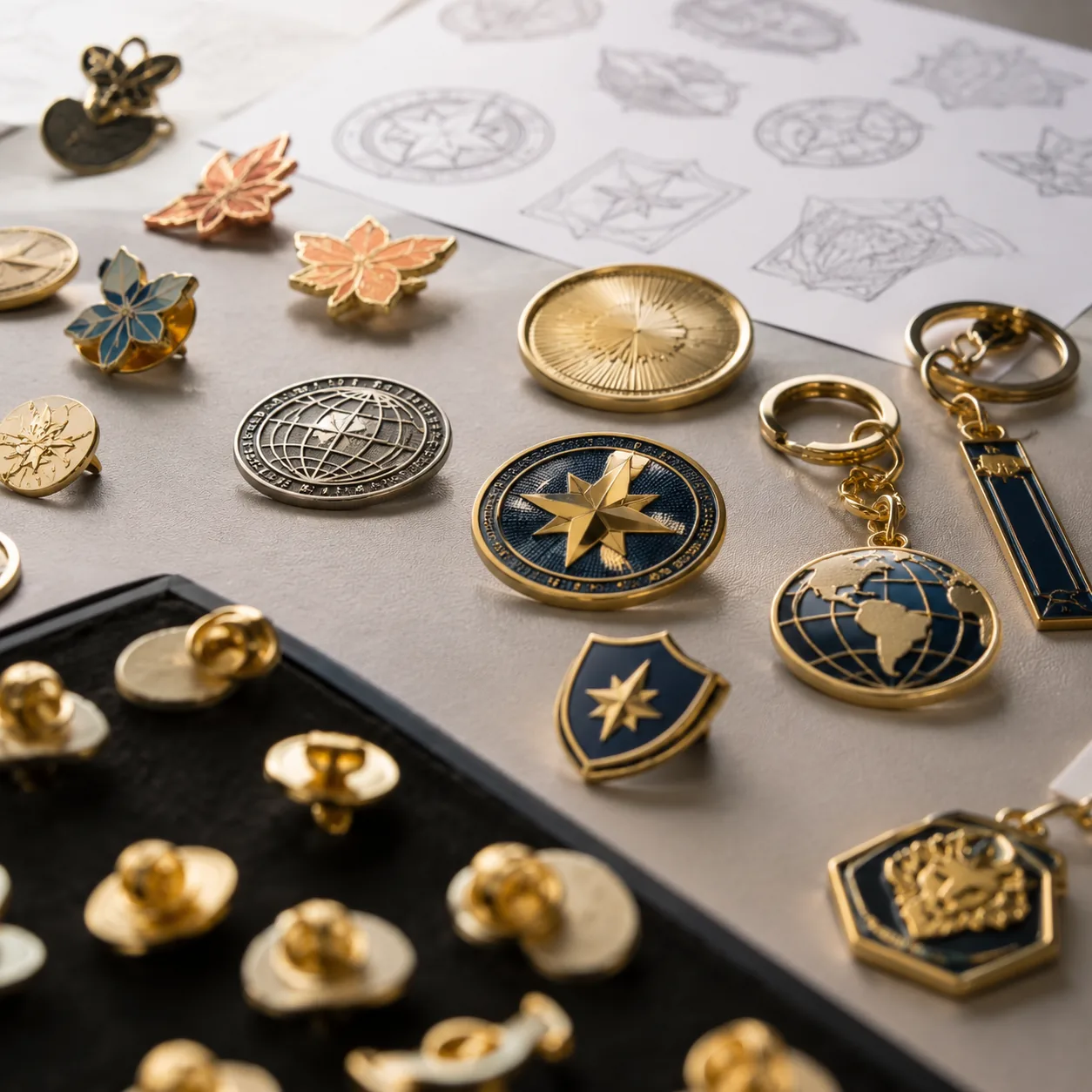
Start with the real cost driver: setup, not piece price
For 50 to 300 custom pins, the biggest cost risk is rarely the quoted unit rate. It is the fixed setup wrapped around the run: die tooling, plating setup, color filling, post soldering, polishing, hand carding, exact-count sorting and any sample revision that forces a second die polish or art adjustment. On a 100-piece order, an avoidable USD 40 to 70 in setup drift usually matters more than negotiating USD 0.06 off the unit price.
In 2026, most export-focused badge factories in China still accept low-volume orders, but they protect efficiency with MOQ tiers, mold fees and finish limits. For a standard 30 mm stamped iron soft enamel pin, 1.4 mm thick, 4 to 6 Pantone colors, one butterfly clutch and individual OPP bag, realistic FOB pricing is typically USD 1.45 to 2.20 at 50 pcs, USD 0.90 to 1.45 at 100 pcs, USD 0.70 to 1.12 at 200 pcs, and USD 0.58 to 0.96 at 300 pcs. Basic die tooling is usually USD 45 to 80. Designs with inner cutouts, multiple relief levels, long irregular outlines or openwork sections often run USD 90 to 150 for tooling.
That is why the first sourcing decision is not the lowest possible MOQ. It is whether the design stays inside a standard production lane. The lowest-risk combinations are usually 25 to 35 mm size, one plating finish, soft enamel or printed epoxy, one attachment style and simple bulk or polybag packing. Once the brief adds spinners, hinges, dual plating, magnet backs, custom gift boxes or mixed-SKU packs, the order behaves like a complex assembly program even if the quantity is only 100 pieces.
Write the RFQ so the factory can quote one process only
A good RFQ eliminates interpretation. "Premium custom pin with strong backing" invites requotes and silent substitutions. "30 mm stamped iron soft enamel pin, 1.4 mm thickness, black nickel plating, 5 Pantone colors, two 8 mm posts, black rubber clutches, individual OPP bag" is quoteable and comparable across suppliers.
For small-MOQ projects, standard technical windows are safer unless the brand has a hard requirement. A practical baseline is 20 to 38 mm overall size, 1.2 to 1.5 mm thickness for stamped iron or brass, and 1.8 to 2.5 mm for zinc alloy castings. Keep filled colors to 6 or fewer on a face under 35 mm if you want stable filling and fewer touch-up cycles. Use one post only for narrow pins up to about 25 mm wide; specify two posts for wider, horizontal or top-heavy designs to reduce rotation in wear. Post length is commonly 8 to 10 mm. If the pin is intended for bags, lanyards or repeated handling, rubber clutches or locking clutches usually outperform standard butterfly clutches.
- State the exact quantity tier: 50, 100, 200 or 300 pcs
- Specify base material: iron, brass or zinc alloy
- Define one process only: soft enamel, imitation hard enamel, printed epoxy or die-cast
- Call out plating exactly: shiny gold, shiny nickel, black nickel, antique brass or matte black
- Set longest side and thickness in millimeters
- Specify post count, post length and clutch type
- List packing separately: bulk, OPP bag, backing card or gift box
- Request split pricing for tooling, sample fee, unit price and packing adders
Artwork should be screened for manufacturability before RFQ release. For die-struck pins, raised metal lines should be at least 0.25 mm, with 0.30 to 0.35 mm preferred for stable enamel retention. Recessed enamel cells narrower than about 0.35 mm are prone to underfill or color bleed. Front-face text should generally stay above 1.2 mm cap height; for serif fonts, 1.5 mm is safer. Interior cutouts should usually be at least 1.0 mm across, and the bridge between cutouts should stay above 0.8 mm to reduce deformation during stamping, polishing or plating.
Choose the process that fits 50 to 300 pieces
The right process for a 100-piece run is the one that balances artwork fidelity, tooling cost and manual correction. Buyers often over-specify premium construction for launch tests or event giveaways where speed, approval certainty and cost control matter more than collector-grade build.
| Pin type | Best low-MOQ use case | Typical MOQ | Sample lead time | Bulk lead time | Typical FOB at 100 pcs |
|---|---|---|---|---|---|
| Stamped iron soft enamel | Simple logos, event pins, startup merch | 50 pcs | 5-7 days | 10-14 days | USD 0.90-1.35 |
| Stamped brass soft enamel | Fine outlines, smaller text, cleaner edges | 100 pcs | 6-8 days | 12-16 days | USD 1.05-1.60 |
| Zinc alloy soft enamel | Open cutouts, asymmetrical shapes, light 3D relief | 50 pcs | 7-10 days | 12-18 days | USD 1.15-1.80 |
| Imitation hard enamel | Smooth premium surface for gifting or resale | 100 pcs | 7-9 days | 14-18 days | USD 1.25-1.95 |
| Printed pin with epoxy | Gradients, faces, photo-like graphics, micro detail | 100 pcs | 4-6 days | 10-12 days | USD 0.85-1.35 |
Stamped iron soft enamel remains the best-value option for straightforward shapes because die cost is moderate and nearly every badge factory can run it. Brass costs more, but it strikes finer detail and cleaner edge definition, which matters when artwork includes thin borders, small lettering or narrow negative space. Zinc alloy is usually the better fit when the design needs open cutouts, irregular silhouettes, deeper relief or shapes that would weaken a stamped blank.
Imitation hard enamel is often chosen for a premium feel, but buyers should understand what they are paying for. The surface is polished flat so the enamel sits level with the metal lines, giving a smoother face than soft enamel. On small runs, however, the extra polishing and slower finishing add days and cost. If the design has only 2 to 4 flat colors and the pin is for gifting, museum retail or commemorative resale, the premium may be justified. For conference giveaways or pilot merchandise, soft enamel usually delivers better economics.
Printed pins with epoxy are often the best technical answer when enamel cannot render the artwork cleanly. If the design includes gradients, facial features, QR-like elements, tiny icons or text below what die-struck metal can hold, CMYK or spot-color print under epoxy usually reduces sample loops and preserves artwork fidelity. The tradeoff is wear resistance: epoxy domes are typically about 0.6 to 1.0 mm thick and can scratch under zipper abrasion or repeated bag contact, so they are better for promotions and event distribution than for long-term collectible use.
Approve samples against measurable tolerances
Sample approval should be tied to measurable criteria, not general appearance. For a 30 mm pin, a workable tolerance set is overall size ±0.20 mm, stamped thickness ±0.10 mm, cast thickness ±0.15 mm, post placement ±0.50 mm, and backing-card hole alignment ±1.0 mm. Flatness matters too: visible warp should stay within about 0.5 mm across the longest side for standard pins. Posts should be perpendicular, solder joints should show no cracking or lift, and clutches should seat firmly without loosening under normal hand pull.
Color needs a realistic approval rule. On low-MOQ soft enamel runs, Pantone control is usually visual rather than spectrophotometer-based. A practical standard is a commercial visual match under 5000K to 6500K neutral light at normal viewing distance. If brand color is critical, ask whether the supplier uses pre-mixed enamel or manual batch mixing and require approval photos next to the Pantone chip or printed reference. Dark platings such as black nickel can visually deepen adjacent colors, especially in small fill areas below 2 mm wide.
Plating should be checked for suitability, not just shine. Decorative custom-pin finishes are typically thin, often around 0.03 to 0.08 microns for gold-tone or nickel-tone appearance layers over the standard base plating stack. That is adequate for gifting, display and ordinary wear, but not for salt exposure, constant zipper abrasion or outdoor use in humid conditions. If the pin is intended for resale and frequent wear, ask whether the factory can add a clear protective topcoat, use antique plating to mask friction marks, or place wear-prone areas in recessed rather than raised surfaces.
Negotiate the line items that actually move margin
On a 100-piece order, the biggest savings usually come from setup, sample policy and packing, not from pushing for a few cents off the piece price. Reducing a mold fee from USD 90 to USD 60 or removing a rigid gift box often saves more than cutting USD 0.05 from each pin. The highest-value negotiation points are tooling, sample credit, packing labor, exact-count charges, overrun or underrun policy and any assembly surcharge for cards, sets or mixed backings.
Ask whether the sample fee is credited against bulk. Many suppliers credit 50 to 100 percent of the sample charge if the approved sample goes directly into mass production with no art change and the same die. Also confirm whether the quote includes one pre-production sample, standard export carton packing, normal production overage and replacement for factory rejects. These terms matter more on a 100-piece order than on a 10,000-piece order because there is less volume to absorb hidden costs.
Packing is where low-MOQ budgets often drift. Bulk pack is usually included or nearly free. Individual OPP bags typically add USD 0.03 to 0.06 per piece. A printed backing card with hand mounting usually adds USD 0.08 to 0.20 per piece depending on card size, paper weight, lamination and whether one or two posts must be aligned. Simple folding paper boxes often add USD 0.18 to 0.40 per set, while rigid gift boxes with EVA or foam insert can add USD 0.40 to 1.20 FOB. On a 100-piece run, packaging can easily cost more than the pin if presentation is overbuilt.
Use a lean QC plan with AQL and defect definitions
A 100-piece order does not need a full audit program, but it does need an acceptance method that both sides understand. For decorative pins, a practical final inspection standard is AQL 2.5 for major defects and AQL 4.0 for minor defects, with 100 percent quantity verification and in-line visual screening during packing. On a lot of 100 pieces, that effectively means very little room for true major defects, so the defect definitions must be explicit before production starts.
Major defects include wrong shape, wrong plating finish, missing enamel, detached clutch, loose post, exposed sharp burr on the front edge, obvious contamination under epoxy, incorrect backing card, or size outside tolerance. Minor defects include backside polishing marks, tiny front specks not visible at normal viewing distance, slight tone variation within accepted visual range, or small scratches on the back that do not affect wear.
- Approve the first article before bulk polishing, plating release or packing
- Check the perimeter for burrs, sharp points and exposed base metal
- Verify post count, spacing and clutch fit on sampled units
- Inspect plating and enamel under 5000K-6500K neutral white light
- Confirm color count, metal lines and fill boundaries against approved vector art
- Reconcile quantity by inner bag, carded set and master carton label
It is also worth asking how the factory segregates a small order during plating and packing. Low-volume jobs are more vulnerable to mixed clutches, finish confusion and count errors when they run beside larger batches. A factory that uses tray labels, work-order tags and final count reconciliation is usually safer than the cheapest quote with weak floor control. If the pins are carded, request packed-carton photos showing SKU label, packed count and carton marks before shipment release.
Build the schedule around queue time, not just production days
Small orders are not automatically faster than large ones. A 100-piece job often waits for the same die shop, plating bath, color-filling bench and packing line as a 5,000-piece job. Lead time depends more on queue position, process complexity, artwork clarity and approval speed than on unit count alone.
For a straightforward low-MOQ pin in 2026, a realistic schedule is 2 to 4 days for artwork cleanup and mold confirmation, 5 to 8 days for pre-production sample, and 10 to 15 days for bulk after sample approval. Zinc alloy castings, imitation hard enamel, custom backing cards, mixed finishes or multiple SKUs in one booking commonly push bulk lead time to 14 to 18 days. Add another 2 to 4 days for exact assortment packing, card insertion, barcode labeling or gift-box assembly.
International buyers should separate factory lead time from in-hands lead time. After production, payment release, carton consolidation, export booking and destination customs can add another 7 to 12 days for air cargo or 25 to 40 days for ocean shipment, depending on lane and consolidation model. If the order supports a conference, retail drop or campaign launch, assume at least one sample correction loop unless the artwork is extremely simple. The cheapest way to protect the deadline is usually not premium freight. It is getting the RFQ, art file and approval criteria right on the first pass.
Follow the lowest-risk path from RFQ to bulk
For a first run, keep the program to one manufacturable SKU unless an assortment is commercially necessary. A single 30 to 35 mm design, one finish, one clutch type and simple individual packing is the cleanest path through tooling, sample approval and final QC. Leave dual plating, spinners, hinge parts, magnetic sets and premium gift presentation for the reorder once demand is proven and the factory already knows the design.
Send a disciplined RFQ pack: vector artwork in AI or editable PDF, target size in millimeters, thickness, Pantone references, base material, finish, post count, clutch type, packing method, quantity tier and required ship date. Ask every supplier to respond in the same format for tooling, sample fee, sample lead time, bulk unit price, bulk lead time and packing adders. That makes quote comparison faster and exposes where one factory is hiding cost in setup or assembly.
Before releasing bulk, confirm exactly what must be approved: front and back sample photos, caliper measurement of the longest side, thickness check, plating finish, post placement, clutch type, backstamp if any and final packing method. On small-MOQ pins, disciplined process choice and measurable approval criteria usually save more money than aggressive unit-price negotiation. When geometry, finish and packaging stay inside a standard factory lane, 50 to 300 custom pins can move from RFQ to bulk with predictable cost, controlled reject risk and far less rework.
Have a project? Send your artwork and target quantity and we’ll reply with a detailed quotation within 12 working hours.
Ready to get this made?
Send your sketch, target quantity and ship-date. Detailed quotation in 12 hours.



