Small-MOQ Custom Pins in 2026: RFQ-to-Bulk Buying Plan
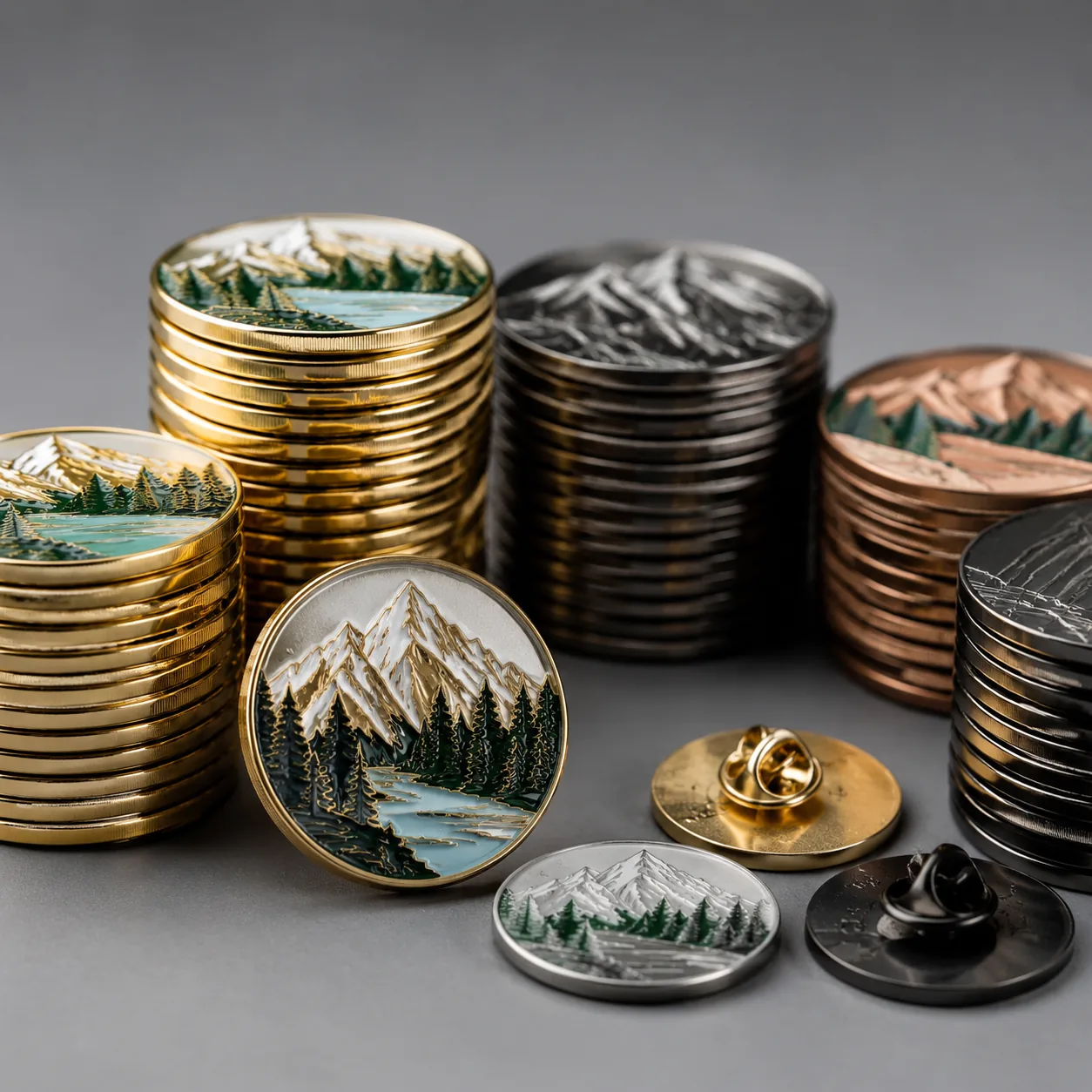
Why 50-300 piece custom pin orders fail before production starts
Most low-volume custom pin orders go wrong before stamping, casting or plating begins. The common cause is not factory capacity; it is mismatch between what the buyer intends and what the supplier has priced. One supplier may quote a 30 mm stamped iron soft enamel pin at 1.2 mm thickness with one butterfly clutch, while another assumes zinc alloy at 2.0 mm with epoxy and two posts. Unit prices then look comparable on paper, but they are not pricing the same product.
Small runs are especially sensitive because fixed costs dominate. On a 100-piece order, tooling, setup, proofing, sample freight and packaging can easily represent 30% to 60% of landed cost. A single avoidable remake can add more cost per piece than it would on a 1,000-piece run. The pin also carries more design risk than many adjacent merch items because line width, enamel cell size, post placement, plating finish and backing-card assembly all affect manufacturability.
The lowest-risk buying sequence is simple: quote only manufacturable builds, lock one final proof or pre-production sample, and release bulk production against that frozen standard. In 2026, many factories accept 50-piece custom pin MOQs, but they still price around setup efficiency and scrap risk. Buyers who control variables early usually get better pricing and fewer surprises than buyers who negotiate only on nominal unit cost.
Step 1: Build an RFQ that removes guesswork
A usable RFQ must define the physical build, the commercial terms and the process limits. If size, thickness, base metal, plating, attachment, packaging or Incoterm is left open, suppliers will fill the gap with their own assumptions. That creates false quote comparisons and almost guarantees change charges later.
For custom pins, specify at minimum: finished size in mm; whether the dimension refers to width, height or longest side; thickness in mm; process; base metal; plating finish; number of enamel colors; attachment type; packaging; order quantity; target ship date; ship-to country; and quotation basis such as EXW, FOB or DDP. For most 50-300 piece orders, a practical baseline build is 25-35 mm, 1.2-1.5 mm thick, stamped iron soft enamel, bright gold or black nickel plating, one butterfly clutch, and individual OPP bag packing.
Include design-for-manufacture limits in the RFQ rather than waiting for the proof stage. For stamped soft enamel, practical working limits are: minimum raised metal line width 0.25-0.30 mm; minimum recessed enamel area 0.50-0.60 mm; minimum text height about 1.2 mm for simple sans-serif lettering; and minimum distance from post center to outer edge 5-7 mm. For hard enamel, keep minimum metal lines at 0.30 mm or wider and avoid many micro-cells, because the fired enamel is polished flush and narrow separators are more likely to wash out. Internal cutouts below 1.0 mm, unsupported sharp points and long thin projections should be flagged early because they raise reject rates and deformation risk.
- Send vector artwork in AI, PDF or SVG, plus a color-reference PNG
- State Pantone references only where exact brand match matters; otherwise allow visual match within normal production variation
- Specify the back clearly: blank, sandblast texture, backstamp, copyright line, laser serial or logo
- Ask the supplier to break out proof time, sample time and mass-production time in calendar days
- Require any artwork simplification or line-thickening to be marked directly on the proof
- Declare packaging at RFQ stage: backing card, barcode label, insertion method, retail box or carton mark requirement
Request tooling as a separate line item. In 2026, tooling for a simple 25-35 mm stamped pin is commonly USD 35-80. Zinc alloy molds and multi-level designs are more often USD 60-120, and moving-part builds such as spinners or danglers can exceed USD 120. Separating tooling from unit price makes low-MOQ quote comparisons much more accurate.
Step 2: Choose the process and metal that fit low-MOQ economics
For 50-300 piece orders, the best build is usually the one that holds visual quality without creating unnecessary setup, polishing or scrap. Stamped iron soft enamel remains the default low-MOQ choice because tooling is relatively simple, factory familiarity is high and color filling is predictable. It is usually the best option for logos, mascots and commemorative designs up to about 40 mm.
Hard enamel gives a flatter, more premium surface, but the process is less forgiving. It works best on simpler graphics with strong shape separation. Very small color cells, dense micro text and narrow channels increase polishing risk and can push reject rates up. Brass is common for hard enamel and die-struck premium pieces because it stamps cleanly and plates well, but it costs more than iron and is often unnecessary for a basic promo run.
Zinc alloy is usually the better choice when the outline is irregular, relief is deeper, the profile exceeds about 2.0 mm, or the design uses larger cutouts and sculpted contours. Offset printing with epoxy is the fallback when artwork contains gradients, photo-like shading, QR elements or text too small to hold as metal lines. It is often a better commercial choice than forcing unmanufacturable detail into soft or hard enamel.
| Build option | Best low-MOQ use | Typical MOQ | Tooling / setup | Mass production lead time | Indicative FOB unit price |
|---|---|---|---|---|---|
| Stamped iron soft enamel | Standard logo or mascot pins, 20-40 mm, 1.2-1.5 mm thick | 50 pcs | USD 35-80 | 8-12 days after proof approval | USD 0.55-1.20 at 100 pcs; USD 0.42-0.95 at 300 pcs |
| Stamped brass hard enamel | Premium corporate, commemorative or resale pins with cleaner color blocking | 100 pcs | USD 50-90 | 12-18 days after proof approval | USD 1.20-2.60 at 100 pcs; USD 0.95-2.10 at 300 pcs |
| Zinc alloy soft enamel | Irregular outlines, cutouts, thicker profile, 3D relief | 50 pcs | USD 60-120 | 10-15 days after proof approval | USD 0.75-1.70 at 100 pcs; USD 0.62-1.40 at 300 pcs |
| Offset printed with epoxy dome | Gradients, tiny text, photo-like artwork, map details or QR-based graphics | 50 pcs | USD 30-60 | 7-10 days after proof approval | USD 0.50-1.05 at 100 pcs; USD 0.40-0.82 at 300 pcs |
| Die-struck no color | Classic badges, understated metal finish, lower color complexity | 50 pcs | USD 35-75 | 8-12 days after proof approval | USD 0.60-1.35 at 100 pcs; USD 0.48-1.05 at 300 pcs |
These ranges assume standard plating, one standard clutch and individual polybag packing, quoted FOB China. Common 2026 adders are: second post USD 0.05-0.12 per piece; rubber clutch instead of butterfly USD 0.02-0.05; locking clutch USD 0.18-0.45; epoxy dome USD 0.05-0.12; glitter or glow enamel USD 0.04-0.15 per affected color area; printed backing card USD 0.06-0.25 depending on gsm and print coverage; and retail box packing USD 0.25-0.80 per piece.
MOQ tiering matters more than many buyers expect. A 50-piece order is often 20% to 45% higher per unit than the same build at 100 pieces, because setup and tooling are spread over fewer units. If the event can absorb extras, moving from 80 units to 100 is often more economical than pushing for a few cents off the quote.
Step 3: Use the proof to lock DFM, plating and hardware
A digital proof is not just artwork approval; it is the factory’s production translation. This is where line widths are adjusted, tiny cutouts are removed, post locations are fixed, back details are positioned and packaging assumptions become explicit. If those changes are approved informally and never copied into the PO or invoice, the project is exposed to rework and dispute later.
Review the proof against measurable checkpoints: final size; border thickness; minimum line width; number of colors; fill boundaries; cutouts; post count and location; backstamp or laser-mark position; approved finish; and exact packaging method. For pins wider than 30 mm or taller than 25 mm, two posts are usually more stable than one, particularly on bags, jackets and caps where rotation is visible. As a rule, keep post centers at least 5-7 mm from the edge and leave at least 12 mm between two posts for good stability.
Treat plating as a design variable, not an afterthought. Bright gold, bright nickel and bright silver generally give the highest visual contrast on fine edges. Black nickel and antique finishes look premium but can reduce separation on dark fills and small details. If transparent enamel is specified, confirm whether the recessed metal beneath it is polished smooth or sandblasted, because texture materially changes the final color depth and reflectivity.
Where detail is critical, note front-side tolerances on the proof. Typical commercial tolerances for custom pins are +/-0.30 mm on overall size, +/-0.15 mm on thickness for stamped parts, and modest post-location shift on the back so long as the front appearance is unaffected. If the design relies on exact symmetry, centered post alignment or controlled border thickness, say so before approving the sample. A 30 mm pin with 0.20 mm lines, several micro cutouts and multiple blocks of tiny text may be technically drawable, but it is usually a weak production design. Simplifying to lines above 0.25 mm and reducing micro features almost always improves readability and yield.
Step 4: Decide when a physical sample is worth the delay
Not every small-MOQ order needs a shipped pre-production sample. If the build is straightforward, the process is standard and the factory can provide a clear vector proof plus in-line photos, skipping a physical sample can save both money and 3-6 days. That is often reasonable for a basic 25-30 mm soft enamel logo pin with standard plating and simple OPP packing.
A physical sample is usually worth the delay when any of the following apply: strict brand colors; hard enamel; fine text close to process limits; transparent or specialty enamel; antique or unusual plating; custom backing cards; committee-based approvals; or an end customer likely to reject visible variation. Typical sample charges in 2026 are tooling plus a setup premium, usually USD 35-90 for simple builds and USD 90-180 for more complex multi-part, spinner, dangler or specialty-finish designs. Courier commonly adds USD 25-45, with 2-4 transit days on major lanes.
When checking a sample, inspect more than the front face. Verify plating consistency, enamel fill level, edge smoothness, epoxy clarity if used, post solder strength, clutch fit, backstamp legibility and actual assembly to the backing card. Standard hand-finished variation is normal; major production defects are not. Reject criteria should include exposed base metal in filled areas, burrs that catch skin, loose posts, obvious plating skips, dust under epoxy, cracked domes or clutches that do not grip reliably.
If you need a formal acceptance basis, use practical accessory standards rather than over-engineered requirements. AQL 2.5 for major defects and 4.0 for minor defects is common for custom metal accessories. For printed backing cards, registration within +/-0.5 mm, correct mounting orientation, clean die-cut edges and no scuffing on the sales face are reasonable expectations on short runs.
Step 5: Freeze the bulk order in writing before deposit
After proof or sample approval, the next failure point is specification drift. A PO that says only "custom pin, gold plating, 100 pcs" still leaves too much room for substitution. On a small run, an unapproved change from iron to zinc alloy, bright gold to antique gold, or one post to two posts can materially change appearance, feel and delivery timing.
The final PO or proforma invoice should freeze the build in measurable terms: final size; thickness; process; base metal; plating finish; Pantone references if required; number and type of attachments; approved artwork revision; back details; packaging method; sample or final proof approval date; and Incoterm. If a backing card is part of the sale unit, specify card size, paper stock, print sides, finish, hole style if retail-hung, whether the pin must be mounted before bagging, and master-carton quantity.
- Reference the final artwork filename and revision date on both PO and invoice
- State the base metal explicitly: iron, brass or zinc alloy
- Specify plating as bright, matte, satin or antique, not only the color family
- Confirm post quantity, post placement if critical, and clutch type
- Lock the unit packing sequence: mounted to card, then OPP bag, then inner pack if required
- Require written approval before any substitution in material, process, finish, hardware or packaging
If the project also includes matching keychains, magnets, patches or lanyards, using one coordinated supplier can reduce proof mismatch and packaging drift. The benefit is usually operational rather than purely price-based, but on a short-run launch that coordination often matters more than a small unit-price difference.
Step 6: Schedule by production gates, not by one quoted lead time
A quoted "12-day lead time" is not enough to manage a low-volume order. You need to know when the clock starts and what it excludes. Delays often happen outside the factory floor: RFQ clarification, proof revisions, deposit receipt, sample transit, card approval, barcode confirmation or export-document review. Buyers often lose a week here and then assume the factory missed schedule.
For a typical 100-300 piece order, a realistic calendar is: 1-2 days for quotation and DFM feedback; 1-3 days for proof revisions; 2-5 days for sample making if a physical sample is required; 8-15 days for mass production depending on process; and 3-7 days for air freight. Express courier can reduce transit to 2-4 days on major lanes, while economy courier often extends it to 5-8. Sea freight is usually uneconomical at this order value unless the pins are consolidating into a larger shipment.
Packaging can add more time than buyers expect. A plain OPP bag usually adds little or no extra production time, but custom backing cards, fold-over inserts, barcode labels or retail boxes can add 2-6 days if files are not approved in parallel. If the card is essential to the sales unit, route it through approval at the same time as the metal proof rather than after sample acceptance.
Peak periods still matter even on small runs. Before trade shows, graduation seasons and year-end gifting, add at least 3-5 buffer days beyond nominal production. Rush service is possible, but compressed plating, curing and inspection windows tend to increase cosmetic variation, especially on dark platings, transparent colors and printed pins with epoxy. If the event date is fixed, simplifying finish or packaging is usually safer than forcing a premium build through an unrealistic calendar.
Step 7: Inspect for the defects that actually matter on low-volume orders
Inspection on a 100-piece order does not need enterprise-level complexity, but it does need discipline. The failures that matter most are count shortages, wrong finish, weak hardware, visible front-side defects and packing errors. Those are the issues that create event-day complaints and expensive recovery.
Before shipment, ask for bulk photos showing front, back, side profile, clutch type, card assembly and outer carton marks. On receipt, inspect enough pieces to detect a systemic issue. For a 100-piece lot, checking around 13-20 units across different inner packs is usually a practical incoming inspection sample. Focus on plating consistency, clutch grip, post alignment, edge smoothness, color contamination, card insertion, barcode accuracy if applicable and count.
For standard stamped pins, slight variation in hand-filled enamel, small polish marks on the back and modest tone shift within the same plating family can be commercially acceptable. Bent posts, missing clutches, incorrect plating, major color bleed, exposed base metal in enamel areas, cracked epoxy, severe burrs and mixed packaging are not. If event timing makes replacement difficult, ask whether the factory can provide a 3% to 5% overrun at the same unit rate or with only packaging cost added. On a 100-piece order, three to five spare units are often more valuable than another USD 0.03 off the quote.
The buying principle is consistent across all small-MOQ custom pins: reduce variables before RFQ, approve one manufacturable standard, and copy that exact standard into the order documents. On low-volume pin projects, the cleanest specification usually outperforms the cheapest quote.
Have a project? Send your artwork and target quantity and we’ll reply with a detailed quotation within 12 working hours.
Ready to get this made?
Send your sketch, target quantity and ship-date. Detailed quotation in 12 hours.



