Small-MOQ Custom Pins in 2026: A Step-by-Step Buying Plan
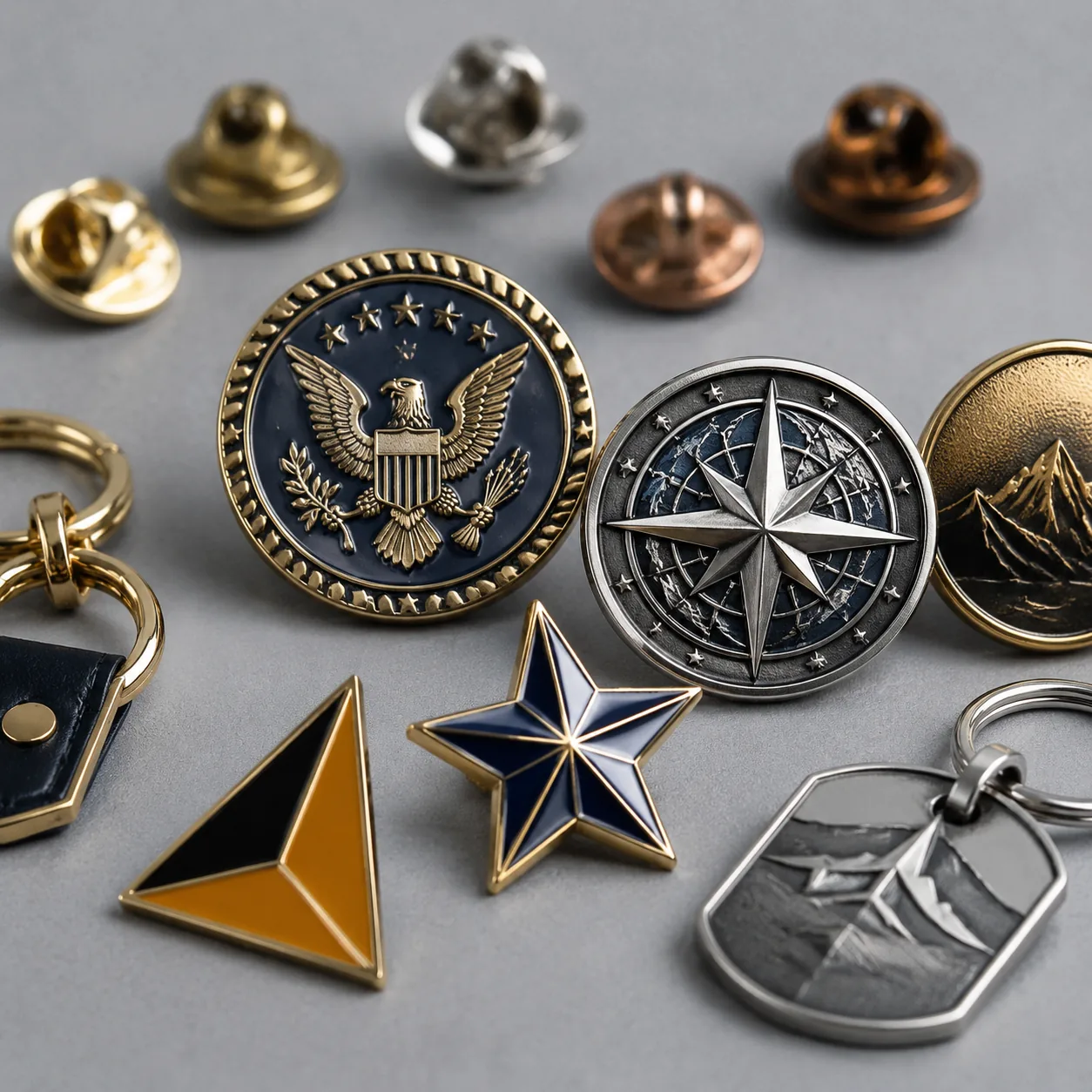
Why 50-300 piece custom pin orders fail
Small custom pin orders usually fail at the specification stage, not the artwork stage. On a 100-piece run, one wrong plating callout, one mislocated post, or one unreadable text area can affect the entire batch because there is no volume buffer. A defect rate that looks minor on a 2,000-piece promo run becomes commercially unacceptable when 8 bad pieces out of 100 means 8% of the order is compromised.
That is why the main objective on a 50-300 piece order is predictability, not the lowest nominal unit price. Buyers need fixed tooling scope, a manufacturable design, explicit tolerances, clear sample gates, and a realistic calendar in days. In 2026, the most workable quantity bands remain 50, 100, 200, and 300 pieces per design. Below 50 pieces, die setup, plating setup, and hand-finishing labor often make a new-tool stamped pin poor value unless an existing die is being reused.
The most common small-order scenarios are practical ones: a distributor validating a client concept, an event team splitting budget across several SKUs, an HR team launching a recognition series, or a brand testing one design before carrying inventory. In each case, the mistake is the same: treating a 100-piece order as too small to justify technical control. In reality, smaller runs need tighter control because any variation is immediately visible in both quality and cost.
Build an RFQ that is quote-ready on first pass
Incomplete RFQs are the biggest reason small pin orders get re-quoted, delayed, or shipped with preventable defects. If the supplier must guess the finished size, body thickness, base metal, plating, enamel type, attachment, backing card, barcode zone, or packing method, the quote will either include a risk premium or leave out items that later become change charges. On a small order, those corrections hit hard because setup cost is already a large percentage of the total.
A good RFQ should read like a production note, not a design brief. Example: 32 x 28 mm finished size; 1.5 mm stamped iron; soft enamel; bright nickel plating; 5 Pantone Solid Coated colours; 1 soldered post with butterfly clutch; backing card 90 x 55 mm on 350 gsm C1S board, 4C/0C; pin mounted centered on card; each set packed in 0.03 mm OPP bag; 100 pcs; FOB Ningbo. With that level of detail, competing suppliers are quoting the same build instead of pricing different assumptions.
Use tolerances only where they affect function or appearance. Good starting points for a small pin program are finished size tolerance +/-0.20 mm, body thickness +/-0.10 to 0.15 mm, post position +/-0.50 mm, card die-cut tolerance +/-0.50 mm, and print registration on the backing card within +/-1.00 mm. For artwork, recessed metal lines should generally be at least 0.25-0.30 mm wide, with minimum spacing of 0.20 mm between lines. Positive text that must remain legible at final size is usually safer at 4.5-5 pt equivalent or above. If the design falls below those limits, decide at RFQ stage whether stamping, etching, offset print, or screen print is the better route.
- Request quantity breaks at 50, 100, 200, and 300 pcs per design
- Send vector artwork in AI, EPS, or editable PDF, plus Pantone references
- State whether tooling is new, reused, or a revision of an existing die
- Specify Incoterm and port: FOB Ningbo, FOB Shenzhen, EXW, or DDP if required
- Ask suppliers to separate tooling, unit price, packaging adders, and freight basis
- Give the schedule in calendar days with a must-ship date
- State inspection level, such as AQL 2.5 major / 4.0 minor, and define zero-tolerance defects
- Mark critical cosmetic zones: front face, logo area, edge facing customer, and retail window side
Select the pin construction that is stable at low volume
The process that looks best in a catalog is not always the process that produces the most consistent result at 100 pieces. Small runs become expensive when the design depends on deep undercuts, multiple cutouts, very thick bodies, transparent fills over texture, or multiple hardware components that add handling steps. The right question is not what looks most premium in theory, but what process gives stable output at this quantity with the fewest failure points.
For most 50-300 piece orders, stamped iron soft enamel remains the best-value construction. It works well for standard event pins, promotional badges, and concept tests when recessed lines are at least 0.30 mm and body thickness is around 1.2-1.5 mm. Brass costs more but usually gives a cleaner strike, sharper borders, and a brighter polish, so it is often worth the premium for resale-grade or corporate gift programs.
Die-struck no-colour pins are still one of the safest small-order options. Because there is no enamel fill, there is no underfill, overflow, or colour contamination risk. Antique nickel, antique bronze, and antique copper finishes highlight relief well and suit club pins, service awards, and uniform badges. If the design relies on relief detail instead of colour blocks, die-struck metal is often more robust than a low-volume enamel build.
Zinc alloy die-cast is generally the better route when the profile is irregular, the body is thick, or the design has larger openwork sections. A cast body in the 2.0-3.0 mm range is common, and cutouts that would distort in stamping are easier to produce in casting. The tradeoff is edge definition: cast edges are usually less crisp than a well-struck brass pin, so choose casting for geometry, not because it seems more flexible in general.
Hard enamel is frequently overspecified on small orders. It gives a smooth face, but the polishing stage can soften tiny ridges and reduce clarity in small lettering. For promo and event use, soft enamel with or without epoxy is usually more economical and more forgiving. Epoxy improves scratch and chip resistance, but it creates a rounded top surface and can slightly mute exposed metal borders. If the target look is flatter and jewelry-like, imitation hard enamel or a clean no-epoxy soft enamel finish may be a better fit than true hard enamel on a very small run.
| Build option | Best use at 50-300 pcs | Typical MOQ | Bulk lead time after proof approval | FOB unit range at 100 pcs | Common tooling range | Technical notes |
|---|---|---|---|---|---|---|
| Stamped iron soft enamel | Events, promos, concept tests | 50 pcs | 10-14 days | USD 0.55-1.30 | USD 35-80 | Best value; recessed lines >=0.30 mm; standard body 1.2-1.5 mm |
| Stamped brass soft enamel or imitation hard enamel | Corporate gifts, resale-grade finish | 100 pcs | 12-18 days | USD 0.95-2.10 | USD 50-100 | Cleaner strike and brighter polish; stronger option for fine borders |
| Die-struck metal, no colour | Recognition pins, clubs, uniforms | 50 pcs | 10-14 days | USD 0.65-1.50 | USD 35-75 | No fill risk; antique finishes show relief well |
| Zinc alloy die-cast | Openwork, thicker profile, irregular outline | 100 pcs | 12-16 days | USD 0.85-1.95 | USD 45-90 | Suited to 2.0-3.0 mm bodies and larger cutouts |
| Soft enamel + epoxy dome | Giveaways needing added surface protection | 100 pcs | 11-15 days | USD 0.70-1.50 | USD 35-80 | Epoxy improves scratch resistance but rounds the face |
Read the quote correctly: MOQ tiers, tooling, plating, and cost logic
Small-order economics are driven more by setup cost than by metal weight. On many pin projects, the total spend difference between 50 and 100 pieces is much smaller than buyers expect. A 50-piece run may be only 20-35% cheaper in total than a 100-piece run, while the unit price can be 35-60% higher. If there is any realistic chance of reordering within 3-6 months, 100 pieces is often the stronger buy.
Ask every supplier to quote four lines separately: tooling, unit price, packaging adders, and freight basis. For a standard 25-35 mm stamped pin, new tooling commonly runs USD 35-80 for iron and USD 50-100 for brass. Cast tooling for irregular shapes is often USD 45-90, but more if there are multiple cutouts or a dangler assembly. A die revision is not automatically free; if outline, openwork, or internal relief changes, revision cost can still be USD 20-50.
Plating must be written explicitly because decorative promo plating is not the same as heavy functional coating. Bright nickel, black nickel, imitation gold, and imitation rose gold on small custom pins are typically decorative finishes, often around 0.03-0.08 microns depending on substrate and process. That is usually acceptable for indoor promotional use, but it is not jewelry-grade wear resistance. If the product will face repeated handling, humid storage, or retail shelf time, ask whether the supplier applies a clear protective topcoat and what tarnish behavior they have observed on similar work.
Use a simple benchmark to pressure-test pricing. A 32 mm stamped iron soft enamel pin with 1 post, bright nickel, 5 colours, 350 gsm card, and OPP bag may quote around USD 1.02-1.15 at 50 pcs, USD 0.74-0.88 at 100 pcs, USD 0.60-0.70 at 200 pcs, and USD 0.54-0.62 at 300 pcs FOB, plus roughly USD 45 tooling. That means product spend might be about USD 54 at 50 pcs versus USD 81 at 100 pcs. In other words, adding 50 more pieces raises spend modestly but often cuts the effective landed cost per usable pin enough to justify the larger order.
Treat the proof as an engineering document, not a picture
Most avoidable errors are still cheap during proof review and expensive after die making starts. The proof should therefore function as a production document. At minimum it should show finished dimensions in mm, body thickness, plating finish, Pantone references, colour count, attachment type, post quantity, post spacing, backing card size, print orientation, barcode placement if any, and packing method. If those fields are missing, the proof is incomplete.
Attachment layout deserves more scrutiny than many buyers give it. A single post on a pin wider than about 30 mm often allows rotation during wear. On a 35-40 mm horizontal badge, two posts spaced about 18-24 mm center-to-center usually improve stability. For magnets, confirm the magnet diameter or bar size, thickness, and whether the magnetic backing will be packed separately to avoid scratching the plated face. For deluxe clutches, brooch bars, or safety-pin hardware, ask that visible hardware finish match the front plating as closely as possible.
This is also the point to redline non-manufacturable details. Tiny enclosed colour cells may underfill. Long narrow cutouts may distort or retain plating solution. Transparent fills over textured metal can vary from piece to piece. If the design includes strokes below 0.20 mm, borders below 0.25 mm, or text below 5 pt equivalent, ask for a revised proof before tooling starts. One extra proof cycle is cheaper than a recut die, a 5-7 day delay, and another sample charge.
Approve the metal part, backing card, and retail packing in the same cycle. A common delay on small-MOQ jobs is that the pin body is approved, but the card dieline, EAN zone, warning text, or carton mark is still unresolved. That is how a nominal 12-day order becomes an 18-day order. Combined approval is one of the easiest ways to protect schedule.
Sample only the risks that can damage the order
A full pre-production sample is not mandatory for every 50-300 piece order. If the SKU is a direct repeat with unchanged dimensions, plating, colours, and attachment layout, a digital proof plus a retained golden sample from the previous run may be enough. But for a new design, fine text, unusual plating, danglers, spinners, magnets, or retail packaging, a physical sample is usually worth both the cost and the time.
Typical sample lead time is 5-8 days after proof approval for a standard pin, with sample charges often in the USD 35-100 range depending on complexity and whether tooling is already covered. If the deadline does not allow a physical sample, tighten remote approval instead. Request straight-on photos under neutral light, macro shots of fine detail, side-profile photos showing enamel fill level, and caliper photos showing final size and thickness. A short video is useful for spotting epoxy waviness, spinner friction, or excessive play in a dangler joint.
Set acceptance criteria in writing. For promo-grade production, front-facing areas should show no exposed base metal, enamel should be substantially level within each cell, plating should appear visually consistent within the same batch, and customer-contact edges should be free from sharp burrs. For retail-grade work, go further: ask for clean polish on visible metal borders, no visible pits on the front face at normal viewing distance of about 30 cm, and attachment solder that does not telegraph through the front.
Tie final inspection to an agreed standard such as AQL 2.5 major / 4.0 minor, but also define zero-tolerance defects. Common zero-tolerance issues include wrong plating colour, wrong backing card artwork, missing clutch, missing post, upside-down card mounting, broken magnet, loose spinner assembly, or any sharp edge on a contact surface. Even on small products, pass/fail rules should be binary.
Control production, packing, and shipment by milestone
Small runs need stronger batch discipline than many buyers assume. A plating bath change, enamel viscosity shift, or operator handoff can affect a large share of a 100-piece order. Before bulk begins, confirm whether the entire order will run as one batch through metal forming, plating, colour fill, and final packing. Same-batch production matters especially for antique finishes, black nickel, transparent colours, and multi-SKU event sets that need to look coordinated side by side.
Put count and packing rules directly into the PO. A general tolerance on many promo items is +/-5% quantity, but retail programs, ticketed event packs, and employee kits often require exact count. If exact count matters, write exact count required. Also specify inner-pack quantity such as 25 or 50 pcs per polybag, one SKU per inner, carton labels with PO number, SKU, and quantity, and an outer carton gross weight limit of 12-15 kg for easier courier handling. For carded pins, require all cards to face the same direction and all clutch backs to be fully seated before bagging to reduce puncture and scuff risk.
For freight, compare courier against consolidated air or sea based on urgency, carton count, and order value. A 100-piece carded order usually remains courier-friendly, but milestone language matters. 'Bulk complete' is not the same as 'handed to forwarder,' 'export customs cleared,' or 'on board vessel.' Those points can differ by 2-5 days. For event-driven orders, ask the factory to confirm each milestone separately: proof approved, sample approved, bulk complete, packed, booked out, and shipped.
Finally, preserve all first-order data so the reorder is easier and more consistent. Save approved artwork, final proof, Pantone references, plating callout, body thickness, post spacing, card stock weight, packaging spec, carton mark, sample photos, and the factory tooling code. A one-page reorder sheet prevents the common small-run downgrade where a supplier quietly substitutes 1.2 mm for 1.5 mm thickness, swaps butterfly clutches for rubber backs, or changes 350 gsm card to 250 gsm to keep the quote low. The best small-MOQ pin order is the one that becomes easy to repeat without relearning the same lessons.
Have a project? Send your artwork and target quantity and we’ll reply with a detailed quotation within 12 working hours.
Ready to get this made?
Send your sketch, target quantity and ship-date. Detailed quotation in 12 hours.



