Small-MOQ Custom Pins in 2026: A Step-by-Step Buying Plan
When 100 Pieces Feels Too Risky
A common 2026 buyer problem is not finding a pin factory that can technically make the design. It is getting a low-volume order approved internally without taking a loss on tooling, sample revisions, or dead stock. If you need 50 to 300 pieces for an event launch, retail test, artist drop, membership program or regional campaign, the wrong sourcing process can push your unit cost above target before production even starts.
At small MOQ, fixed costs matter more than almost anything else. Tooling, plating setup, color separation, manual packing and inspection time do not shrink in direct proportion with quantity, so a 75-piece order can cost nearly as much to set up as a 300-piece order. The practical question is not only who offers the lowest MOQ, but which design and order structure keeps total landed cost stable while still meeting brand and quality requirements.
The process below is built for small-batch buyers who want a repeatable path from RFQ to sample to bulk without paying for avoidable complexity. It is especially useful when buying custom enamel pins in iron, zinc alloy or brass at 0.8 to 1.5 mm thickness, with common sizes between 25 and 38 mm and MOQ tiers starting from 50 pieces.
Step 1: Start With a Cost-Stable RFQ, Not Just Artwork
For low-volume projects, the RFQ has to remove expensive ambiguity. Send vector artwork in AI, EPS or editable PDF, plus exact finished size in mm, target thickness, attachment type, plating color, enamel type, packaging method and planned quantity ladder such as 50, 100, 200 and 300 pieces. If any of those items are left open, many suppliers will quote a low entry price and recover margin later through revision charges or by shifting to a different process.
For example, a 30 mm soft enamel iron pin at 1.2 mm thickness with 2 Pantone colors, shiny nickel plating, one butterfly clutch and polybag packing usually sits around FOB USD 0.62 to 0.95 at 100 pieces, plus tooling around USD 45 to 80. The same visual design in die-struck brass with imitation hard enamel and polished surface may move to FOB USD 1.10 to 1.80 at 100 pieces, with tooling closer to USD 80 to 140. Those numbers are normal because brass costs more, polishing time is longer, and a flatter premium surface requires tighter process control.
If the project is uncertain, ask for two quote paths in the same RFQ: one target version and one value-engineered backup. At ZheCraft, this usually means quoting an original spec and then a simplified version with fewer enamel areas, standard plating, single post construction and basic individual packing so the buyer can compare commercial impact before artwork approval.
- State size as exact finished dimensions, for example 32 mm wide x 28 mm high, tolerance ±0.2 mm
- Specify base metal grade or process preference: iron stamping (1.0–1.5 mm), zinc alloy die casting (2.0–2.5 mm), or brass stamping (1.2–1.5 mm)
- List color count (max 6 for soft enamel under 30 mm) and color standard, e.g., Pantone Solid Coated reference
- Request MOQ breaks at 50, 100, 200 and 300 pieces with tooling shown separately
- Define packaging at RFQ stage: bulk, individual polybag, backing card (300–400 gsm), velvet pouch, or gift box
Step 2: Choose the Build That Makes Sense at 50 to 300 Pieces
Small MOQ buyers often over-spec the first run. Hard enamel, brass, custom back cards, multiple attachments and specialty plating can make sense for a flagship product, but they are not always the right choice for a test order. The most efficient low-MOQ build in 2026 is still usually soft enamel on stamped iron for flat artwork, or zinc alloy with soft enamel for cutout or irregular profiles that stamped iron cannot hold cleanly.
Use brass or imitation hard enamel when the brand requires a jewelry-like finish, a very smooth face, or stronger perceived value at retail. Do not choose those automatically for giveaway campaigns below 200 pieces unless the recipient experience truly depends on it. On small orders, a premium build can raise unit cost by 40 to 90 percent while adding 3 to 5 days to polishing and finishing.
| Build option | Best for | Typical MOQ | Lead time after art approval | FOB price at 100 pcs | Trade-off |
|---|---|---|---|---|---|
| Stamped iron soft enamel, 1.2 mm | Event giveaways, simple logos, cost control | 50 pcs | 10–14 days | USD 0.62–0.95 | Recessed enamel surface, lower premium feel; max 6 colors |
| Brass with imitation hard enamel, 1.2–1.5 mm | Retail, membership pins, premium corporate use | 50 pcs | 13–18 days | USD 1.10–1.80 | Higher cost; stricter polishing control; max 4 colors |
| Zinc alloy soft enamel, 2.0–2.5 mm | Cutouts, complex shapes, 3D edges | 50 pcs | 12–16 days | USD 0.95–1.55 | Thicker profile; tooling cost often higher by USD 20–40 |
| Die-struck metal without color, 1.5–2.0 mm | Formal badges, understated branding | 50 pcs | 10–14 days | USD 0.78–1.30 | Less visual impact for colorful artwork; no enamel fill |
Step 3: Strip Out the Features That Punish Small Orders
The easiest way to control low-MOQ cost is to remove the features with high setup or handwork burden. Each extra screen print, glitter fill, translucent enamel zone, spinner part, chain attachment, custom-cut backing card or gift box adds labor that is spread over very few units. On a 100-piece run, even a USD 0.12 packing upgrade increases total FOB by USD 12, which is meaningful when the base pin cost may only be USD 75 to 110.
There are also technical penalties. Very fine lines below 0.25 mm, isolated metal islands, deep cutouts near attachment posts, and more than 6 enamel colors on a pin under 30 mm all raise rework risk. For a first low-volume production, keep metal lines above 0.3 mm, enclosed color areas above 0.5 mm, and practical thickness at 1.2 mm for stamped products unless there is a functional reason to go thicker.
A useful rule is to spend budget on the feature the end user notices first. If the pin is for retail, that may be a cleaner plate finish (e.g., polished nickel vs. matte) or upgraded backing card (400 gsm with foil stamping). If it is for mass giveaway use, that is usually reliable attachment hardware (two posts for pins over 30 mm) and readable artwork rather than premium box packaging.
Step 4: Lock Sample Criteria Before the Sample Exists
Small orders get into trouble when the buyer approves a sample casually and discovers during bulk inspection that both sides interpreted quality differently. Before sampling, define measurable acceptance points. For enamel pins, this usually includes overall size tolerance of ±0.2 mm, thickness tolerance of ±0.1 mm for stamped items, plating coverage without exposed base metal on visible areas, and enamel fill with no obvious pits or overflow at arm's length under neutral light (D65, 500 lux).
Sample approval should also define attachment performance and packing method. A single-post pin above 30 mm may rotate on fabric, so many buyers should move to two posts or one post plus anti-rotation nub even at small MOQ. Butterfly clutch fit should be secure but removable by hand (pull force 5–10 N), while rubber clutch may be preferred for youth, apparel, or lower-snag applications.
If a pre-production sample is made from the same mold and process route as bulk, expect roughly 5 to 7 days for standard builds and 7 to 10 days if there are print layers, epoxy dome, or special plating. Sample charges vary, but for low-MOQ jobs the practical range is often tooling plus USD 20 to 50 for courier and handling unless the supplier credits sample cost into bulk order value.
Step 5: Place Bulk by Quantity Ladder, Not by Guess
For low-volume buying, the difference between 100 and 200 pieces is often smaller than new buyers expect. Once tooling and setup are already paid, the incremental unit cost for doubling quantity may be modest because raw material and plating are not the main cost drivers. A pin quoted at FOB USD 0.82 at 100 pieces may drop to USD 0.56 to 0.65 at 200 pieces and USD 0.48 to 0.58 at 300 pieces on the same spec.
That matters because overbuying 50 extra units can be cheaper than reordering 50 later. A repeat order below 100 pieces may still trigger minimum production charge (often USD 50–100), new plating setup, and fresh freight paperwork, even if the tool is usable. If the design has any chance of repeat demand within 6 to 12 months, buy one commercial step higher than your immediate need if storage cost is low and branding is stable.
Ask the supplier to confirm tooling retention period (typically 12–24 months) and reorder conditions in writing. In practical factory terms, low-volume buyers should expect tool storage to be handled on a best-effort basis unless a formal archive system exists. If your design is strategic, request a golden sample photo record with Pantone references, plating callout, pin back location dimensions and packing method on the purchase order so the second run does not drift.
Step 6: Inspect Small Orders Harder, Because Defects Hurt More
A defect rate that feels acceptable on a 5,000-piece giveaway can be painful on a 100-piece retail drop. If 8 pieces fail, that is 8 percent of your sellable stock. For low-MOQ orders, use an inspection plan that focuses on visible finish and count accuracy, with AQL 2.5 for major defects and AQL 4.0 for minor defects as a practical baseline for finished goods, while treating missing attachment hardware, wrong plating color, wrong artwork and missing pieces as critical shipment issues.
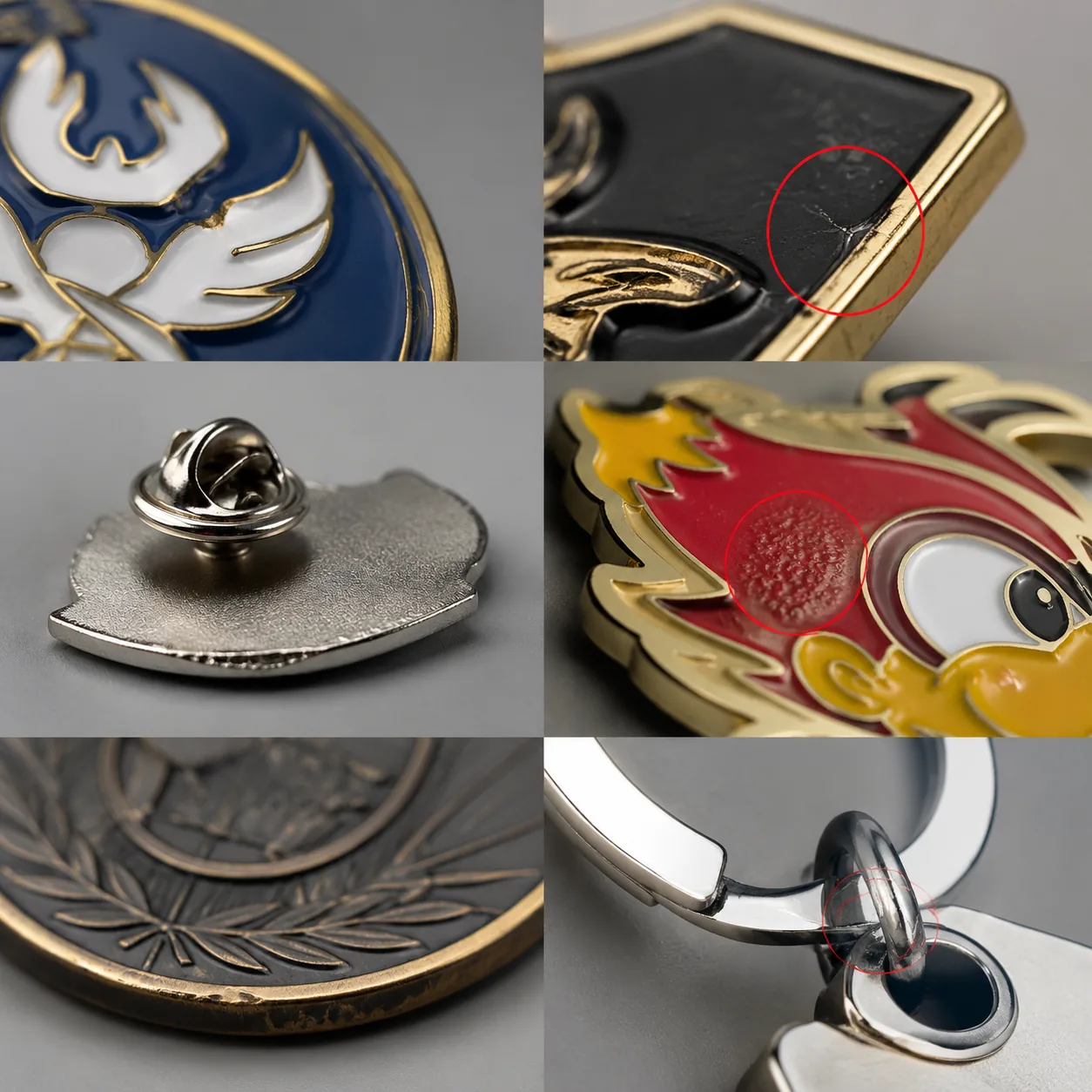
Inspection points should include size (caliper check on 10% of units), thickness (micrometer on 5%), plating uniformity (visual under D65 light), enamel cleanliness (no pits >0.5 mm), attachment alignment (post perpendicular to back within 2°), clutch fit (secure but removable), scratch level after packing (no visible scratches under 30 cm distance), and correct assortment by SKU if there are multiple designs. For individually packed pins, random drop tests (1 m onto carpet) and rub checks (5 cycles with white cloth) are useful because poor bagging or loose metal-to-metal contact can create scratches during export transit. Carton marks and inner quantity labels also matter more on small orders because manual miscounts are common when several low-volume SKUs are packed together.
If you cannot justify a third-party inspection (typically USD 200–400 per day), request high-resolution staged photos (front, back, edge, and clutch close-up) and short videos (10 seconds per design) before balance payment. That is not equal to in-person QC, but it can catch obvious issues such as wrong attachment, missing backstamp, uneven epoxy or mixed plating before shipment leaves the factory.
Step 7: Keep Freight and Packing Proportional to the Order
On low-MOQ shipments, freight can distort the economics more than the product itself. A 100-piece order with a FOB value under USD 120 can easily end up with door-to-door express freight above the product cost if each pin is in a rigid gift box (e.g., USD 35–50 via DHL for a 1 kg box). The commercial fix is simple: match packaging density to the sales channel and avoid paying air freight for empty space.
For standard 25 to 35 mm pins, bulk packing or individual polybag packing is the most efficient. A typical export carton for small pin orders should use 5-ply corrugated board with inner bags grouped by SKU, and total carton weight preferably below 12 kg for easier handling and lower damage risk. Backing cards (300–400 gsm, single-sided print) are usually sensible when the item goes straight to retail display or event handout, but velvet boxes and acrylic cases should be reserved for higher-value commemorative pieces (e.g., limited edition runs over USD 2.00 per pin).
As a rule of thumb, keep total packed weight per pin under 20 to 30 g for standard promotional use. If packaging pushes freight per unit beyond the visual value it adds, remove it from the first run and upgrade only after demand is proven.
What To Do Next
If you are buying a small-MOQ pin in 2026, treat the first order as a controlled pilot, not a miniature version of a large corporate rollout. Use one stable design, one practical finish, one attachment standard and one packaging method. Keep the spec sheet tight enough that three suppliers would quote essentially the same product.
The most reliable sequence is straightforward: issue a complete RFQ with quantity ladders, compare one original spec against one value-engineered option, approve only against measurable sample criteria, then place bulk at the next sensible quantity break rather than the absolute minimum. For many buyers, the sweet spot is 100 to 200 pieces in stamped iron or zinc alloy, 1.2 to 2.0 mm thick, with standard plating (shiny nickel or matte gold) and simple individual packing (polybag or backing card).
Before you send the RFQ, prepare six non-negotiables on one page: artwork file (AI or EPS), exact size in mm, process choice (e.g., iron soft enamel), color references (Pantone codes), attachment type (butterfly clutch or rubber clutch), and packing method (polybag or backing card). That single page will prevent more rework than weeks of back-and-forth after quoting starts.
Have a project? Send your artwork and target quantity and we’ll reply with a detailed quotation within 12 working hours.
Ready to get this made?
Send your sketch, target quantity and ship-date. Detailed quotation in 12 hours.



