Small-MOQ Custom Pins in 2026: A Decision Framework
Start with the real commercial constraint, not the MOQ
Most 50-300 piece pin orders fail on the wrong variable. The limiting factor is usually not whether a factory will accept the quantity; it is whether the project can absorb fixed setup cost while still meeting a deadline, a resale margin, or a presentation standard. A 100-piece order can be efficient when it stays inside standard factory flow: one plating finish, 3-5 enamel colors, one standard butterfly or black rubber clutch, and bulk or simple polybag packing. The same 100 pieces become expensive when the spec adds dual plating, 7-8 color breaks, custom backing cards, barcode labels, locking backs, and a pre-production sample.
For 2026, the practical low-MOQ band for custom metal pins remains about 50 to 300 pieces per design. Below 50 pieces, suppliers may still quote, but fixed operations dominate the economics: die engraving, strike or mold setup, plating line setup, color filling, polishing, soldering, and final inspection do not shrink in proportion to unit count. On a standard 30 mm stamped iron soft enamel pin at 100 pieces, a realistic China FOB price is usually USD 0.70-1.20 each, plus one-time tooling of about USD 45-90. At 300 pieces, the same unchanged spec often drops to USD 0.48-0.82 each. At 50 pieces, the unit price commonly rises to USD 0.95-1.55 because setup cost is spread over too few units.
This is why the first decision is not "Can someone do 50 pieces?" It is "What cannot be compromised?" Protect the features that affect use and sell-through: final size, legibility, attachment stability, finish consistency, and in-hand date. If the budget is tight, cut optional complexity before cutting function. Shrinking a pin from 30 mm to 22 mm to save a few cents often damages readability more than reducing one enamel color or switching from locking backs to standard clutches.
Standardize the build before asking for price
Low-MOQ projects stay commercially viable when the specification uses common materials, common finishes, and common packing steps. For most orders, that means stamped iron or die-cast zinc alloy, standard decorative plating such as shiny gold, shiny nickel, black nickel, or antique bronze, and standard thicknesses. Stamped iron soft enamel is typically 1.2-1.5 mm thick. Die-cast zinc alloy is usually 2.0-3.0 mm thick because the process supports deeper relief, cutouts, and irregular outlines.
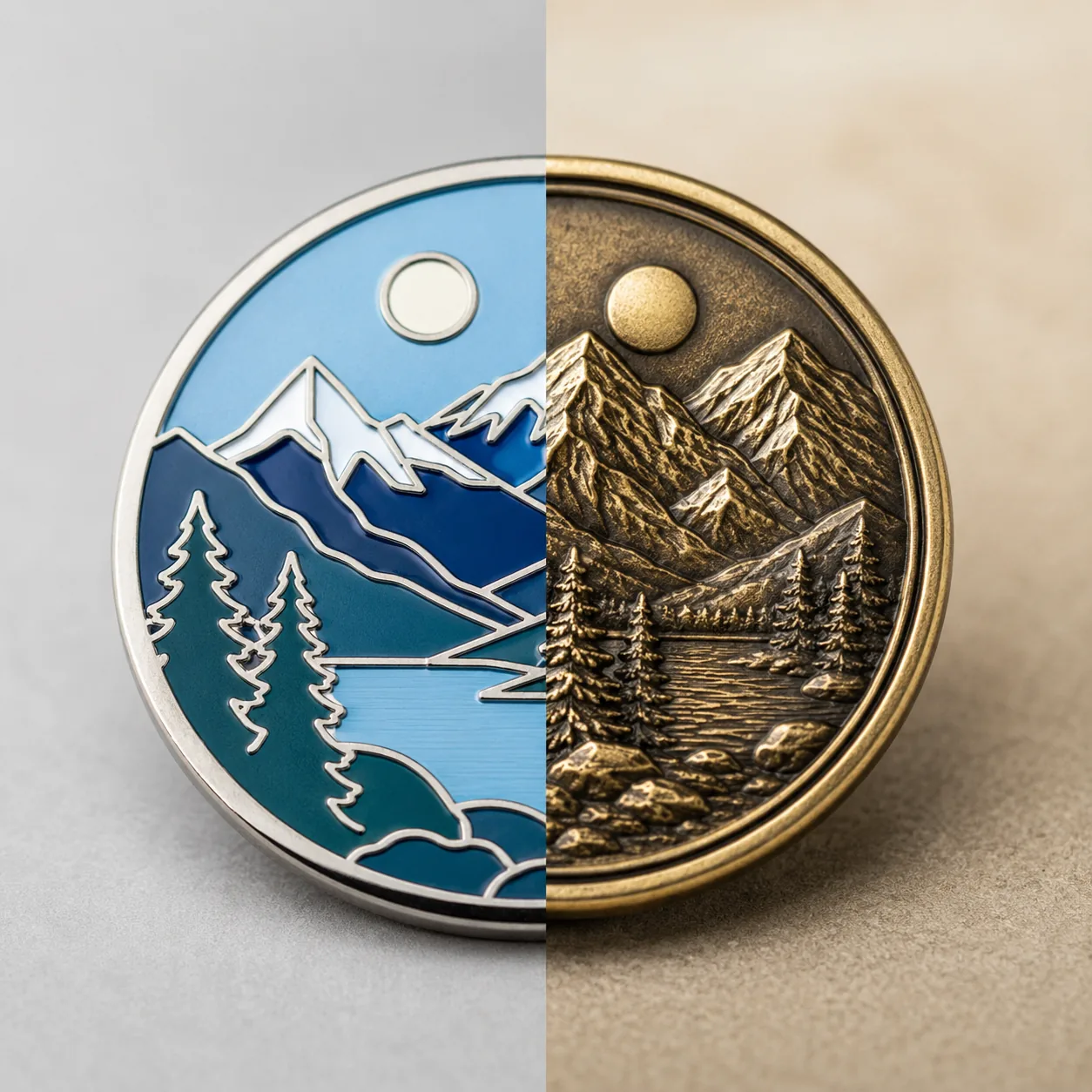
For 25-35 mm designs, stamped iron soft enamel remains the default small-order choice because tooling is moderate, color fill is predictable, and detail holds reasonably well when line widths are designed correctly. Brass imitation hard enamel gives a flatter, more jewelry-like face, but it generally needs tighter polishing control and more labor, so it is harder to keep economical below 100 pieces. Die-cast zinc alloy is usually the better option when the design has large cutouts, curved silhouettes, offset outlines, or raised relief that would distort in a stamped blank. Printed pins with epoxy make more sense when the artwork includes gradients, halftones, very small text, or frequent version changes that would make multiple dies uneconomic.
| Build option | Best small-MOQ use case | Typical MOQ | Tooling USD | FOB unit at 100 pcs | Lead time after art approval |
|---|---|---|---|---|---|
| Stamped iron soft enamel | 25-35 mm logos, mascots, event pins, simple merch pins | 50-100 | 45-90 | 0.70-1.20 | 10-15 days |
| Stamped brass imitation hard enamel | Premium flat face, cleaner polish, retail or museum-shop look | 100 | 60-120 | 0.95-1.75 | 12-18 days |
| Die-cast zinc alloy soft enamel | Cutouts, irregular silhouettes, thicker feel, dimensional relief | 100 | 70-140 | 1.10-2.00 | 12-18 days |
| Printed iron or aluminum with epoxy | Gradients, fine text, versioned artwork, low tooling risk | 50-100 | 20-55 | 0.55-1.05 | 8-12 days |
Standardization also makes quotes comparable. One supplier may include butterfly clutches, individual polybags, and export carton packing in the unit price while another assumes bulk packing only. That is not a true process cost difference. Lock the specification first: size in millimeters, base metal, thickness, process, plating, number of enamel colors, backing hardware, and packing method. Then compare tooling, FOB unit price, sample charges, and lead time.
Separate fixed cost from variable cost drivers
In small runs, cost drivers do not behave the same way. Tooling is usually fixed and paid once per design. Variable cost sits in the operations that repeat on every piece: extra enamel colors, second posts, locking backs, screen print details, epoxy doming, custom cards, barcode labels, exact counting, and individual set packing. Buyers who expect reorders should sometimes accept slightly higher tooling if it improves die life, repeatability, or future unit pricing.
A common mistake is chasing low tooling while approving a design that is slow to make and hard to inspect. A 32 mm pin with eight isolated enamel cells, two screen-printed details, textured recesses, and two locking backs can cost more at 100 pieces than a cleaner 30 mm pin with four enamel colors and one standard clutch. On low quantities, simplification that preserves the visible look usually saves more than aggressive price negotiation.
- Keep enamel colors to 3-5 unless added colors clearly improve recognition at final size
- Use one plating finish; mixed or masked dual plating often adds about 10-20% on small orders
- Use one centered post for balanced shapes up to roughly 25-28 mm, but specify two posts for wide, asymmetrical, or top-heavy pins
- Choose butterfly or black rubber clutches unless theft resistance or premium resale justifies locking backs
- Skip custom backing cards for internal recognition, event handouts, or sample kits
- Avoid separate tooling for minor variants if one shared die plus print or color change can achieve the same result
Attachment and packaging are two of the most frequent overspend areas. A locking back typically adds about USD 0.12-0.35 per piece depending on style and plating. On a USD 0.80-1.00 pin, that increase is material. A custom printed backing card plus individual polybagging often adds another USD 0.08-0.25 per set, while barcode labels may add USD 0.02-0.06 each. Those upgrades can be justified for retail display, ecommerce fulfillment, or subscription boxes, but they are often unnecessary for employee recognition, campus giveaways, or distributor sampling.
Match the process to the business purpose
Do not default to soft enamel simply because a previous project used it. If the artwork includes gradients, photographic shading, halftones, QR-style micro detail, or text below about 1.0 mm cap height, a printed pin with epoxy is often the more rational choice. In practical terms, filled metal struggles when strokes drop below about 0.25-0.30 mm or when isolated cells become too narrow to fill cleanly. Print can reproduce those details more reliably as long as the supplier controls registration and color reference.
Likewise, not every project needs a collector-grade build. For a one-day event, pilot merchandise test, campus promotion, or distributor leave-behind, a printed badge with epoxy on a 0.8-1.0 mm base can come in materially cheaper than a filled enamel build while still looking clean at normal viewing distance. The trade-off is less perceived metal depth, softer edge definition, and a less premium in-hand feel. That can be acceptable if the pin's job is awareness or access, not collectible resale.
Use case should drive the spec. Retail merchandise, fan products, museum shops, and subscription-box programs usually justify heavier feel, better polish, tighter plating consistency, and more careful individual packing. Internal recognition, market testing, employee milestones, and event giveaways often do not. The right process is the one that achieves the commercial goal of this batch with the least avoidable cost and risk.
Engineer around the most common quality failures
Low-value orders often receive less engineering attention, so the purchase order needs to be more explicit. On pins in the 25-35 mm range, the highest-risk issues are metal line width, enamel fill consistency, post placement, plating coverage, color interpretation, edge finishing, and pack count accuracy. If those points are controlled in the artwork proof and PO, most low-MOQ disputes become easier to resolve.
For stamped designs, a practical minimum raised metal line width is about 0.25-0.30 mm, and a practical minimum recessed enamel cell width is about 0.35 mm. Below that, filled areas are more likely to clog, underfill, or lose separation. Typical overall size tolerance is about +/-0.20 mm, and thickness tolerance is usually +/-0.10 mm on stamped pieces. For die-cast zinc alloy, tolerances can be slightly looser on irregular outlines because post-cast finishing varies more. On soft enamel, a slight meniscus is normal because the enamel sits below the metal ridges. Rejectable conditions should be defined more precisely: exposed base metal inside a color field, enamel overflow across metal lines, visible pits on the face, misaligned print, loose posts, or scratches visible at roughly 30 cm under normal indoor light.
Plating specifications also need realistic language. Decorative gold-tone finishes on promotional pins are generally flash deposits in the approximate range of 0.03-0.08 microns over a nickel or copper-plus-nickel base, not heavy jewelry-grade gold plating. Nickel underlayers commonly run about 0.5-1.0 microns depending on the finish system and appearance target. That is adequate for normal promotional use, but it is not designed for high abrasion, constant friction against bags or jackets, or luxury presentation over many years. If a pin will be worn daily, say so; otherwise suppliers may assume standard decorative plating only.
| Spec area | Practical small-run target | Why it matters |
|---|---|---|
| Artwork metal line width | At least 0.25-0.30 mm | Reduces fill bleed and detail loss |
| Minimum enamel cell width | At least 0.35 mm | Improves clean fill and color separation |
| Stamped pin thickness | 1.2-1.5 mm typical | Balances rigidity, appearance, and cost |
| Attachment placement | Single centered post or dual-post for wide shapes | Prevents rotation, sagging, and twisting |
| Decorative inspection level | AQL 2.5 major / 4.0 minor | Makes cosmetic quality measurable |
| Packing count tolerance | Usually +/-1 piece per inner pack unless exact count is specified | Prevents receiving disputes and recount cost |
Plan backward from the in-hand date
Buyers often assume a small quantity will move faster through production. In practice, low quantity does not remove the core steps: die making or mold setup, stamping or casting, trimming, polishing, plating, filling or printing, epoxy curing if required, attachment soldering, inspection, and packing. For a standard small-run pin, a realistic production window is 10-15 calendar days after artwork approval, plus about 3-7 days for air shipment. More complex builds, nonstandard packing, or a physical pre-production sample can push factory lead time to 16-22 days before dispatch.
If the delivery date is fixed, remove optional complexity instead of demanding an unrealistic 7-day turnaround. Dropping custom cards for plain polybags can save 1-2 days. Approving artwork within 24 hours often saves more time than reducing the order from 150 pieces to 100. Choosing a standard plating finish also avoids waiting for a less common bath setup or a masked dual-plating operation. If a plated sample, photo sample, or full pre-production sample is required, budget another 3-7 days depending on courier transit and approval speed.
Rush timelines expose the same weak points repeatedly: enamel consistency, post alignment, carding accuracy, and carton count errors. A practical decorative inspection target for low-MOQ pins is often AQL 2.5 for major defects and AQL 4.0 for minor defects. If appearance matters, define major defects in the PO: missing fill, wrong plating, visible face scratches at 30 cm, incorrect backing hardware, loose posts, count shortage, or color mismatch against the approved Pantone reference or signed sample. Without those definitions, borderline cosmetic failures are more likely to be treated as acceptable under time pressure.
Choose suppliers on small-order discipline, not headline price
A factory that performs well on 5,000 pieces can still be inefficient on 100. Low-MOQ buyers should favor suppliers that quote quickly from complete specifications, identify artwork risks before invoicing, separate tooling from unit price, and spell out exactly what is included in the offer. Vague quotes become expensive orders because assumptions on clutches, cards, labels, sample approval, or freight terms are discovered too late.
Ask how approvals are handled. Some suppliers move straight from vector proof to production. Others offer a photo sample, plated sample, or full pre-production sample for roughly USD 30-80 and typically 3-7 additional days. On a first order with a new supplier, paying for one meaningful checkpoint is often cheaper than remaking a flawed batch. Also ask whether tooling is retained for 12-24 months, whether Pantone references and plating notes are logged, and whether repeat orders can match prior post placement, carding method, and carton labeling.
Strong small-order suppliers also think in reorder logic. They keep die files, approved proofs, post-location drawings, plating notes, and packaging instructions so that the second 100-piece run is a controlled repeat instead of a new development cycle. That matters more than saving USD 0.04 per piece on the first order, especially for agencies, ecommerce brands, school stores, and merchandising teams that reorder in uneven batches.
Use a lean RFQ that forces comparable quotes
The fastest route to a sound low-MOQ order is a disciplined RFQ. State the batch purpose in one sentence: retail sale, giveaway, employee recognition, pilot merchandise, or distributor sample. Then lock the essentials before sending inquiries: size in millimeters, process, base metal, plating finish, number of colors, attachment style, packing method, target ship date, destination country, and whether repeat consistency matters.
Send the same specification sheet to two or three qualified suppliers and require the quote to separate these line items: tooling, unit FOB, sample charge if any, attachment type, packaging cost, freight term, and production lead time in days. If the order is 100 pieces or less, ask one direct commercial question: what simplifications would reduce cost without changing the visible look at normal viewing distance? Good suppliers answer with specifics, such as reducing one enamel color, switching locking backs to rubber clutches, or converting a cutout design from die-cast zinc to stamped iron.
Approve production only after reviewing a clean proof that shows overall dimensions, line thickness, post position, plating finish, Pantone references or a signed visual standard, text legibility, and packing method. For small-MOQ custom pins in 2026, disciplined specification usually saves more money than hard bargaining. The best supplier is not the one that agrees to every request. It is the one that simplifies the build, protects the brand cues and functions that matter, and delivers a repeatable result on a 50-300 piece order.
Have a project? Send your artwork and target quantity and we’ll reply with a detailed quotation within 12 working hours.
Ready to get this made?
Send your sketch, target quantity and ship-date. Detailed quotation in 12 hours.



