Small-MOQ Custom Pins: 2026 Cost Traps and Spec Choices
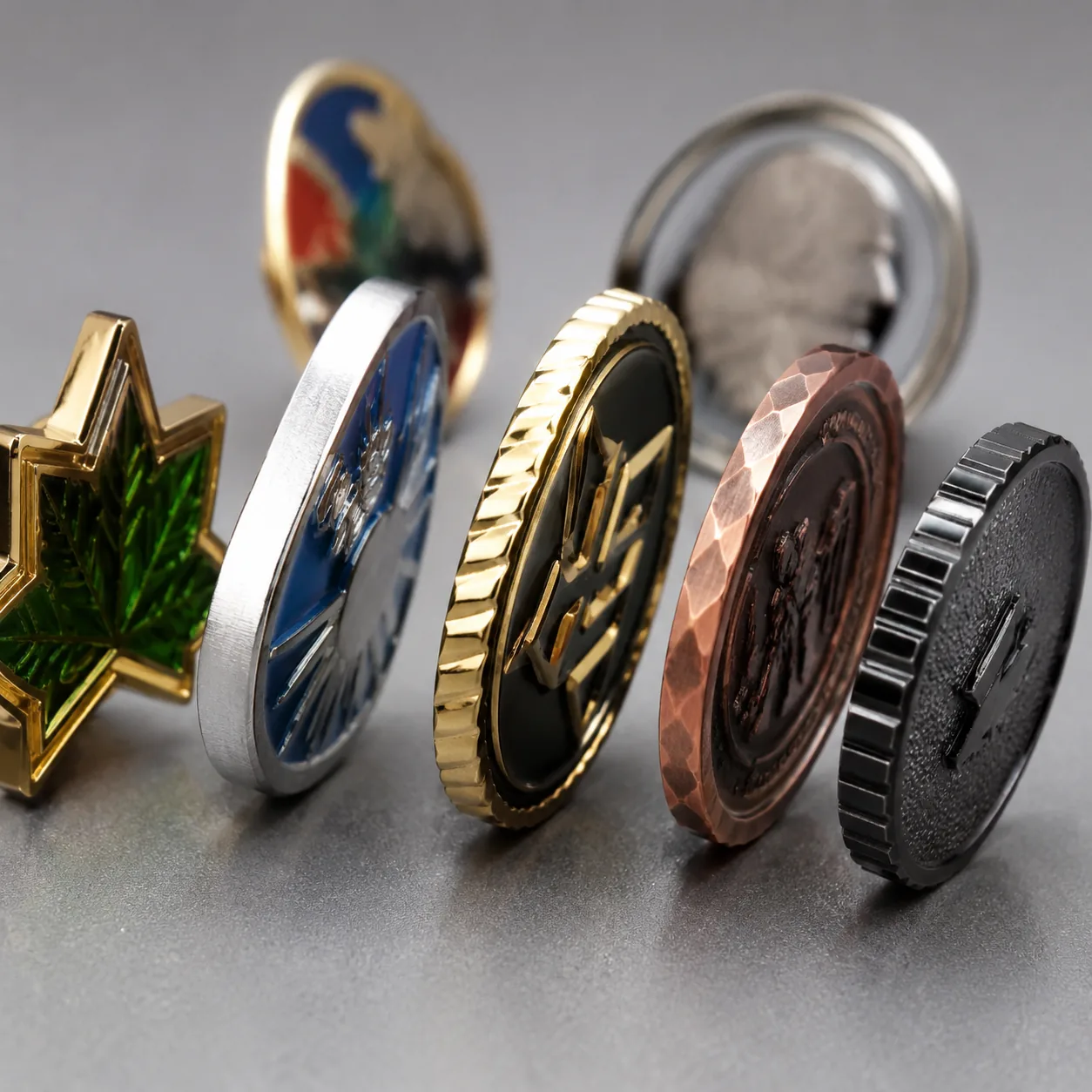
Why does a 100-piece custom pin order often look expensive?
At 50 to 300 pieces, the cost driver is factory setup and touch labor, not metal weight. A supplier still has to clean vector art, engineer line widths, engrave or CNC the die, strike trial parts, trim edges, plate, fill colors, oven-cure enamel, polish, solder posts, fit clutches, inspect, count, and export-pack the order whether you buy 100 pieces or 1,000. Those fixed steps do not shrink much just because the run is small.
For a realistic 2026 benchmark, a 100-piece order of 30 mm stamped iron, 1.2 mm thick, soft enamel, 4 fill colors, nickel plating, and butterfly clutch typically lands around USD 1.10 to 1.90 FOB per piece, plus a one-time mold charge of roughly USD 65 to 120. At 300 pieces, the same build is more commonly USD 0.78 to 1.30 FOB. At 1,000 pieces, it often drops to USD 0.45 to 0.85 FOB. The design did not become easier to manufacture; the non-recurring setup cost was simply spread over more units.
Small buyers also get misled by partial quotations. One supplier may quote USD 1.22 FOB and include mold, individual polybagging, and inspection to AQL 2.5 major / 4.0 minor. Another may quote USD 0.97 FOB based on 1.0 mm thickness instead of 1.2 mm, exclude mold, leave packaging undefined, and inspect only for obvious functional defects. On a 100-piece order, that lower unit rate can still produce a higher total landed cost or a visibly weaker pin.
The practical takeaway is that low-MOQ savings usually come from removing labor-heavy details, not from pressing a factory below its commercial floor. On a 100-piece order, deleting a backing card, dual plating, glitter fill, or an epoxy dome often saves more than negotiating USD 0.03 per piece on the base pin.
Which specification choices raise cost fastest below 300 pieces?
Below 300 pieces, labor complexity usually matters more than material input. Moving from 25 mm to 30 mm adds some metal and enamel volume, but the sharper cost jumps come from features that add handling, scrap exposure, or slower inspection: more fill colors, tiny recessed wells, openwork, double posts, dual plating, transparent enamel over texture, glitter, glow pigment, epoxy domes, or retail packing.
This is where many first-time buyers overspec the job. A 100-piece pin with 7 colors, 2 cutouts, black nickel plating, 2 posts, and a printed backing card in a clear barcode sleeve is no longer a simple promotional item. It is a hand-assembled SKU with multiple failure points: bent bridges, color contamination, plating scratches, off-center cards, and attachment mismatch during packing.
Geometry limits matter as much as decorative options. For standard stamped pins, overall size tolerance of plus or minus 0.30 mm is commercially normal, and post location tolerance of plus or minus 1.0 mm is typical. Raised metal lines below about 0.35 to 0.40 mm become difficult to hold consistently in stamped iron, especially across several cavities and repeated runs. Openwork bridges under about 0.80 mm are prone to bending on 1.2 mm stock. On die-cast zinc alloy, very fine dividers can soften visually even when nominal dimensions are technically met.
Plating is another area where buyers often ask for more than the application needs. Decorative nickel, gold-tone, black nickel, or copper-tone plating on lapel pins is usually very thin, commonly around 0.03 to 0.08 microns. That is standard for promotional, commemorative, and employee-recognition use. If the pins will sit in humid storage for months or be handled as retail collectibles, the bigger quality gain usually comes from cleaner polishing, better bagging, and scratch control rather than demanding unusually heavy decorative plating.
| Spec choice | Typical effect at 50-300 pcs | Typical FOB add-on | Best use case |
|---|---|---|---|
| 30 mm stamped iron, 1.2 mm, soft enamel, 4 colors, butterfly clutch | Baseline commercial specification | Reference point | Events, staff pins, promo resale |
| Increase thickness from 1.2 mm to 1.5 mm | Heavier feel and better rigidity, especially with cutouts | USD 0.05-0.12 per pc | Pins above 30 mm or designs with openwork |
| Upgrade iron to stamped brass | Sharper lines, cleaner polish, lower risk on fine detail | About 10%-25% over iron | Corporate seals, museum retail, small text |
| Imitation hard enamel with polished flat face | More polishing, flatter face requirement, stricter cosmetic sorting | USD 0.18-0.40 per pc | Premium institutional or gift presentation |
| Cutout or openwork areas | Higher die complexity and greater bend risk | USD 0.08-0.25 per pc | Artwork that truly needs negative space |
| Glitter, glow, or transparent enamel | Extra fill handling and more appearance rejects | USD 0.05-0.18 per color area | Novelty, festival, youth merchandise |
| Backing card plus polybag or barcode sleeve | Manual packing plus material cost | USD 0.12-0.45 per set | Retail-ready distribution |
Which production process is smartest for 50 to 300 pieces?
For most B2B buyers, stamped soft enamel remains the safest process in this volume band. It gives crisp raised borders, predictable color separation, broad supplier capacity, and stable pricing. A solid commercial build is iron base, 1.2 to 1.5 mm thickness, 25 to 32 mm face size, 4 to 6 colors, single plating, and one butterfly or black rubber clutch. After final proof approval, production is commonly 10 to 16 calendar days ex-factory.
Stamped brass is worth considering when the artwork depends on finer separators, compact typography, or a cleaner polished face. Brass generally stamps more sharply than iron and holds repeated raised lines in the 0.30 to 0.40 mm range more reliably. That makes it useful for institutional seals, anniversary emblems, and retail pins where muddy borders will be obvious. Expect roughly a 10 to 25 percent unit-price premium over iron at the same size and finish, while mold cost often stays in a similar USD 70 to 130 range for low-MOQ tooling.
Zinc alloy die casting is the better choice when the design has deep relief, an irregular silhouette, thick-profile edges, or large open areas that are difficult to strike cleanly in stamped sheet metal. It solves some geometry limits, but it is not automatically the cheapest small-run option. Tooling can be higher, often about USD 90 to 180 for simple low-volume molds, and badge-style dividers usually look softer than on a stamped pin. For flat logo pins, stamping is usually the better process. For mascots, sculptural icons, and 3D profiles, casting is usually the better trade.
Printed pins with an epoxy dome are also valid at low MOQ when the artwork contains gradients, halftones, QR codes, or very small text that enamel cannot reproduce economically. They can reduce cost if the alternative is a soft-enamel design with many tiny isolated color wells. The trade-off is wear resistance and perceived value: a printed face, even domed, will usually scratch or haze sooner than recessed enamel if the pin is carried against bags, lanyard hardware, or keys.
Buyer checklist: How do you cut cost without making the pin look cheap?
- Keep the face size in the 25 to 32 mm range unless the design truly needs more area.
- Limit small-run designs to 4 to 6 solid colors. Tiny isolated color pockets increase fill time and reject risk.
- Use one plating finish only. Dual plating is rarely economical below 300 pieces.
- Default to stamped iron for mainstream promo pins; upgrade to brass only when line detail or finish quality requires it.
- Choose 1.2 mm thickness for standard event pins and 1.5 mm when the pin exceeds 30 mm, includes cutouts, or needs a heavier hand-feel.
- Use one standard attachment such as butterfly clutch or black rubber clutch unless a locking back is functionally necessary.
- Request inspection at AQL 2.5 major / 4.0 minor, and define visible defects: plating pits, exposed base metal, enamel underfill, overflow, scratches, bent posts, and loose clutches.
- Set realistic tolerances: plus or minus 0.30 mm overall size, plus or minus 1.0 mm post location, and smooth accessible edges with no sharp burrs.
- Skip retail packaging unless the pins will be sold individually by SKU or inserted into a formal gift set.
- If ordering multiple designs, standardize bag size, backing-card size, and master-carton count so packing can run with less manual variation.
When is brass worth paying for instead of iron?
Pay for brass when the pin has to read as precise rather than simply durable. Brass usually produces cleaner stamped edge definition, a finer pre-plate polish, and a more controlled premium appearance on detailed artwork. That matters for corporate anniversary pins, university emblems, museum-store merchandise, alumni programs, and formal insignia where small text and tight separators must stay legible.
A practical threshold is line width and spacing. If most raised metal lines are above 0.50 mm and the design is a 28 to 32 mm event giveaway, iron is usually sufficient. If the design uses repeated lines around 0.30 to 0.40 mm, compact lettering, or tightly grouped color fields, brass is easier to justify because it lowers the risk of muddy borders, broken separators, and inconsistent fill wells. The difference is especially visible on polished or imitation hard enamel styles.
That said, substrate alone does not create premium feel. A 30 mm iron pin at 1.5 mm thickness with even enamel fill, clean plating, centered posts, and disciplined packing can feel more substantial than a poorly controlled brass pin. On small orders, buyers usually gain more by locking a balanced specification and measurable QC standard than by upgrading metal automatically.
What lead times and MOQ tiers are realistic for 2026 orders?
For straightforward low-volume programs, the normal commercial MOQ is often 50 pieces per design for stamped iron soft enamel, 50 to 100 pieces for stamped brass, 100 pieces for die-cast zinc alloy, and 50 pieces for printed-epoxy styles. Factories may advertise lower MOQs, but below those levels the quote usually carries a setup-heavy price that erases the apparent advantage.
A realistic schedule after final artwork approval is 1 to 3 days for artwork cleanup and proofing, 3 to 5 days for mold making, and 6 to 9 days for production steps such as stamping or casting, plating, color filling, curing, polishing, post soldering, inspection, and packing. That puts many standard 50 to 300 piece orders at roughly 10 to 17 calendar days ex-factory. If a pre-production sample is required, add about 5 to 9 more days depending on whether approval is by photo or physical courier sample.
Rush production is possible, but small quantity does not automatically mean fast delivery. Pin factories batch work by plating finish, process type, and line loading. A 100-piece nickel-plated enamel order can still wait behind larger jobs using the same plating tank and curing line. If you ask for 100 pieces in 5 to 7 days with custom cards, 2 posts, and special effects, expect a rush surcharge, higher defect risk, or both.
For shipments this small, courier or air consolidation usually makes more sense than ocean freight, so the main schedule lever is factory lead time rather than vessel booking. Most avoidable delays come from post-approval changes: moving a post, changing Pantone references, revising card dimensions, or altering the outer shape after tooling has started.
How should you compare competing quotes for the same 100-piece order?
Start by forcing a true apples-to-apples quotation. Every supplier should price the same finished size in millimeters, base metal, thickness, process, plating, number of colors, attachment type, packaging method, mold charge, inspection level, and delivery term such as EXW or FOB. Without that, the comparison is mostly noise.
Then check the usual commercial downgrades. A cheaper quote may quietly change 1.5 mm thickness to 1.0 mm, switch brass to iron, replace enamel with print-plus-epoxy, drop individual polybags, or exclude mold and export carton. On a 100-piece order, a unit price that is USD 0.15 lower means little if it omits a USD 90 mold charge or leaves packing and QC undefined.
Inspection language matters as much as the headline price. A credible supplier should state the included acceptance level, commonly AQL 2.5 major / 4.0 minor for appearance-led promotional pins, and define defects such as plating pits, exposed base metal, enamel underfill, color contamination, bent posts, loose clutches, and attachment misalignment. If the factory cannot define what counts as defective, the quote is not anchored to a measurable quality standard.
The strongest quotations also show production judgment. If the art includes text that will close up, bridges that are too thin, or a post layout likely to let the pin rotate on fabric, a serious supplier will flag those issues before tooling. That is usually a stronger capability signal than a fast sales reply or an unusually low piece rate.
What must be locked in writing before you pay for tooling?
Before releasing tooling payment, the approved proof or tooling sheet should lock the finished size, base metal, thickness, process, plating finish, color count, color references, attachment type and position, packaging method, approved artwork revision, mold charge status, and commercial term. If brand color matters, specify Pantone references. If exact Pantone matching is limited by enamel chemistry, plating tone, or extremely small fill wells, note that limitation on the approval record.
The document should also define tolerances and inspection criteria in plain manufacturing terms. For a standard stamped pin, that usually means overall size plus or minus 0.30 mm, post location plus or minus 1.0 mm, no sharp accessible burrs, secure post soldering, even enamel fill within normal process variation, and face-side plating coverage free of obvious pits or exposed base metal. If the backstamp matters, specify minimum legibility and orientation expectations as well.
Finally, protect the reorder path. Ask the supplier to retain the final proof, mold number, item code, plating code, packing specification, and carton count under your SKU. Many small buyers discover on the second run that the clutch changed, the metal got thinner, or the card stock was substituted because the first order was never frozen tightly enough. On a 100-piece program, disciplined documentation is usually worth more than one last attempt to save a few cents on the quote.
Have a project? Send your artwork and target quantity and we’ll reply with a detailed quotation within 12 working hours.
Ready to get this made?
Send your sketch, target quantity and ship-date. Detailed quotation in 12 hours.



