SKU Labeling Specs for Mixed Custom Promo Orders
Why good promo products still fail at receiving
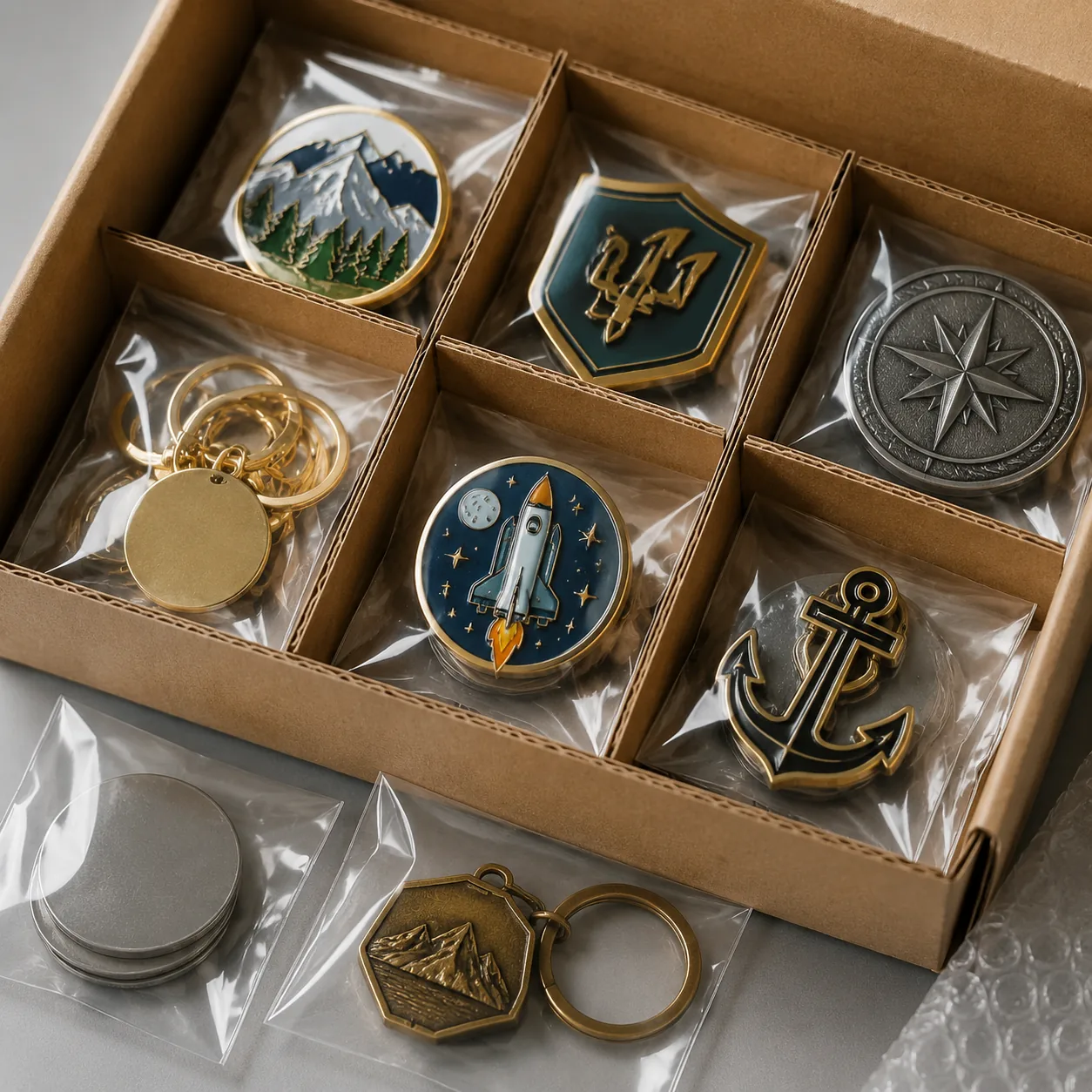
A custom pin, coin, patch, keychain or lanyard order can pass product inspection and still fail at the distributor warehouse. The usual problem is not enamel fill, plating color or stitching quality. It is a carton that contains several similar SKUs, inner bags with no identifier, a barcode that does not match the PO, or carton marks that force the receiver to open and count every box manually.
Mixed promotional orders are especially vulnerable because the product differences are often small: gold versus antique brass plating, 30 mm versus 35 mm size, butterfly clutch versus rubber clutch, English card versus French card, or branch-specific packaging. To the factory these may look like minor variants. To the warehouse they are separate inventory records, pick faces and fulfillment rules.
SKU labeling should be specified before sampling or at least before mass packing. If the supplier receives labeling instructions after products are bagged, the correction usually means opening sealed cartons, relabeling each unit or inner pack, rebuilding the packing list and losing 2 to 5 working days. For seasonal campaigns, retail launches and event programs, that delay can be more expensive than the labels themselves.
The practical target is simple: every sellable unit, inner pack and master carton should identify the same SKU in the same way, and the carton-by-carton packing list should match what the warehouse scans. The following specifications are written for RFQs and purchase orders where the buyer wants fewer receiving disputes, fewer chargebacks and less manual sorting after delivery.
Lock the SKU master before artwork approval
The SKU structure is the first control point. A SKU should represent the version that must be stored, picked, replenished or reported separately. If a 30 mm hard enamel pin uses the same artwork but three plating finishes, the finishes should be three SKUs. If one design is packed on a retail card for one channel and in a plain OPP bag for another, those should also be separate SKUs because the package configuration changes the receiving and fulfillment requirement.
Do not rely on factory nicknames such as gold badge, silver pin or logo coin. They are understandable during sampling but unsafe during production when cartons and inner packs look similar. Use a structured code such as BRAND-EVT26-PIN30-GD-BTY-R1, where the final segments identify product type, finished size, finish, attachment and artwork revision. Keep the code readable: 20 to 32 characters works well on 50 x 30 mm unit labels and 60 x 40 mm inner labels.
A usable SKU master should include item name, buyer SKU, supplier item code, PO number, artwork revision, finished size and tolerance, material, finish, attachment, individual packing, inner pack quantity, master carton quantity, barcode data, country-of-origin wording and carton mark wording. For metal promo products, size tolerance is usually ±0.2 mm to ±0.5 mm for die-struck or zinc alloy items, while printed or embroidered patches often use ±1 mm to ±2 mm depending on border type. State these figures in the SKU master so inspection and labeling reference the same version.
- Use one SKU per fulfillable version, not one SKU per artwork family.
- Add revision codes such as R1, R2 or CARD-A when visual differences are small.
- Do not reuse one barcode across different finishes, attachments or packing formats.
- Keep buyer SKU, barcode data and PO line number in separate columns.
- Send the final SKU master in Excel or CSV before mass packing starts.
- Freeze changes at least 3 working days before the planned packing date.
Specify labels by packing level
Most failures happen when buyers label only the master carton. For mixed promotional products, labels should exist at three levels: individual unit, inner bag or inner box, and master carton. The content can vary by level, but the SKU and barcode must remain consistent. If the warehouse scans unit labels, do not let the inner label use a shortened SKU or the supplier’s internal model number.
For pins, coins, brooches and keychains in OPP bags, 40 x 25 mm or 50 x 30 mm adhesive labels usually fit without covering the product. For backing cards, 30 x 20 mm can work if it carries only SKU, barcode and country-of-origin text, but 40 x 20 mm is safer when the SKU exceeds 18 characters. For lanyards, 50 x 30 mm is normally the minimum because the polybag surface wrinkles and the barcode needs quiet space. Matte white thermal transfer stock of 60 to 80 gsm face paper is more reliable than glossy or transparent labels for warehouse scanning.
Label placement should be controlled like any other packaging specification. On individual bags, place the label centered on the back face with ±5 mm tolerance and keep the barcode flat, not folded over an edge or heat seal. On inner cartons, place the label on one short side facing outward when packed in the master carton. On master cartons, use two labels on adjacent sides so the receiver can scan from a pallet or conveyor without rotating every carton.
| Packing level | Recommended label size | Minimum content | Placement tolerance |
|---|---|---|---|
| Individual OPP bag | 40 x 25 mm or 50 x 30 mm | SKU, barcode, COO, optional PO | Back face, centered ±5 mm; barcode flat |
| Retail backing card | 30 x 20 mm or 40 x 20 mm | SKU, UPC/EAN or Code 128, COO | Lower back area; do not cover hang hole or legal copy |
| Inner bag or inner box | 60 x 40 mm | SKU, item name, quantity, PO, finish | One short side; readable when carton opens |
| Master carton | 100 x 70 mm or A6 | PO, carton number, SKU list, quantities, NW/GW, COO | Two adjacent sides; position ±10 mm |
| Pallet label if required | A5 or 4 x 6 in | PO, shipment ID, carton range, total quantity | Two pallet sides; vertical barcode if specified |
Control barcode format and scan quality
Barcode format should come from the buyer or receiving warehouse, not from the factory. Code 128 is common for internal alphanumeric SKUs because it supports letters and numbers in a compact width. UPC-A and EAN-13 are retail identifiers and should be supplied by the brand owner or an authorized GS1 source. QR codes can be useful for URLs or serialized event kits, but they should not replace the linear barcode if the receiver’s scanners expect Code 128, UPC or EAN.
The print specification matters more than the barcode name. On a 50 x 30 mm unit label, keep Code 128 height at 10 to 15 mm and preserve at least 2.5 mm quiet space on both sides. Avoid shrinking generated barcodes below 80 percent of original scale because low-cost 203 dpi thermal printers can blur narrow bars. For small labels, a 300 dpi thermal transfer printer is preferred; for carton labels, 203 dpi is acceptable if the barcode is large enough and printed on matte stock.
Require human-readable text below every barcode. It provides a backup when a scanner fails and lets inspection compare the visible SKU against the SKU master. For warehouse-grade reliability, the supplier should scan the first 20 labels per SKU during line setup, then at least one label per inner pack or one label per 500 units during packing, whichever is stricter. For master cartons, scan 100 percent of carton labels before sealing or palletizing.
Formal ISO/IEC barcode grading is rarely necessary for custom promo orders, but practical acceptance criteria should still be written. Set a zero-defect rule for wrong encoded data, wrong SKU, duplicated carton number or unreadable master carton barcode. Treat cosmetic label issues as minor only if the barcode scans, the text is legible and the label remains attached after normal handling.
Write mixed-carton and kitting rules
Mixed cartons save freight and reduce void fill, but they create receiving risk. If the warehouse expects one SKU per carton, do not allow mixed cartons unless the PO explicitly permits them. Small custom items make this tempting: one 35 x 25 x 20 cm carton may hold 2,000 to 5,000 lapel pins or patches, so factories often want to place remainder quantities together. That is acceptable only when each SKU is physically separated and the carton label lists every SKU and quantity.
A practical rule is one SKU per master carton when the SKU quantity reaches 500 pieces or more. Remainders below 200 pieces may be mixed if they are sealed in separate inner bags or inner boxes with matching labels. Do not mix visually similar finishes loose in one carton, even if each unit has a label; gold, polished brass, rose gold and antique brass are frequently confused under warehouse lighting.
For example, an order of 1,000 gold pins, 1,000 nickel pins and 120 antique brass pins should ship the two 1,000-piece SKUs in separate master cartons or carton groups. The 120-piece remainder can go into a clearly marked mixed carton only if the pins are in sealed inner packs of 50, 50 and 20 pieces, each with SKU, finish and quantity. The master carton label should state MIXED SKU and list all contents, not just the dominant SKU.
Kits need a separate rule. If a conference pack contains one pin, one lanyard and one patch, assign a finished kit SKU and keep component SKUs visible on the production traveler. A warehouse receiving finished kits should scan the kit SKU, not the individual component SKUs. If components ship bulk for local assembly, the carton labels must state component quantities and should not imply that complete kits are inside.
| Scenario | Recommended rule | Risk if omitted |
|---|---|---|
| SKU quantity 500 pcs or more | Pack one SKU per master carton whenever possible | Receiver opens cartons and counts mixed stock manually |
| Remainder below 200 pcs | Allow mixed carton only with sealed, labeled inner packs | Small quantities are lost, merged or short-shipped |
| Similar finishes or sizes | No loose mixing in the same carton | Gold, brass, rose gold or 30/35 mm versions are confused |
| Finished event kits | Use finished kit SKU on unit and carton labels | Warehouse may split kits or receive components incorrectly |
| Retail replenishment | Follow routing guide label position and barcode format exactly | Chargebacks for non-compliant carton marks or labels |
Set carton quantities, weights and marks
Quantity control should be easy to verify without opening every unit. For pins, patches and lightweight keychains, inner packs of 50 or 100 pieces are practical. For heavier challenge coins, use 25 or 50 pieces per inner box depending on diameter and thickness. A 45 mm zinc alloy coin at 3 mm thickness commonly weighs about 35 to 45 g before packaging; 500 pieces can exceed 18 kg after boxes, labels and cartons are added.
Master carton gross weight should usually stay below 15 kg for courier shipments and below 18 kg for sea or air freight handling. For dense metal products, smaller cartons such as 30 x 22 x 18 cm may be safer than standard 40 x 30 x 25 cm cartons. For patches, lanyards and soft goods, carton volume usually matters more than weight, but compression can deform backing cards or bend retail hang tabs if cartons are overpacked.
Carton construction should match the product weight and shipment method. Single-wall cartons are rarely suitable for dense coins or keychains. Use five-ply export cartons for master cartons above 10 kg, reinforced tape on all seams, and corner protection when retail cards or gift boxes are inside. If pallets are used, specify no overhang, stretch wrap, and pallet labels on two sides.
Carton numbering must match the packing list exactly. Use 1 of 12, 2 of 12 and so on, with SKU-level quantity per carton. For mixed cartons, print MIXED SKU in large text and list each contained SKU and quantity on both the carton label and the packing list. Net weight and gross weight should be measured after packing, not estimated from the quotation.
- Use inner quantities of 50 or 100 pcs for pins, patches and light keychains.
- Use 25 or 50 pcs per inner box for heavy coins or boxed metal items.
- Limit gross weight to 15 kg for courier and 18 kg for bulk freight handling.
- Require PO, SKU, carton number, quantity, NW, GW, carton size and COO on each master carton.
- Use five-ply export cartons for dense products or any carton above 10 kg.
- Require a carton-by-carton packing list before balance payment or shipment release.
Budget realistic cost, MOQ and lead time
SKU labeling is inexpensive compared with receiving errors, but it is not free when done correctly. Basic black-and-white adhesive unit labels usually add USD 0.01 to 0.03 per piece FOB China for 1,000 to 10,000 pieces. Barcode labels with scan checks commonly add USD 0.02 to 0.05 per piece. Inner pack labels and carton labels usually add USD 0.02 to 0.08 per pack or carton, depending on size, variable data and whether the factory must print carton-specific lists.
Variable data drives handling time. A one-SKU order can be labeled during normal bagging with little schedule impact. A 30-SKU program with branch-specific cartons, serial carton numbers and mixed-kit structures needs a label map, scanner checks and supervisor sign-off. Allow 1 to 2 extra working days for 5 to 10 SKUs, 2 to 4 days for 11 to 30 SKUs, and 4 to 7 days for larger multi-branch or retail routing programs.
MOQ affects the economics. For custom metal promo products, production MOQs often start around 100 pieces per design, while efficient unit pricing is usually reached at 500 to 1,000 pieces. Labeling a 100-piece SKU is possible, but the setup time per SKU becomes a larger share of cost. If the warehouse can accept consolidated low-volume variants, group them at the carton level; if the warehouse picks by variant, separate them and pay for clean labeling.
| Requirement | Typical FOB add-on | Lead-time impact | Best use case |
|---|---|---|---|
| Fixed SKU label on each unit bag | USD 0.01-0.03 per pc | 0-1 working day | Distributor orders with simple receiving |
| Barcode label plus scan check | USD 0.02-0.05 per pc | 1-2 working days | Warehouse, retail or FBA-style routing |
| Inner pack labels | USD 0.02-0.08 per pack | 0-1 working day | Mixed cartons and branch allocations |
| Carton-by-carton packing list | USD 5-25 per order | 1 working day | Orders with more than 3 SKUs |
| Finished kit labeling | USD 0.08-0.25 per kit | 2-5 working days | Event packs, retail bundles and welcome kits |
| Serialized unit labels | USD 0.05-0.15 per pc | 3-7 working days | Security badges, numbered coins or controlled giveaways |
Inspect labeling like product quality
Labels should be inspected with the same discipline as the product. A label can look clean and still encode the wrong SKU. Include labeling, barcode data, carton marks and packing-list accuracy in the final inspection checklist alongside plating scratches, enamel overflow, attachment strength, embroidery density or patch border quality.
For general visual packaging defects, AQL 2.5 major and 4.0 minor is practical for many promotional orders. For barcode data, SKU mismatch, wrong carton quantity, missing COO or incorrect PO number, use a critical classification with zero acceptance in the inspected sample. One wrong master carton label can misroute hundreds or thousands of pieces, so it should not be treated as a minor packaging defect.
Sample across the packing sequence, not only cartons near the door. Open cartons from the beginning, middle and end of the run, and include every SKU in small programs. For larger orders, use the agreed AQL level for unit labels and inspect 100 percent of master carton labels against the packing list. Label placement tolerance can be ±5 mm on unit packs and ±10 mm on cartons, provided the barcode remains flat, clean and scannable.
- Scan sampled unit and inner labels against the SKU master before cartons are sealed.
- Scan 100 percent of master carton barcodes and compare them with the packing list.
- Check that inner pack quantities add up to the carton label and PO line quantity.
- Reject any wrong SKU, wrong barcode data, duplicate carton number or missing COO as critical.
- Photograph two carton sides, one opened carton and one inner pack per SKU before shipment.
- Declare any overage on the packing list; do not hide extra pieces in a random carton.
The best next step is to make SKU labeling a purchase-order specification, not a warehouse complaint after delivery. Send the SKU master, barcode data, label sizes, mixed-carton rules, carton mark format and inspection standard with the RFQ. Ask the supplier for a digital packing mockup before mass packing: one unit label, one inner label, one master carton label and one sample carton-by-carton packing list. That one-day approval step prevents the most common receiving failures on mixed custom promo orders.
Have a project? Send your artwork and target quantity and we’ll reply with a detailed quotation within 12 working hours.
Ready to get this made?
Send your sketch, target quantity and ship-date. Detailed quotation in 12 hours.



