Single-Sided vs Double-Sided Metal Giveaways: Buyer Framework
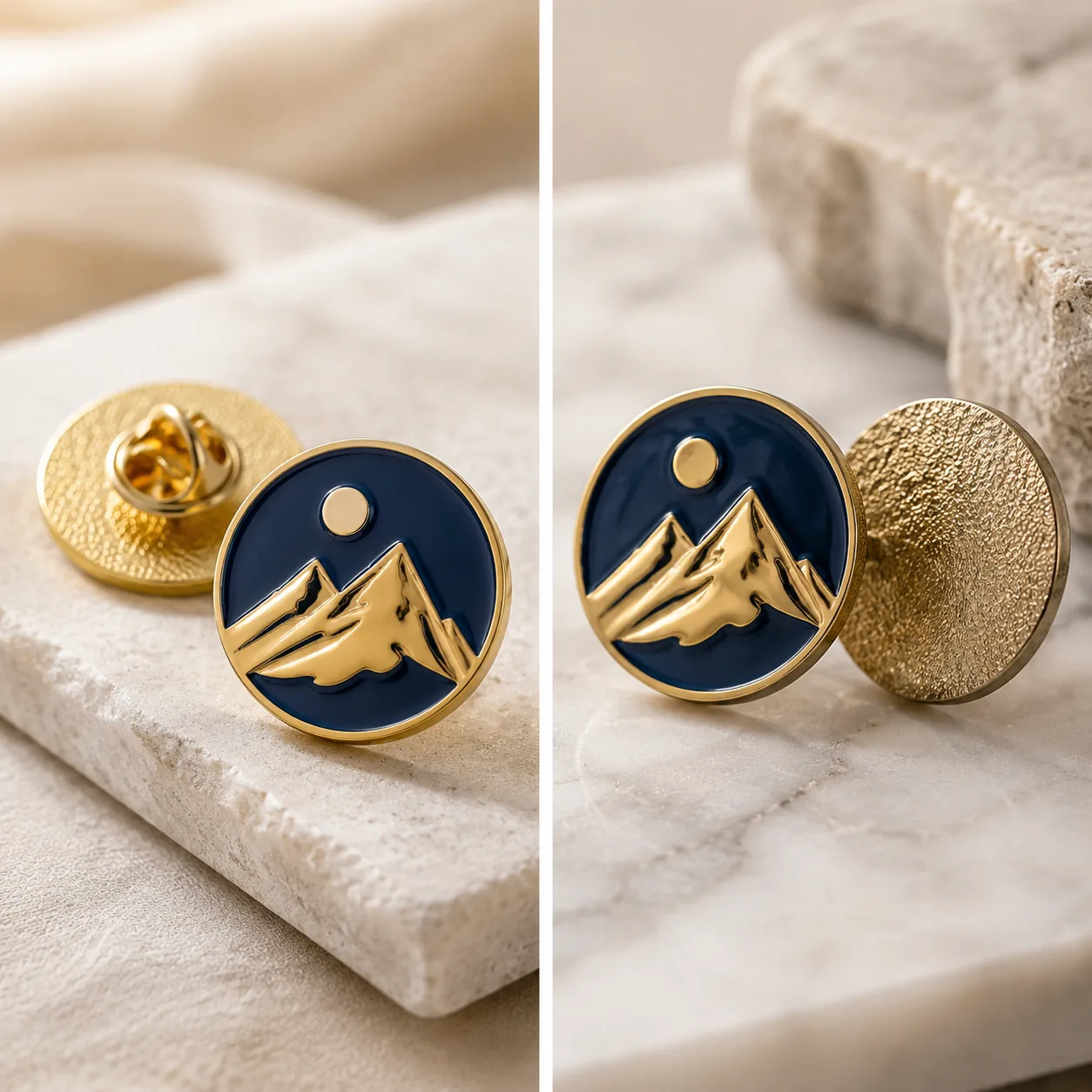
1. Decide Whether the Back Has Commercial Value
The reverse side of a metal giveaway is not a free decoration area. It changes tool design, polishing access, plating contact points, attachment layout, packing method and inspection time. For lapel pins, keychains, medals, challenge coins and magnets, the first decision is commercial: will the end user see and value the back, or is it mainly a functional surface?
A plain or lightly marked back is usually the better specification for trade show pins, staff badges, refrigerator magnets with full magnet coverage, and low-cost campaign keychains. If the reverse only needs a country mark, brand mark, batch code or short legal text, a flat back with recessed stamp or laser engraving normally gives the best balance of cost, speed and reliability.
Use a double-sided build when the reverse is part of the product experience: challenge coins handled on both faces, hotel or locker key tags with room numbers, retail collectibles shown in clear packaging, rotating charms, medals with event information, or character merchandise where the back view matters. Avoid approving double-sided detail simply because a supplier says the mold can make it. Every extra raised line, recessed enamel cell or texture adds polishing and plating risk, especially when the front already has dense enamel areas.
For typical 25-80 mm zinc alloy, iron or brass items, moving from a plain reverse to a full molded reverse can increase FOB unit cost by about 8-35 percent. Double-sided enamel is usually higher, often 15-45 percent above a single-sided version, because both faces need controlled filling, curing, polishing and cosmetic sorting.
2. Specify the Reverse Grade Before Artwork
The reverse should be quoted as a defined grade, not described as “logo on back.” A recessed stamp, raised relief, laser mark and enamel-filled logo use different tooling, masking and inspection standards. If the grade is not fixed before artwork, buyers often receive quotes that look comparable but include different assumptions.
| Reverse-side grade | Practical specification | Best use | Main risk | Typical FOB impact vs plain back |
|---|---|---|---|---|
| Plain flat back | Flat functional area; keep 0.8-1.2 mm clear around posts, magnets or adhesive | Budget pins, magnets, basic keychains | Can look unfinished for retail items | Baseline |
| Recessed backstamp | 0.15-0.30 mm recess; 0.25 mm minimum line width; 1.2 mm minimum text height | Logo, batch code, country of origin | Fine text may fill after plating, especially antique finish | +USD 0.01-0.04/pc |
| Raised back logo | 0.20-0.40 mm relief; 0.30 mm minimum stroke; rounded high points | Premium badges, club coins, brand merchandise | High points can flatten during polishing | +USD 0.03-0.08/pc |
| Laser engraving | Approx. 0.03-0.08 mm mark depth after plating; QR modules 0.35 mm or larger | Serial numbers, names, variable data, short QR codes | Low contrast on mirror gold, black nickel or dark antique finishes | +USD 0.04-0.18/pc |
| Full reverse relief | Two molded faces; 0.30-0.60 mm relief difference; registration tolerance stated | Challenge coins, medals, rotating charms | Higher mold alignment and sorting burden | +8-35% |
| Double-sided enamel | Metal walls 0.30 mm minimum; color cells preferably 0.80 mm or larger | Retail pins, reversible pendants, collectible charms | Overflow, pinholes, scratches and uneven polishing on either face | +15-45% |
For orders below 500 pieces, laser engraving is often more economical than making a second detailed mold, especially for variable names, numbering or multilingual backs. At 1,000-5,000 pieces, molded reverse detail becomes more attractive because tooling cost is diluted across more units. As a working guide, a simple backstamp may add little or no production time after artwork approval, while double-sided enamel often adds 3-7 production days because curing, polishing protection and final sorting are slower.
3. Match the Construction to the Product Type
Pins, coins, keychains and magnets should not share one back-side rule. The attachment and use pattern control the specification. A lapel pin has a post, clutch, brooch bar or safety pin across the reverse; a coin is handled on both sides; a magnet needs flat contact and reliable adhesive; a keychain often flips in use.
For enamel pins from 20-45 mm, a single-sided front with recessed backstamp is the most stable default. Common base thickness is 1.2-1.6 mm for iron or brass and 1.5-2.0 mm for zinc alloy. Decorative plating is typically specified by finish rather than measured thickness, but many factories target roughly 0.08-0.20 microns for flash gold, nickel, black nickel or brass-tone plating. If enamel is requested on the back, keep at least 2.5 mm clearance between the pin post and any enamel wall; clutch pressure and flexing can chip fill near the post.
Challenge coins from 38-60 mm usually justify double-sided artwork. Die-struck brass at 2.5-4.0 mm thickness holds clean relief, while zinc alloy casting can support thicker 3D shapes at lower tooling cost for complex outlines. Reeded, rope or diamond-cut edges can improve perceived value and hide minor sidewall marks, but they also add polishing and plating contact points.
For keychains, the decision depends on how the charm sits in use. A 50 mm zinc alloy charm with a split ring normally rotates, so a blank back may feel cheap unless the budget is intentionally promotional. If the charm is mounted against leather, PVC, a bottle opener plate or a backing card, a clean single-sided build is usually enough. For magnets, avoid decorative backs where a full rubber magnet, ferrite magnet or adhesive pad covers the surface; prioritize pull force and flatness instead.
4. Price the Second Side as a Process, Not a Surface
The second side is not priced only by mold area. It adds engraving time, mold polishing, slower buffing, more masking decisions, higher reject rates and more inspection points. A reliable comparison quote should state whether both-side polishing, both-side enamel inspection, protective separation and variable engraving are included.
For a 30 mm soft enamel pin, 1.5 mm iron, four enamel colors, nickel plating and butterfly clutch, a realistic FOB range at 1,000 pieces is about USD 0.42-0.72 for a single-sided front with backstamp. Full reverse relief without enamel commonly moves the range to USD 0.50-0.86. Double-sided enamel may reach USD 0.58-1.05, depending on color count, plating finish, wall density and packing.
For a 50 mm zinc alloy keychain, 3.0 mm thickness, antique nickel plating and standard split ring, a single-sided relief version may quote around USD 0.85-1.45 FOB at 1,000 pieces. A double-sided relief version usually sits around USD 1.05-1.85. Add epoxy doming, glitter enamel, glow enamel, sequential numbering or individual QR engraving and the increase is often USD 0.05-0.25 per piece.
Lead time should also be quoted honestly. Typical timing after approved artwork is 5-8 days for sample tooling and pre-production sample photos, then 10-18 days for 500-3,000 single-sided enamel pins. Double-sided relief often adds 2-4 days. Double-sided enamel, antique plating with heavy hand finishing, or individual engraving can push mass production to 18-28 days before international freight. Urgent orders should simplify the reverse before cutting quality controls.
5. Control Thickness, Registration and Edge Detail
Double-sided metal products need enough thickness to carry relief on both faces without weak edges, sink marks or distortion. For stamped brass or iron coins, 2.5 mm is a practical minimum for two-sided relief, while 3.0-3.5 mm is safer for 45-60 mm coins with borders, portraits or deep antique recesses. For zinc alloy keychains, 2.5 mm can work for simple reverse detail, but 3.0-4.0 mm gives better strength around split-ring holes, cutouts and rotating hardware.
Registration must be stated in measurable terms. For mass production, a practical front-to-back alignment tolerance is usually ±0.20 mm for die-struck brass or iron and ±0.30 mm for cast zinc alloy, assuming the design is not over-detailed. Overall size tolerance is commonly ±0.20 mm for stamped items and ±0.30 mm for cast zinc alloy. Thickness tolerance is often ±0.10 mm for simple stamped pins and ±0.15-0.20 mm for thicker cast keychains or coins.
Fine artwork needs wider metal walls than buyers expect. Use 0.25 mm minimum recessed line width for clean nickel or gold backstamps, 0.35 mm for antique plating, and 0.30 mm minimum metal walls around enamel. For small reverse text, keep letters at least 1.2 mm high for simple sans-serif fonts; 1.5 mm or higher is safer after plating. QR codes should be tested at actual size because mirror plating, curved surfaces and antique recesses reduce scan reliability.
- Specify finished thickness after plating, not only base metal thickness.
- Keep at least 0.8 mm metal margin from reverse detail to the outer edge.
- Use 0.35 mm line width for antique-plated backstamps when text must remain readable.
- Keep enamel cells 0.80 mm or larger where possible; avoid tiny isolated color islands on both faces.
- State front-to-back registration tolerance, especially for centered borders, holes, QR codes or serial plates.
- Request sample photos of the front, back, side profile, attachment area and packaging method before mass production.
Edge finish can create hidden cost. Mirror gold, black nickel and gunmetal show scratches more readily than antique nickel or antique brass. If both faces are visible to the buyer, specify tissue separation, OPP bagging, coin capsules or tray packing after final QC. Bulk packing double-sided polished parts almost guarantees scuffing during domestic handling and export transit.
6. Set Inspection Standards for the Side That Matters
Inspection should match how the product will be used. If the back is mostly functional, the front should carry the stricter cosmetic standard. If both sides are visible in retail packaging, coin capsules or collector sleeves, the reverse needs nearly the same inspection level as the front. That requirement affects sorting time, reject allowance and delivery date.
For most B2B promotional orders, AQL 2.5 for major defects and AQL 4.0 for minor cosmetic defects is a practical baseline. Major defects include wrong plating, incorrect attachment, missing enamel, unreadable required text, sharp burrs, broken hardware, detached magnet, wrong individual number, or QR code that does not scan under agreed conditions. Minor defects include small reverse scratches under 0.5 mm, slight plating shade variation, tiny enamel pinholes, shallow polishing waves or minor antique-tone differences not visible at normal viewing distance of about 30-40 cm.
For retail collectibles, membership coins or paid merchandise, tighten the standard before production. AQL 1.5 major and AQL 2.5 minor is more suitable, but it should be reflected in price and lead time. Do not wait until final inspection to define what counts as a scratch, stain, plating burn or unreadable mark. Approve limit samples or annotated defect photos during pre-production so the factory and buyer inspect against the same standard.
7. Send an RFQ That Prevents Requoting
A strong RFQ makes the reverse-side decision visible. It should include front and back artwork at actual size, preferably vector files, with dimensions in millimeters. It should also state base metal, finished thickness, plating finish, enamel type, attachment, packing method, MOQ target, delivery deadline and inspection level. Without those details, one factory may quote a plain back, another may include laser engraving, and another may omit both-side sorting, making the lowest price unreliable.
Useful MOQ tiers for custom metal giveaways are 100 pieces for samples, pilots or small campaigns; 300-500 pieces for standard promotional production; 1,000 pieces for better unit pricing and steadier color control; and 3,000-5,000 pieces where tooling and setup costs become a smaller part of the unit price. Ask for tiered pricing at 300, 500, 1,000 and 3,000 pieces if demand is uncertain.
- Define the reverse as plain, recessed backstamp, raised logo, laser engraving, full reverse relief or double-sided enamel.
- State whether the back is visible to the end user, hidden by function, or equal in importance to the front.
- List required tolerances for size, thickness, relief height, registration and text readability.
- Ask the supplier to confirm whether posts, magnets, split-ring holes, bottle opener areas or adhesive pads conflict with the back design.
- Request separate FOB pricing for MOQ tiers and itemize mold, sample, engraving, epoxy, capsule or individual bag costs.
- Confirm AQL level, cosmetic limits and pre-production sample approval requirements before paying the deposit.
If the reverse side increases perceived value, specify it early and pay for the correct process. If it does not, keep the back flat, readable and functional. In many B2B orders, that discipline delivers a cleaner product, shorter lead time and fewer inspection disputes than an unnecessary double-sided specification.
Have a project? Send your artwork and target quantity and we’ll reply with a detailed quotation within 12 working hours.
Ready to get this made?
Send your sketch, target quantity and ship-date. Detailed quotation in 12 hours.



