Single-Sided or Double-Sided Metal Giveaways: Decision Matrix
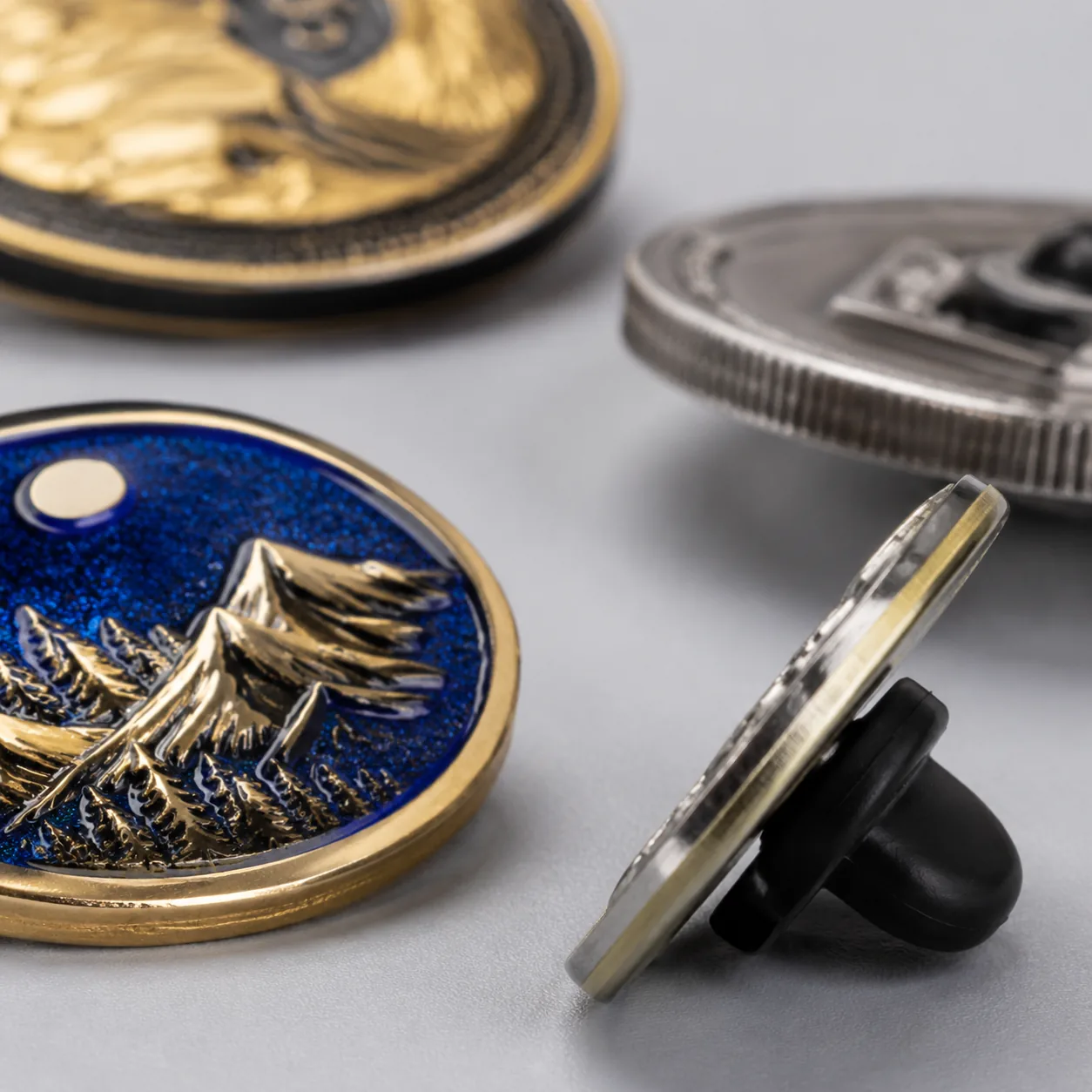
1. Decide Whether the Back Is Hidden, Functional or Visible
Rear-side design should be decided before quotation, not after the first mold proof. On metal giveaways, many post-delivery complaints involve the back: a keychain flips and exposes an unfinished casting mark, a challenge coin feels flat in the hand, a magnet looks cheap when removed from its retail card, or a licensed logo is missing the required copyright line. The back affects mold construction, item thickness, polishing access, plating coverage, attachment layout, packing protection and final inspection criteria.
Classify each SKU into one of three groups. Hidden backs are mostly covered during use, such as lapel pins worn against fabric or magnets permanently placed on a refrigerator. Functional backs carry hardware or compliance information: pin posts, brooch bars, magnet pockets, reorder codes, country-of-origin marks or copyright text. Visible backs rotate or are handled regularly, including keychains, zipper pulls, ornaments, medals, bag charms and challenge coins. Visible backs normally justify at least shallow relief; retail or collector items often justify full double-sided decoration.
For a basic lapel pin, a recessed backstamp with a plain polished or sandblasted rear is usually sufficient. For a 45-55 mm keychain, both faces are part of the user experience because the item twists on the split ring. For magnets, rear detail may seem unnecessary, but the back still matters if the product is sold loose, packed in a clear bag, or requires a clean recessed magnet pocket instead of a surface-glued strip. This classification prevents a supplier from quoting a low-cost one-sided mold and then adding rear tooling, enamel and inspection charges during approval.
2. Choose the Rear Construction by Process and Use Case
A double-sided product does not always need two fully decorated faces. Many B2B orders need brand control rather than decoration: a recessed logo, event year, reorder code, safety statement, legal line or laser-marked serial number. Full rear enamel is justified when the item flips often, is sold as merchandise, or must look complete from every angle. It adds filling, drying, cleaning, polishing and color inspection steps, so it should be specified deliberately.
The best construction depends on the base process. Zinc alloy die casting is flexible for sculpted two-sided keychains, medals, ornaments and bag charms, especially at 2.5 mm thickness and above. Brass or iron stamping is efficient for coins and pins with crisp line art, but heavy relief on both faces can reduce edge definition if the design asks the metal to move too deeply in opposite directions. Etched stainless steel can be made two-sided for flat graphic styles, but front-to-back registration is usually less precise, and very fine etched rear lines can trap plating residue or polishing compound.
| Rear-side option | Best use | Typical specification | Main trade-off |
|---|---|---|---|
| Plain polished or sandblasted back | Budget pins, internal giveaways, low-visibility magnets | 0.8-2.0 mm item thickness; no rear artwork except hardware zone | Lowest unit cost, but can look unfinished if the item rotates |
| Recessed backstamp | Brand mark, copyright, reorder ID, event year, COO mark | 0.15-0.30 mm recessed depth; 1.2 mm minimum metal text height; 0.20 mm minimum line gap | Durable and economical, but not decorative |
| Shallow 2D rear relief | Coins, medals, premium keychains, bag charms | 0.30-0.60 mm relief; 0.20-0.25 mm minimum raised line width | Adds mold time and more polishing checks |
| Rear enamel color | Two-sided keychains, charms, retail coins, licensed items | 0.25 mm minimum metal line; soft enamel fill tolerance typically ±0.10 mm | Better perceived value, higher reject risk and usually 3-7 extra production days |
| Full 3D rear relief | Commemorative coins, sculpted ornaments, premium medals | 2.8-5.0 mm thickness recommended; 3D model tolerance commonly ±0.10-0.20 mm | Best hand feel, highest tooling cost and weight |
Keep rear text larger than front text because hardware interrupts the surface. Avoid cast or stamped text below 1.2 mm high, avoid enamel-separated letters below 1.5 mm, and keep QR codes printed or laser marked unless the code is large enough to be sample-tested. For scannable QR codes, a practical minimum is about 18-20 mm square on a flat area with strong contrast; smaller molded codes are unreliable.
3. Set Thickness, Weight and Hardware Zones Early
Double-sided decoration usually requires more thickness, not just another engraved surface. A 1.2 mm iron soft enamel pin can carry front color well, but it is too thin for strong relief on both faces. For a two-sided zinc alloy keychain, 2.0 mm is a practical lower limit, 2.5 mm is safer for daily handling, and 3.0-3.5 mm is common for challenge coins with relief on both sides. Large sculpted coins or medals may run 4.0-5.0 mm, but that should be a premium decision because weight and freight increase quickly.
Use weight estimates during design approval. A 50 mm zinc alloy keychain at 2.5 mm thickness typically weighs about 28-35 g before the split ring; at 3.5 mm it may reach 42-52 g depending on cutouts and enamel coverage. A 45 mm brass coin at 3.0 mm usually falls around 38-45 g, while a 60 mm medal at 3.5 mm can exceed 70 g before ribbon or packaging. For conference giveaways, badge reels or lanyard medals, an extra 15-25 g per unit can make the item uncomfortable even if the sample feels premium.
Reserve functional metal before placing rear artwork. For keychain holes, keep at least 1.5 mm of metal from the hole edge to the outside edge on small zinc alloy items, and 2.0 mm or more on heavier daily-use keychains. For pin posts, reserve a flat soldering pad of about 5-7 mm diameter per post; do not place enamel or fine rear relief under the solder area. For magnets, use a flat pocket matched to the magnet diameter or strip size. Uneven rear relief under adhesive is a common cause of peel-off during transit or after a few weeks of use.
4. Price the Full Cost: Tooling, MOQ Tiers, FOB and Packaging
The cost increase from rear-side work is not a fixed percentage. A simple recessed backstamp may add USD 30-80 in tooling or setup and USD 0.02-0.06 per unit. Shallow rear relief may add USD 60-150 to tooling depending on size and complexity. Full rear enamel can add 15-40% to the unit price because it increases coloring, drying, cleaning and inspection labor. Two-sided 3D relief raises tooling further because the factory must machine or EDM both faces, control parting lines and leave enough access for polishing.
As FOB China references at 1,000 pcs, a 40 mm iron soft enamel pin, 1.2 mm thick, single-sided, four colors, nickel plated with one butterfly clutch, often runs USD 0.45-0.85 excluding premium packaging. Adding a recessed backstamp usually brings it to roughly USD 0.50-0.95 plus any tooling charge. A 45 mm zinc alloy keychain, 2.5 mm thick, soft enamel on both sides with a standard split ring, commonly falls around USD 1.15-2.20 FOB. A 50 mm antique brass challenge coin, 3.0 mm thick, two-sided relief with recessed enamel on one or both faces, typically ranges from USD 1.40-2.80 FOB depending on edge style, plating and packing.
| Order tier | Single-sided pin or coin | Branded-back version | Full double-sided enamel item | Typical lead time after artwork approval |
|---|---|---|---|---|
| 100 pcs | Possible for simple pins; highest unit price | Possible for simple backstamp | Possible but inefficient; sample strongly advised | Sample 5-8 days; bulk 14-22 days |
| 300 pcs | Common trial MOQ for pins, coins and magnets | Efficient for backstamp or shallow rear relief | Practical starting tier for two-sided keychains | Bulk 16-25 days |
| 1,000 pcs | Best comparison tier for FOB pricing | Tooling cost diluted | Efficient for enamel, polishing and QC sorting | Bulk 18-28 days |
| 3,000 pcs | Lower unit price; freight planning important | Good for reorder programs | Best labor efficiency but higher sorting allowance needed | Bulk 22-35 days depending on plating and packing |
Packaging must be quoted on the same basis. A plain OPP bag may add USD 0.02-0.05 per unit. A printed backing card with bag often adds USD 0.08-0.18. A velvet pouch, acrylic coin capsule, blister card, EVA tray or rigid gift box can add USD 0.20-0.80 or more. Double-sided items are often upgraded for retail, so compare total FOB including hardware and packing, not only the metal part.
5. Control Registration, Orientation and Artwork Tolerances
Two-sided designs introduce tolerance stack-up. If both faces have centered borders, portraits, logos, cutouts or text rings, specify front-to-back registration on the engineering drawing. For cast zinc alloy keychains, a practical registration tolerance is usually ±0.30 mm. For stamped brass or iron coins with stable geometry, ±0.20 mm is often achievable. For etched stainless steel or very thin parts, tolerance may be looser near cutouts or long narrow sections.
Orientation errors are preventable but common. A rear logo can be correct in the artwork file and still appear upside down when the keychain hangs from the ring. The production drawing should show hanging direction, ring position, front face and rear face in the same orientation. For coins, specify coin alignment, where the reverse is upright after a side-to-side flip, or medal alignment, where it is upright after a vertical flip. This is critical for commemorative, military, school and collector coins.
- Reserve flat hardware zones before adding rear artwork.
- Keep enamel, small text and thin raised lines at least 1.0 mm from keyring holes, magnet edges and soldered pin posts.
- Specify front-to-back registration tolerance, normally ±0.20 mm for stamped brass or iron and ±0.30 mm for cast zinc alloy.
- Mark hanging direction and reverse orientation on the engineering drawing, not only in the design file.
- Avoid rear enamel directly under soldering, adhesive, brooch bars or magnet pockets.
- Use 1.2 mm minimum height for recessed or raised metal text and 1.5 mm or larger for enamel-separated text.
- Confirm whether serial numbers are engraved, laser marked, printed or molded; each method has different durability, setup cost and lead time.
If the design uses cutouts, translucent enamel, rotating elements, spinner coins or exact symmetry, tell the factory before mold cutting. These features reduce tolerance flexibility. A 0.30 mm center shift may be acceptable on a normal badge but obvious when a front window must reveal a rear symbol or when two border rings must visually overlap.
6. Specify Finishes, Plating Thickness and Wear Expectations
Double-sided products expose more surface area to handling. Decorative plating on promotional metal items is commonly around 3-5 microns. For daily-use keychains, heavy bag charms or paid retail merchandise, 5-8 microns is a more robust target, especially for nickel, black nickel, imitation gold or rose gold. Thicker plating improves wear resistance, but it will not hide poor polishing, sharp burrs or inadequate cleaning before plating.
Finish selection affects both appearance and reject rate. Bright gold and mirror nickel show scratches, buffing waves and plating shadows easily. Antique nickel, antique brass and antique copper hide minor handling marks and make relief more readable, but they can reduce contrast on very small rear text. Black nickel looks modern but shows fingerprints and may vary slightly between plating batches. Matte finishes reduce glare but can make enamel overflow more visible along borders.
Hard enamel on both sides gives a smooth surface and better scratch resistance than soft enamel, but it requires more polishing and may soften fine rear lettering. Soft enamel gives stronger recessed color contrast and usually costs less, but dirt can collect in low areas on daily-use items. Epoxy can protect printed or soft enamel surfaces, yet on two-sided keychains it may round the edge, change hand feel and trap bubbles in dense cavities. For heavy-use giveaways, avoid large mirror-flat areas on both faces unless the buyer accepts micro-scratches visible under close inspection.
7. Lock Inspection Criteria Before Bulk Production
Double-sided items need stricter inspection than basic one-sided giveaways because there are more visible surfaces, edges, hardware points and orientation risks. For standard B2B promotional products, many buyers use general inspection level II with AQL 2.5 for major defects and AQL 4.0 for minor defects. For retail merchandise, licensed products or collector coins, tightening major defects to AQL 1.5 is reasonable, but it can add sorting labor, cost and 1-3 calendar days before shipment.
Define defects operationally. Major defects include wrong rear artwork, missing color, exposed base metal, plating blister, sharp burr, loose pin post, weak magnet adhesion, broken keyring loop, upside-down reverse orientation or registration outside the approved tolerance. Minor defects include tiny polishing marks, slight antique-tone variation, soft enamel low spots within ±0.10 mm, or small dust points not visible at a normal viewing distance of about 30-40 cm under white light.
| Inspection point | Recommended buyer specification | Typical acceptance tolerance |
|---|---|---|
| Front-back alignment | Measure from shared centerline, border or ring hole | ±0.20 mm for stamped brass/iron; ±0.30 mm for cast zinc alloy |
| Rear text legibility | Confirm smallest text on mold proof and physical sample | 1.2 mm minimum recessed or raised metal text height |
| Enamel level | Check both sides under normal white light before packing | Soft enamel fill variation ±0.10 mm; no missing color |
| Plating coverage | Inspect edges, holes, recessed rear areas and high points | No exposed base metal, blistering or burnt plating on visible surfaces |
| Hardware strength | Manual pull check for rings, posts, magnets or brooch bars | No detachment, cracked solder or rotation beyond approved construction |
| Orientation | Back design aligned to hanging direction or coin/medal flip standard | No unapproved upside-down logo or reverse face |
| Packing protection | Prevent face-to-face rubbing during transit | OPP bag, tissue divider, backing card, pouch or tray based on finish sensitivity |
A pre-production sample adds about 5-8 days, but it is strongly recommended for any double-sided item with enamel, 3D relief, serial numbers, moving parts, strict alignment or retail packaging. Keep the approved sample as the golden sample for final inspection. Photographs are useful for documentation, but they cannot fully verify weight, edge feel, enamel level, magnet seating or plating tone.
8. Send a Quote Brief That Prevents Rework
A clear RFQ should label each SKU as single-sided, branded-back, decorative-back or full double-sided. Then state the intended use: lapel pin, keychain, retail coin, magnet, ornament, medal, zipper pull or bag charm. This lets engineering recommend the correct material, thickness, attachment and packing before the quote is locked to the wrong construction.
Send vector artwork for both faces with the front and back shown in correct orientation. Include target size in millimeters, preferred thickness, base metal, plating finish, enamel type, attachment, packaging, quantity tiers such as 300, 500, 1,000 and 3,000 pcs, and the inspection standard required. If comparing suppliers, require each quotation to state whether it includes rear mold work, rear enamel, backstamp, hardware, individual packing, sample cost and lead time in calendar days.
For a safe first order, ZheCraft normally recommends a physical sample for any double-sided item above USD 1.00 FOB, any licensed design, or any product intended for resale. After approval, store the signed golden sample, final drawing, Pantone list, plating finish, thickness, hardware specification, packing method and AQL requirements together. That production file is what keeps a double-sided item consistent when reordered months later.
Have a project? Send your artwork and target quantity and we’ll reply with a detailed quotation within 12 working hours.
Ready to get this made?
Send your sketch, target quantity and ship-date. Detailed quotation in 12 hours.



