Single-Sided or Double-Sided Metal Giveaways: Buyer Decisions
1. Classify the Back: Hidden, Handled, Collectible or Functional
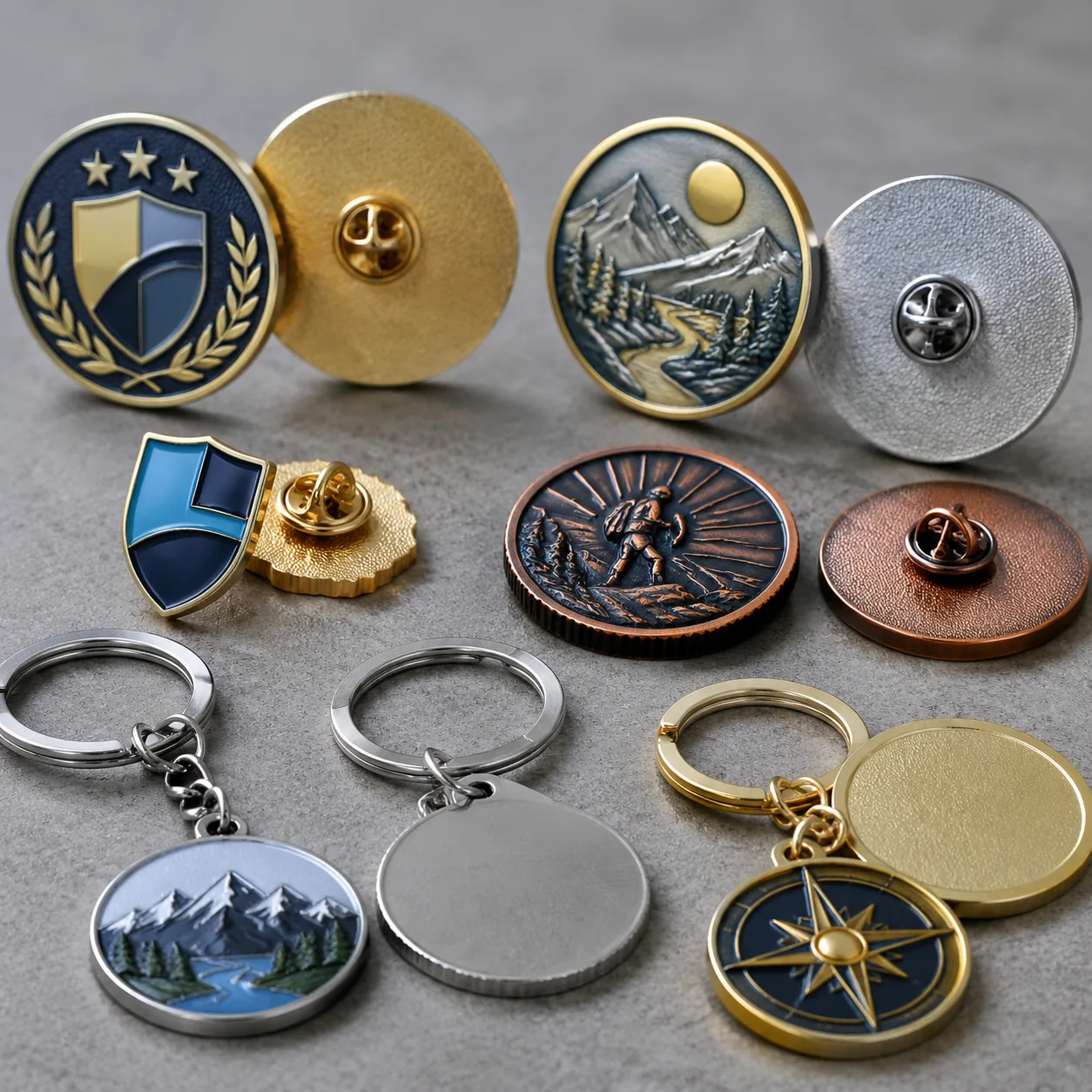
The reverse-side decision should start with use, not artwork preference. A lapel pin worn against fabric hides its back during normal use, so full reverse-side enamel or sculpted relief usually adds cost without improving perceived value. A challenge coin, metal keychain, bottle opener, luggage charm or bag tag is handled, turned over and often presented loose; in those formats, the second face can carry real buyer value. The question is not whether two sides look better on a proof. It is whether the end user will see, touch, scan or rely on the reverse side.
Separate functional reverse detail from decorative reverse detail before asking for quotes. Functional features include backstamps, country-of-origin marks, batch codes, serial numbers, QR codes, safety text, recessed magnets, anti-rotation posts, solder pads and loop hardware. Decorative features include second-side relief, soft enamel, hard enamel, UV print, texture, antique fill, epoxy or a second plating finish. These affect cost and risk differently. A shallow backstamp included in the die may add USD 0.00-0.06 per piece, while full double-sided hard enamel changes tooling, polishing, filling, rejection rate and lead time.
- Use single-sided construction for pins worn flat, backing-card giveaways and event items where the front carries the complete message.
- Use double-sided construction for handled items such as challenge coins, retail keychains, bottle openers, luggage charms and premium awards.
- Use a functional reverse when the item needs traceability, origin marking, QR scanning, reorder control, attachment control or safety text.
- Avoid full double-sided enamel on pins below 20 mm unless the reverse uses broad metal lines, few colors and no small text.
- Quote plain-back, backstamp and decorated-back versions at the same quantity tiers so the cost delta is visible.
2. Match Reverse Detail to the Product Format
A 25 mm corporate lapel pin with a butterfly clutch normally performs best as a single-sided stamped iron or brass badge with a clean plated back and optional logo backstamp. A 50 mm challenge coin normally feels unfinished with a blank reverse, especially in military, sports, membership, service-award and collector programs. A 60 mm hotel keychain, retail charm or bottle opener often benefits from double-sided detail because the buyer evaluates weight, edge finish and both faces in the hand.
Magnets and patches require a different decision. For fridge magnets, reverse decoration is normally wasted because a magnet sheet, ferrite disc or neodymium magnet covers the back and sits against the display surface. The critical specification is magnet type, pull force and adhesive bond, not reverse artwork. For PVC or embroidered patches, the practical reverse choice is backing type: sew-on, iron-on adhesive, hook-and-loop, peel-off adhesive, paper liner or molded PVC. Mixed promotional kits should not force one reverse-side rule across all SKUs; a coin, pin, magnet and patch have different contact points and different value from second-side detail.
| Product type | Typical size | Best reverse-side choice | Technical caution |
|---|---|---|---|
| Lapel pin or brooch | 18-35 mm | Single-sided front, plated back, optional backstamp or origin mark | Back is hidden; reverse enamel can interfere with posts, clutch fit or solder strength |
| Challenge coin | 38-70 mm | Double-sided relief, antique finish or relief plus recessed enamel | Keep rim height consistent within about ±0.15 mm to prevent rocking |
| Metal keychain | 35-65 mm | Double-sided for retail or premium gifts; backstamp for budget promos | Keys scratch mirror plating; antique finishes hide wear better |
| Fridge magnet | 40-80 mm | Single-sided front with magnet sheet or recessed magnet | Confirm pull force instead of decorating a covered back |
| Bottle opener | 55-90 mm | Double-sided branding with functional opener geometry | Maintain 2.2-2.5 mm local thickness around opener cutouts |
| PVC patch or charm | 40-90 mm | Single-sided molded face with selected backing | Two-sided PVC raises mold cost, thickness and edge mismatch risk |
3. Lock Construction Before Final Artwork
Back construction must be decided before final vector artwork because it affects die layout, metal flow, soldering, polishing access and inspection. A plain plated back can accept a single post, two-post anti-rotation layout, safety pin, magnet recess, laser engraving or adhesive pad. A decorated reverse needs reserved no-decoration zones for posts, rings, hinges, magnets and opener cutouts. If those zones are not planned, the factory may grind through decoration to solder hardware, creating a weak joint and a visibly damaged back.
For stamped iron or brass, double-sided relief is most stable at 1.5-3.0 mm body thickness. Relief depth of 0.30-0.50 mm per side is usually enough for readable detail without pushing metal so far that the opposite face ghosts. For zinc-alloy die casting, 3D shapes and double-sided designs are practical at 3.0-5.0 mm total thickness, with the thinnest raised wall kept at 0.8 mm or more. For etched brass, reverse detail can be clean but flatter; it suits fine logos, shallow text and simple recessed fields better than sculpted awards.
Use manufacturing limits, not only what looks sharp on screen. For common metal giveaways, raised metal borders should be at least 0.30 mm wide after polishing, recessed enamel channels should be at least 0.25 mm deep, and spacing between raised lines should be at least 0.30 mm. Raised text should be 1.5 mm high or larger on stamped metal and 1.2 mm or larger on cast zinc alloy. Laser text can be smaller, but buyer-critical text should remain readable after plating, polishing, handling and any epoxy coating.
4. Compare MOQ, Tooling, FOB Cost and Lead Time
Double-sided decoration does not double unit price, but it increases die work, alignment control, polishing time, enamel filling, rejection risk and QC hours. At 500 pieces, a 40 mm stamped iron soft-enamel item with a plain back may quote around USD 0.65-1.20 FOB per piece, depending on plating, color count and packaging. The same size with double-sided relief commonly moves to USD 0.85-1.65 FOB. Double-sided soft enamel may reach USD 1.10-2.10 FOB, and double-sided hard enamel may reach USD 1.35-2.80 FOB when both faces require multiple color fills and flat polishing.
Tooling is often the clearest difference. A single-sided soft-enamel pin die for common 20-35 mm sizes may cost USD 45-90. Double-sided stamped relief can require USD 80-180 because both faces need controlled alignment. Larger zinc-alloy keychains, bottle openers and 3D cast pieces often require USD 120-300 tooling, especially with cutouts, sidewalls, moving mold sections, raised rims or precise opener geometry. For repeat programs, amortize tooling across expected reorders instead of judging only the first purchase order.
| Spec choice | Practical MOQ | Typical FOB impact | Typical lead-time impact |
|---|---|---|---|
| Plain plated back with hardware | 100-300 pcs | Baseline | 10-18 days after artwork approval |
| Backstamp included in die | 100-300 pcs | +USD 0.00-0.06 per pc if tooling allows | Usually no extra time |
| Laser serial number or QR code | 100-500 pcs | +USD 0.05-0.18 per pc | Adds 1-3 days |
| Double-sided relief, no reverse enamel | 300-500 pcs | +15-35 percent | Adds 2-5 days |
| Double-sided soft enamel | 300-500 pcs | +25-60 percent | Adds 4-8 days |
| Double-sided hard enamel | 300-500 pcs | +35-75 percent | Adds 5-10 days due to extra polishing |
| Double-sided 3D zinc-alloy casting | 500 pcs and up | +30-80 percent | Adds 5-10 days after mold approval |
5. Control Thickness, Weight and Balance
A decorated back often pushes the design toward thicker metal, but heavier is not automatically better. A 30 mm lapel pin above about 8 g can pull on lightweight shirts or rotate if the post is poorly placed. A 50 mm challenge coin below roughly 25 g may feel underweight for an award or collector item, while 35-55 g usually feels substantial. For metal keychains, 18-45 g including ring and chain is a practical target; heavier pieces can damage pockets, phone screens, mailer inserts or neighboring products during shipment.
Balance matters whenever the attachment point is not centered. A keychain with heavy relief on one side and a small split-ring loop at the top may twist so the intended front does not face outward. A pin post should sit close to the center of mass: within about ±1.0 mm for small pins and ±1.5 mm for larger brooches is a realistic target. For two-post pins, post spacing should match both the pin size and backing-card layout, not just the visual centerline.
Specify weight as a target range, not an exact number. A realistic production tolerance is ±10 percent for zinc-alloy casting and ±5-8 percent for stamped iron or brass, depending on plating, enamel fill and polishing loss. Dimensional tolerance for common promotional metal items is often ±0.2 mm on length and width, ±0.15-0.25 mm on thickness, and ±0.3 mm on hardware placement unless tighter fixtures are quoted. If the product must stay below a postal weight band or fit a retail tray, tell the supplier before sampling; removing 3-5 g after mold cutting usually requires changing thickness, alloy, cutout area or relief depth.
6. Specify Plating, Polishing and Surface Protection
Double-sided products spend more time in finishing because both faces must be polished, cleaned, plated and inspected. Polishing can round fine raised text, thin metal borders and make enamel channels uneven. Decorative flash plating is often thin: gold-color flash may be around 0.05-0.10 microns, nickel or black nickel around 0.08-0.15 microns, and upgraded nickel, brass or antique finishes around 0.10-0.25 microns depending on the supplier and corrosion requirement. For heavy-handling retail keychains, ask whether thicker plating, clear lacquer or epoxy is appropriate, but confirm the visual trade-off before approval.
Finish choice affects defect visibility. Antique nickel, antique brass and antique copper hide minor polishing marks and make relief easier to read, especially on double-sided coins. Mirror gold, rose gold and black nickel show fingerprints, small pits, flow marks and hairline scratches more clearly, so they need better base polishing and stricter rejection criteria. Epoxy protects soft enamel from wear, but it can make shallow reverse detail look swollen if the recess is not deep enough or if the dome flows over raised lines.
- Keep raised borders at least 0.30 mm wide after polishing and plating, not just in the artwork file.
- Use antique finishes for complex double-sided relief with shadows, texture, small type or high-touch handling.
- Avoid large mirror-plated flat fields on both sides unless light hairline marks are acceptable.
- Approve plating by physical sample or master chip, not by screen color or a verbal finish name.
- Reserve epoxy for color fields with enough recess depth; shallow reverse detail can lose crispness under dome coating.
- For humid or outdoor use, request nickel-free, RoHS, REACH or salt-spray requirements before quoting.
7. Define Inspection Criteria for Both Faces
Many disputes start when the buyer approves a front-view proof but never defines reverse-side defects. The inspection plan should state whether the back is customer-facing or functional only. If the reverse is decorated, it should be judged with the same visual standard as the front. If the reverse is hidden against fabric, minor polishing waves or small contact marks may be acceptable, while hardware strength, post placement and clutch fit become the critical checks.
For general B2B promotional orders, AQL 2.5 for major defects and AQL 4.0 for minor defects is a practical baseline. Major defects should include wrong plating color, missing enamel, unreadable required text, loose hardware, sharp burrs, visible scratches longer than 3 mm, enamel overflow affecting the design, QR codes that do not scan, and reverse artwork misalignment above 0.5 mm on coins or above 0.8 mm on larger keychains. Minor defects can include dust points in enamel below 0.3 mm, slight shade variation within the approved sample range, or polishing marks visible only under strong angled light.
Functional reverse features need functional tests. QR codes should scan from 10-15 cm with a normal phone camera under office light; for reliability, keep printed or laser QR modules at least 0.35-0.45 mm after plating. Laser text should remain legible after a dry cloth rub. Soldered pin posts should pass a pull test of 3-5 kgf for standard lapel pins; heavier brooches may need multiple posts, a wider solder pad or a safety-pin fitting. Magnets should have a pull force at least four times the finished item weight for flat fridge use, and higher when the target surface is powder-coated, curved or frequently bumped.
8. Build the RFQ Around the Reverse-Side Decision
Before requesting quotes, define whether the reverse side is hidden, handled, collectible or functional. That classification drives metal thickness, die type, finish, hardware location, inspection criteria, packaging and budget. Do not apply the same back treatment to every item in a mixed promotional kit. A coin, lapel pin, keychain and magnet have different contact points, different failure modes and different value from reverse-side detail.
A complete RFQ should include front artwork, reverse artwork or backstamp, target size, thickness range, plating finish, enamel type, attachment type, packaging, quantity tiers and whether the reverse is customer-facing. When uncertain, request two quote columns: one for plain back or backstamp, and one for full double-sided decoration. This allows engineering to flag weak line widths, post conflicts, enamel-fill risks, QR-size limits, mold-cost differences and lead-time changes before sampling, when revisions are still inexpensive.
- Quote quantity breaks at 100, 300, 500, 1,000 and 3,000 pieces so tooling and setup effects are visible.
- State the required schedule, such as sample in 7-10 days and mass production in 12-25 days after sample approval.
- Define whether the approved sample controls both faces, plating shade, weight range, hardware, packaging and labeling.
- Request sample photos or video of both sides, edge thickness, hardware and packaging, not only a front-view image.
- For repeat orders, keep the die number, approved sample, plating name, Pantone references, QR file and reverse-artwork version in one reorder record.
- If budget is fixed, simplify the reverse side before reducing metal thickness, plating quality or hardware strength.
Have a project? Send your artwork and target quantity and we’ll reply with a detailed quotation within 12 working hours.
Ready to get this made?
Send your sketch, target quantity and ship-date. Detailed quotation in 12 hours.



