Should You Split a Promo Order Across Countries in 2026?
The March 2026 event scenario: one delivery date, four custom SKUs, and almost no recovery time
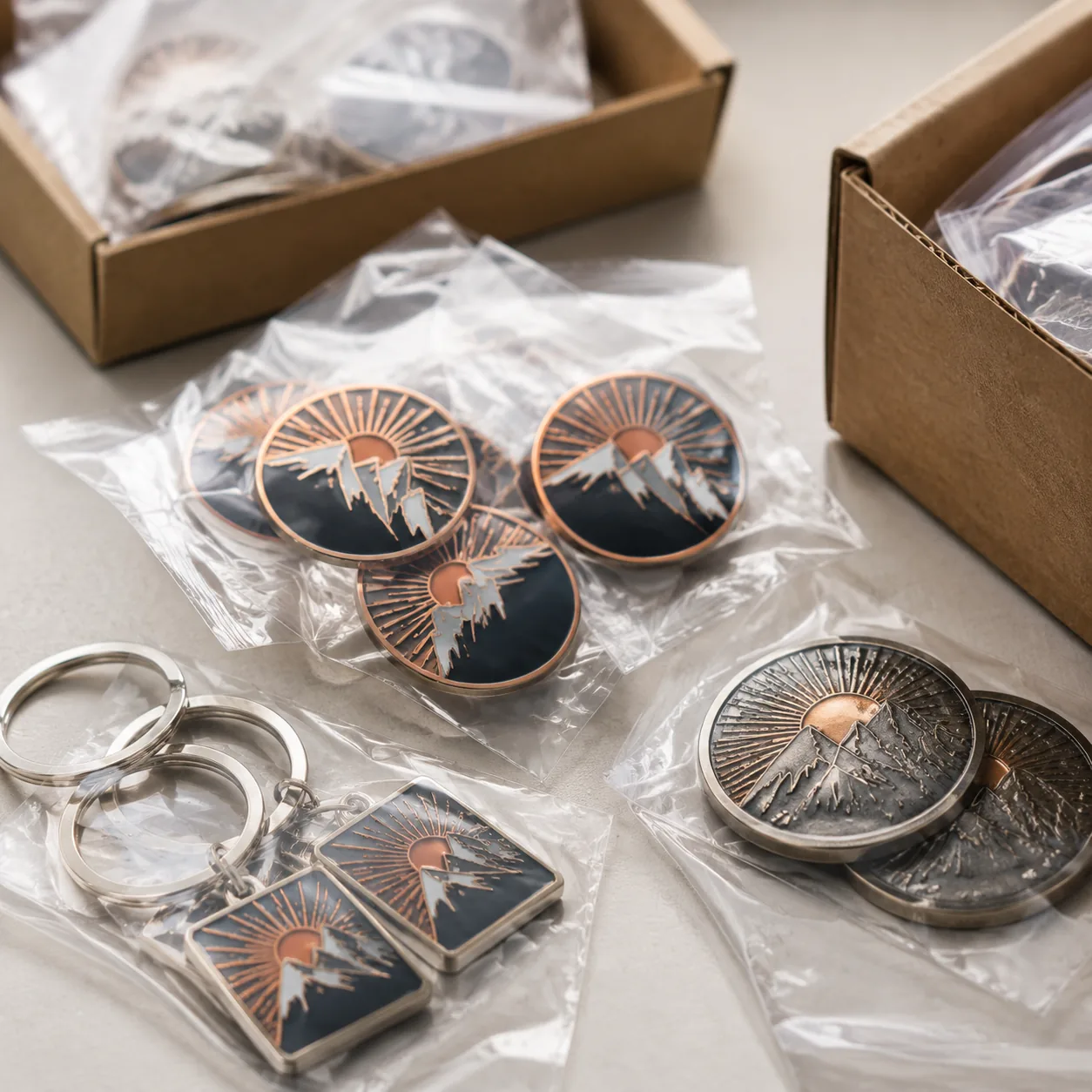
A US promotional-products distributor wins a March 2026 event program for 12,000 attendee kits. Each kit includes four branded items: a 35 mm soft enamel pin, a 45 mm zinc alloy keychain, a 75 mm woven patch, and a 20 x 900 mm polyester lanyard. All goods must arrive at one US warehouse by the first week of February, leaving roughly 3 to 5 business days for receiving, carton counts, short-ship claims, kitting, and outbound staging.
That timing changes the sourcing question. In the past, the default answer was often one China-based coordinating supplier, one consolidated shipment, and one customs entry. In 2026, that is no longer automatically the lowest landed-cost route. Buyers need to compare FOB price against tariff exposure, duplicate sample rounds, second-lane freight, added inspections, broker fees, warehouse deconsolidation, and the risk that one delayed SKU stops all 12,000 kits from shipping.
The useful question is not simply whether to move out of China. It is whether a specific product family can be sourced elsewhere without giving back the savings through more tooling, more approvals, more handoffs, and more schedule risk. In promo, metal and textile items behave very differently in tooling, tolerances, MOQ logic, and quality control. Some splits follow factory logic. Others only create expensive complexity.
Group by process family first: metal together, textiles together
For this order, the most rational split is metal versus textile, not pin versus keychain versus patch versus lanyard. Pins and keychains share die development, plating chemistry, polishing, color-fill control, attachment testing, and profile inspection. Patches and lanyards share thread or print setup, cutting, sewing or heat finishing, backing or hardware attachment, and softer dimensional tolerances. Grouping by manufacturing process reduces duplicate approvals and makes QC easier to manage.
In most 2026 buying situations, metal should stay consolidated unless volume is large enough to justify duplicate tooling and separate oversight. A 35 mm stamped iron pin at 1.2 mm thickness with bright nickel plating, two Pantone enamel fills, and a butterfly clutch follows almost the same approval path as a 45 mm die-cast zinc alloy keychain with 3.0 mm average thickness, bright nickel finish, and split ring assembly. Keeping both at one metal factory reduces plating mismatch, Pantone interpretation drift, and repeated proof cycles.
Textiles are usually the first candidates to move. A 75 mm woven patch with heat-cut edge and iron-on backing has limited tooling dependence and a broad supplier base. A 20 mm heat-transfer lanyard with a standard black safety break, metal swivel hook, and single-sided print is even easier to source because the hardware is often standard stock and setup cost is low. If any family can move cross-country without disrupting the full program, it is normally textiles.
| Item | Process family | Typical 2026 MOQ | Best sourcing logic |
|---|---|---|---|
| Soft enamel pin, 35 mm | Stamped metal, plating, enamel fill | 300-500 pcs per design | Keep with one metal factory to consolidate die cost, plating family, Pantone approvals, and pull testing |
| Zinc alloy keychain, 45 mm | Die-cast metal, plating, assembly | 300-500 pcs per design; 1,000 pcs for best pricing | Keep with same metal supplier as pin when finish, fill, or backing-card appearance must align |
| Woven patch, 75 mm | Woven textile, cut edge, backing | 500 pcs standard; 1,000-2,000 pcs for target price on custom colors | Good split candidate if landed savings survive extra inspection and freight |
| Polyester lanyard, 20 x 900 mm | Heat-transfer textile, hardware assembly | 250-500 pcs standard with stock hardware | Often the easiest SKU to quote separately because tooling is minimal and capacity is broad |
Model landed cost at set level, not just SKU FOB
Use a real cost model. For 12,000 sets in 2026, competitive FOB price bands are often as follows: the 35 mm soft enamel pin at USD 0.38 to 0.47 each for stamped iron, 1.2 mm thickness, two spot colors, and butterfly clutch; the 45 mm zinc alloy keychain at USD 0.70 to 0.86 each for die-cast zinc, bright nickel plating, and split ring; the 75 mm woven patch at USD 0.23 to 0.32 each for heat-cut edge with iron-on backing; and the 20 x 900 mm polyester lanyard at USD 0.34 to 0.46 each for single-sided heat-transfer print with black safety break and swivel hook.
At mid-range pricing, program FOB lands around USD 21,600 to 23,400 before setup costs and logistics. Add typical tooling of USD 60 to 120 for a pin die and USD 110 to 180 for a keychain mold. Pre-production sample charges are usually modest but real: USD 25 to 45 for a patch sample revision, USD 30 to 70 for a lanyard sample set, and courier cost if physical approval samples are needed.
Now test a split scenario. If a second-country textile supplier beats the incumbent by USD 0.04 on the patch and USD 0.05 on the lanyard, paper savings total USD 1,080 across 12,000 sets. But then add one extra third-party inspection at roughly USD 300 to 450, a second export lane at USD 500 to 1,000 depending on mode and carton volume, a second customs entry and broker handling at about USD 175 to 325, and domestic deconsolidation or re-kitting labor at USD 0.03 to 0.06 per set, or another USD 360 to 720. The saving can narrow to almost nothing.
That is why the right threshold is a full-set number, not a per-SKU headline. On a four-SKU promo program at this size, the split usually needs to improve landed cost by at least USD 0.08 to 0.12 per finished set, or about USD 960 to 1,440 total, before it clearly beats consolidation. Anything smaller is often just volatility masked as savings.
Lead time is the real constraint: missed cut-off is costlier than a cheap quote
A March event order is governed by calendar discipline more than unit price. For custom metal goods in early 2026, a realistic path is 3 to 5 calendar days for artwork proof and mold confirmation, 7 to 10 days for a pre-production sample, and 12 to 18 days for mass production after approval. If plating lines are congested, if assembly includes backing cards, or if factory loading is tight before holiday closures, bulk can extend to 20 to 24 days.
Textile timelines are shorter in production but not always in revision loops. Woven patches commonly need 4 to 6 days for sample and 8 to 12 days for mass production. Heat-transfer lanyards often need 3 to 5 days for sample and 7 to 10 days for production when stock hardware is used, but custom safety breaks, special buckles, or strict color matching can add 2 to 4 days.
One coordinating supplier means one artwork package, one sample-release flow, one carton-mark standard, and one shipment release. A split means separate proof interpretation, separate sample approval, separate pre-shipment inspection, and separate freight booking. None of those tasks is huge in isolation. Together, they consume the small schedule buffer that event programs rely on.
The key operational risk is dependency. If patches and lanyards arrive on time but keychains miss vessel cut-off by four days, the warehouse still cannot complete 12,000 kits. The end customer does not grade factories separately. The only KPI that matters is complete kit readiness by ship date.
- Ask for sample lead time and bulk lead time in calendar days, not broad ranges
- Freeze artwork for all SKUs before any supplier starts mass production
- Treat each proof, sample, inspection, and shipment release as a costed checkpoint
- Confirm vessel cut-off or airfreight decision date before issuing POs
- Avoid split sourcing when one delayed lane can stop final kitting
Brand consistency fails at the edges: tolerances, plating, thread, and print profile
Clients do not experience these as four unrelated products. They experience one branded kit. That is where split sourcing often disappoints even when each SKU passes its own inspection. Pantone 286 in soft enamel can read darker and glossier than Pantone 286 in woven thread, while the same blue on a heat-transfer lanyard may print slightly cooler because of fabric base color and transfer profile. Bright nickel plating can also make adjacent colors appear colder than on textile pieces.
Control that risk with measurable specifications. For metal, write the base material, finish, thickness, attachment, and inspection limits into the PO and approval sheet. A common commercial target for bright nickel on indoor-use promo items is approximately 0.03 to 0.05 microns. Outer-profile tolerance can usually be held to plus or minus 0.15 mm on stamped pins and plus or minus 0.20 mm on die-cast keychains. Thickness tolerance is often plus or minus 0.10 mm for pins and plus or minus 0.15 mm for keychains. Pin-post solder position should be checked against artwork centerline, and split-ring assembly should pass a manual pull and rotation check.
For textiles, use textile-appropriate criteria instead of metal-style cosmetic expectations. A 75 mm woven patch should typically hold finished size within plus or minus 1.0 mm, backing alignment within plus or minus 1.5 mm, and clean edge finish with no loose yarns visible at normal viewing distance. A 20 mm lanyard can usually hold width within plus or minus 0.5 mm and total cut length within plus or minus 5 mm. Hardware should open and close cleanly, heat-transfer print should show no ghosting or obvious banding, and safety-break function should be checked by sample pull.
For final inspection, AQL 2.5 major and 4.0 minor is common for commercial promo runs, but the inspection checklist should reflect the actual product. If logo text drops below 2.0 mm cap height on the patch or below about 1.2 pt equivalent line detail in the pin art, require a physical readability review at sample stage rather than approving from vector artwork alone. One supplier coordinating the mixed-media set can at least compare all physical samples side by side before bulk release. That single step often protects brand consistency better than a few cents of apparent FOB savings.
When a cross-country split is worth it
Split sourcing is not inherently wrong. It works when the split follows manufacturing logic, destination logic, or both. The strongest case is a mixed program where premium metal pieces need tight finish control and one simple textile SKU is high volume, low tooling, and operationally separate from the premium presentation.
A practical example: keep the pin and keychain with one metal supplier because they share bright nickel finish, two Pantone fills, and matched backing-card presentation. Quote the lanyard separately if it is a utility SKU with one-color or simple heat-transfer art, standard black breakaway, standard swivel hook, and individual polybag packing. In that case, the textile split does not interfere with the premium look of the sponsor-facing items.
Another valid case is regional distribution. If 8,000 full kits ship to the US but 4,000 lanyards are for an EU event leg with different language inserts, local warehousing, or different replenishment timing, placing that textile volume closer to destination may reduce double handling and storage cost. The split then exists because of logistics and final use, not because every non-China quote is assumed to be better.
| Decision factor | Keep consolidated | Split across countries |
|---|---|---|
| Order size under 5,000 sets | Usually best choice | Rarely worth duplicate setup and admin |
| Premium metal finish with matched presentation | Best choice | Only if one party controls physical sample matching and final QC |
| Simple textile SKU above 10,000 pcs | Possible | Often worth quoting as a controlled split |
| Origin-level set packing or shared backing cards | Best choice | Weak option because packing ownership becomes unclear |
| Different destination regions or replenishment lanes | Possible | Often a valid reason to split |
| Less than 7 days warehouse buffer before event | Best choice | High risk unless both lanes are already proven |
Use a pre-RFQ screen: MOQ tiers, freight logic, and ownership
Before sending RFQs, build a comparison sheet with at least nine fields: USD FOB or ex-works price, tooling cost, sample charge, MOQ, sample lead time, bulk lead time, carton dimensions, gross carton weight, and estimated freight plus customs cost. Add two control fields that buyers often skip: destination handling or re-kitting cost, and schedule-risk score. That forces the team to compare total program economics instead of chasing the lowest unit quote.
MOQ friction matters more than many buyers expect. Metal factories commonly quote 300 to 500 pcs MOQ per design for simple pins and 500 pcs or more for keychains, with the best pricing usually starting around 1,000 pcs per design. Textile suppliers may offer 250 to 500 pcs MOQ for standard lanyards with stock hardware, but woven patches and custom thread-color combinations often need 1,000 to 2,000 pcs per design or colorway to reach target pricing. If the event has sponsor versions, language variants, or attendee tiers, a split can create uneven leftovers and expensive overbuys.
Ownership must also be explicit before POs are placed. Confirm who holds the master physical color standard, who prints or supplies backing cards, who approves carton marks and shipping labels, who books freight, and where final set packing occurs. Unowned tasks become delay points, and delay points erase small sourcing gains.
A useful 2026 filter is simple: reject a split unless two conditions are true at the same time. First, the affected family shows modeled landed savings of at least 5 to 8 percent after inspection, freight, customs, and warehouse handling. Second, a five- to seven-day slip in that lane does not create a single-point failure for event delivery.
A practical decision rule for your next mixed promo order
Start by issuing RFQs by process family: metal, textile, and packaging. Require every supplier to quote the same fields: USD FOB price, MOQ, tooling, sample charge, sample lead time in days, bulk lead time in days, packing method, carton dimensions, gross weight, and inspection standard. If you are evaluating a split, also require each party to state who owns the master color standard, who owns backing cards or inserts, and whether final packing happens at origin or after import.
Then separate must-match elements from acceptable variance. Must-match normally includes logo proportion, primary Pantone shades, plating family, attachment style, and any presentation detail the client will see side by side. Acceptable variance may include backing-paper shade, polybag type, or slight thread-texture differences on a utility accessory. Buyers who define that line early cut sample loops and shorten approvals.
Finally, price the program two ways: fully consolidated and process-split. If the split model does not beat consolidation on landed cost, schedule reliability, and approval workload together, keep the order under one coordinating supplier. If it does win, split only the lowest-risk family first, usually simple textiles, rather than fragmenting the entire project on the first attempt.
- Build RFQs around process families, not just catalog item names
- Request MOQ tiers, tooling, sample charge, and lead times in days for every SKU
- Define must-match brand elements before any proofing starts
- Model landed cost with inspections, broker fees, freight, duty, and re-kitting included
- Assign one owner for final packing and one owner for color-standard control
- Split only when savings are clear and a 5-7 day lane slip will not break the event date
Have a project? Send your artwork and target quantity and we’ll reply with a detailed quotation within 12 working hours.
Ready to get this made?
Send your sketch, target quantity and ship-date. Detailed quotation in 12 hours.



