Should You Split a 300-Piece Order Across Multiple SKUs?
Why a 300-piece split order gets expensive faster than buyers expect
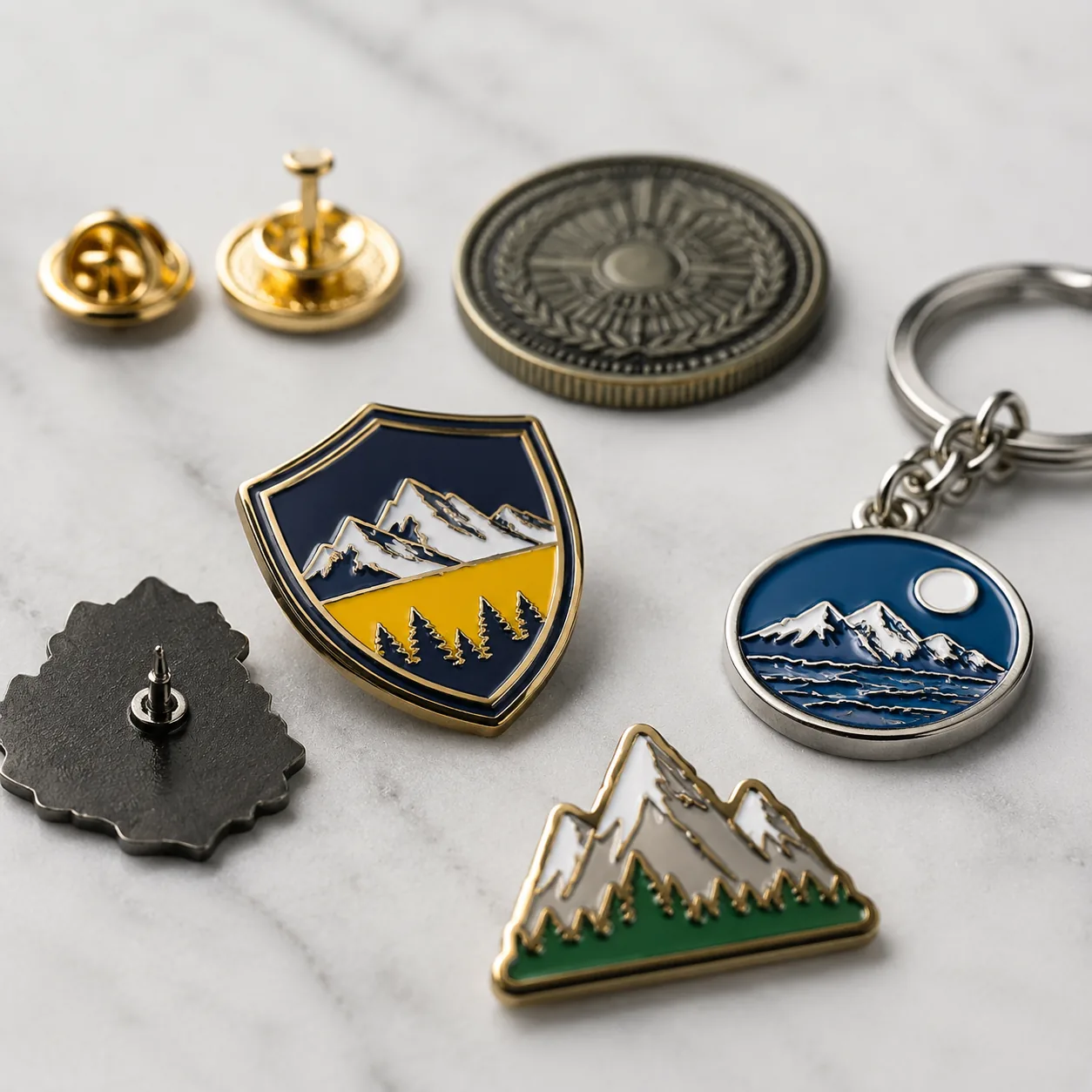
A 300-piece custom promo order feels substantial on the buying side, but for a factory producing metal pins, keychains, coins, badges, or tags, it is still a short run. Once those 300 units are divided into three, four, or six SKUs, fixed costs stop being shared efficiently. Each SKU may need its own die line review, sample proof, plating setup, color-fill controls, counting plan, and final pack-out segregation. The total order quantity stays at 300, but the factory workload starts to resemble several micro-orders.
The biggest planning mistake is to treat every SKU split as only an artwork change. In practice, a new SKU often changes the process route. A different outer silhouette usually needs a new stamping die. Deeper relief, open cutouts, or undercut areas may force a move from stamped iron to zinc alloy die casting. A different attachment such as a magnet, split ring, safety pin, or rubber clutch changes assembly labor and increases the chance of mixed hardware during packing. Even if the artwork files arrive together, production does not behave like one simple lot.
The economics improve only when all SKUs stay on one production platform: same size family, same base metal, same thickness, same finish, same attachment, same backing card dimensions, and similar artwork complexity. For example, four enamel pin designs at 30 mm, 1.2 mm thick stamped iron, bright nickel plating, soft enamel fill, butterfly clutch, and one 90 x 55 mm card format can usually be managed as one disciplined project. By contrast, mixed plating, mixed hardware, epoxy on one SKU, glitter on another, and retailer-specific assortment packing turn one PO into a cluster of exceptions.
For most small-MOQ buyers, the cheapest variety comes from changing the visible message layer rather than the physical platform. Different face artwork, variable numbering, printed inserts, or different backer cards can create useful assortment without forcing the supplier to retool metalworking, replating, and re-assembly for every design.
When splitting 300 pieces makes commercial sense
A split order is usually viable when the designs are modular rather than physically different products. Common workable structures are 3 SKUs x 100 units, 4 SKUs x 75 units, or at most 5 SKUs x 60 units. At those levels, proofing and pack-out are still manageable if the specs stay aligned. In 2026 sourcing terms, many factories can still quote competitive FOB pricing when each SKU shares one finish, one attachment, one card size, and no special packing logic.
A practical example: four pin SKUs at 75 pieces each, all 28-32 mm, 1.0-1.2 mm stamped iron, bright nickel, four standard Pantone fills, butterfly clutch, and individual OPP bag. Even if each outline needs a separate die, polishing, plating, filling, and counting remain reasonably standardized. That is very different from a 6-SKU split at 50 pieces each with sizes from 25 mm to 50 mm, mixed black nickel and imitation gold, one magnet version, one glitter version, one epoxy dome, and two backing card sizes. That second scenario should be expected to price like six separate low-volume jobs.
As a rule of thumb, metal items become noticeably inefficient below about 50 units per SKU. At that point, fixed labor for setup, edge polishing, color filling, inspection, and hand counting dominates the piece price. Textile-based promo goods such as woven patches, printed inserts, paper cards, or sublimated straps tolerate lower per-SKU quantities better because tooling is lighter or absent and changeovers are shorter.
If the goal is cost control, 3 SKUs of 100 or 4 SKUs of 75 usually outperform 6 SKUs of 50. The difference is not only piece price. It also affects proof cycle time, defect exposure, and the probability of assortment errors during final packing.
Which specifications drive cost fastest on low-volume multi-SKU orders
Tooling is the first cost driver. For 2026 FOB sourcing, a simple stamped iron die for a pin or tag commonly costs about USD 35-70 per design. A zinc alloy die-cast mold for deeper relief or more complex outlines more often lands at USD 80-150 per design. Challenge coins often need front and back dies, typically around USD 45-95 per side for standard 38-45 mm diameters. On a 300-piece order, adding three or four extra tools can erase most of the savings buyers expect from combining SKUs under one PO.
Finish variation is the second driver. Bright nickel, imitation gold, black nickel, antique brass, antique copper, dyed black, and dual plating are not operationally interchangeable. Decorative plating on promo metal goods often falls in the 0.03-0.08 micron range, sometimes over a copper strike or nickel flash, then sealed with a clear lacquer when better tarnish resistance is required. Mixing finishes on small lots creates extra rack changes, more appearance checks, and higher risk of shade mismatch between lots.
Artwork detail is the third driver. For soft enamel goods, most factories prefer minimum raised metal line width of 0.25-0.30 mm, minimum recessed channel width of 0.30 mm, and practical minimum text height around 1.2-1.5 mm depending on font weight. Below those limits, polishing can wash out edges and color filling becomes less stable. If one SKU pushes 0.20 mm lines, tiny serif text, or fragile bridges while the others do not, that single design can delay the whole approval cycle.
Packing complexity is the fourth driver. Plain OPP bag packing adds little labor. Custom backer cards, barcode labels, retailer carton marks, exact-count assortment kits, and inner-box sorting can add USD 0.05-0.25 per unit on a 300-piece order because the work is mostly manual. On small split orders, pack-out is often the hidden cost center rather than the metal component itself.
| Variable | Lower-risk spec | Higher-risk spec | Typical 2026 impact |
|---|---|---|---|
| Tooling | Shared profile family or reused base shape | Unique outline or separate die/mold per SKU | USD 35-150 extra per design |
| Dimensions | Same size family, overall tolerance +/-0.5 mm | Mixed diameters, lengths, or thicknesses | About 3-10% higher unit cost |
| Plating | One finish across all SKUs | Mixed nickel, gold, black nickel, antique, dyed black | Extra setup and more appearance-control labor |
| Artwork detail | 0.25-0.30 mm lines and simple fills | Tiny text, narrow channels, glitter, epoxy, cutouts | Longer proofing and higher reject risk |
| Attachment | One clutch, ring, or magnet type | Mixed hardware across SKUs | Added assembly and sorting cost |
| Packaging | One card size and one bag format | SKU-specific cards, labels, and assortments | USD 0.05-0.25 more per unit |
The cheapest way to create variety without rebuilding the product
The most efficient structure is one master specification with front-art variation only. For example: 30 mm soft enamel pin, 1.2 mm stamped iron, bright nickel, four to six Pantone colors, butterfly clutch, one OPP bag, one 90 x 55 mm backing card, and finished outline tolerance of about +/-0.15 mm on critical features or +/-0.30 mm overall depending on shape. Under that structure, the supplier changes the face design while the manufacturing recipe stays stable.
Color discipline matters more than many buyers assume. If four SKUs can share the same red, navy, white, and black instead of each requiring its own custom palette, the fill station runs faster and sample approval is easier. On a 300-piece order, one disputed Pantone match can consume the margin on the whole PO because a small remake still triggers full handling, sorting, and reship labor.
Where possible, vary the lowest-cost visible layer rather than the hardware body. A common keychain frame can often carry different printed inserts, epoxy stickers, laser serials, QR codes, or region-specific backing cards without requiring multiple molds. That approach often keeps the project within the original budget instead of pushing total cost 15-35% higher.
A useful buyer test is simple: if the end customer still perceives meaningful variety while the metal body stays the same, keep the body fixed and change only what is cheap to print, label, or personalize.
Checklist before approving a split-SKU 300-piece order
- Keep all SKUs on the same base spec: material, thickness, finish, attachment, and packaging format.
- Target at least 50 units per SKU; 75-100 per SKU is safer for metal goods.
- Hold the size family tight, ideally within +/-0.5 mm overall across related SKUs.
- Confirm whether each design needs a separate die or whether one base outline can be reused.
- Standardize the Pantone palette so multiple SKUs share the same core colors.
- Set manufacturable artwork limits before proofing: 0.25-0.30 mm metal lines, 0.30 mm channels, 1.2-1.5 mm text height.
- Quote two structures: one harmonized split version and one fully separated by SKU.
- Define packing at RFQ stage, including exact counts, barcode labels, assortments, and carton marks.
- Agree inspection criteria in writing, including dimensional tolerance, cosmetic standard, hardware checks, and AQL.
- Clarify whether partial shipment is allowed if one SKU misses the main schedule.
How split orders change lead times in practice
On straightforward custom metal goods, schedule pressure usually shows up first in pre-production rather than on the line. A simple single-SKU pin order often needs 2-4 days for digital proofing, 3-6 days for die making, and 7-10 production days after final approval. That places many standard jobs around 14-20 calendar days before transit if no pre-production sample is required.
Multi-SKU orders add friction mainly in approval and final pack-out. Each design must be checked for spelling, die line accuracy, Pantone callouts, recessed areas, attachment placement, cutout strength, and text manufacturability. If just one SKU has a weak bridge, over-detailed border, or tiny reversed text, release of the full PO may stall while artwork is revised. On 300-piece jobs, one problematic design can hold back several otherwise ready SKUs because factories prefer to plan plating and assembly together.
Final packing also becomes less linear. Stamping or casting can be grouped, but polishing, plating inspection, color fill verification, card matching, and exact counting still happen by SKU. If the order includes assortment packing, retail labels, or region-specific cards, final inspection and pack-out commonly add 1-3 extra days even at only 300 total units.
For 2026 planning, a well-harmonized 300-piece split order is often realistic at about 16-24 calendar days after final approval. A fragmented structure with multiple tools, mixed hardware, and exact-count assortment packing can move into a 22-32 day range. Rush service exists, but on split jobs it usually increases the exact risks buyers are trying to avoid: color inconsistency, wrong assortment counts, and labeling mistakes.
How to compare quote structures fairly
Do not compare suppliers on total PO value alone. Ask for tooling by SKU, piece price by SKU, plating or hardware surcharges, packaging charges, exact-count or assortment fees, sample cost if any, and stated trade term such as EXW, FOB, or DDP. A quote that looks slightly higher can still be commercially safer if it clearly states tolerances, lead times, and packing assumptions instead of hiding them inside a blended unit price.
For standardized custom metal pins at 300 pieces total, 2026 FOB pricing commonly falls around USD 0.45-0.95 per piece when specs are harmonized and artwork is straightforward. A 4-SKU split at 75 pieces each can still remain near that range if dies are simple and all SKUs share one finish and one card format. A 6-SKU split at 50 pieces each with mixed plating, custom cards, or multiple attachments can easily rise to USD 1.05-1.55 FOB before freight, duty, or destination handling.
For zinc alloy keychains or heavier die-cast pieces, 300-piece total pricing is more often around USD 0.95-1.90 FOB depending on size, attachment, relief depth, and plating. Challenge coins in the 38-45 mm range commonly land around USD 1.20-2.60 FOB on shared specs, then rise materially when each SKU adds separate edge treatment, both-side complexity, epoxy, or presentation box packing.
Also verify quantity tolerance and counting assumptions. Many factories reserve an overrun or underrun allowance of about +/-3% to 5% on custom small orders unless exact count is written into the PO. If you need precise counts by SKU for retailer kits, event packs, or distributor bundles, state that at RFQ stage. Exact count by SKU is a chargeable service because it adds recounting, relabeling, and carton verification labor.
The quality risks that appear most often on split low-MOQ orders
The most common failure is not a catastrophic defect but inconsistency across SKUs that are meant to look like one coordinated set. Nickel tone can vary slightly between plating windows. The same Pantone can appear different when one design has broad fill areas and another has narrow channels. Edge polish often looks cleaner on a simple round pin than on a complex silhouette with multiple inside corners. Buyers notice those differences immediately when the products are merchandised together.
The second major risk is pack-out error. Once several SKUs share one PO, the weak point often shifts from manufacturing defect to sorting defect: wrong backer card, wrong barcode label, wrong hardware, mixed inner-pack counts, or swapped variants in a master carton. On a 300-piece assortment order, one carton-level error can disrupt a launch because there is usually no surplus inventory to absorb the mistake.
Controls should therefore cover both product quality and assortment accuracy. Reasonable controls for custom metal goods include approved artwork for each SKU, dated color approvals, dimensional checks on diameter or length, plating confirmation, hardware pull or twist checks where relevant, and final inspection to an agreed AQL. For routine promo goods, many buyers accept critical 0, major 2.5, minor 4.0. For retail assortments, collector sets, or brand-sensitive launches, a tighter plan such as critical 0, major 1.0, minor 2.5 is easier to defend because pack accuracy matters as much as surface finish.
The operational takeaway is simple: on split low-MOQ orders, QC must inspect the collection logic, not only the individual unit. A pin can meet dimensional tolerance and still fail the order if it is mounted on the wrong card or packed into the wrong assortment.
What to do before you place the PO
Start with one blunt internal question: do you need multiple physical products, or only multiple messages? If the answer is messaging, keep the hardware identical and vary only the insert, front print, serial code, or backing card. That is usually the safest route for protecting budget, schedule, and SKU accuracy on a 300-piece order.
Then issue the RFQ in two versions. Version A should request one harmonized platform with artwork variation only. Version B should request the exact split your team wants, including any different finishes, attachments, packaging, or assortment rules. The side-by-side comparison makes the cost of variety visible instead of burying it inside one blended quote.
Before award, ask the supplier to state the commercial breakpoints in writing: minimum units per SKU, tooling count, proofing days, production days, finish controls, dimensional tolerances, exact-count packing assumptions, AQL standard, and whether partial shipment is permitted. If those answers are specific, a 300-piece split order can work. If the answers stay vague, simplify the structure before a small order turns into an avoidable cost and schedule problem.
Have a project? Send your artwork and target quantity and we’ll reply with a detailed quotation within 12 working hours.
Ready to get this made?
Send your sketch, target quantity and ship-date. Detailed quotation in 12 hours.



