Shipping Specs for Custom Promo Orders: Prevent Freight Surprises Before PO Release
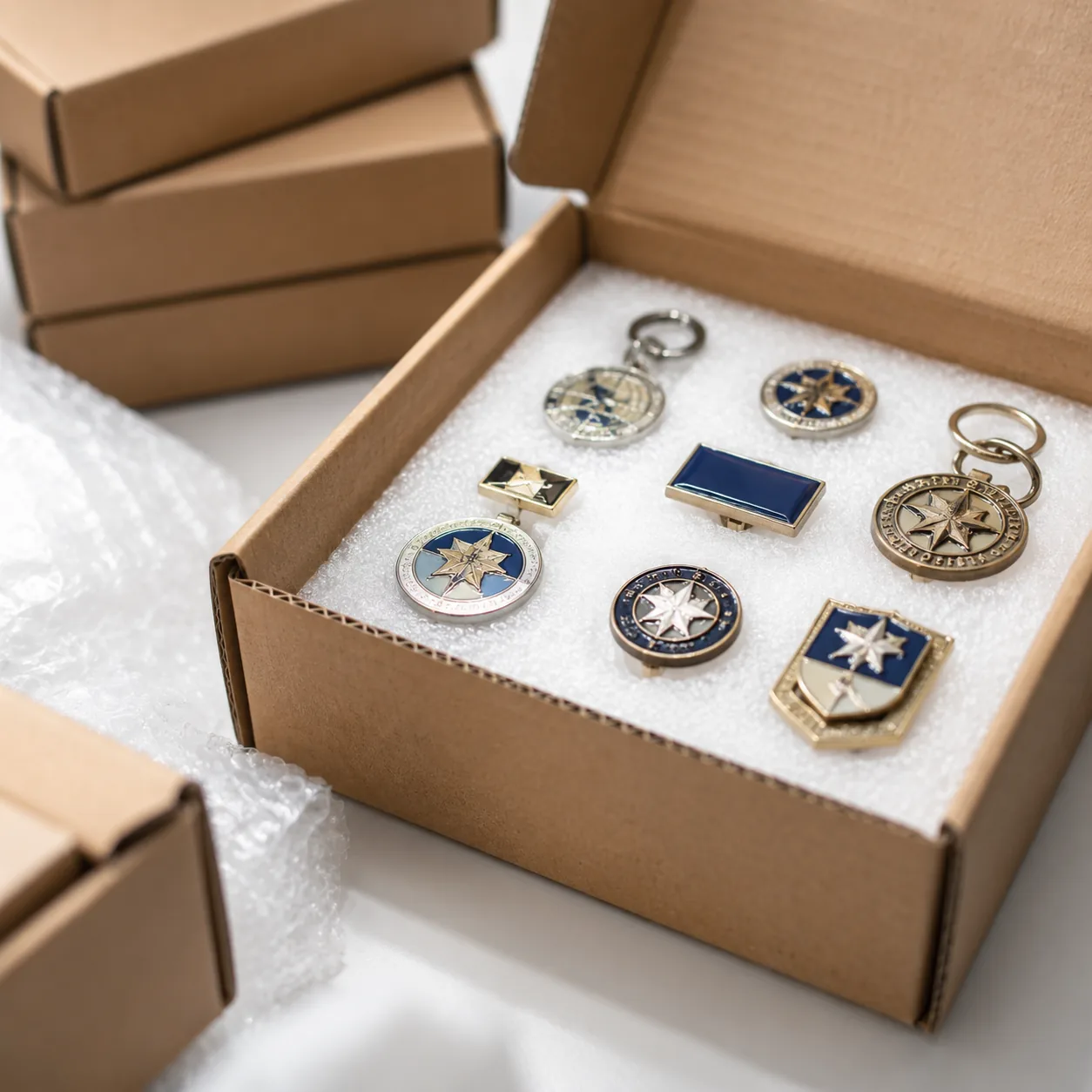
Freight Risk Starts Before the Product Is Packed
A common sourcing failure appears after the golden sample is approved: the buyer budgets from the unit FOB price, then learns that the order ships in more cartons than expected or is billed by dimensional weight instead of actual weight. For event-driven orders, that gap can turn a 20-day production run into a missed launch because air freight, customs data, and split shipments are discussed only after cartons are sealed.
Small promotional products are not automatically cheap to ship. A 25 mm soft enamel pin may weigh 6 to 9 g loose, but the shipped unit can reach 12 to 18 g once a rubber clutch, 300 gsm backing card, OPP bag, barcode label, inner box, desiccant, and export carton share are included. Acrylic keychains are lighter, but retail cards and protective film increase carton volume. For courier and air cargo, volume often drives the bill.
Treat shipping data as part of the RFQ, not as a post-production detail. A useful quote should state unit FOB price, MOQ tier, Incoterm and named place, packed unit weight, pieces per carton, carton dimensions, gross carton weight, production lead time, inspection point, and proposed shipment method. If the supplier cannot estimate these values within a practical range before mass production, the landed-cost quote is not yet reliable.
Quote the Packed Unit, Not the Loose Item
Buyers often request pricing for a 30 mm pin, 50 mm keychain, or 45 mm challenge coin, but freight is calculated from the packed unit. The packed unit includes the item, attachment, retail card or pouch, label, inner carton, and master carton. It also determines barcode readability, warehouse put-away space, carton count, and whether goods survive parcel handling.
For enamel pins, a loose packed unit is commonly one pin in a 60 x 80 mm OPP bag with butterfly clutch or rubber clutch. A retail unit may use a 55 x 85 mm backing card in 300 to 350 gsm paper plus an OPP bag. The card should leave at least 3 to 5 mm clearance around the pin face and post so stacked packs do not puncture or bend. For brooches above 35 g, a 70 x 90 mm card or small paper box may be safer, but carton volume increases quickly.
For challenge coins, packaging can change freight more than the coin specification. A 50 mm zinc alloy coin at 3 mm thickness usually weighs 45 to 60 g. An acrylic capsule adds about 8 to 15 g, a velvet pouch adds 5 to 12 g, and a magnetic gift box can add 50 to 100 g. If the order ships by courier, the gift box may add more delivered cost than the metal upgrade itself.
| Product and packing style | Typical packed unit weight | Typical carton loading | Specification risk |
|---|---|---|---|
| 25 to 30 mm enamel pin, OPP bag only | 7 to 12 g | 1,000 to 2,000 pcs/carton | Loose clutches can scratch plating if not separated |
| 30 to 40 mm pin with backing card | 12 to 20 g | 500 to 1,000 pcs/carton | Card size may push billing to dimensional weight |
| 50 mm challenge coin in OPP bag | 50 to 70 g | 200 to 400 pcs/carton | Carton can exceed safe manual handling weight |
| 50 mm coin in capsule and gift box | 110 to 170 g | 50 to 120 pcs/carton | Air freight can exceed the product cost on low-value programs |
| PVC or acrylic keychain on retail card | 18 to 45 g | 300 to 800 pcs/carton | Large cards create void space and crush risk |
Set MOQ, Lead Time, and FOB Tiers Together
MOQ and price tiers should be quoted with packing and lead time attached. A 100-piece trial order may use courier-ready packing and digital proof approval. A 5,000-piece order may require mold scheduling, bulk material purchase, printed cards, export cartons, and third-party inspection. The unit price alone does not show those operational differences.
For custom enamel pins, common MOQ tiers are 100, 300, 500, 1,000, and 5,000 pieces. Typical FOB China price ranges are about USD 0.45 to 1.80 per piece for 20 to 40 mm pins, depending on mold size, plating, enamel count, epoxy, attachments, and card packing. Normal production after artwork approval is 12 to 18 calendar days for simple soft enamel pins and 15 to 22 days for hard enamel or epoxy programs. Add 2 to 5 days if custom backing cards, barcode labels, or special clutches must be sourced.
For keychains, common FOB ranges are USD 0.55 to 2.50 for acrylic, PVC, zinc alloy, leather, or mixed-material styles. Lead time is usually 15 to 25 days after approved artwork and mold. Challenge coins are often USD 1.20 to 5.50 FOB for 40 to 60 mm sizes, depending on thickness, 2D or 3D relief, edge cutting, enamel, numbering, plating, and packaging. Coins commonly need 18 to 30 days because molds, die-striking, plating, coloring, polishing, and inspection cannot be compressed safely.
| Item type | Practical MOQ tiers | Typical FOB China range | Normal production lead time |
|---|---|---|---|
| Soft enamel pin, 20 to 40 mm | 100 / 300 / 500 / 1,000 / 5,000 pcs | USD 0.45 to 1.80/pc | 12 to 18 days after artwork approval |
| Hard enamel pin with card | 300 / 500 / 1,000 / 5,000 pcs | USD 0.75 to 2.40/pc | 15 to 22 days after artwork approval |
| Acrylic or PVC keychain | 300 / 500 / 1,000 / 3,000 / 5,000 pcs | USD 0.55 to 2.50/pc | 15 to 25 days after artwork approval |
| Challenge coin, 45 to 60 mm | 100 / 300 / 500 / 1,000 / 3,000 pcs | USD 1.20 to 5.50/pc | 18 to 30 days after artwork approval |
| Mixed promo kit with retail packing | 500 / 1,000 / 3,000 / 5,000 pcs | Quote by bill of materials | 22 to 35 days after all components are approved |
Choose Incoterms Before Comparing Suppliers
A factory quote is incomplete unless the Incoterm and named place are stated. EXW Yiwu, FOB Ningbo, FOB Shanghai, CIF Los Angeles, and DDP Chicago are different commercial offers. Two suppliers may quote USD 0.62 per pin, but one may include export handling to Ningbo port while another expects the buyer or forwarder to collect goods from the factory gate.
FOB is often the cleanest comparison point for sea freight and many air freight programs because the factory handles China-side export procedures and delivers cargo to the forwarder at the named port. EXW can look cheaper by USD 0.02 to 0.08 per piece on small metal items, but the forwarder then charges pickup, export declaration, local handling, and sometimes document correction. DDP is convenient for event teams and distributors, but it hides freight, duty, customs risk, delivery appointment rules, and remote-area surcharges inside one price.
For a 5,000-piece enamel pin order, China-side FOB handling may add roughly USD 80 to 180 per shipment depending on carton count, port, and paperwork. That cost is usually easier to control than asking an express courier to collect EXW cartons without clear HS code, declared value, country-of-origin statement, and packing data. For orders above 10,000 pieces or multi-SKU promo kits, quote FOB plus a separate forwarder estimate so product and logistics changes remain visible.
- State the Incoterm and named place, such as FOB Ningbo or EXW Yiwu, not just FOB or EXW.
- Confirm whether the quote includes export carton marks, commercial invoice, packing list, customs declaration support, and export license handling.
- Separate product unit price from freight so carton-count changes do not hide margin loss.
- Define who pays for China local pickup, port handling, export declaration, destination customs clearance, duty, and tax.
- For DDP quotes, ask whether duties, remote-area fees, delivery appointments, address correction, and failed delivery are included.
Calculate Dimensional Weight Before Approving Packaging
Courier and air carriers charge by the higher of actual weight or dimensional weight. Dimensional weight is commonly calculated as length x width x height in cm divided by 5,000 for courier shipments; some air lanes or forwarders use 6,000. A carton measuring 50 x 40 x 40 cm has 80,000 cubic cm. At a divisor of 5,000, it bills as 16 kg even if the actual gross weight is 12 kg.
This is why backing cards, foam inserts, capsules, and rigid gift boxes need freight approval before mass production. A larger card that adds only USD 0.05 to the unit cost may reduce carton loading from 1,000 to 600 pieces. If the carton is billed by volume, freight per piece can increase more than the packaging cost. Distributors often discover this too late because the end client has already approved the retail presentation.
When packaging is not yet locked, request two packing simulations: the safest retail presentation and the most freight-efficient acceptable option. For complex orders, a practical packing trial uses 20 to 50 finished units stacked in the proposed inner carton. The factory should estimate compression, void space, gross carton weight, barcode orientation, and whether carton fill rate exceeds 85 percent without pressing products hard enough to bend cards or crack acrylic.
| Freight factor | Buyer specification to request | Practical target |
|---|---|---|
| Export carton size | Sealed length, width, and height in cm | Tolerance within plus or minus 10 mm per side |
| Gross carton weight | Actual kg including products, inner boxes, tape, and labels | 8 to 18 kg for normal hand-loaded cartons |
| Dimensional weight | Carton cm divided by carrier divisor | Use divisor 5,000 for courier estimates unless the forwarder confirms otherwise |
| Carton compression | No crushed retail packs after stacking | 24-hour stack test at 3 cartons high for fragile retail packaging |
| Carton fill rate | Avoid large voids and uncontrolled movement | Target above 85 percent filled volume without product pressure |
Specify Cartons, Labels, and Transit Protection
Export cartons for pins, coins, keychains, magnets, patches, and lanyards are usually 5-ply corrugated board for international shipments. For dense metal goods, specify double-wall board or higher burst-strength cartons when gross carton weight exceeds 15 kg, especially for sea freight consolidation. Courier parcels above 18 kg are more likely to be dropped, re-taped, or split during sorting.
A practical master carton for small metal promo products is usually between 35 x 30 x 25 cm and 45 x 35 x 35 cm. Larger cartons may reduce carton count in the factory, but they are harder to handle and weaker at the corners. For challenge coins, the limit is safe lift weight, not volume. Five hundred loose 60 g coins already weigh 30 kg before inner packaging, which is unsuitable for normal parcel handling.
Carton marks should be specified, not improvised. At minimum, require item code, PO number, SKU, carton number, quantity, gross weight, net weight, country of origin if required, and handling marks such as Keep Dry. If retail cartons or inner packs need barcode labels, set placement tolerance within plus or minus 3 mm and require a scan test before shipment release. A wrong barcode or missing origin label can delay a shipment as effectively as a product defect.
- Use 5-ply export cartons for standard courier or air shipments and double-wall cartons for dense coin or mixed-metal orders above 15 kg per carton.
- Limit gross carton weight to 8 to 18 kg unless the receiving warehouse approves heavier handling.
- Require inner cartons, dividers, sleeves, or individual bags when plated metal surfaces can rub during transit.
- Add silica gel or desiccant for sea freight or humid storage, especially for nickel, gold, black nickel, antique brass, painted iron, and paper cards.
- Define transit acceptance: no torn OPP bags, bent backing cards, cracked acrylic boxes, loose clutches, unreadable labels, or carton seam failure.
Plan Split Shipments Before Cartons Are Sealed
Split shipments are useful when launch stock, samples, or event quantities must arrive before the full order. The error is deciding after packing. If 2,000 pins from a 20,000-piece order must ship by courier and the balance by sea, the packing list, carton numbering, labels, invoice values, and sometimes retail barcodes should reflect the split before mass packing starts.
A common split is 10 to 20 percent by courier or air freight and 80 to 90 percent by sea. For example, a brand may courier 1,000 lanyards and 500 pins for a launch event, then sea ship the remaining 9,000 lanyards and 4,500 pins for regional replenishment. This protects the event date without paying express rates on the full order.
The trade-off is control. Each shipment needs its own packing list, commercial invoice, carton marks, tracking number, and QC release. If the same PO has mixed destinations, apply inspection sampling to each shipment lot, not only to the combined production batch. Otherwise one warehouse may receive all borderline defects while another receives the clean cartons.
| Shipment plan | Best use case | Typical transit after QC release | Main risk |
|---|---|---|---|
| 100 percent courier | Samples, urgent event stock, small orders below 100 kg | 3 to 7 days | High freight cost, remote-area charges, dimensional billing |
| Partial courier, balance sea | Launch stock needed early, bulk stock can wait | Courier 3 to 7 days; sea 25 to 45 days | Wrong carton split if labels and packing list are not planned |
| 100 percent air freight | Medium orders where sea is too slow and courier is too costly | 5 to 12 days plus handling | Dimensional weight and airport handling fees |
| 100 percent sea freight | Large replenishment orders with flexible schedule | 25 to 55 days depending port and customs | Schedule risk if production slips or customs data is incomplete |
Tie Shipping Approval to Final QC
Shipping approval should occur after final QC but before cartons leave the factory. For custom metal promo products, inspection is commonly performed under ANSI/ASQ Z1.4 general inspection level II, with AQL 2.5 for major defects and AQL 4.0 for minor defects unless the buyer sets stricter limits. Critical defects should have zero acceptance, including sharp burrs, unsafe pin posts, broken split rings, wrong logo, mixed SKUs, restricted-material issues, or cartons marked for the wrong destination.
Inspection should verify more than product appearance. Check carton count, carton dimensions, gross and net weight, SKU labels, barcode readability, inner pack count, master carton marks, desiccant use, and whether the actual packing matches the approved packing sample. For retail programs, a missing barcode, incorrect country-of-origin statement, or mismatched carton number can delay warehouse receipt and chargebacks.
For plated metal items, shipping QC should include abrasion and storage risk. Decorative precious-color finishes often use a final surface layer in the approximate range of 0.05 to 0.20 microns, over base plating and polishing. Even when plating thickness and adhesion are acceptable, pins and coins can arrive scratched if bulk-packed metal parts move against each other. For enamel fill and printed details, set visual tolerance under normal viewing at 30 to 50 cm, and define whether small dust, pinholes, or color overflow are minor or major defects before production starts.
- Approve one complete packed reference unit before mass packing, not only one loose product sample.
- Measure at least three sealed export cartons and record actual size and gross weight before freight booking.
- Photograph carton marks, inner packing, pallet condition, and label placement during final inspection.
- Confirm AQL sampling covers product defects, packing defects, label defects, and mixed-SKU risk.
- Hold shipment release until the packing list matches physical carton count, carton numbering, weight, and destination.
Before issuing the PO, ask the supplier to quote the product and shipment as one controlled package: quantity tier, unit FOB price, Incoterm, production lead time in days, packed unit weight, carton loading, carton size, inspection standard, and shipment options. Approve the product sample and shipping plan together. A product that looks correct but cannot ship on budget and on time is not yet a deliverable order.
Have a project? Send your artwork and target quantity and we’ll reply with a detailed quotation within 12 working hours.
Ready to get this made?
Send your sketch, target quantity and ship-date. Detailed quotation in 12 hours.



