Sharp Edges, Burrs and Snags in Metal Giveaways: QC Specs
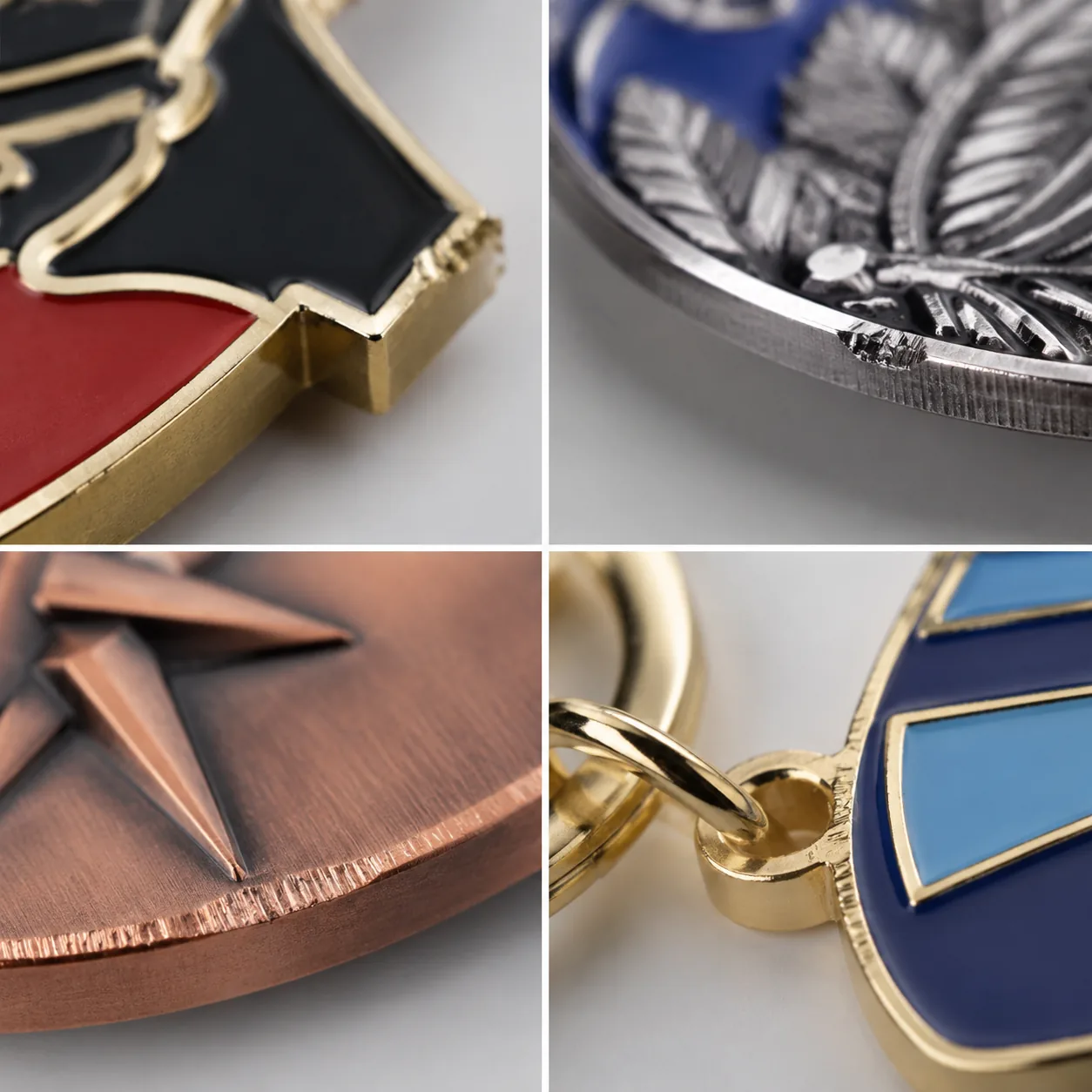
1. Lock Edge Safety Specs Before Tooling
Most burr problems are created before production starts. A buyer approves a smooth pre-production sample, then 10,000 to 50,000 pins, coins or keychains arrive with sharp rims, rough holes or snagging hardware. The sample may have been hand-finished by a senior operator, while the bulk order ran through faster tumbling, belt polishing and spot deburring. The defect is not only poor hand feel. Sharp edges can tear 0.04 mm OPP bags, scratch bright plating during transit, damage printed cards and create safety complaints at events or retail counters.
The RFQ and purchase order should define the edge condition as clearly as size, plating and artwork. A practical mass-production spec is: no visible burrs at 30 cm under 600 to 800 lux lighting, no user-contact edge that catches a clean cotton glove during a 360-degree wipe test, and no protruding flash above 0.05 mm on outer edges. For wearer-facing edges on pins, name badges and brooches, tighten burr height to 0.03 mm maximum. For non-contact back recesses, smooth tooling witness lines may pass if they cannot be felt with a fingernail.
Classify cosmetic edge marks separately from touch-safety defects. A faint parting line on the back of a coin is usually minor. A raised barb near a split ring, brooch pin, pin post, magnet cup or coin rim is major, or critical if it can cut skin. This classification keeps inspection objective: every imperfect edge is not equal, but every user-contact edge must be safe.
2. Stamped Pins: Control Thin-Sheet Burrs
Stamped iron and brass are efficient for flat enamel pins, badges, tags and nameplates, but blanking thin sheet can leave needle burrs on the back perimeter. Risk rises below 1.0 mm thickness, at acute internal corners, and when the blanking die clearance is excessive or the die edge is worn. A 25 mm soft enamel pin can look clean on the front while the back edge snags a jacket lining.
Specify base metal, thickness and deburring as one package. Economy promotional pins commonly use 0.8 mm iron. Better badges use 1.0 to 1.2 mm brass because it forms cleaner edges and resists corrosion better under nickel, gold or antique plating. Premium lapel badges and nameplates may use 1.5 mm brass when weight, flatness and edge feel matter. For a 25 mm soft enamel stamped pin, typical FOB China pricing at 1,000 pieces is USD 0.32 to 0.65 in iron and USD 0.45 to 0.85 in brass, depending on enamel colors, plating, attachments and packing. Moving from 0.8 mm iron to 1.2 mm brass often adds USD 0.08 to 0.22 per piece.
Use measurable language: deburred back perimeter, edge radius target R0.10 to R0.20 mm, no loose metal slivers, and burr height maximum 0.03 mm on the wearer-facing side. For internal cutouts below 2.0 mm wide, stamped metal becomes less stable because tooling and polishing access are limited. If the artwork has lace-like gaps, sharp internal points, thin text islands or negative spaces under 1.5 mm, photo etching or zinc alloy casting is often more consistent even when the unit price is higher.
3. Cast Zinc Alloy: Manage Flash and Holes
Zinc alloy die casting suits 3D relief keychains, magnets, bottle openers, medallions and complex badges. Its main edge risk is mold flash, especially around parting lines, side walls, ring holes, loops and raised relief. Flash can be missed at visual inspection because the front logo looks acceptable after plating while roughness remains inside the keyring hole or around the loop that users touch daily.
Confirm the parting-line location during artwork approval. A capable factory should avoid logo faces, readable text, finger-contact zones and split-ring holes where the design allows. For a 45 mm zinc alloy keychain at 3.0 mm thickness, normal dimensional tolerance is about ±0.20 mm for overall length and width, and ±0.10 mm for critical hole diameter if the hole is drilled or reamed after casting. Flash control should be tighter than size tolerance: no raised flash above 0.05 mm on outer edges, no sharp flash above 0.03 mm inside holes, and no roughness that catches a cotton glove during a ring-hole wipe test.
Tooling and lead time should reflect complexity. A simple 2D zinc alloy keychain usually needs 7 to 10 days for sampling and 12 to 18 days for 1,000 to 5,000 pieces after sample approval. A multi-level 3D mold with deep relief, enamel fill, epoxy or antique plating usually needs 10 to 15 days for sampling and 18 to 28 days for mass production. Typical FOB pricing for a 45 mm zinc alloy keychain is USD 0.75 to 1.80 at 1,000 pieces and USD 0.58 to 1.35 at 5,000 pieces, depending on casting weight, plating, enamel count, epoxy, ring hardware and packaging.
4. Balance Polishing With Detail Retention
Over-polishing creates a different failure: the edge becomes smooth but the artwork loses definition. Logo strokes, raised borders, serial numbers, coin relief and small lettering can round off when a factory tries to rescue rough casting or stamping by extending tumbling time or using aggressive buffing wheels. The root cause may be worn dies, poor cutting clearance, porous casting or bad gate placement, not insufficient polishing.
Define protected details before production. Raised text on enamel pins should normally be at least 0.30 mm high and 0.30 mm wide. For plated-only small badges, 0.35 to 0.45 mm is safer. For challenge coins with antique plating, 0.50 mm or more improves legibility after polishing and plating. Recessed engraved text should generally be at least 0.25 mm deep for coins and 0.15 to 0.20 mm for small badges, depending on font, finish and plating thickness.
A balanced spec covers both smoothness and artwork survival: outer rim deburred to R0.10 to R0.20 mm, logo lines not visibly rounded at 30 cm, raised border height tolerance ±0.05 mm after plating, and engraved text readable without magnification. If the design uses tiny raised type or hairline borders, antique silver, antique brass or matte nickel can hide light abrasion better than mirror gold or bright nickel. Mirror finishes expose over-polished corners, pits and rack marks.
| Product type | Main edge risk | Practical buyer spec | Typical MOQ / FOB range |
|---|---|---|---|
| Stamped enamel pin, 0.8 to 1.2 mm | Back-edge burrs, sharp internal corners | Back burr max 0.03 mm; R0.10 mm minimum edge radius; no glove catch | MOQ 100 to 300 pcs; USD 0.32 to 0.85 at 1,000 pcs |
| Zinc alloy keychain, 2.5 to 4.0 mm | Mold flash on side wall, loop and holes | Outer flash max 0.05 mm; hole flash max 0.03 mm; smooth ring-hole wipe | MOQ 300 to 500 pcs; USD 0.75 to 1.80 at 1,000 pcs |
| Challenge coin, 3.0 to 4.5 mm | Rim roughness, sharp reeded peaks | Rim profile ±0.10 mm; no sharp peaks; edge radius R0.15 mm target | MOQ 100 to 300 pcs; USD 1.20 to 3.80 at 500 pcs |
| Photo-etched badge, 0.6 to 0.8 mm | Thin-edge distortion, acid undercut | Thickness ±0.05 mm; no visible undercut at 30 cm; smooth back edge | MOQ 300 to 500 pcs; USD 0.40 to 1.10 at 1,000 pcs |
5. Plating Can Recreate Rough Edges
A part can pass polishing and fail after plating. Nickel, gold, black nickel, copper, brass tone and antique finishes can reveal pits, trap buffing compound in recesses or create rough deposits on imperfect edges. Die-cast pores, poor cleaning, excessive current density and poor rack contact are common causes. The bulk lot may match the approved color but still feel gritty on the rim or leave dark residue on packaging.
For most promotional metal items, decorative nickel or brass-tone plating is commonly 3 to 8 microns. Flash gold is often thinner and mainly decorative; premium gold systems with a nickel undercoat and heavier gold top layer cost more. Do not specify aerospace plating for an event pin, but do require uniform coverage, no exposed base metal, no blistering, no black burn marks and no plating nodules on handling edges. For outdoor, retail or high-touch programs, ask the supplier to state the plating stack and target thickness in microns before price approval.
Rack marks need an approved location. On coins, place them on the edge, back recess or a non-logo zone when possible. On pins, keep them away from the front logo, outer perimeter and any point that touches fabric. Antique finishes can vary slightly in recessed darkness, but gritty residue that transfers to a white cloth should fail inspection. For black nickel, roughness is especially visible because high points polish bright while recesses remain dark.
6. Test Hardware and Packaging for Snags
Many burr complaints are not on the main metal face. They occur around attachments: butterfly clutches, brooch pins, split rings, jump rings, swivel hooks, magnet cups, chains and soldered posts. If these components are underspecified, the badge body may be smooth while the hardware scratches phones, tears backing cards or catches clothing.
For standard lapel pins, specify a 0.9 to 1.0 mm post diameter, 8 to 10 mm post length, post alignment within ±5 degrees, and a clean solder area with no spikes. For brooch pins, common lengths are 25, 32, 38 and 45 mm; the needle must close fully into the safety catch and must not protrude beyond it. For keychains, 25 to 30 mm outside-diameter split rings suit most giveaways, with 1.8 to 2.2 mm wire for normal retail handling. Reject split-ring gaps above 0.30 mm after assembly and any ring end that scratches or tears a 0.04 mm OPP bag.
Packaging is part of edge control. A bright nickel keychain packed loose in a bag can abrade against its own ring during 30 to 45 days of ocean freight and warehouse handling. Individual OPP bags should typically be 0.04 to 0.06 mm thick. For mirror-plated, epoxy-coated or retail-grade items, add tissue, foam, a backing card or a compartment bag. The extra packaging cost is usually USD 0.03 to 0.15 per piece, which is lower than sorting or reworking a scratched shipment.
- Check approved samples with bare fingers, a cotton glove and a clean white cloth.
- Wipe the perimeter, holes, back attachment, solder points, ring hardware and rack-mark areas.
- Reject any edge that catches the glove, scratches skin or tears a 0.04 mm OPP bag.
- Confirm rack-mark location and attachment hardware before mass plating and assembly.
- Keep one signed golden sample for edge feel, not only for color, size and logo position.
- Add defect photos to the PO for recurring distributor programs or retail replenishment orders.
7. Apply AQL by Safety Risk
If the purchase order only says smooth finish or high quality, final inspection becomes subjective. One inspector may treat a rough coin rim as cosmetic while the distributor treats it as a safety defect. Define burrs, sharp edges and snagging before production starts, then link each defect class to an AQL level.
A practical plan is AQL 0 for critical safety defects, AQL 1.0 for major functional defects, and AQL 2.5 or 4.0 for minor cosmetic defects depending on product grade. Critical defects include sharp points that can cut skin, loose metal slivers, exposed pin tips, broken safety catches and detached magnets. Major defects include burrs that catch a glove, rough holes that damage split rings, plating blisters on handling edges and solder spikes around pin posts. Minor defects include smooth parting-line marks on non-facing areas or slight antique-darkening variation within the approved sample range.
For a 5,000-piece order, final random inspection commonly follows ISO 2859-1, general inspection level II. Sample size and accept/reject numbers depend on lot size and selected AQL, but defect classification is the real control point. For higher-risk orders, add in-process inspection after blanking or casting, then final inspection after plating and assembly. Waiting until packed-goods inspection often forces sorting, re-polishing or re-plating finished pieces, adding 3 to 7 days and avoidable cost.
8. RFQ Data That Prevents Edge Disputes
Before approving production, ask the supplier to mark expected risk zones on the artwork: cut edges, internal corners, ring holes, brooch pins, magnet cups, rim profiles, solder areas and rack marks. Decide which surfaces are user-contact edges and which are non-contact cosmetic areas. This keeps the quotation realistic because polishing every hidden surface like jewelry increases labor, may soften detail and can add several days.
For normal B2B promotional orders, a sound control package includes a pre-production sample, signed golden sample, edge and burr limits in the PO, defect classification, approved hardware, packaging method and final random inspection before shipment. Sampling is typically 7 to 12 days for stamped pins and 10 to 15 days for complex cast pieces. Mass production is usually 12 to 25 days after approval; 18 to 35 days is more realistic for large 3D coins, multi-plating items, epoxy doming or retail packaging.
Typical MOQs start around 100 to 300 pieces for simple pins, coins or keychains, but edge consistency is easier at 500 pieces and above because fixtures, polishing batches and QC sampling are more stable. A complete RFQ should include size, thickness, base metal, plating finish, attachment type, packaging, quantity, target market and whether the item touches skin, fabric or children. A quote that ignores edge control may look cheaper, but it is rarely the lowest-cost option if the finished goods snag clothing, scratch packaging or require rework before delivery.
Have a project? Send your artwork and target quantity and we’ll reply with a detailed quotation within 12 working hours.
Ready to get this made?
Send your sketch, target quantity and ship-date. Detailed quotation in 12 hours.



