Shared Tooling for Pin Variants: When One Mold Saves Money
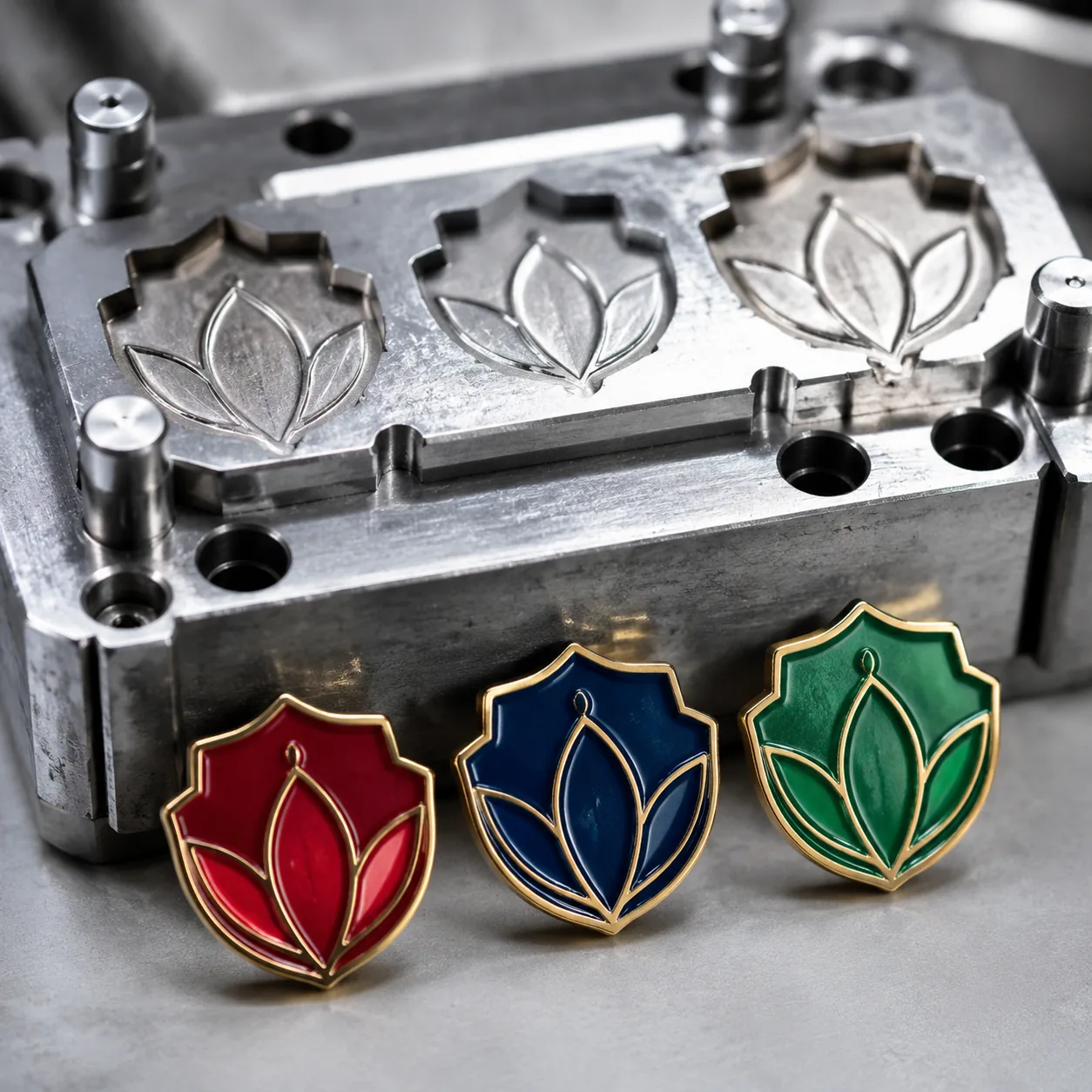
The Cost Problem: Many Similar Pins, Many Mold Fees
Variant programs look simple on a buyer’s spreadsheet: one parent logo, 12 branch names, three event dates, or different enamel colors for regional teams. The cost problem appears when each small design change is treated as a new metal tool. For custom pins, a basic iron or brass stamping die commonly runs USD 60 to 180 FOB China per design. Zinc alloy die-casting molds are often USD 40 to 120 for simple 2D shapes and USD 120 to 250 for deeper 3D relief. On low-volume orders of 100 to 300 pieces per variant, tooling can add USD 0.30 to 1.80 per pin before plating, enamel, attachment, packing or freight.
Shared tooling saves money only when the unchanged parts are truly identical. The outer silhouette, raised metal borders, recessed enamel cells, relief depth, cutouts and molded backstamp must stay fixed. A factory can then reuse one main die or mold and vary the post-molding decoration: Pantone enamel fills, printed names, UV artwork, laser engraving, sequential numbering, backing cards or labels. If the metal relief changes, the tool changes. Enamel walls and raised lettering are formed by the die face, not by production instructions.
At ZheCraft in Yiwu, we review variant programs by separating fixed geometry from variable decoration before quoting. This prevents the common dispute where a buyer approves one unit price, then learns that every branch name requires a separate die because the names were drawn as raised metal instead of printed or engraved.
Changes That Usually Share One Main Mold
The safest variables are operations applied after the shared base is produced. Soft enamel colorways can change inside the same recessed cells as long as the metal dams and cell shapes do not move. Screen printing and UV printing can carry dates, department names or event numbers on top of enamel or plating. Laser engraving can add serial numbers, branch codes or short personalization on a plated panel. These operations may require screens, print fixtures or engraving files, but they do not require a new main mold.
MOQ depends on the operation, not only the total order. For soft enamel, 100 pieces per colorway is usually workable if the combined order reaches 300 to 500 pieces. Hard enamel is less efficient at very small splits because polishing must stay level across filled colors; 200 pieces per colorway is a better planning floor. Offset-printed pins with epoxy can run 100 pieces per image version, but each version may carry a setup charge. Laser engraving can go lower, sometimes 50 pieces per code, because file switching is fast.
Plating can share the mold but not the bath. Nickel, gold, black nickel, antique brass and antique silver require separate plating lots, rack handling and QC checks. For variant quantities under 300 pieces, expect a USD 15 to 45 plating split charge or a higher unit price. Mixed plating also adds tone risk: gold thickness, antique rub-off and black nickel shade can vary if lots are not controlled.
| Variable item | Shares main mold | Typical extra cost | Practical MOQ per variant | Technical risk |
|---|---|---|---|---|
| Enamel color only | Yes | USD 0 to 15 setup | 100 to 200 pcs | Baked enamel can shift 1 to 2 Pantone tones |
| Screen printed name or date | Yes | USD 15 to 45 per screen | 100 pcs | Text strokes below 0.18 mm may blur |
| UV printed logo version | Yes | USD 20 to 60 setup | 100 pcs | Registration drift above ±0.20 mm is visible |
| Laser engraved code | Yes | USD 0.03 to 0.12 per side | 50 pcs | Low contrast on mirror gold or chrome |
| Plating finish change | Yes, separate lot | USD 15 to 45 split charge | 200 to 300 pcs | Tone and thickness variation between baths |
| Raised metal name change | No | New tool USD 60 to 180 | 100 to 300 pcs | Often missed if artwork is not layered |
Changes That Require New Tooling
Any change to metal geometry normally requires a new tool. This includes the outside outline, cutouts, raised text, recessed enamel cells, 2D or 3D relief, rim style, pierced holes and most molded or stamped backstamps. A one-letter change in raised text is not a small artwork edit from the factory’s side; it changes the die face. A new icon in a recessed enamel cell also changes the metal walls around that cell.
Small drawing differences matter more than many buyers expect. Two pins may look identical in a presentation PDF but differ by 0.3 to 0.8 mm in border position, cell width or attachment placement. That can break shared tooling because enamel needs a stable metal dam. For soft enamel, use raised metal walls of at least 0.30 mm where possible. For hard enamel, 0.35 mm is safer because polishing removes surface material. Avoid enamel channels below 0.50 mm; very fine cells trap bubbles, overfill or polish-through defects.
Realistic dimensional tolerances should be written into the technical drawing. For stamped iron or brass pins, outside-size tolerance is usually ±0.15 mm on simple shapes and ±0.20 mm on detailed silhouettes. Zinc alloy die-cast pins are commonly ±0.20 mm, with thicker or deeper 3D pieces closer to ±0.25 mm. Pin post location should be controlled separately, commonly ±0.50 mm from the approved sample. If variants must fit the same backing card holes, foam insert or retail tray, specify the shared outside size and attachment coordinates, not only the visible design.
Design the Variant System Before Artwork Approval
The lowest-risk approach is to define fixed and variable layers before final artwork. Put the brand mark, outside shape, metal borders, enamel cells and attachment location into the fixed tooling layer. Put local office names, years, campaign numbers, short slogans and SKU identifiers into variable layers such as screen print, UV print, laser engraving, printed backing cards or barcode labels.
For text that changes often, avoid raised metal unless each version has enough volume to absorb a new tool. Screen print can hold clean sans-serif text at about 5 pt on smooth enamel or a flat plated panel; 4 pt may pass on a proof but often fails in mass inspection. For laser engraving, buyer-facing text should be at least 1.2 mm high. Serial numbers and internal codes can be smaller, but should be tested on the actual plating finish because contrast differs sharply between nickel, black nickel, matte gold and antique finishes.
A practical compromise is a fixed metal badge with a blank recessed or flat panel. Keep the panel at least 12 mm wide by 4 mm high for short branch names, and 18 mm by 5 mm if the text includes a city plus year. Use matte nickel, antique silver or painted black panels when laser contrast is critical. Avoid black laser marking on mirror gold if the buyer needs high legibility under retail lighting.
- Mark every artwork element as fixed metal, fixed enamel, variable enamel, variable print or variable engraving.
- Keep changing names, dates and branch codes out of raised metal unless each version justifies separate tooling.
- Use one shared nominal size across the program, such as 25.0 mm, 30.0 mm or 38.0 mm.
- Specify pin post or magnet position tolerance, commonly ±0.50 mm from the approved sample.
- Ask for one master technical drawing plus a variant matrix instead of separate unlinked artwork files.
- Confirm whether backstamp text is molded, laser engraved or printed, because only the last two can vary without new tooling.
Cost Model and MOQ Tiers
Shared tooling pays off when the base pin is common and each variant quantity is modest. For a 30 mm soft enamel iron pin with one clutch, standard nickel plating and no epoxy, a typical FOB Yiwu or Guangdong range is USD 0.55 to 0.95 at 500 pieces of one design. At 1,000 pieces, the range may drop to USD 0.42 to 0.78. Hard enamel in the same size is more often USD 0.85 to 1.45 at 500 pieces because polishing and surface control take longer. Zinc alloy 3D pins can range from USD 0.90 to 1.80 depending on depth, plating and finishing.
The penalty appears when a buyer splits a modest quantity into many raised-metal versions. Ten 100-piece variants with separate dies can add USD 600 to 1,800 in tooling. Spread across 1,000 pins, that is USD 0.60 to 1.80 per piece before any unit-cost increase caused by small-batch handling. If the same ten variants share one mold and vary only by enamel color or printed name, the main tooling is paid once and the buyer absorbs only setup, sorting and decoration charges.
MOQ tiers should be quoted by both total program quantity and per-variant quantity. A factory may accept 1,000 total pieces split into ten 100-piece colorways, but it may price 50-piece variants much higher because each color mix, screen, packing label and QC record still consumes labor. For very low quantities, a shared pin plus variable backing card or sticker is often more economical than forcing every difference onto the metal item.
| Scenario | Main tooling | Typical FOB unit range | Lead time after sample approval | Best use case |
|---|---|---|---|---|
| One 1,000 pc soft enamel design | USD 60 to 120 | USD 0.42 to 0.78 | 12 to 18 days | Simple campaign or giveaway pin |
| Ten 100 pc raised-metal variants | USD 600 to 1,800 total | USD 0.90 to 1.80 | 18 to 28 days | Only when each version needs molded detail |
| Ten 100 pc color variants, shared mold | USD 60 to 120 plus minor setup | USD 0.58 to 1.05 | 14 to 22 days | Regional or team color programs |
| Ten 100 pc printed-name variants, shared mold | USD 60 to 120 plus USD 15 to 45 per screen | USD 0.65 to 1.20 | 16 to 25 days | Branch names, dates or departments |
| One shared pin plus variant backing card | USD 60 to 120 for pin; card setup separate | USD 0.50 to 1.00 plus card cost | 14 to 24 days | Low-volume personalization with clean logistics |
QC Controls for Multi-Variant Orders
Variant programs usually fail in approval control, sorting and labeling rather than in the molding step. The factory may stamp or cast all shared bases together, plate them in one or several lots, then split them into enamel filling, printing, engraving and packing batches. If the purchase order does not define variant codes clearly, the right pin can be packed on the wrong card or mixed into the wrong carton.
Use a variant matrix with one row per SKU. Include artwork file name, Pantone colors, plating finish, attachment, quantity, packaging, barcode, carton mark and approval requirement. For color inspection, define D65 lighting where possible. Baked enamel should be compared against an approved production sample, not only a paper Pantone chip, because enamel, glitter, glow powder and transparent colors can shift after baking or polishing.
For commercial promotional pins, AQL General Inspection Level II with AQL 2.5 for major defects and 4.0 for minor defects is a common inspection basis. Premium retail, museum or licensed products may use AQL 1.5 major and 2.5 minor, but this should be quoted before production because tighter sorting adds labor. Treat variant mix errors as major defects even if the physical pin is well made; the order is not usable if SKU allocation is wrong.
- Approve one golden sample for the shared metal base before mass production starts.
- Approve a digital proof or physical standard for every variable color, print or engraving file.
- Require inner bags, trays or bundles labeled by variant code before final carton packing.
- Set an overrun or underrun allowance, often ±3 percent per variant for custom metal goods.
- Request pre-shipment photos showing every variant, not only the master design.
- Check barcode, backing card and carton mark against the variant matrix during final inspection.
Lead Time and Scheduling Risks
Shared tooling reduces die-making work, but it does not automatically shorten the whole schedule. A realistic shared-mold enamel pin program needs 2 to 4 days for artwork engineering and technical drawing, 5 to 8 days for tooling and sample production, 1 to 3 days for buyer sample review if decisions are fast, and 10 to 18 days for mass production after approval. Complex printed variants, special plating or retail packaging can push production to 20 to 28 days.
Color-only variants usually move faster than printed-name variants because enamel filling can be planned by cell and Pantone code. Printed variants require screen output or UV setup, registration checks and drying time before epoxy. If epoxy dome is added, allow 24 to 48 hours of curing before final packing, especially in humid weather. Antique plating may also need extra brushing or tumbling time to control contrast.
Rush orders are possible only when the variable system is simple. A 1,000-piece order with five soft enamel colorways, standard nickel plating and butterfly clutches may finish in 12 to 16 production days after artwork approval. A 1,000-piece order with 25 printed names, individual barcode labels, mixed carton allocation and AQL 1.5 inspection is more realistically 18 to 25 days, even though the mold is shared.
When Shared Tooling Is the Wrong Choice
Do not force shared tooling when brand accuracy depends on sculpted differences. University crests, licensed characters, military insignia, police badges, commemorative coins and award pins often require exact raised or recessed detail. Printing a changed emblem onto a shared blank may reduce tooling, but it can look flat, wear faster, fail licensor approval or undermine the perceived value of the item.
Avoid shared tooling when the common base creates a design compromise. If every branch name must fit into the same 12 mm panel, long names may become unreadable. If one variant needs antique silver and another needs polished gold, the same relief may not suit both finishes because antique plating needs deeper recesses to hold contrast, while polished gold shows surface waviness and polishing marks more clearly.
Also consider reorders. If the first batch uses a shared base but one SKU becomes a bestseller, a dedicated mold with raised detail may be worth the later investment. A good RFQ should identify this path early: start with shared tooling for market testing, then convert high-volume variants to dedicated tooling once demand is proven.
RFQ Checklist for Buyers
Before asking factories for prices, prepare a one-page variant matrix and a layered artwork file. Separate fixed metal geometry from variable decoration, then ask the supplier to confirm in writing which versions share the main tool and which require new tooling. This single step prevents most mold-fee disputes and makes price comparisons more reliable.
A complete RFQ should include target size, base metal, plating finish, enamel type, number of variants, quantity per variant, attachment, backstamp method, packaging, barcode needs, inspection level and target delivery date. If you are unsure whether a name or date should be raised metal, printed or engraved, state the brand objective and budget target. ZheCraft can mark up the artwork with fixed and variable zones before sampling, which is faster than quoting 20 unclear files separately.
The best buying decision is not the lowest tooling line. Compare total FOB cost, mold charges, setup charges, lead time, reorder flexibility, inspection standard and the visual quality of the variable elements. Shared tooling is the right choice when it protects the brand, keeps production controlled and reduces cost without hiding a design compromise.
Have a project? Send your artwork and target quantity and we’ll reply with a detailed quotation within 12 working hours.
Ready to get this made?
Send your sketch, target quantity and ship-date. Detailed quotation in 12 hours.



