Serial Numbers and QR Codes on Metal Giveaways: Buyer Specs
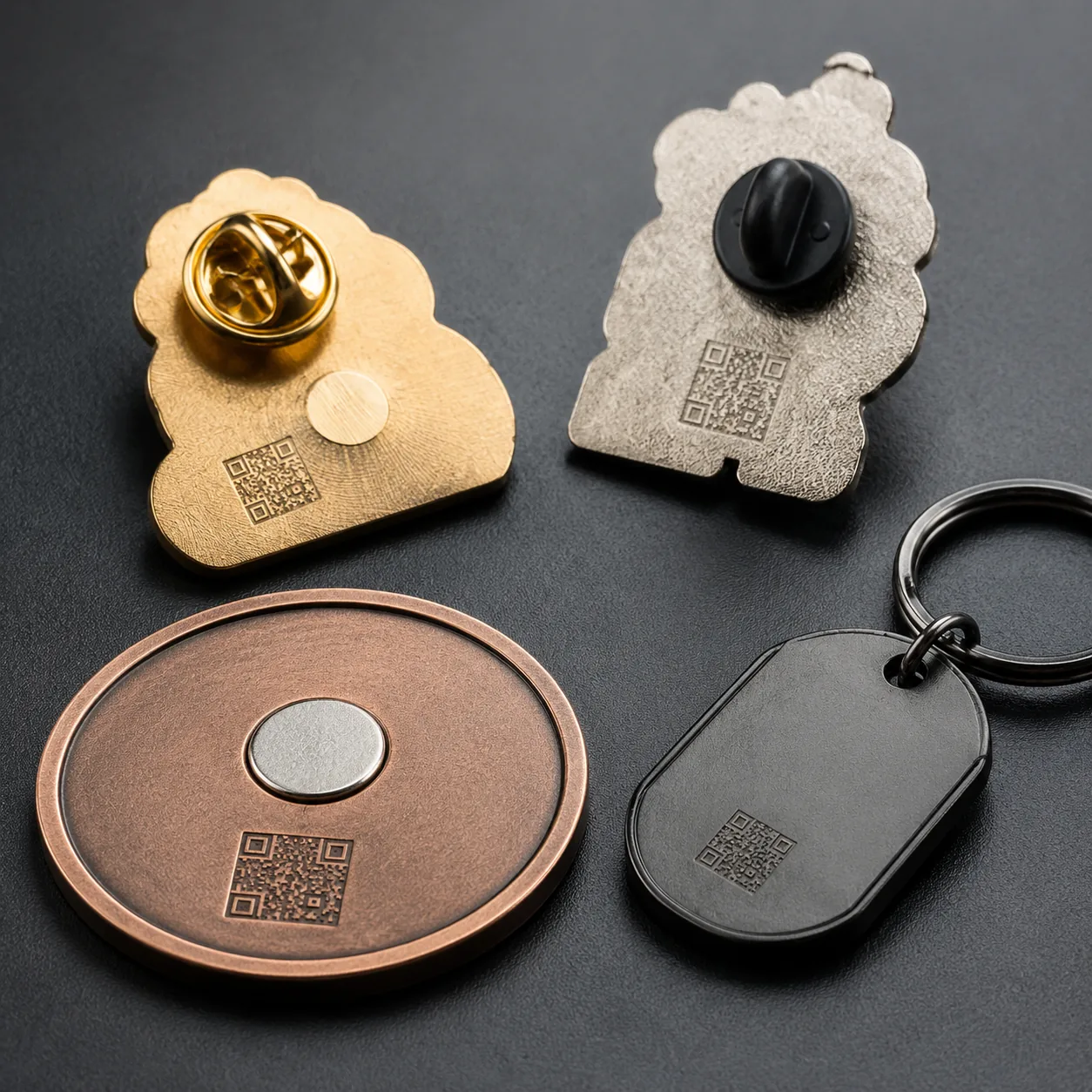
Why Codes Fail After the Metalwork Is Approved
The most common failure on corporate coins, member badges, lapel pins and event keychains is not the stamping or casting. It is the small variable mark added after the main product looks approved. A 16 mm QR code may scan on the pre-production sample, then mass production arrives with 5-8 percent weak scans because the mark was placed on a polished curve, the quiet zone was crowded by relief, or plating reduced contrast.
For B2B orders, serial numbers and QR codes usually support a business process: warranty registration, attendee access, limited-edition control, staff authentication, distributor traceability or anti-counterfeit checking. That makes the mark functional, not decorative. The purchase order should define data content, size, contrast, placement, tolerance, inspection method and acceptance level before the factory quotes or samples.
Treat variable marking as a separate process gate after stamping, casting, polishing, plating, enamel and epoxy. A 40 mm coin outline may reasonably hold ±0.2 mm dimensional tolerance, but a 12 mm QR code with 0.25-0.30 mm modules cannot tolerate plating build-up, tilted laser focus or glossy glare. The buyer specification must control the final physical mark, not only the artwork file.
Select the Marking Method Before Final Artwork
Choose the marking method according to the function of the code. A decorative serial number on the back of a challenge coin can be shallow and subtle. A QR code used for admission control or product registration needs high contrast, a flat panel and enough size to scan under normal indoor light.
Fiber laser engraving is the standard option for zinc alloy, brass, iron, stainless steel and nickel-plated promotional metal. It is permanent and economical for changing data. Typical laser depth is 0.01-0.04 mm for surface marking and 0.05-0.10 mm for deeper engraving on suitable metals. On mirror gold, chrome, black nickel, antique brass and antique copper, contrast varies by finish, so a recessed matte panel is often safer than marking directly over decorative relief.
UV printing or pad printing can produce sharper black-on-white QR codes, especially on enamel or painted panels, but adhesion must be tested. For handled products, specify cross-hatch adhesion of 4B or 5B where applicable, plus a dry rub test of at least 20 cycles. Stickers are acceptable for temporary packaging traceability, but not for premium or tamper-resistant product identification.
| Marking method | Best use | Buyer spec range | Main risk |
|---|---|---|---|
| Fiber laser engraving | Serial numbers, QR codes and batch IDs on metal backs | Text 1.2-3.0 mm high; QR 12-22 mm; depth 0.01-0.04 mm typical | Low contrast on mirror or dark antique finishes |
| Deep laser engraving | Security text or durable serials on stainless steel/brass | Depth 0.05-0.10 mm; stroke ≥0.15 mm; flatness within 0.15 mm | Slower cycle time and visible recess |
| UV printing | High-contrast QR codes on enamel, paint or matte panels | QR 10-22 mm; line tolerance ±0.10 mm; optional clear coat 8-15 microns | Ink abrasion if uncoated or poorly cured |
| Pad printing | Simple fixed marks on flat panels | QR 14-25 mm; 1-2 colors; panel flatness within 0.20 mm | Less efficient for unique data |
| Etched and filled | Fixed batch marks or security panels | Line width ≥0.15 mm; etch depth 0.08-0.15 mm | Not economical for changing serials |
| Sticker label | Carton, polybag or temporary campaign tracking | QR 10-30 mm; adhesive matched to surface | Can peel, abrade or look low-grade |
QR Code Size, Contrast and Quiet Zone Specs
Do not specify a QR code as “as large as possible.” State the final marked size, data format, error correction level, module size and quiet zone. The quiet zone is the blank border around the code. If nearby relief, enamel lines or coin rims enter that border, phone cameras may read them as part of the code.
For phone scanning on flat metal, 12 mm square is a practical minimum only when the URL is short, the surface is matte and the code is low density. A safer production range is 15-18 mm for typical promotional URLs and 18-22 mm for antique finishes, curved backs, epoxy-coated surfaces or longer encoded strings. Keep the module size at 0.30 mm or larger where possible; below 0.25 mm, polishing variation and laser spot size can close small cells.
Specify error correction level Q or H for handled items. Level H increases code density, so it may require a larger physical size, but it improves scan reliability when the surface is scratched or slightly worn. If marketing requires long tracking URLs, use a buyer-controlled short redirect. A short URL often reduces the QR version, increases module size and improves scan speed.
- Reserve a quiet zone of at least 4 modules on all sides; for 0.30 mm modules, specify at least 1.2 mm clear border.
- Keep the code on a flat panel with height variation no more than 0.10-0.15 mm across the scan area.
- Avoid mirror gold, chrome and high-gloss epoxy for small codes unless sample scan tests pass at angled light.
- Keep the code at least 1.5 mm from coin rims, 2.0 mm from metal edges and 3.0 mm from pin posts or ring holes.
- Scan the sample at 15 cm, 30 cm and 50 cm using at least two phone models before approving mass production.
Serial Number Rules That Prevent Reorder Errors
Serial numbers usually fail because the data rule is unclear, not because the factory cannot engrave digits. A buyer may request 0001-1000, then reorder 1001-1500, while the artwork says “No. 001” and the PO says “1,000 pcs assorted.” That creates avoidable duplicates, missing numbers and warehouse sorting disputes.
A complete numbering rule defines prefix, digit count, start number, end number, skipped numbers, duplicate policy, remake policy and packing sequence. A clean instruction is: “AB26-0001 to AB26-1000, four digits, no duplicates, rejected pieces remade with the same serial, pack in ascending order, 100 pcs per inner box, carton label to show serial range.” This removes operator interpretation.
For legibility on plated metal, use sans serif fonts such as Arial, Helvetica or OCR-B. Text below 1.0 mm high is high risk after polishing and plating. Specify 1.2 mm minimum for back-side traceability, 1.5 mm for codes customers may read, and 2.0-3.0 mm for front-side limited-edition numbering. Minimum finished stroke width should be 0.12 mm for laser or print, and 0.15 mm if the mark is over antique plating or textured relief.
| Requirement | Recommended specification | Reason |
|---|---|---|
| Back-side traceability | 1.2-1.5 mm text height; stroke ≥0.12 mm; placement ±0.30 mm | Readable without crowding the reverse design |
| Collector numbering | 2.0-3.0 mm height on a flat banner or recessed panel | Visible to end users without magnification |
| High-volume batch ID | Prefix plus 5-6 digits; packed in bags of 50 or 100 by sequence | Reduces duplicate claims and warehouse sorting time |
| Manual-entry security code | Avoid O/0, I/1 and B/8; use uppercase letters only | Cuts customer service errors |
| QC replacement rule | Remake rejected numbers with the same serial, not the next serial | Keeps shipped goods aligned with the buyer database |
Placement Specs for Pins, Coins, Keychains and Magnets
Placement is a manufacturing constraint, not only a graphic decision. On enamel pins, the reverse side may already include posts, clutch spacing, copyright text, debossed logos and safety marks. Adding a QR code after those items can force it near a post, where the laser focus is uneven and shadows reduce phone-camera contrast.
For lapel pins under 30 mm, a QR code on the back is rarely robust unless it is a very short URL at 8-10 mm and the buyer accepts higher scan risk. A serial number is usually the better choice. For pins over 35 mm, a 12-15 mm QR code can work if the back includes a reserved flat panel and the nearest pin post is at least 3 mm outside the quiet zone.
Challenge coins and keychains offer more usable area. For a 40-50 mm coin, reserve a 16-22 mm reverse-side cartouche with matte nickel, matte silver or satin black fill. Keep it away from rope edges, reeded rims and high relief. For keychains, place the code on the flat back plate, not on the split-ring tab; keys and rings can scratch printed or laser-marked data during transit and daily use.
- Pins: keep codes at least 3 mm from posts and 2 mm from the metal outline; use serials if the available panel is below 12 mm.
- Coins: avoid antique relief under QR cells; use a recessed flat cartouche with placement tolerance ±0.30 mm.
- Keychains: avoid moving tabs, ring holes and high-abrasion areas; bag pieces individually if the code is printed.
- Magnets: confirm the magnet sheet or ferrite disc does not cover the marked metal back if scanning is required.
- Medals and badges: verify the code scans while attached to the lanyard or ribbon, not only as a loose sample.
MOQ, FOB Cost and Lead-Time Impact
Variable marking adds handling time because each piece must be oriented, marked, checked and kept in sequence. The base MOQ for a custom metal pin or coin may be 100 pcs, but serialized or unique QR workflows become more efficient at 300 pcs and above. Below 100 pcs, setup, data handling and inspection can cost more than the marking cycle itself.
As a practical FOB China reference, simple laser serial numbering usually adds USD 0.03-0.08 per piece at 300-1,000 pcs. Laser QR codes add USD 0.06-0.15 per piece depending on size, finish, fixture time and scan checking. UV printed variable QR codes commonly add USD 0.10-0.25 per piece because data setup, ink curing, coating and adhesion checks create more process risk. Unique QR codes matched to a buyer database may reach USD 0.15-0.35 per piece when 100 percent scan logs and carton mapping are required.
Lead time depends on when the final data is locked. Serial numbers normally add 1-2 production days. QR codes with functional scan checks add 2-5 days. Unique codes tied to a database, carton sequence and exported scan logs add 4-7 days. If the buyer changes URLs or data files after mass marking starts, expect a 3-7 day delay for stopping, reprogramming, re-sampling and rechecking.
| Order condition | Typical MOQ tier | Added lead time | FOB add-on range |
|---|---|---|---|
| Laser serial numbers only | 100-300 pcs | 1-2 days | USD 0.03-0.08 each |
| Laser QR plus serial | 300 pcs and up | 2-4 days | USD 0.06-0.15 each |
| UV printed QR on enamel or paint | 300-500 pcs | 3-5 days | USD 0.10-0.25 each |
| Unique QR matched to database | 500 pcs and up | 4-7 days | USD 0.15-0.35 each |
| Tamper or carton label only | 500 pcs and up | 1-3 days | USD 0.03-0.12 each |
Inspection Plan and AQL for Functional Codes
For general appearance, many importers use ANSI/ASQ Z1.4 general inspection level II with AQL 2.5 for major defects and 4.0 for minor defects. Functional codes need stricter treatment. An unreadable QR code, wrong serial, duplicate serial or missing mark should be classified as a critical defect because it can block access, break registration or misalign the buyer database.
A practical plan combines visual AQL with functional verification. Use AQL 2.5/4.0 for plating, enamel, scratches and general workmanship, then inspect QR scanability at special level S-3 or S-4 at minimum. For unique codes tied to payment, access, warranty or authentication, require 100 percent scan verification and an exported log showing code value, serial number, pass status and timestamp.
Define the scan environment in the PO. A code that scans only under perfect factory lighting is not production-ready. Test under normal indoor light at 15-30 cm, then repeat with the product tilted about 20 degrees. For printed codes, add dry rub testing and tape-pull or adhesion testing where the surface allows it. For epoxy-coated pieces, scan after epoxy application, not before.
- Classify unreadable QR codes, wrong serials, duplicates and missing marks as critical defects with zero acceptance in the inspected sample.
- Treat code placement error over ±0.50 mm as a major defect if it affects appearance, quiet zone or scan reliability.
- Require carton labels showing serial ranges, such as carton 1: AB26-0001 to AB26-0200.
- Keep the approved marked sample, final data file, scan method and production photos for reorder control.
- Order 2-5 percent overrun for replacement needs, or reserve 5-10 marked spare pieces for small campaigns.
RFQ Wording and Pre-Production Approval
The RFQ should make variable data visible from the first quote. If a buyer requests a 45 mm antique silver challenge coin and later adds a unique QR code, the original design, cost and lead time may no longer be valid. Antique relief and polished rims are attractive, but they are poor scan surfaces unless a flat matte panel is built into the reverse design.
Attach the QR value or data format, not only a screenshot. If final URLs are not ready, provide a sample URL with the same length and structure. For serials, provide a CSV or Excel file for unique codes, or a written sequence rule for simple numbering. The file should include one row per piece with serial number, QR value, packing group and any special note.
Approve a marked pre-production sample using the real plating, real code size and real coating stack. Scan it with two phones under office light and angled light. If the item uses epoxy, test after epoxy because optical distortion can change scan behavior. Lock the data file before mass marking begins, and treat later data changes as a controlled revision.
| RFQ item | Good wording | Avoid |
|---|---|---|
| QR size | Laser QR code, 18 mm square, error correction H, quiet zone ≥1.5 mm | Add QR on back |
| Surface | Recessed matte nickel panel, flatness within 0.15 mm across code area | Put it wherever it fits |
| Serial sequence | AB26-0001 to AB26-1000; no duplicates; remakes use same rejected numbers | Number them 1 to 1000 |
| Tolerance | Code placement ±0.30 mm on flat panel; wrong data zero tolerance | Factory standard |
| Inspection | 100 percent scan check with exported scan log; unreadable code is critical | Factory to check quality |
| Packing | Pack ascending, 100 pcs per inner box, carton label to show serial range | Normal export packing |
Before approving production, decide whether the code is mission-critical or decorative. If it controls access, warranty, authentication or registration, pay for the larger code area, matte surface and scan verification. If it is only a collector detail, a clean laser serial number may be cheaper, more durable and less disruptive to the product design.
Have a project? Send your artwork and target quantity and we’ll reply with a detailed quotation within 12 working hours.
Ready to get this made?
Send your sketch, target quantity and ship-date. Detailed quotation in 12 hours.



