Rush Trade-Show Orders: RFQ-to-Delivery Sourcing Plan
Work Backward From the In-Hand Deadline
For a fixed trade-show date, the controlling milestone is not the factory ship date. It is the date the booth team has the cartons in hand, counted, sorted and ready for booth setup or hotel delivery. Set the in-hand deadline 3 working days before booth setup for simple domestic delivery and 5 working days before setup when goods are going to a convention-center dock, hotel receiving desk, advance warehouse, third-party booth builder or weather-prone city. That buffer covers missed delivery windows, damaged cartons, dock appointments, union handling rules, repacking and shortages found during count-in.
For China-origin promotional metal goods and lanyards, express courier transit to the US or EU is typically 3 to 6 calendar days after pickup when the invoice, packing list and consignee tax details are complete. Standard air freight is usually 4 to 7 days airport to airport, plus 1 to 3 days for export handling, customs clearance and final delivery. Above 80 to 120 kg chargeable weight, courier cost rises sharply, but it is often still the lower-risk route for a trade show because there are fewer handoffs and clearer tracking.
The first sourcing decision is whether the item needs new tooling. Soft enamel pins, die-struck badges, cast zinc alloy keychains and challenge coins normally require a mold or die. Screen-printed lanyards, dye-sublimated lanyards, printed backing cards, stock split rings, standard badge reels and existing-mold openers can move faster. If fewer than 18 calendar days remain before cargo must leave China, avoid new custom metal tooling unless the artwork is simple, the order is small and proof approval can happen the same day.
Send One Complete RFQ Packet
A rush RFQ loses time when the supplier has to chase missing dimensions, artwork, packing or delivery details. Send one complete packet and ask for the earliest ex-works date and FOB date, not only the lowest unit price. The quote should separate tooling days, sample decision, bulk production days, packing days, inspection timing, freight cutoff and the date cargo will be ready for carrier pickup.
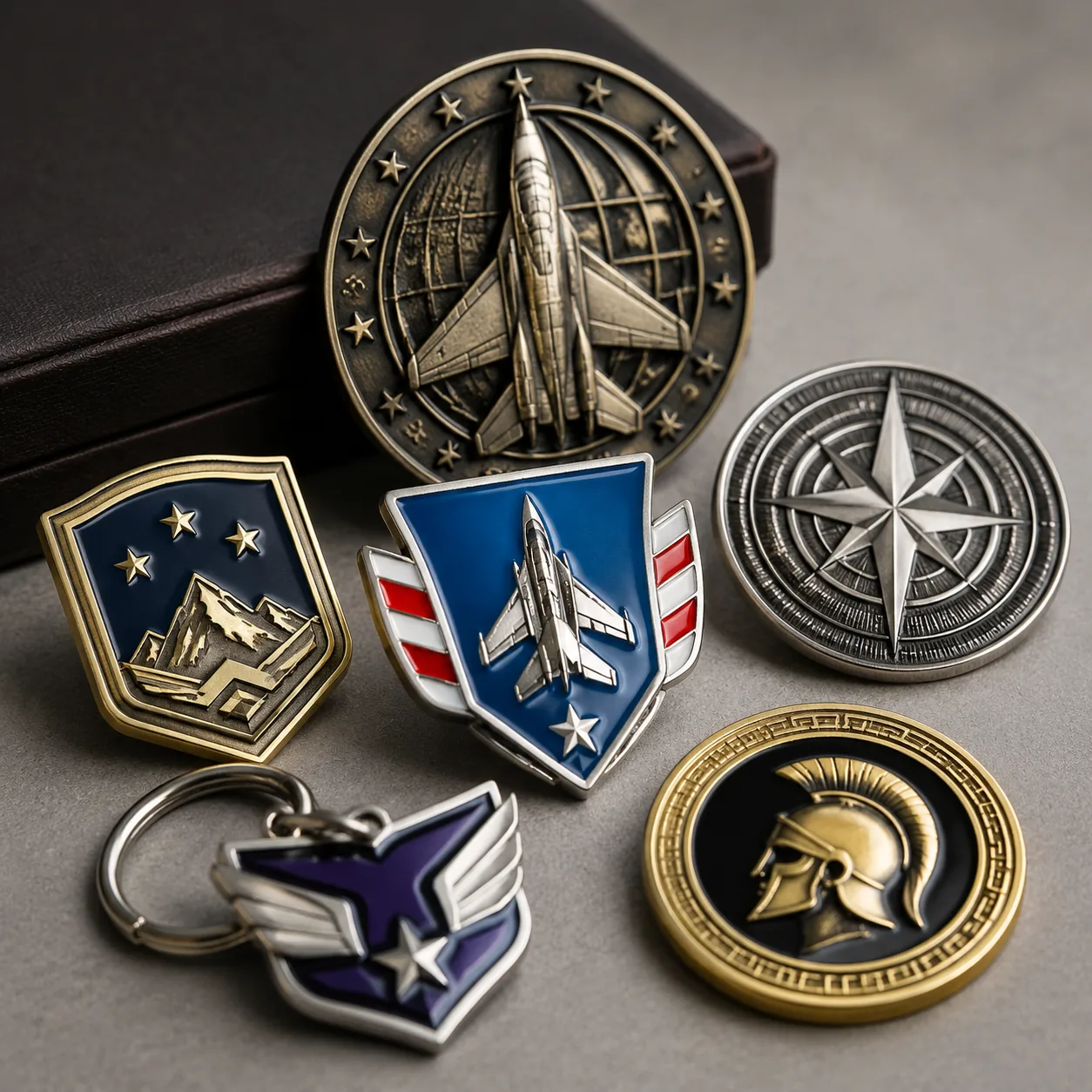
For pins and badges, specify finished size in millimeters, thickness, base metal, plating, enamel type, attachment, backstamp, quantity and packing. A common soft enamel pin is 25 to 35 mm wide, 1.2 to 1.5 mm thick, iron or zinc alloy, with 0.30 to 0.50 mm raised metal lines and 3 to 6 Pantone Solid Coated colors. Challenge coins commonly run 38 to 50 mm diameter and 3.0 to 4.0 mm thick in zinc alloy, iron or brass, with antique nickel, antique brass, black nickel or imitation gold plating. For lanyards, state width, finished loop length, material, print method, clip, breakaway, badge holder size and packing count.
- Delivery country, postal code, consignee type and required in-hand date
- Approved vector artwork in AI, EPS, PDF or editable SVG, with fonts outlined
- Exact order quantity and permitted overrun or underrun, commonly +/- 3% for rush production
- Finished size, thickness, base material, plating and Pantone Solid Coated references
- Attachment hardware, such as 8 mm butterfly clutch, 12 mm rubber clutch, 25 mm split ring, 20 mm lobster clasp, J-hook or badge reel
- Packing method, inner bag count, carton marks, barcode labels and hotel or advance-warehouse label rules
- Approval owner, backup approver and maximum response time for quotation, proof, sample photos and inspection decisions
Select a Rush-Safe Construction
Rush-safe does not mean generic. It means the construction has few failure points within the available days. Soft enamel pins are usually safer than hard enamel on a 20 to 30 day trade-show schedule because the enamel sits slightly below the metal rim and avoids the same grinding and polishing risk. Hard enamel gives a smooth jewelry-like face, but it requires overfill, baking, grinding and polishing. Compressed timing increases the risk of color contamination, low-fill areas, scratches, rounded detail and late rework.
For coins and keychains, zinc alloy casting works for irregular outlines, relief logos and 3D surfaces, but mold making, tumbling, plating and color fill still take time. A flat die-struck iron badge can be faster for simple 2D artwork. For lanyards, screen printing is normally fastest for 500 to 2,000 pieces with 1 to 3 solid colors. Dye sublimation is better for gradients, photographic artwork and full-bleed graphics, but it requires heat setting and registration control. Woven lanyards are durable and premium, but letters below about 3 mm high will lose clarity.
| Product route | Rush-friendly specification | Typical MOQ | FOB USD range | Production days after proof approval | Main trade-off |
|---|---|---|---|---|---|
| Soft enamel pin | 25 to 35 mm, iron, 1.2 to 1.5 mm, 4 to 6 colors, standard clutch | 100 to 300 pcs | 0.55 to 1.35 | 10 to 16 | Recessed color and tactile metal; not a flat polished surface |
| Hard enamel pin | 25 to 35 mm, brass or zinc alloy, polished flat, simple outlines | 300 pcs | 0.95 to 2.40 | 16 to 24 | Premium finish; polishing defects are hard to recover under rush timing |
| Challenge coin | 38 to 45 mm, 3.0 mm, antique plating, no enamel or one-side enamel | 100 pcs | 1.80 to 4.80 | 14 to 22 | High perceived value; weight raises air freight cost |
| Zinc alloy keychain | 40 to 60 mm, 2D relief, split ring, one-side enamel | 300 pcs | 0.90 to 2.60 | 14 to 21 | Flexible outline; casting and plating need early first-piece checks |
| Screen-printed lanyard | 15 to 20 mm polyester, 900 mm loop, metal hook, optional breakaway | 300 to 500 pcs | 0.38 to 0.85 | 7 to 12 | Fast and economical; weak for gradients and tiny text |
| Dye-sublimated lanyard | 20 mm polyester, two-side full-color print, metal hook | 500 pcs | 0.55 to 1.10 | 9 to 14 | Good for full color; accept edge alignment tolerance |
| PVC patch | 60 to 80 mm, 2D relief, 2.0 to 2.5 mm thick, hook-and-loop or sew-on backing | 100 to 300 pcs | 0.85 to 2.20 | 12 to 18 | Durable and colorful; less formal than metal or woven items |
Lock the Proof in One Approval Cycle
The production proof is the control document. It should show final dimensions, metal line widths, enamel areas, plating finish, attachment position, backstamp, edge treatment, packaging and carton quantity. For soft enamel, a minimum raised metal line width of 0.30 mm is workable; for hard enamel and plated outlines, 0.35 mm is safer. Text below 1.2 mm high, isolated islands below 0.8 mm, cutouts under 1.0 mm and enamel pockets with sharp inside corners should be revised before the mold is cut.
Use tolerances that match mass production instead of treating the proof as artwork only. For die-struck or cast metal items under 40 mm, specify size tolerance of +/- 0.3 mm. For larger coins and keychains, +/- 0.5 mm is more realistic. Thickness tolerance is commonly +/- 0.2 mm for pins and +/- 0.3 mm for coins. For lanyards, width tolerance of +/- 1 mm, finished loop tolerance of +/- 10 mm and print registration tolerance of +/- 1.5 mm are practical rush-order limits.
Color should be defined by Pantone Solid Coated references with realistic acceptance criteria. Enamel over antique plating reads darker than enamel over bright nickel. Translucent enamel, glitter, epoxy coating and black nickel can shift visual color under different lighting. Ask for approval photos under neutral D65-type lighting and reject filtered phone images. If legal, brand or sponsor teams must review the proof, route it as soon as it arrives. A 20-hour internal delay can erase the value of paying a rush premium.
Sample Only When It Protects the Date
A physical pre-production sample is the best way to confirm plating tone, weight, surface quality, attachment strength and actual color behavior. It is also a calendar cost. For custom metal products, sampling commonly adds 5 to 9 days: 2 to 4 days for mold or die work, 1 to 3 days for sample finishing and 2 to 4 days for courier transit depending on destination and customs. If the show is 45 to 60 days away, approve a physical sample. If it is 20 to 30 days away, photo and video approval may be the only workable route.
For photo or video sample approval, require evidence rather than a single beauty shot. Ask for front, back, edge and attachment photos; a short rotation video; caliper readings for width and thickness; and a weight reading for coins or keychains. Decorative flash gold is often about 0.05 to 0.10 microns. Nickel or black nickel decorative layers may be about 0.10 to 0.20 microns. Specify thicker plating only when the requirement is real, because it raises cost and does not eliminate scratches on soft base metals.
If physical sampling is skipped, add first-piece control before bulk output runs too far. For soft enamel pins, check clean metal lines, enamel below the rim, no overflow, no bare plating in color areas and firm clutch fit. For coins, check edge lettering, relief depth, antique wiping consistency and packaging scuffs. For lanyards, check total loop length, width, print direction, hook orientation, breakaway function and whether the logo faces correctly when worn.
Inspect Before Full Packing
Bulk production should not be a silent period between deposit and pickup. For rush orders, require three checkpoints: mold or print file completion, first mass-production pieces and packing start. These updates allow correction while the affected quantity is still small. Sorting 200 early pieces is manageable. Discovering wrong plating on 5,000 packed pieces one day before pickup is usually not recoverable.
For pins, badges, coins and keychains, use ANSI/ASQ Z1.4 or ISO 2859-1, General Inspection Level II, with AQL 2.5 for major defects and AQL 4.0 for minor defects. Critical defects should have zero acceptance. Critical issues include wrong logo, wrong event date, sharp edges, broken posts, detached magnets, unsafe small parts for child-facing programs and missing legal marks where required. Major defects include wrong plating, obvious Pantone mismatch, missing enamel, bent attachments, weak rings, incorrect backing cards and packaging errors that affect distribution.
Functional checks must match the item. A promotional pin post should withstand a 2 to 3 kg pull test for normal use; stronger requirements should be stated before tooling because post diameter, solder area and base thickness may change. Jump rings should close with visible overlap and no open gap above 0.2 mm. Split rings should recover after opening without permanent spread. Magnets should be tested on clean painted steel, not stainless steel, because many stainless grades are weakly magnetic or non-magnetic. For lanyards, pull-test the hook and breakaway, then confirm the breakaway releases consistently.
Confirm Freight Before Packing Starts
Many rush orders are produced on time and still miss the event because freight is arranged too late. Confirm carton dimensions, gross weight, chargeable weight, invoice description, declared value, HS code and importer details before packing is complete. A common pin export carton is about 35 x 25 x 20 cm and may hold 500 to 1,000 pieces depending on backing cards and bags. A 45 mm challenge coin can weigh 35 to 55 g before packaging, so 2,000 coins may exceed 90 kg net weight before cartons, inner boxes and pallets.
For shipments under 80 kg chargeable weight, express courier is usually the simplest rush method. For 80 to 300 kg, door-to-door air freight or economy air may reduce cost, but it adds coordination: commercial invoice, packing list, customs broker details, importer tax number and final-mile delivery appointment. Sea freight is normally unsuitable for fixed trade-show rush dates unless the event is 70 to 90 days away and the order is bulky, such as several thousand lanyards with badge holders.
Packing should support booth operations. If staff will hand items out quickly, individual OPP bags with 100 pieces per inner bag and clear carton labels are more useful than premium boxes. If the items are VIP gifts, rigid boxes, velvet pouches or custom inserts may be appropriate, but they add freight volume and often 3 to 6 packing days at scale. For hotels, convention centers and advance warehouses, put the show name, booth number, exhibitor name, onsite contact, delivery window and carton count on every carton. Missing carton marks can delay receiving even when the courier arrives on time.
Use Deadline-Based Decision Rules
When the event date is fixed, reduce uncertainty before negotiating small price differences. Ask the supplier for a written schedule covering proof, tooling, sample decision, bulk production, packing, inspection and freight pickup. A quote that is 8% cheaper but vague on dates is not cheaper if it risks missing the show. The useful question is not whether the factory can rush; it is which specification can ship on the required date with controlled defects.
For most 2026 rush trade-show orders, a practical target is 25 to 35 calendar days from approved artwork to delivery for custom metal items by air, and 14 to 22 days for printed lanyards or non-tooled accessories. Below 20 calendar days, simplify aggressively: fewer colors, no complex cutouts, no hard enamel if soft enamel works, standard attachments, standard OPP packing and express courier. Below 12 calendar days, use stock shapes, printed inserts, existing molds or domestic decoration rather than forcing a new custom metal product.
- Freeze artwork and product specification before asking for final FOB pricing
- Approve digital proofs within 4 working hours on rush orders
- Use photo or video sample approval only when the schedule cannot absorb courier sample time
- Set inspection criteria before bulk production, including AQL 2.5 major and AQL 4.0 minor
- Confirm carton marks, inner packing count, HS code and freight method before production is complete
- Keep at least 3 working days between expected delivery and booth setup for sorting, local delay or repacking
- Escalate immediately if the supplier cannot confirm dated milestones for tooling, production and pickup
ZheCraft can support rush trade-show sourcing when the buyer is clear on date, quantity, artwork and acceptable construction trade-offs. Send the deadline, delivery country, artwork and target item in one message. From there, the factory can confirm which route is realistic, which details carry risk and where extra cost actually protects the event date.
Have a project? Send your artwork and target quantity and we’ll reply with a detailed quotation within 12 working hours.
Ready to get this made?
Send your sketch, target quantity and ship-date. Detailed quotation in 12 hours.



