Rush Spec Sheet for Custom Pins Before a 2026 Trade Show
Define the true delivery point, then build the schedule backward
Rush pin programs usually fail on logistics definition, not on whether a factory can stamp metal fast enough. A PO that says only “need by March 15” is incomplete because that date could mean ex-factory completion, courier pickup, customs-cleared arrival, receipt at a 3PL, arrival at an advance warehouse, or handoff at the convention booth. For trade-show orders, the operative date is the in-hands date at the final receiving point, with consignee name, mobile number, receiving hours, booth or warehouse reference, and carton-label format stated on the PO.
For a standard China-made custom pin order in 2026, a realistic rush path is 1-2 business days for artwork cleanup and proofing, less than 1 business day for buyer approval if stakeholders are prealigned, 7-10 calendar days for production of a simple 2D soft enamel or printed pin, 1-2 days for counting, packing, and export handoff, and 3-6 days for express transit to the US or EU. Customs review, brokerage questions, or consignee-delivery appointment issues can add another 1-3 days. In practice, a stable rush program needs about 16-22 calendar days from final artwork release to delivered receipt. Once the total window drops below about 14-16 calendar days, every nonstandard element sharply increases failure risk: custom boxes, magnetic backs, dual plating, venue delivery, or couriered pre-production samples.
If the event date is immovable, write the assumptions directly into the spec sheet and PO: Incoterm, importer of record, whether duties and taxes are prepaid, whether split shipment is allowed, and the minimum quantity that must arrive first to save the event. A factory can only compress production if the downstream freight decision is already fixed.
| Spec line | Rush-safe target | High-risk target | If omitted |
|---|---|---|---|
| In-hands date | 16-22 calendar days from final artwork release | Under 14-16 calendar days | Factory quotes only production lead time; buyer absorbs transit and customs gap |
| Delivery point | Named office, warehouse, or booth with contact, hours, and label format | Country or city only | Final-mile risk and receiving refusal remain unresolved |
| Shipping term | DDP or named courier account with consignee confirmed | Unspecified | Disputes over duty, brokerage, and booking responsibility |
| Split shipment | Allowed, with first-arrival quantity stated | Not discussed | Entire order waits on one delayed carton |
| Approval method | Digital proof plus production photos | Couriered pre-production sample required | Adds about 3-5 days before mass production |
| Carton limits | Max 12-15 kg and preapproved dimensions for venue delivery | No limits stated | Venue or advance warehouse can refuse delivery |
Issue artwork like a production drawing, not a brand request
Rush orders are delayed more often by weak artwork packages than by die-making, plating, or enamel filling. The fastest artwork release includes editable vector art in AI, EPS, or layered PDF; all fonts outlined; Pantone Solid Coated references for every visible color; finished size in millimeters; front and back callouts; plating finish; attachment locations; backstamp artwork; and any printed or epoxy-coated areas clearly marked. A PNG, screenshot, or note to “match our website blue” nearly guarantees another proof cycle and creates avoidable color disputes later.
For stamped soft enamel or imitation hard enamel pins, geometry determines manufacturability. Rush-safe minimum raised metal line width is generally 0.25-0.30 mm; below 0.20 mm, stamping definition and plating continuity become unstable. Minimum recessed enamel cell width should be about 0.50 mm, with 0.60-0.70 mm safer for repeatable fill across 500-1,000 pieces. Minimum positive text height should be about 1.2 mm for simple capitals and 1.5 mm or larger for narrow, serif, or outlined fonts. Reverse text and outline strokes below roughly 0.15-0.20 mm often close up after stamping, plating buildup, and enamel spread.
If the art includes gradients, drop shadows, halftones, photographic texture, or microtype, offset printed metal with epoxy is usually the correct build. It can shorten engineering review by 1-2 days because the supplier does not have to force unsuitable digital effects into enamel cells and raised metal outlines. On a compressed calendar, changing the construction is often faster and safer than trying to preserve every design effect in enamel.
- State finished size as width x height in mm, for example 30 x 28 mm
- Provide Pantone references for every color, including black, white, and metallic-look callouts
- Mark raised metal, recessed enamel, printed areas, and epoxy coverage separately
- Define front and back orientation so posts do not interfere with logos, text, or cutouts
- Supply backstamp artwork in vector format and define the maximum usable back area
- Call out no-go zones near edges, cutouts, posts, and clutches where text cannot be placed
Choose the construction that fits both the artwork and the deadline
Under rush conditions, the best construction is the one with the fewest unstable process steps for the actual artwork. For most event programs, 2D stamped iron soft enamel remains the safest baseline because tooling is straightforward, standard bright platings are common, and minor cosmetic variation is manageable. Imitation hard enamel gives a flatter, higher-end face, but it adds polishing control, usually adds 1-2 production days, and raises reject risk on thin lines, tiny color compartments, and dense edge detail.
Offset printed metal with epoxy is often the fastest option for detailed logos, many colors, gradients, and small text. It is especially practical below about 20-25 mm, where enamel line-and-cell limits become restrictive. Die-cast zinc alloy is better for 3D relief, hollow cutouts, and thicker profiles around 2.0-3.0 mm, but mold development, trimming, and finishing are less forgiving than a simple 2D stamped pin. Soft PVC works for casual merch and patch-style looks, but it is usually the wrong choice for formal corporate branding or for buyers who need a metallic jewelry-like appearance.
| Build type | Typical MOQ | Typical lead time | Best use case | FOB unit price |
|---|---|---|---|---|
| Stamped iron soft enamel, 25-35 mm, 1.2-1.5 mm thick | 100 pcs | 7-10 days | Fastest mainstream event pin for simple 2D logos | USD 0.55-1.05 at 100 pcs; USD 0.32-0.58 at 500 pcs; USD 0.24-0.42 at 1,000 pcs |
| Stamped iron imitation hard enamel, 25-35 mm, 1.2-1.5 mm | 100 pcs | 9-12 days | Flatter premium face on simple art with limited colors | USD 0.70-1.30 at 100 pcs; USD 0.42-0.76 at 500 pcs; USD 0.34-0.60 at 1,000 pcs |
| Offset printed metal with epoxy, 25-35 mm | 100 pcs | 6-9 days | Detailed logos, gradients, small type, many colors | USD 0.50-0.95 at 100 pcs; USD 0.28-0.52 at 500 pcs; USD 0.22-0.40 at 1,000 pcs |
| Die-cast zinc alloy, 30-40 mm, 2.0-3.0 mm thick | 100 pcs | 8-12 days | 3D relief, interior cutouts, thicker premium profile | USD 0.90-1.80 at 100 pcs; USD 0.58-1.10 at 500 pcs; USD 0.48-0.92 at 1,000 pcs |
| Soft PVC pin or patch-style badge, 30-40 mm | 200 pcs | 10-14 days | Rubberized look for casual merch or youth campaigns | USD 0.65-1.20 at 200 pcs; USD 0.40-0.70 at 500 pcs; USD 0.34-0.58 at 1,000 pcs |
If approvals are already compressed, ask the supplier to quote only two constructions: one rush-safe baseline and one premium alternative. Sending five parallel options to internal stakeholders usually slows decision-making more than it improves sourcing quality.
Lock the physical specs that most affect yield: size, thickness, plating, and fittings
For a standard trade-show giveaway pin, the most reliable specification block is usually 25-32 mm wide, 1.2-1.5 mm thick for stamped iron, standard soft enamel or epoxy print, and one butterfly clutch below 25 mm or two posts at 30 mm and above. For elongated, asymmetrical, or top-heavy shapes, two posts with center spacing of roughly 8-15 mm reduce rotation on garments, lanyards, and tote bags. Above about 40 mm width, two posts should be treated as standard rather than optional.
Reducing metal thickness below 1.2 mm to save cost is usually false economy on a rush order. Thin stamped pins bend more easily during polishing, attachment welding, counting, and transit, and they increase rework for post alignment. At the other end, increasing thickness above about 1.8 mm on a basic event pin adds weight, plating exposure, and edge finishing time without much benefit unless the heavier premium feel is intentional.
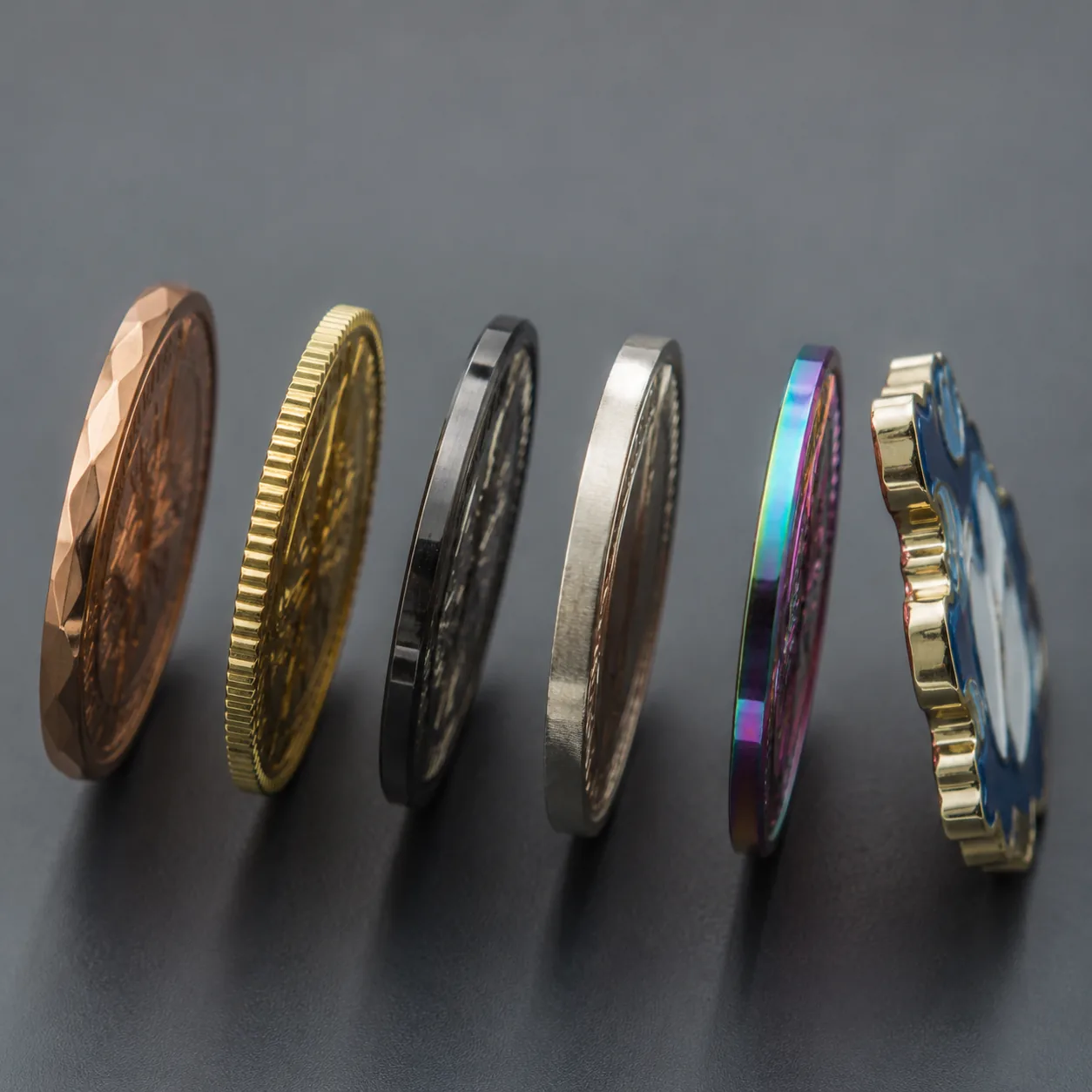
For decorative promo pins, bright gold, bright nickel, black nickel, and dyed black are generally the safest rush platings because they are standard line setups at many factories. Matte finishes, dual plating, antique hand-brushed effects, rainbow plating, or tightly controlled satin surfaces add handling variation and can add 1-3 days. Decorative flash plating on promo pins is commonly around 0.03-0.08 microns for gold-tone appearance. If storage humidity, corrosion resistance, or wear matters, specify the plating stack or salt-spray expectation rather than assuming all finishes perform alike. For example, 24-hour neutral salt spray may be reasonable for standard promo use, while higher requirements should be confirmed before quoting because they can change both cost and line selection.
Standard fittings such as butterfly clutch, black rubber clutch, and deluxe clutch are rarely the bottleneck. Magnetic backs, brooch bars, safety pins, cufflink fittings, or jewelry locking systems must be confirmed before approval because accessory stockouts can delay a simple pin more than the metal body itself. If the order is safety-sensitive for garments or children’s items, that also needs to be raised up front; a different attachment or compliance path may be required.
Keep packaging functional and schedule-safe
Packaging is a common hidden delay because buyers often finalize it after the pin itself is already approved. Bulk bagging or a simple backing card usually preserves the schedule. Rigid boxes, folded inserts, barcode programs, tissue wrap, retail sleeves, and multi-piece presentation sets can add more time than the metalwork. The practical test is whether the packaging materially improves event handling, retailer compliance, or damage protection enough to justify the extra days and per-piece cost.
For booth giveaways, bulk pack or a simple 300-350 gsm backing card is usually enough. For sponsor kits, VIP mailers, or paid merchandise, a 4C backing card plus self-seal polybag is often the best speed-to-presentation compromise. If card presentation matters, lock the card size, euro-hole position, bleed, finish, and barcode rules before the pin goes into production so the print vendor does not wait on final measured dimensions.
| Packaging option | Added lead time | Typical added cost at 500 pcs | Rush recommendation |
|---|---|---|---|
| Bulk pack, 50-100 pcs per inner bag | 0-1 day | USD 0.00-0.02 per pc | Best when delivery date is critical |
| Custom backing card, 300-350 gsm, 1C or 4C | 2-4 days | USD 0.05-0.12 per pc | Good balance for event handout and branding |
| Backing card plus self-seal polybag | 2-4 days | USD 0.08-0.16 per pc | Recommended if cards may scuff in transit |
| Barcode label on card or polybag | 1-2 extra days | USD 0.01-0.04 per pc | Use only if retailer, 3PL, or venue requires it |
| Rigid gift box or drawer box | 5-8 days | USD 0.45-1.20 per pc | Avoid on rush timelines unless margin justifies it |
Write QC tolerances that protect function without over-specifying cosmetics
Rush orders still need a written defect hierarchy. The smart approach is to relax only minor cosmetic variation that does not affect use while holding firm on safety, attachment integrity, approved artwork revision, and shipment count. On an event giveaway pin, small enamel shade drift may be commercially acceptable if the lot remains reasonably consistent with the approved proof. Missing clutches, loose posts, visible sharp burrs, wrong plating, wrong artwork revision, or short count are not minor defects; they make the goods unsafe, unusable, or unsellable at the show.
A workable QC clause for custom pins is typically ANSI/ASQ Z1.4, General Inspection Level II, with AQL 2.5 for major defects and 4.0 for minor defects unless your company uses a stricter internal standard. Practical dimensional tolerance is often ±0.20 mm on overall size for a 25-35 mm pin, ±0.10-0.15 mm on critical post placement, and ±0.15 mm on nominal thickness such as 1.5 mm. For printed designs or epoxy dome coverage, define acceptance by approved proof and factory production photo rather than vague language such as “same as sample.”
Color matching for enamel is usually visual, not instrument-controlled, so the golden reference must be explicit. State whether approval is tied to the signed digital proof, an approved production photo under neutral lighting, or a retained previous sample. Also define functional cosmetic limits on the front face: for example, no exposed base metal on visible raised areas, no enamel void greater than 0.30 mm on the front, no front-edge burrs detectable by finger contact, and no loose posts after a basic hand-torque check. If count accuracy matters for event staffing, require sealed inner-bag counts and carton labels by quantity.
- Put the AQL level and inspection basis on the PO, not only in email threads
- State dimensional tolerances in mm for size, thickness, and post placement
- Require count verification by sealed inner bags and labeled cartons
- Set zero tolerance for missing clutches, loose fittings, bent posts, sharp burrs, and wrong plating
- Approve one golden reference by digital proof or production photo before the full run
Put freight, customs, and receiving instructions directly on the PO
A factory can finish on time and still miss the show if freight terms are unresolved. The shipping block on a rush PO should state shipping method, Incoterm, commercial invoice description, consignee details, importer of record if required, country-of-origin marking requirement, and maximum carton dimensions or weight if the venue or advance warehouse has limits. Convention centers often require specific labels, dock windows, and advance-warehouse deadlines, and they may reject unidentified or overweight cartons.
For 100-500 pins, international express courier is usually the simplest route because it combines export movement, customs handling, and final-mile tracking. For several thousand pins, especially with cards or mixed promo kits, air freight can lower per-piece logistics cost but adds more handoffs and customs coordination. Even on low-value promo goods, leaving a 2-5 day customs buffer is prudent for US or EU arrivals tied to a hard event date. Saving USD 80-150 on freight does not compensate for a missed booth setup.
If direct-to-show delivery is unavoidable, confirm whether the venue accepts freight on weekends, whether labels must include booth number and exhibitor name, and whether carton weights are capped at 13-15 kg. Also decide up front whether partial delivery is acceptable. A line such as “Minimum 300 pcs must arrive by April 6, 2026; balance may follow by April 9, 2026” gives the supplier and forwarder permission to protect the event instead of treating the order as all-or-nothing.
Use one rush-ready baseline spec instead of open-ended option requests
The fastest sourcing move is not asking the supplier to “recommend options” after the calendar is already compressed. It is issuing one complete specification sheet with minimal room for interpretation. At minimum, include quantity, finished size in mm, construction, thickness, plating, Pantone colors, attachment, backstamp requirement, packaging, approval method, QC standard, delivery term, and in-hands date.
A practical rush brief can be this specific: 500 pcs custom pin; stamped iron soft enamel; 30 x 28 mm finished size; 1.5 mm thickness; bright nickel plating; 4 Pantone colors; minimum metal line width 0.30 mm; minimum enamel cell width 0.60 mm; two posts with butterfly clutches, 10 mm center spacing; backstamp logo centered within an 18 x 10 mm usable zone; backing card 300 gsm, 4C, 55 x 90 mm; self-seal polybag; digital proof approval within 24 hours; production photo approval instead of courier sample; ANSI/ASQ Z1.4, Level II, AQL 2.5 major / 4.0 minor; DDP to Las Vegas advance warehouse; in-hands no later than April 6, 2026; split shipment allowed with a minimum first arrival of 300 pcs.
That level of detail lets the factory flag real risks immediately, quote standard versus rush lead times honestly, and suggest substitutions before time is lost. For event-driven sourcing, the best supplier is not the one promising miracles. It is the one willing to identify which specifications are stable, which add days or scrap risk, and which should be simplified now so the pins actually reach the booth on time.
Have a project? Send your artwork and target quantity and we’ll reply with a detailed quotation within 12 working hours.
Ready to get this made?
Send your sketch, target quantity and ship-date. Detailed quotation in 12 hours.



