Rush-Schedule Spec Sheet for Custom Pins and Badges
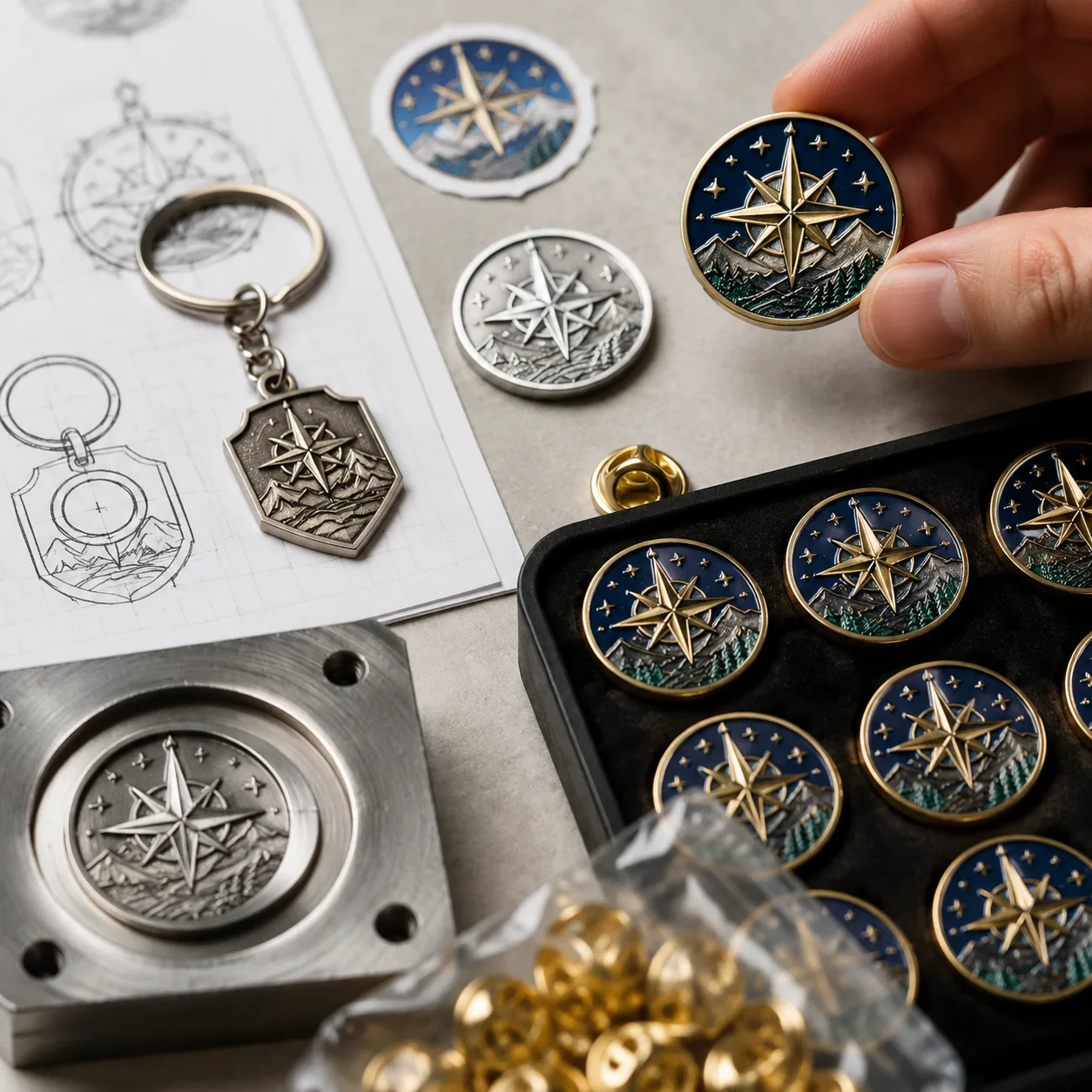
When a 14-day pin order misses, the root cause is usually the spec sheet, not factory capacity
Most late rush orders are not late because a factory cannot physically make metal pins quickly enough. They are late because the PO says only size, logo, and quantity while leaving plating, attachment, Pantone references, packaging, and approval method unresolved. A capable pin supplier can often complete tooling, stamping or die casting, plating, color fill, assembly, inspection, and export packing in about 10 to 16 calendar days after final artwork approval for a standard custom pin. The delays usually start when the buyer changes finish after tooling is cut, requests a physical sample after photo approval was assumed, or switches from bulk pack to backing card after assembly is already in progress.
For event work, 21 calendar days to in-hands delivery is a realistic red line, not a comfortable plan. Below that threshold, every production variable that affects tooling, plating, assembly, packing, or shipment release should be fixed before the factory starts. Orders that ship on time usually lock seven items up front: build method, finished size and tolerance, plating, Pantone system, attachment, packaging, and release rule. Orders that slip are still debating bright nickel versus antique bronze after sample photos, changing card size once pins are mounted, or asking for a pre-production sample that consumes 2 to 4 days in courier transit alone.
This guide focuses on common custom pins and badges in the 25 mm to 45 mm range, with base thickness typically 1.2 mm to 2.0 mm, MOQs from 100 to 5,000 pieces, and FOB China pricing. As a market reference, a 30 mm stamped iron soft enamel pin at 300 pieces commonly falls around USD 0.42 to 0.72 FOB China, excluding freight, duty, and destination handling. A 30 mm brass hard enamel version is more often USD 0.78 to 1.38 FOB at the same quantity. Rush production that requires queue reprioritization typically adds 10% to 25%, while upgrades such as magnetic backs, printed backing cards, or gift boxes can add more cost and time than the metal body itself.
1) Lock the build method first because it decides schedule, detail limits, and scrap risk
The first line to finalize is the manufacturing method. It determines tooling complexity, polishing time, minimum detail, defect exposure, and how much interpretation risk the artwork carries. For most true rush schedules, stamped iron soft enamel is the fastest low-risk option for standard lapel pins. It provides crisp raised metal borders, predictable color-fill behavior, and shorter finishing cycles than premium constructions. Hard enamel looks flatter and more formal, but it needs tighter polishing control and offers less tolerance for thin dividers, micro text, or multiple isolated color islands.
For stamped soft enamel, practical default artwork limits are 0.25 mm to 0.30 mm minimum raised metal line width, 0.30 mm minimum recessed cavity width, 0.20 mm minimum gap between adjacent metal lines, and 0.8 mm to 1.0 mm minimum text height for readable uppercase text after plating. Base thickness is commonly 1.4 mm to 1.6 mm before plating for a standard event pin. Zinc alloy die casting is better when the design includes internal cutouts, open windows, compound curves, or sculpted relief that is hard to stamp cleanly. It usually adds 1 to 3 calendar days versus a simple stamped iron pin because casting, trimming, and surface finishing involve more variables. Brass hard enamel is suitable for premium presentation badges and resale-quality pins, but it is often the wrong choice when delivery is under 14 days and the artwork includes six spot colors, tiny date text, and thin recessed channels.
| Build method | Best use under rush | Typical MOQ | Lead time after art approval | FOB USD at 300 pcs, 30 mm | Key technical note |
|---|---|---|---|---|---|
| Stamped iron soft enamel | Fastest standard event pin | 100 | 10-14 days | 0.42-0.72 | 0.25-0.30 mm min metal line; 1.4-1.6 mm base; visible enamel recess is normal |
| Zinc alloy soft enamel | Irregular shape, cutouts, open areas | 100 | 12-16 days | 0.58-0.98 | Better for complex geometry; usually adds 1-3 days; thickness often 1.8-2.0 mm |
| Brass hard enamel | Premium flat-face badge | 100 | 14-20 days | 0.78-1.38 | More polishing; tighter art limits; higher scrap risk on fine detail |
| Die-struck brass or iron, no color | Formal emblem, service pin, relief badge | 100 | 10-13 days | 0.45-0.88 | No enamel-fill step; relief depth typically 0.25-0.45 mm |
| Offset or screen-printed epoxy badge | Photo detail, gradients, fine text | 200 | 9-12 days | 0.38-0.70 | Fast for complex graphics; epoxy dome usually 0.6-1.0 mm thick |
If the event date is fixed, choose the process that minimizes production interpretation, not the process that looks best in a perfect sample loop. A clean 30 mm soft enamel pin with one bright plating finish and one backing type will usually ship faster and with fewer disputes than a mixed-finish hard enamel badge with selective plating and subjective appearance requirements.
2) Put size, tolerance, and artwork rules in measurable numbers
Rush orders fail when dimensions are described visually instead of numerically. A usable spec should state one controlling finished dimension in millimeters, one base thickness, one attachment location, and one general tolerance. Example: 32.0 mm width x proportional height; 1.5 mm base thickness before plating; two posts on horizontal centerline; post centers 18.0 mm apart; finished outer-dimension tolerance +/-0.25 mm. That is enough for tooling, QC, and packaging to work from one reference.
Do not over-specify dimensions that have no commercial value. End users will not notice whether a giveaway pin is 31.8 mm or 32.2 mm wide. They will notice if the pin rotates, if posts are misaligned, if enamel floods over metal lines, or if the edge feels sharp. For most event pins, practical production controls are +/-0.20 mm to +/-0.30 mm on overall size, +/-0.10 mm on base thickness before plating, and +/-0.15 mm on post location. Plating thickness is decorative rather than structural for these products, so call for appearance consistency rather than unrealistic micron targets on all visible areas.
Artwork limits should be written on the spec sheet so the supplier can flag problems before tooling starts. Useful defaults for rush production are: minimum metal line 0.25 mm for soft enamel; minimum recessed area width 0.30 mm; minimum enclosed text height 0.8 mm; minimum spacing between separate lines 0.20 mm; no unsupported needle-point corners; and no reverse text smaller than 0.7 mm stroke height on the back. If Pantone matching is required, specify Pantone Solid Coated unless there is a reason to use another library. If color-critical branding matters, identify the two or three sensitive colors rather than writing 'all colors exact,' which is not a usable factory instruction.
Packaging dimensions must also be treated as production dimensions. A 32 mm pin mounted on a 55 x 85 mm, 350 gsm coated card in a standard OPP bag usually packs faster and denser than the same pin on a 70 x 100 mm card. At 3,000 pieces, that larger card can add one or two extra export cartons, increase chargeable air volume, and slow manual insertion, even though the metal pin itself has not changed.
3) Choose plating and color finish for queue speed, not just appearance
Plating is not a decorative afterthought on a rush order. It affects line scheduling, visual consistency, handling steps, and rework risk. Standard bright nickel, imitation gold, silver-tone, and black nickel usually move faster than antique gold, antique bronze, antique copper, or dual-plating combinations because they involve less subjective hand wiping and fewer masking steps. If the shipment is tied to a hard event date, one standard plating is safer than selective plating, split plating, or mixed matte-and-bright instructions on the same SKU.
Write the finish in production-ready language. Example: bright nickel plating, uniform commercial tone to approved photo sample, no exposed base metal on front face, decorative top layer typically 0.03 to 0.08 microns over standard undercoats. For event pins, that is an appearance requirement, not a jewelry-grade wear spec. If pins will be handled repeatedly, such as resale souvenirs or VIP credentials, a clear protective topcoat can reduce light tarnish and minor handling marks, but it does not make the product abrasion-proof.
Antique finishes can look strong on relief badges, but they are slower and more variable because recess darkness depends on hand wiping and visual judgment. They are poor choices when tiny contrast details matter, when several SKUs need to match in event photography, or when the buyer has not defined how dark the recess should look. Under a compressed schedule, bright plating is usually the lower-risk choice. If edge quality matters, add a simple rule such as: no sharp accessible burrs; touch-safe in normal handling; backside trim marks acceptable if not visible from front at normal wear angle.
For color fill, specify whether a normal soft-enamel meniscus below the metal line is acceptable. On soft enamel, a slight dip is standard and should not be treated as a defect. If a near-level face is required, that may mean imitation hard enamel, added polishing, or an epoxy topcoat, each of which can add cost and 1 to 3 days. On a rush PO, vague language such as 'premium finish' or 'high quality plating' creates approval arguments without helping production.
4) Attachment drives wearability, complaint rate, and assembly time
Attachment is not a minor hardware detail. It determines whether the badge sits straight on clothing, how quickly attendees can wear it, and how many replacements the event desk may need. For a 25 mm to 30 mm pin under about 8 g unit weight, one standard post with butterfly clutch is usually sufficient. Once width exceeds 35 mm, unit weight rises above roughly 8 g to 10 g, or the shape is tall and narrow, two posts are usually worth the small added cost because they reduce rotation and improve perceived quality.
Specify attachment type and position numerically. Example: two 8 mm posts; post wire diameter 0.9 mm to 1.0 mm; centers 18.0 mm apart; aligned on horizontal centerline; black rubber clutches pre-assembled. For magnetic badge backs, specify magnet plate size and intended garment type. A magnet set that holds on a shirt may slip on a heavy blazer. Common lightweight name-badge magnets are around 45 x 13 mm or 45 x 17 mm with two or three internal magnets, but they add weight, cost, and sometimes separate air-shipment handling requirements.
- Under 30 mm and under 8 g: one post with butterfly clutch is usually sufficient
- 30-45 mm, tall vertical shape, or over 8 g: use two posts to prevent rotation
- For delicate garments: consider rubber clutch or magnet backing, but verify hold strength
- Avoid specialty locking backs on event giveaways unless tamper resistance is required
- For brooch bars, specify bar length and position to prevent forward sagging
- Require post solder or attachment integrity with no loose posts after 100% assembly inspection
As a cost reference, a second standard post and clutch often adds only USD 0.03 to 0.08 per piece at normal event volumes. A rubber clutch may add about USD 0.01 to 0.03 compared with a butterfly clutch. Magnet backs are a much larger step-up, often around USD 0.18 to 0.45 extra per piece depending on size and grade. For a one-day handout item, keep the attachment simple. For a multi-day conference badge that must sit straight on a jacket, the second post is usually the cheaper decision overall because it avoids replacements and complaints.
5) Keep packaging simple enough to survive the deadline and freight math
Packaging is one of the easiest ways to break a rush schedule because it adds manual counting, insertion, and verification. If pieces are for registration-desk handout, the fastest reliable option is usually bulk packing in PE bags by 50 or 100 pieces per inner bag, separated by SKU. If branding matters, a simple backing card is still manageable: 300 to 350 gsm coated paper, single-side print, straight cut or simple die-cut, size tolerance about +/-1 mm, inserted into a clear OPP bag. That typically adds 1 to 2 days, not 4 to 6.
Custom gift boxes, EVA foam inserts, barcode-by-unit matching, and multi-part presentation sets add handling steps and extra checkpoints. A stock velvet box or rigid paper box for a premium badge may add roughly USD 0.35 to 1.20 per set and often 2 to 5 extra days depending on local stock and print requirements. That may make sense for sponsor gifts, speaker awards, or executive recognition, but it is rarely the correct choice for 2,000 attendee pins needed next week.
If air freight is likely, carton rules should be on the same spec sheet. State five-layer export cartons, inner polybag separation by SKU, maximum 15 kg gross weight per carton, carton dimension target if needed for courier limits, and carton marks on at least two sides with item code, quantity, and carton number. Those lines reduce warehouse mistakes and make partial release practical when the first cartons need to leave before the full order is complete.
6) Define approval gates and QC criteria that a factory can actually execute
On a normal schedule, buyers can afford multiple sample loops. On a rush schedule, the approval method itself must be fixed in writing. State whether production runs from digital artwork approval only, from digital approval plus factory photo confirmation, or from a physical pre-production sample. Inside a 14- to 18-day total window, a couriered physical pre-production sample is often the schedule killer unless buyer and supplier are in the same country.
A practical rush-control method is to approve vector artwork first, then approve one factory photo set showing plated blanks, front-side color fill, and back attachment before mass-production release. That creates three real checkpoints without spending days on courier transit. Appearance acceptance should also be measurable: colors visually matched to approved Pantone references under neutral light near D65 conditions; no obvious front-face scratches at 30 cm viewing distance; no exposed base metal on front; no chipped enamel larger than 0.2 mm in visible logo areas; and no sharp burrs on accessible edges.
QC language should be short and testable. For many custom metal giveaway programs, AQL 2.5 for major defects and 4.0 for minor defects at General Inspection Level II is workable. Major defects usually include wrong size beyond tolerance, wrong attachment, wrong plating, wrong or missing color fill, loose or broken post, unreadable event date, mixed SKU in same labeled bag, wrong count per retail pack, or severe enamel overflow affecting logo recognition. Minor defects usually include small backside marks, slight polish variation, slight color drift within commercial tolerance, or tiny front imperfections not visible at normal viewing distance.
If several SKUs share one event date, add one more release instruction: no hold for complete set matching unless buyer approval is required in writing. That prevents finished cartons of one design from sitting idle while another SKU waits for rework, packaging, or final color confirmation.
7) Build shipment rules and quote tiers into the same one-page document
A rush order is not complete when production ends. It is complete when cartons can be released without another internal approval chain. Put the ex-factory date, shipping mode, and partial-shipment rule directly on the PO or spec sheet. Example: ex-factory by March 4; ship via DHL, FedEx, or UPS express; partial shipment allowed; balance ships only with buyer approval. Without those lines, suppliers often wait for all SKUs, all cards, or all accessories before booking outbound freight.
For 100 to 500 pieces, express air is usually the rational choice despite higher freight per unit. For 1,000 to 5,000 pieces, split shipment often works better: send the first 300 to 1,000 pieces by express for event use, then move the balance by economy air if budget matters. That works only if the factory pre-sorts and labels cartons clearly, so require carton numbering such as 1/12, 2/12, and SKU quantity on each master carton.
Use MOQ tiers when requesting quotes so decisions can be made without another RFQ round. A practical grid is 100, 300, 500, 1,000, and 3,000 pieces, with standard lead time, rush lead time, tooling charge, and rush surcharge shown separately. In many pin programs, the price drop from 300 to 500 pieces is more meaningful than buyers expect because tooling cost is spread across more units, while the production-time difference may be zero if the same plating and packing batch absorbs the larger run.
The fastest buyer-side checklist is simple: art file format, quantity tier, build method, size, thickness, Pantone references, plating, attachment, packaging, approval method, AQL, ex-factory date, ship mode, and partial-release rule. When those lines are written once and not reopened, the supplier can quote, tool, schedule, and ship with far less stop-start risk.
What to issue today: a one-page rush spec with no open decisions
If the event date is fixed, issue a one-page spec sheet today with only the production-critical lines: item type, build method, finished size, thickness, plating, Pantone references, attachment, packaging, approval method, AQL standard, ex-factory date, and ship mode. That plain document is more useful than a polished brief full of unresolved choices.
Then define what cannot change after artwork approval. For most trade-show and conference orders, that should be finish, backing type, and packaging format. Once those are fixed, a competent supplier can quote faster, cut tooling faster, and hold schedule with much less rework risk. If the factory believes the order may still change from magnetic badge to two-post pin midway through, the real lead time is already longer than the calendar suggests.
A practical sequence is straightforward: send vector art plus quantity tiers of 100, 300, 500, 1,000, and 3,000; request standard and rush pricing; choose the fastest low-risk build; approve production against a written photo-approval rule; and authorize partial shipment if needed. In rush custom pins and badges, delivery discipline beats specification elegance. The buyers who ship on time are usually the ones who stop revising soon enough for the factory to start.
Have a project? Send your artwork and target quantity and we’ll reply with a detailed quotation within 12 working hours.
Ready to get this made?
Send your sketch, target quantity and ship-date. Detailed quotation in 12 hours.



