Rush Promo Orders for 2026 Events: What to Cut, Keep, or Split
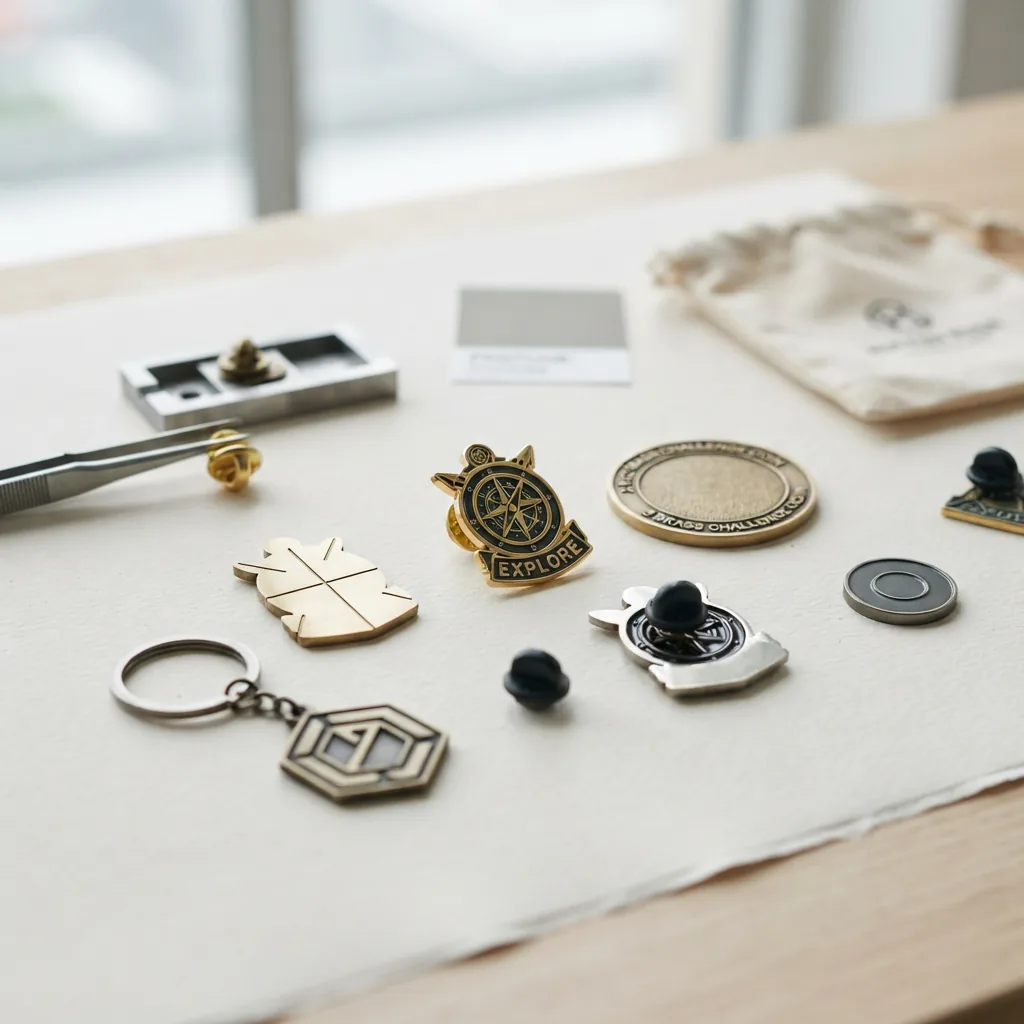
When the event date is fixed, the real decision is schedule fit
Most rush-order failures do not start with an uncooperative factory. They start when a buyer tries to force a 24- to 32-day program into a 10- to 14-day in-hand window without changing the construction, packaging, or approval chain. For custom promo items, the calendar has to absorb artwork cleanup, die-line confirmation, tooling, pre-production sample or production-photo approval, manufacturing, inline QC, export documentation, line-haul, customs clearance, and final delivery. Treat any of those steps as zero days and the schedule is already wrong.
For 2026 event buying, the most useful first classification is still simple: keep the original spec, cut low-value specs, or split the order. A 35 mm soft enamel iron pin, 1.2 mm thick, 4 Pantone colors, nickel plating, 2 butterfly clutches, bulk packed 100 pcs per polybag, can often run in about 10 to 14 calendar days at 300 to 500 pcs after final proof approval. Change that same item to hard enamel on brass, mirror polish, glitter fill, laser serial number, and individual rigid box with EVA insert, and the production window commonly moves to 18 to 24 days before freight is even booked.
Rush projects usually hold only when three variables are locked in the first 24 to 48 hours: final vector artwork, exact quantity by SKU, and one approval owner with authority to respond the same business day. If those stay open, a supplier may reserve line capacity, but it still cannot release tooling, plating sequence, print layout, backing-card print, or pack-out materials. The slip starts before manufacturing starts.
Plan backward from the in-hand date, not the factory ship date
Start from the date the goods must physically arrive at the venue, office, or 3PL, then subtract the non-factory time first. For US and EU destinations, air freight plus export handling, customs clearance, and final-mile delivery usually consumes 5 to 9 calendar days. Express courier can reduce that to roughly 3 to 6 days for small cartons under about 60 to 80 kg chargeable weight, but volumetric weight, remote delivery zones, and customs inspection still create variance. Sea freight is rarely a credible rush option unless production is already complete and the event window is still 35 to 45 days out.
A practical rule for 2026 is straightforward. With less than 21 calendar days to in-hand delivery, treat the order as constrained-spec by default. With 21 to 30 days, you can usually keep one or two decorative upgrades if the design is simple, quantity is moderate, and the supplier already runs that category regularly. Above 30 days, most standard custom pins, keychains, patches, and lanyards are realistic again, but only if internal sign-off stays disciplined and packaging does not reopen late.
| Available time to in-hand delivery | Usually realistic | Usually too risky |
|---|---|---|
| 10-14 days | Repeat orders, stock-webbing lanyards with simple heat-transfer print, soft enamel pins 100-300 pcs by express air, woven patches with standard border | New tooling with deep inner cutouts, hard enamel, custom rigid boxes, mixed SKU assortments, sea freight |
| 15-21 days | Simple new metal products with one plating finish, dye-sublimation lanyards, woven patches, standard QC at AQL 2.5 major / 4.0 minor | Artwork changes after sample approval, mixed attachments in one PO, epoxy domes, split packaging instructions, multiple approvers |
| 22-30 days | Most standard pins, keychains, patches, and lanyards at 300-2,000 pcs with bulk packing | Late packaging decisions, nonessential decorative upgrades, avoidable rework |
| 30+ days | Broader spec flexibility, lower FOB pricing, easier sample loop, more freight options | Artificial rush premiums caused by slow internal approvals |
If the backward schedule does not fit, do not force the full PO through one path. Splitting 300 to 500 event-critical units onto express air and sending the balance later by standard air or sea often costs less than accelerating every SKU. It also protects the event date without locking the entire order into the fastest and most expensive route.
Choose product families that actually compress well
Not every promo category shortens equally. Soft enamel pins, woven patches, and dye-sublimation lanyards usually compress better than hard enamel pins, die-cast zinc alloy keychains, spinner charms, challenge coins with capsules, or multi-component gift sets. The reason is process count. Every extra step adds another queue: casting trim, fine polish, plating, print, epoxy cure, assembly, insert packing, retail boxing, and carton assortment.
A woven patch at 70 x 50 mm using 75D yarn, up to 8 colors, merrow border, and heat-seal backing can often run in 7 to 10 production days at 500 pcs. A 45 mm die-cast zinc alloy keychain with 3D relief, epoxy window, swivel connector, split ring, and EVA insert gift box can easily require 16 to 22 production days because each secondary operation adds setup time, cosmetic inspection, and rework risk. A 20 x 900 mm polyester lanyard, 0.9 to 1.2 mm material thickness, heat-transfer printed on both sides with one standard J-hook and optional breakaway buckle, is usually a safer rush choice than a custom metal keychain with moving parts.
If the event objective is identification, giveaway volume, or access control, choose the product that delivers the function with the fewest process dependencies. The most premium-looking item on a mood board is often the wrong rush item. The right item is the one that can be tooled, produced, packed, and shipped with the fewest decision points.
| Product type | Rush-friendly spec | Typical MOQ tiers | Typical production lead time | Indicative FOB price |
|---|---|---|---|---|
| Soft enamel iron pin, 30-40 mm | 1.2 mm thickness, up to 4 colors, nickel or black nickel plating, 2 butterfly clutches, bulk pack | 100 / 300 / 500 pcs | 10-14 days | USD 0.38-0.85/pc at 500 pcs |
| Hard enamel brass pin, 30-40 mm | Polished face, up to 4 colors, 2 clutches, no box | 100 / 300 / 500 pcs | 16-22 days | USD 0.75-1.60/pc at 500 pcs |
| Woven patch, 70 x 50 mm | Merrow or heat-cut edge, sew-on or heat-seal backing, no backing card | 100 / 300 / 500 pcs | 7-10 days | USD 0.22-0.55/pc at 500 pcs |
| Dye-sublimation lanyard, 20 x 900 mm | Single hook, optional safety break, no individual bag | 100 / 500 / 1000 pcs | 7-12 days | USD 0.32-0.90/pc at 500 pcs |
| Die-struck challenge coin, 45 mm | 2D relief, one plating, no capsule or gift box | 100 / 300 / 500 pcs | 12-18 days | USD 1.20-2.80/pc at 300 pcs |
Cut specs that consume days but add little event value
Rush sourcing is mostly a deletion exercise. The usual time-drains are rigid gift boxes, mixed plating within one PO, multiple attachment styles, laser numbering, epoxy domes, oversized dimensions, backing-card changes after approval, and SKU-level packing splits. None of those features is automatically wrong. They are simply poor choices when the delivery window is tight and the event does not depend on them.
Use a blunt filter: will the attendee, staff user, or booth visitor notice this feature during the event itself? If not, remove it from the rush version. A rigid presentation box can add about USD 0.35 to 1.20 per piece and 2 to 5 production days depending on insert type, manual pack-out, and carton assortment. A laser serial number may add only USD 0.03 to 0.10 per piece, but it can still create an extra handling step and slow final packing. Epoxy domes often add 1 to 3 days because cure time and dust control are not compressible without cosmetic risk.
- Keep one plating finish across the order. Nickel, black nickel, or imitation gold are easier to schedule than mixed finishes.
- Hold enamel colors to 4 or fewer where possible. More cells mean more hand fill, more touch-up, and more cosmetic sorting.
- Use standard attachments already proven for the category, such as butterfly clutch for pins or lobster clasp plus split ring for keychains.
- Avoid special effects unless they are central to the campaign concept. Glitter, glow, translucent fill, pearl enamel, and epoxy domes all add curing or inspection risk.
- Skip individual retail packaging unless the item is for resale, sponsor gifting, or executive handout.
- Use one backing-card size per SKU and lock card dimensions early so print and packing materials can be ordered once.
In manufacturing terms, every deleted option reduces queue dependence. Rush schedules usually fail at shared bottlenecks such as plating, printing, curing, and final packing, not in stamping alone. A cleaner bill of materials gives the factory room to absorb a one-day slip without missing the ship date.
Pay for the bottleneck, not for a vague rush promise
Under deadline pressure, buyers often accept blanket rush premiums without checking whether the extra spend changes the real constraint. Paying more helps when the supplier must fast-track tooling, reserve overtime, move a job ahead in plating, split production across lines, or ship direct by air instead of waiting for consolidation. It does not help when artwork is still changing, packaging is unresolved, or the spec includes process time that cannot be compressed without driving defect risk.
For standard custom metal giveaways, a realistic rush premium is often 10% to 25% on ex-works or FOB item cost when the job needs queue priority but not special engineering. Freight upgrades often cost more than production acceleration. On a 500-piece soft enamel pin order worth roughly USD 190 to 425 FOB, the production rush premium may be only USD 25 to 80. Upgrading from standard air consolidation to express air can add USD 120 to 320 depending on gross weight, volumetric weight, destination, and whether remote-area surcharges apply.
Ask every supplier to separate three values clearly: standard item price, rush production premium, and freight upgrade. If those are bundled into one number, you cannot tell whether the extra charge buys real calendar compression or just logistics pass-through. In many cases the best answer is not accelerating the full order. It is rushing one SKU, deleting one packaging step, or shipping only a partial quantity first.
Use split orders before approving a compromised full order
A split-order strategy is often the most rational answer when marketing wants a premium finish but operations need goods on site. The goal is not one perfect shipment. The goal is to get the right quantity of usable product to the event date, then let the balance arrive through a lower-risk and lower-cost route.
Example: an event team needs 2,000 units in hand within 24 days. The preferred spec is a 38 mm hard enamel brass pin with printed backing card and paper sleeve. The supplier estimates 18 to 20 production days plus 6 days for air freight and clearance, which leaves almost no recovery buffer. A stronger structure is 500 soft enamel iron pins with simple card and polybag packing for shipment one in 12 to 14 production days, followed by 1,500 premium hard enamel units on standard timing. The event requirement is protected without permanently downgrading the campaign.
Split orders also improve quality control. The first shipment can be inspected to AQL 2.5 major and 4.0 minor with focused checks on clutch pull, color match against approved Pantone references, plating cleanliness, burr-free edges, and count accuracy. If the second batch has not entered final packing, what is learned from the first batch can still be applied before the balance ships. That is especially useful when the first lot reveals practical issues such as card-hole misalignment, loose clutch fit, or color drift under booth lighting.
Rush QC needs fewer checkpoints, but tighter measurable ones
Under deadline pressure, many buyers add approvals because they want reassurance: more photos, more videos, more status updates, more sample comments. In practice, too many checkpoints slow the cycle and create conflicting instructions. Rush workflows work better with fewer approvals, each tied to measurable criteria and a fixed response deadline.
For metal products, three checkpoints are usually enough: artwork proof sign-off, pre-production sample or detailed production-photo approval, and pre-shipment QC release. At sample stage, specify tolerances. For dimensions under 50 mm, plus or minus 0.20 mm is a practical target. For thickness, plus or minus 0.10 to 0.15 mm is common depending on process. Attachment location should be centered within plus or minus 1.0 mm. For woven patches, size tolerance of plus or minus 1.5 mm is more realistic because border formation and heat-cut shrinkage vary slightly. For lanyards, strap width tolerance of plus or minus 1.0 mm and finished length tolerance of plus or minus 5 mm are typical workable limits.
For decorative nickel, black nickel, or imitation gold plating on promo metal items, the coating is cosmetic and often falls around 0.03 to 0.10 micron depending on the process route and visual requirement. Buyers should not treat that as a heavy functional coating. Release criteria should focus on uniform appearance, complete coverage on visible surfaces, no blistering, no exposed base metal on the front face, and no obvious color variation outside the approved sample range. For enamel fill, define acceptable limits for underfill, overflow, pinholes, and color drift at the sample stage so QC can inspect against a rule instead of debating subjective perfection.
Rush orders are the wrong place to chase luxury-grade cosmetics on mid-cost event merchandise. Set a release standard that matches the use case: correct size, correct attachment, correct color family, clean front appearance at 30 cm viewing distance, safe edges, and acceptable count. That gives the supplier a defensible target and reduces approval churn.
What to do next if your 2026 event window is already tight
Classify the order now into one of three lanes: standard, constrained-spec, or split-shipment. If the in-hand deadline is under 21 days, assume constrained-spec unless the item is a repeat order with proven tooling, unchanged packaging, and a known shipping lane. Then lock four fields in writing: product construction, quantity by SKU, packaging style, and approval owner with same-day sign-off authority.
Send suppliers a short rush RFQ with the in-hand date, destination city and country, quantity, target size in mm, plating or print method, attachment, packaging, and latest acceptable ship date. Ask for two quotes side by side: best standard timing and fastest realistic timing. Each quote should separate FOB item cost, rush premium, tooling cost, sample cost if any, and freight method. That exposes whether the right move is to simplify, split, or change product family before more time is lost.
For MOQ planning, ask for at least three tiers: 100, 300, and 500 pcs on small metal items; 100, 500, and 1,000 pcs on lanyards and patches. Rush feasibility changes with quantity because die loading, plating batch efficiency, print setup, and packing labor do not scale linearly. A supplier can often compress 300 simple pins into a schedule that becomes risky at 2,000 pcs on the same dates. The most useful first file pack is simple: vector artwork, target size in mm, quantity by SKU, finish, attachment, packaging, destination country, and latest acceptable ship date. That is enough for a capable supplier to tell you quickly whether to keep the spec, cut low-value features, or divide the shipment before another two days disappear.
Have a project? Send your artwork and target quantity and we’ll reply with a detailed quotation within 12 working hours.
Ready to get this made?
Send your sketch, target quantity and ship-date. Detailed quotation in 12 hours.



