Rush Orders in 2026: Pins vs Patches vs Lanyards vs Coins
When the event date is fixed, choose the item with the fewest process failures
The usual rush-order mistake is asking every supplier the same question: can you deliver in 10 days? That skips the real decision. Under deadline pressure, the safest item is the one most likely to clear artwork approval, tooling, production, inspection, packing, export handoff, and freight without adding hidden delay. A quoted lead time means very little if it excludes die time, sample approval, accessory shortages, or final packing.
For most 2026 event programs, dye-sublimated lanyards and woven patches remain the lowest-risk rush categories because they avoid several metal bottlenecks: die engraving, die striking or casting, plating queues, enamel fill, oven curing, polishing, and heavier cosmetic sorting for pits, edge nicks, plating burns, and dent marks. A product can look simple on a quote sheet and still be fragile on schedule if it depends on too many manual finishing steps.
Category alone does not decide speed. The real lead-time drivers are mold or no mold, printed color or hand-filled enamel, bright plating or antique finish, bulk pack or carded retail pack, and stocked hardware versus custom attachment. A 30 mm soft enamel pin in iron with four fills, one butterfly clutch, and bulk packing can be feasible in 8 to 11 production days. The same pin with dual plating, epoxy dome, custom card, and individual polybag can become a 12 to 16 day factory job before freight is even booked.
The ranges below use realistic China factory-side planning numbers for standard custom work in 2026. They are not best-case promises that assume immediate approvals, no artwork revisions, no stock issues, and zero remake risk. They are the ranges procurement, marketing, and event teams should use when comparing pins, patches, lanyards, and coins for trade shows, sponsor kits, internal programs, or channel events.
2026 rush comparison: MOQ, tooling, lead time, and risk
| Product | Typical MOQ tiers | Tooling needed | Pre-production sample | Mass production lead time | Rush-safe spec window | FOB unit range at 500 pcs | Main rush risk |
|---|---|---|---|---|---|---|---|
| Soft enamel pin, 25-35 mm | 100 / 300 / 500 pcs | Yes, stamped iron or zinc alloy mold; die charge usually USD 55-110 | Digital proof; physical sample usually skipped on rush | 8-12 days | 1.2-1.5 mm thick, <=4 Pantone fills, line width >=0.25 mm, cutouts >=1.2 mm, one clutch | USD 0.48-0.98 | Plating queue, enamel fill consistency, backing card delay |
| Die-struck pin, no color, 25-35 mm | 100 / 300 / 500 pcs | Yes; same die path as soft enamel | Digital proof only on most rush orders | 7-10 days | Raised/recessed metal, relief depth about 0.20-0.35 mm, sandblast background, single clutch | USD 0.42-0.88 | Scratch visibility, fine-detail flattening, plating marks |
| Woven patch, 60-80 mm | 100 / 300 / 500 pcs | No metal mold; cut path file only | Digital proof; sewn strike-off optional | 5-8 days | Simple shape, woven text stroke >=1.0-1.2 mm, size tolerance +/-1-2 mm, heat-seal or plain backing | USD 0.38-0.92 | Border accuracy, backing choice, trim tolerance |
| Embroidered patch, 60-80 mm | 100 / 300 / 500 pcs | No metal mold; embroidery program setup only | Digital proof; sewn sample optional | 6-9 days | Text >=4-5 mm cap height, 50-75% thread coverage, merrow border preferred | USD 0.45-1.12 | Coverage loss, border distortion, thread shade substitution |
| Dye-sublimated lanyard, 20 mm x 900 mm folded | 100 / 300 / 500 pcs | No hard tooling; print layout setup only | Digital artwork proof | 4-7 days | 15 mm or 20 mm width, standard J-hook or swivel hook, breakaway optional, print registration tolerance about +/-1.5 mm | USD 0.52-1.18 | Attachment stockouts, webbing color shift, sewing backlog |
| Screen-printed polyester lanyard, 20 mm x 900 mm folded | 100 / 300 / 500 pcs | Screen setup only; usually 1 screen per color | Digital artwork proof | 5-8 days | 1-2 spot colors, standard hardware, no detachable buckle if avoidable | USD 0.48-1.08 | Registration drift, ink dry time, logo alignment |
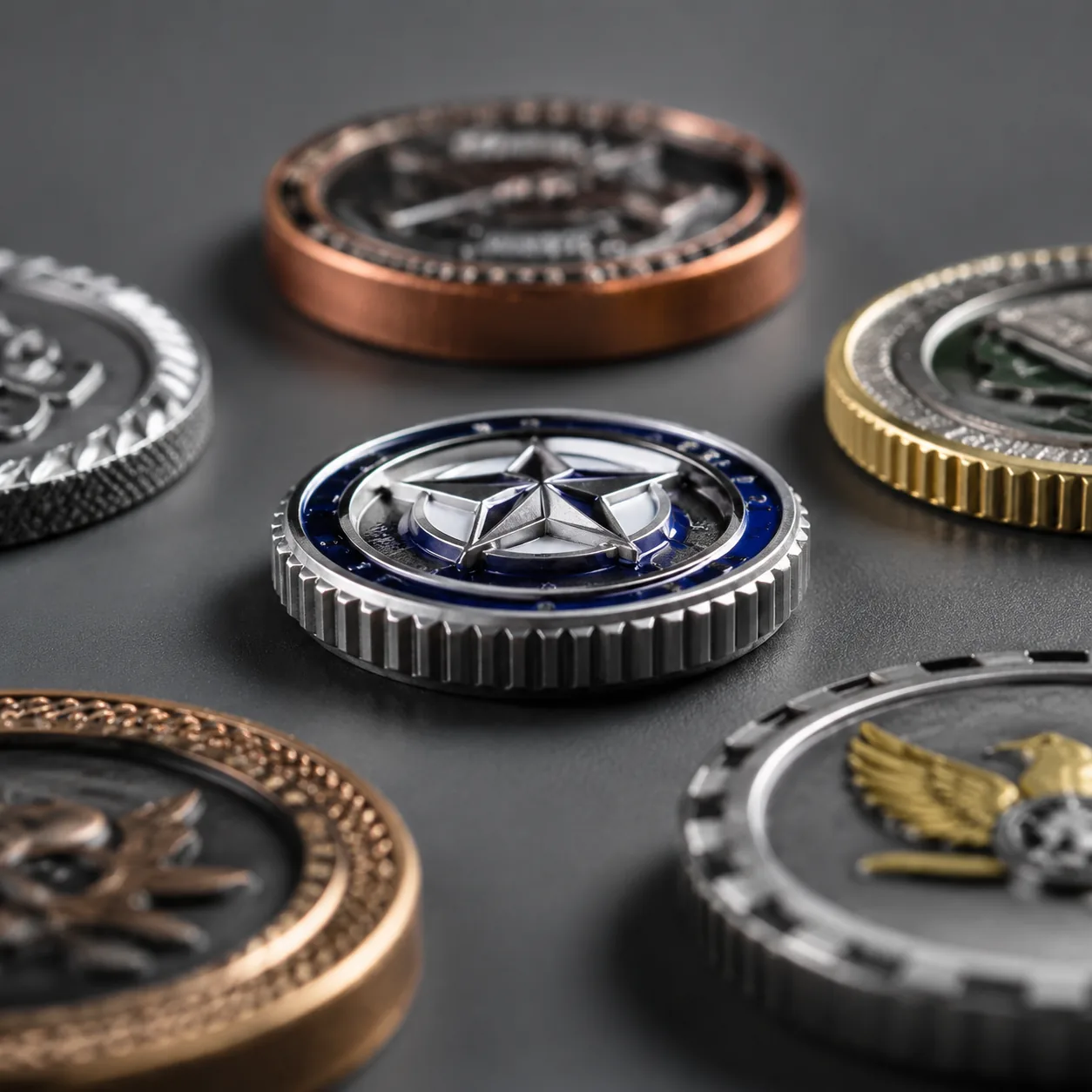
| Soft enamel challenge coin, 38-45 mm | 100 / 300 / 500 pcs | Yes, stamped mold; tooling often USD 80-160 | Digital proof; physical sample recommended if time allows | 10-15 days | 2.0-3.0 mm thick, <=5 fill colors, standard flat or rope edge, bulk pack | USD 1.25-2.85 | Fill consistency, edge defects, packing time |
| 3D relief coin, antique finish, 45 mm | 100 / 300 / 500 pcs | Yes; deeper mold and longer polish route | Physical sample preferred | 12-18 days | Moderate relief depth, single antique finish, no insert, bulk pack | USD 1.90-3.95 | Longer polishing, antique variation, visual sorting load |
At the same 500-piece volume, lanyards and woven patches usually compress best because they have less tooling dependency and lower inspection time per piece. Coins sit at the opposite end because they are heavier, more exposed to visible surface defects, and often sold with capsules, velvet boxes, or gift sleeves that can add 1 to 3 working days by themselves.
If you have 7 to 10 days, lanyards usually win and woven patches are next safest
When the delivery window is genuinely tight, dye-sublimated polyester lanyards usually offer the highest on-time probability. They move from approved art to print production without a metal die, hold full-color logos without screen registration limits, and use widely stocked accessories such as swivel hooks, bulldog clips, lobster clasps, and safety breakaways. For standard 15 mm or 20 mm width and 900 mm folded length, a realistic 2026 factory lead time is 4 to 7 days for 100 to 1,000 pieces. FOB pricing is commonly USD 0.52 to 1.18 at 500 pieces and about USD 0.44 to 0.86 at 1,000 pieces depending on hardware, buckle, and breakaway.
A practical rush spec is 20 mm polyester, full-color sublimation on both sides, one swivel hook, black plastic buckle only if required, and bulk pack 50 or 100 per bag. Standard webbing weight is usually around 120 to 150 gsm equivalent after finishing, and finished length tolerance is typically +/-5 to 10 mm. If you add detachable buckles, double hooks, individual name personalization, or multiple hardware mixes in one PO, sewing and sorting time usually increases enough to erase the category's speed advantage.
Woven patches are the next safest rush choice, especially when artwork includes small text, line detail, or compact logos. Under time pressure, woven construction usually reproduces finer shapes more consistently than embroidery because it avoids thick thread loft and reduces edge pull. For a 70 mm patch with merrow or heat-cut border and heat-seal backing, factories commonly quote 5 to 8 production days. Practical finished-size tolerance is usually +/-1 to 2 mm, and border placement can vary about +/-1 mm on complex shapes.
For legibility, keep minimum woven text stroke at 1.0 to 1.2 mm, avoid interior gaps under 0.8 mm, and do not expect textile colors to match a printed Pantone proof exactly. On rush textile runs, a visual variance broadly equivalent to Delta E 2 to 4 is common and commercially normal. Embroidered patches are still workable, but once thread coverage climbs above roughly 75%, stitch density, pull distortion, and thread substitutions create more variables than most rush programs need.
When metal is worth the extra days
Speed is not the only buying criterion. If the item is meant for sponsor recognition, employee milestones, donor packs, military-style exchange, or collector trading, perceived value per piece may matter more than pure turnaround. In those cases, a die-struck pin or a simple coin can still be the smarter commercial choice even with a longer production clock.
Within the metal category, die-struck pins are often the best rush compromise because they remove enamel filling and curing from the route. A standard spec is 1.2 to 1.5 mm thickness in iron, raised polished metal, recessed sandblasted background, and bright gold, bright nickel, or black nickel plating. That can save 1 to 2 working days compared with a similar soft enamel version. The trade-off is readability: on logos smaller than about 25 mm, relief below 0.20 to 0.25 mm tends to look flatter than buyers expect, especially in bright lighting.
Soft enamel pins still work under deadline when the design is controlled. A 30 mm iron pin with four or fewer fills, bright nickel, one butterfly clutch, and bulk pack is usually a credible 8 to 12 day factory program. Once the design adds glitter enamel, transparent fill, screen-printed detail, epoxy dome, dual posts, custom carding, or cutouts below about 1.2 mm, the schedule usually stops being truly rush-safe.
Coins make more sense when quantity is lower and value per piece is higher. A 45 mm coin at 3.0 mm thickness in zinc alloy or brass with one antique finish and standard edge usually needs 12 to 16 days. For 200 executive gifts or award pieces, that can still be a better use of budget than 2,000 lower-value giveaways. Where buyers misjudge the category is using coins for booth traffic or general attendee handouts, where the same spend usually buys more units, easier distribution, and lower freight exposure with lanyards or patches.
The bottlenecks that quietly add 2 to 4 days
Rush orders rarely fail because the core item cannot be manufactured. They fail because secondary requirements add handling time after the main item is done. The most common schedule breakers in 2026 are custom backing cards, barcode labels, individual polybags, mixed hardware within one PO, split assortments by region or name, and waiting to consolidate with a later item instead of releasing finished cartons immediately.
Plating choice is a major variable on pins and coins. Bright gold, bright nickel, and black nickel are usually easier to schedule. Antique silver, antique copper, dual plating, and selective plating require more handling and tighter visual sorting because every rub mark, tone shift, and plating line is visible. If you are rushing metal, one standard finish and one standard attachment is safer than a richer spec with more inspection touchpoints.
Artwork discipline is another schedule lever. Same-day approval of vector art with exact dimensions, Pantone references, attachment locations, backing choice, packaging notes, and barcode position often saves more time than requesting overtime. The fastest projects are not always the simplest designs; they are the projects where nothing critical is still undecided when tooling starts. For metal, vector linework under 0.20 to 0.25 mm and recessed areas below about 0.30 mm deep are common sources of redraw and approval delay.
Quality control standards matter as well. Many factories inspect standard event merchandise to AQL 2.5 for major defects and 4.0 for minor defects, with tighter internal cosmetic checks on plated metal. Under rush, those AQL thresholds may stay the same, but the fallout rate can rise if the design includes subjective details such as antique contrast, deep relief, exact card alignment, or multi-part assembly. Compressing schedule does not remove defect risk; it compresses the recovery window for sorting or remake.
Rush-safe specs vs rush-danger specs
- Rush-safe pins: 25-30 mm, 1.2-1.5 mm thickness, <=4 enamel colors, line width >=0.25 mm, no cutouts, one butterfly clutch, bulk packed
- Rush-safe lanyards: dye-sublimated polyester, 15 mm or 20 mm width, 900 mm folded length, one stocked hook, no detachable buckle unless required, no individualized names
- Rush-safe patches: woven construction, simple outer shape, heat-seal or plain backing, text strokes >=1.0-1.2 mm, no metallic thread, finished-size tolerance accepted at +/-1-2 mm
- Rush-danger coins: 3D relief, spinner inserts, cutouts, edge lettering, sequential numbering, capsules, velvet boxes, gift sleeves, or multi-part assembly
- Rush-danger across categories: repeated artwork edits, mixed SKUs in one PO, manual assortments, custom retail packaging, barcode relabeling, and late packaging changes
- Rush-danger in logistics: holding finished cartons for consolidation, requiring one complete shipment instead of partial release, or choosing heavy coin programs with last-minute air freight
These rules are not about what a capable factory can produce in theory. They are about what remains controllable when time pressure removes the buffer for rework, extra sorting, and approval loops. Nearly any experienced supplier can produce complex effects with enough lead time. In a rush program, the goal is to strip out variables that create subjective inspection calls or labor-heavy finishing.
This is also where buyers save money by simplifying the right detail rather than pushing unit price. Removing a custom backing card from a pin set may save only USD 0.06 to 0.18 per piece, but it also removes a manual assembly step and can pull shipment forward by a full working day. Skipping individual polybags on lanyards can save another USD 0.02 to 0.05 each and reduce packing touches. On a trade-show deadline, those days matter more than marginal packaging upgrades.
Rush premiums, freight math, and cost per usable piece
Rush production costs more, but not every rush premium buys the same amount of schedule protection. Expediting lanyards from 7 days to 5 days usually means priority printing, sewing allocation, and some overtime, which factories can often manage with moderate risk. Compressing a coin from 16 days to 9 or 10 days means overlapping tooling, die striking, plating, fill, inspection, and packing, which increases both cost and defect exposure.
A realistic 2026 rush premium is about 5% to 12% for standard lanyards and woven patches, 8% to 18% for simple pins, and 12% to 25% for coins depending on quantity, finish, and packaging. Freight then changes the economics again. Lanyards and patches are light enough that air shipping is often tolerable. Coins are dense: a 45 mm x 3.0 mm zinc alloy coin often weighs around 32 to 45 g depending on relief and edge, so 500 pieces can reach roughly 16 to 23 kg net before inner packaging. Add acrylic capsules or gift boxes and chargeable air weight climbs fast.
The more useful metric is cost per usable event-ready piece, not FOB alone. For example, a 500-piece lanyard program at USD 0.82 FOB plus moderate air freight may land near USD 0.95 to 1.10 delivered per piece and still arrive two days before setup. A simple pin at USD 0.72 FOB can look cheaper on paper, but if carding adds delay, partial remake risk rises, or the shipment misses the event window, the real usable cost is effectively much higher. Teams that score quotes on schedule confidence, cosmetic risk, packaging readiness, and freight together usually make better rush decisions than teams comparing unit price only.
What to do if your event is inside 21 days
Use three deadline bands. At 14 to 21 days, simple metal products are still realistic if art is approved immediately, tooling starts the same day, and packaging stays basic. At 8 to 13 days, lanyards and woven patches are usually the safest custom options. At 7 days or less, expect design simplification, partial shipment, limited packaging, or a switch to stocked blanks with minimal customization such as one-color print on stock lanyards or a simplified patch with standard backing.
Then issue one clean RFQ with only non-negotiable specifications: product type, exact size, quantity, color count, material, attachment, packaging, inspection standard, target ship date, and destination. If you are comparing categories, ask every supplier for two numbers: best standard lead time and fastest credible lead time with explicit exclusions. Also ask whether the quoted lead time starts from payment, artwork approval, or mold approval, because suppliers often count from different milestones.
Finally, lock the approval path before artwork starts. Name one approver, require same-day signoff, and pre-authorize the features that can be removed if the schedule slips: custom cards, individual bags, extra attachments, detachable buckles, gift boxes, or split assortments. On a fixed-date event, the safest product is usually the one with the fewest process steps, the fewest cosmetic judgment calls, and the lightest freight profile. In practice, that usually means lanyards first, woven patches second, simple pins third, and coins only when perceived value justifies the extra days and freight.
Have a project? Send your artwork and target quantity and we’ll reply with a detailed quotation within 12 working hours.
Ready to get this made?
Send your sketch, target quantity and ship-date. Detailed quotation in 12 hours.



