Rush Orders in 2026: Pins vs Patches vs Lanyards for Events
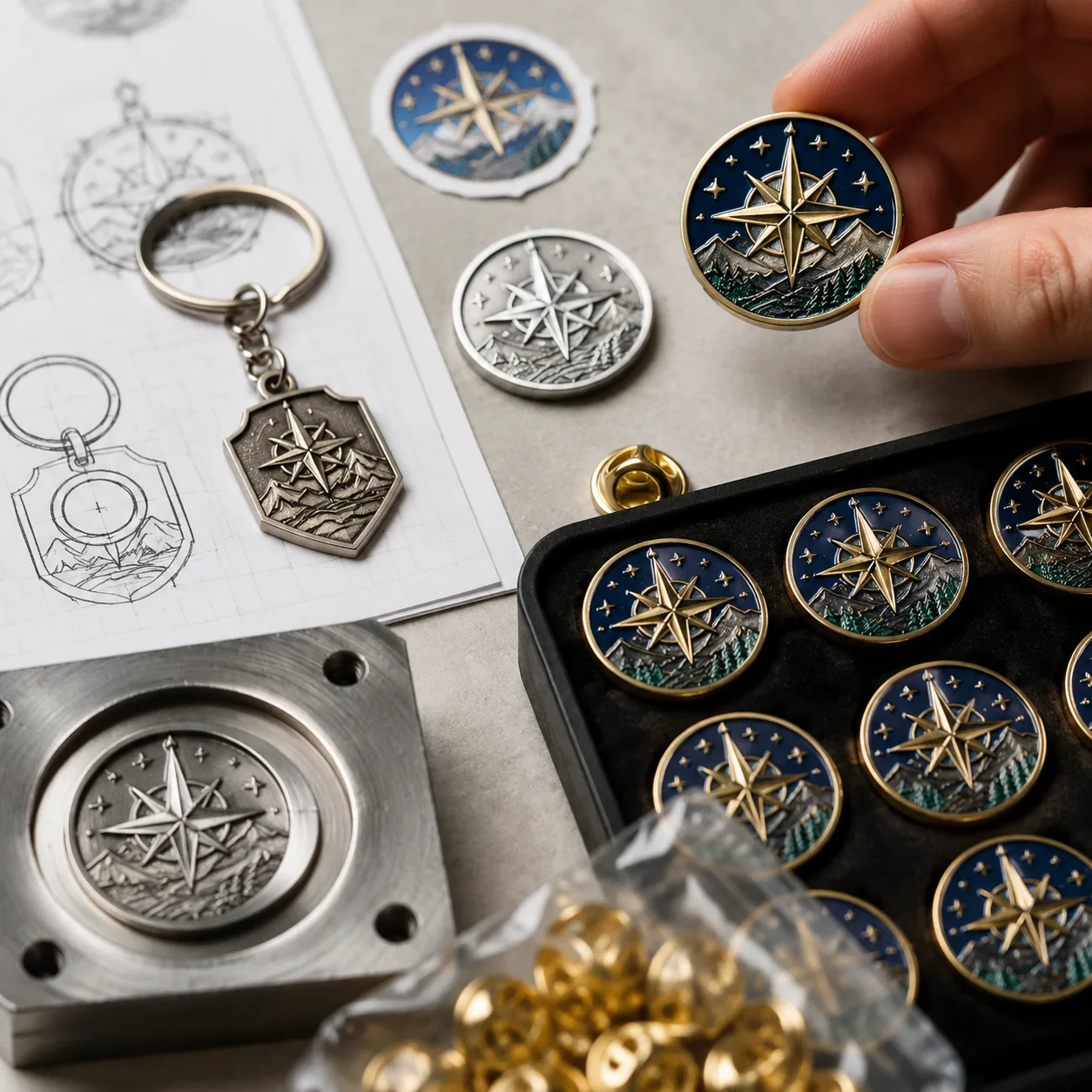
Choose by schedule risk first, appearance second
When the event date is fixed, the real decision is not which item looks best in a mockup. It is which item can clear artwork approval, engineering review, production, inspection, packing, and air shipment with enough margin left for a delay. For 2026 trade shows, campus activations, distributor meetings, and product launches, the wrong format can add 3 to 8 working days before mass production even begins.
Pins, patches, and lanyards do not carry the same pre-production risk. A standard 20 mm polyester lanyard with stock swivel hook, 900 mm finished loop length, and bulk packing can often release within 24 hours of final artwork approval. A soft enamel pin usually needs a die-line, mold cutting, plating allocation, enamel fill, oven curing, polishing, and attachment confirmation. A woven or embroidered patch avoids metal tooling in most standard shapes, but backing type, border style, edge method, and thread-color approval still create delay points.
If your in-hand date is less than 25 calendar days away, compare manufacturability before aesthetics. Buyers who treat all three items as interchangeable usually lose time in proof revisions and construction changes, not on the sewing line or print line. In practical rush buying, standard lanyards are usually the lowest-risk route, patches are the middle ground, and pins are the most sensitive to artwork complexity and process variation.
Rush specs compared: MOQ, lead time, tolerance, and FOB cost
| Factor | Soft enamel pin | Woven or embroidered patch | Printed polyester lanyard |
|---|---|---|---|
| Typical rush MOQ | 100 to 300 pcs | 100 to 300 pcs | 100 to 500 pcs |
| Common quote size | 30 to 35 mm | 75 to 90 mm | 15 mm or 20 mm x 900 mm loop |
| Tooling required | Yes; 1 die per shape, typically USD 45 to 90 | No for standard woven or embroidered styles; yes for molded PVC or special hardware | No for standard screen print or sublimation; yes for custom buckle, badge reel, or molded accessory |
| Fastest realistic production after art approval | 7 to 9 working days | 5 to 7 working days woven; 6 to 8 working days embroidered | 4 to 6 working days screen print or sublimation |
| Safer production window | 10 to 12 working days | 7 to 10 working days | 6 to 8 working days |
| Physical sample impact | Pre-production metal sample adds 4 to 6 working days | Sewn sample adds 3 to 5 working days | Physical sample adds 2 to 3 working days |
| Typical FOB at 300 pcs | USD 0.75 to 1.35 | USD 0.55 to 1.05 | USD 0.38 to 0.72 |
| Typical FOB at 1000 pcs | USD 0.45 to 0.88 | USD 0.34 to 0.78 | USD 0.24 to 0.46 |
| Main rush blockers | Die-line revision, plating queue, post-position change, enamel curing | Backing change, border change, thread substitution, laser-cut distortion | PMS approval, stock hook shortage, width change, breakaway requirement |
| Fine-detail limit | Text below 1.2 mm cap height and lines below 0.25 mm are high risk | Embroidery text below 3.0 mm is risky; woven can hold about 1.5 to 2.0 mm text height | Screen print lines below 0.30 mm may fill; sublimation reproduces finer detail but looser PMS control |
| Dimensional tolerance | ±0.15 to ±0.30 mm | ±1.0 to ±2.0 mm | Width ±1.0 mm; length ±5 to ±10 mm |
| Material or finish spec | 1.2 to 1.5 mm iron or zinc alloy; nickel, black nickel, or imitation gold plating | Polyester thread or woven yarn; merrow, heat-cut, or laser-cut edge | Polyester strap about 0.8 to 1.2 mm thick with stock metal hook |
| Inspection norm | AQL 2.5 major / 4.0 minor | AQL 2.5 major / 4.0 minor | AQL 2.5 major / 4.0 minor |
If pure speed is the priority, standard printed lanyards are usually the safest choice because they avoid mold cutting, plating, and enamel curing. If perceived value matters more than absolute speed, soft enamel pins remain viable, but only when the design is simplified early and hardware stays standard. Patches sit between the two: less tooling risk than pins, but still vulnerable to late changes in border, backing, and shape.
Where rush orders fail first: artwork and construction limits
Pins are the least forgiving when artwork looks clean on screen but falls below production limits. Common failure points are cap-height text under 1.2 mm, metal lines under 0.25 mm, isolated enamel islands smaller than about 0.35 mm, narrow bridges between cutouts, and multiple interior voids in a 30 mm shape. A redraw is not a cosmetic issue; it delays die release, proof approval, and line booking. For rush programs, the safest pin specification is usually 30 to 35 mm, 4 to 6 fill colors, one metal level, no danglers or spinners, and one standard butterfly clutch or rubber clutch.
Patches are more forgiving only when the construction matches the artwork. Embroidery works best for bold emblems and logos with stitch paths above roughly 0.8 mm. It struggles with dense serif text, tiny ® marks, and tight corners because satin stitches crowd and lose edge definition. Woven patches handle finer detail and can usually hold text around 1.5 to 2.0 mm high, making them the better option for conference crests, club badges, and logos with small type. However, sharp points, internal holes, and highly irregular outlines increase trimming time and can push edge variation beyond the nominal ±1 to 2 mm tolerance.
Lanyards are usually the easiest art path. Repeating logos, sponsor names, safety messages, and simple event branding translate well to 1-color or 2-color screen print. Sublimation is better for gradients, photos, multi-color patterns, and small repeating text, but exact Pantone matching is less predictable than spot-color printing. In practical production, color variance on sublimated polyester often lands around Delta E 3 to 5 depending on fabric lot, white-point variation, and press temperature. If the marketing team requires a physical color match before release, the lanyard's speed advantage narrows quickly.
A useful rule is simple: unstable artwork favors lanyards, detail-heavy artwork often favors woven patches, and premium but simplified artwork can justify pins only when approval is already locked.
Cost under pressure: rush premiums, tooling, and hidden adders
Rush cost rarely appears only as a line called rush fee. More often it shows up as overtime allocation, reduced line efficiency, die acceleration, extra QC attention, split packing, and air-freight urgency. A quote that looks only slightly above standard timing can still end up expensive once hardware, packaging, and shipping method are finalized.
For pins, a standard 30 mm soft enamel design with 4 colors, iron base, and butterfly clutch at 300 pcs often lands around USD 0.75 to 1.00 FOB, plus a die charge of roughly USD 45 to 90. Under rush timing, the same build typically moves to about USD 0.95 to 1.35 FOB. Black nickel plating, two posts, custom backstamp, individual polybagging, or rubber clutches push both cost and risk higher. Zinc alloy casting, glitter, translucent fills, sliders, or layered construction should not be treated as true rush-friendly specifications.
Patches usually absorb rush timing better. A 75 mm embroidered sew-on patch at 300 pcs is often about USD 0.55 to 0.80 FOB in standard timing and USD 0.62 to 0.95 in rush. A woven patch of similar size may be USD 0.65 to 1.05 depending on thread density and edge finish, but it often avoids redesign when the logo contains fine text. Hook-and-loop backing, iron-on film, peel-and-stick adhesive, or paired-set collation usually adds USD 0.06 to 0.22 per piece and may add 1 to 3 working days if capacity is tight.
Lanyards remain the best speed-per-dollar option in most event scenarios. A 20 mm x 900 mm polyester lanyard with 1-color screen print, stock swivel hook, and bulk packing is commonly around USD 0.38 to 0.55 FOB at 300 pcs and USD 0.24 to 0.36 at 1000 pcs. Adders such as detachable buckle, safety breakaway, badge reel, woven jacquard strap, double-sided print, or retail header bag can lift the unit cost to roughly USD 0.60 to 0.85 and create hardware bottlenecks if stock is short.
| Order scenario | Pins FOB estimate | Patches FOB estimate | Lanyards FOB estimate |
|---|---|---|---|
| 300 pcs, simple spec, standard timing | USD 0.75 to 1.00 | USD 0.55 to 0.82 | USD 0.38 to 0.60 |
| 300 pcs, simple spec, rush timing | USD 0.95 to 1.35 | USD 0.62 to 0.98 | USD 0.42 to 0.72 |
| 1000 pcs, simple spec, standard timing | USD 0.45 to 0.88 | USD 0.34 to 0.78 | USD 0.24 to 0.46 |
| 1000 pcs, upgraded hardware or backing | USD 0.60 to 1.12 | USD 0.46 to 1.00 | USD 0.36 to 0.80 |
These are typical FOB China ranges for common builds, not universal promises. Freight, compliance labeling, retail packaging, and split shipments can change landed cost more than the base unit price. Under deadline pressure, compare the fastest acceptable specification rather than the cheapest theoretical build.
Lead-time math buyers miss: factory days are not in-hand days
Rush orders fail when buyers focus only on quoted production days. A 6-working-day lanyard job is not a 6-day in-hand program. Time is also required for proof approval, line booking, in-process inspection, carton consolidation, export paperwork, and freight. Air freight from China to the US or Europe is often 3 to 7 calendar days door-to-door after dispatch, but during peak trade-show periods customs holds, flight rollovers, or destination handling delays can stretch that to 8 to 10 days. Sea freight is rarely realistic for a sub-30-day event deadline.
A more accurate post-artwork timeline looks like this. Lanyards typically need 1 day for proofing, 4 to 6 working days for production, 1 day for packing, and 3 to 7 calendar days for air delivery. Patches usually need 1 to 2 days for proofing, 5 to 8 working days for production, 1 day for packing, and the same 3 to 7 freight days. Pins commonly need 1 to 2 days for die-line approval, 7 to 10 working days for production, 1 day for packing, and 3 to 7 freight days.
That means a nominally fast pin order can still require about 14 to 20 calendar days when nothing slips. If a physical sample is required, add 3 to 6 working days depending on product type. If you have less than 3 weeks remaining, buyers often end up moving from pins to lanyards or from embroidered patches to woven patches because the simpler process leaves more schedule margin.
Quantity changes matter too. A last-minute increase from 300 to 1500 lanyards may add only 1 to 2 working days if stock hardware is available. The same jump on pins can affect die scheduling, plating queue time, and final inspection capacity much more materially. Rush planning is not just about the item; it is about how forgiving the production route remains when the order changes after approval.
Quality shortcuts that are acceptable, and defects that are not
Rush production does not mean quality standards disappear. It means buyers need to separate acceptable simplifications from defects that should fail inspection. The safest compromise is often waiving a physical pre-production sample when the specification is standard and the digital proof fully defines size, color callouts, backing, hardware, and packing. The costliest mistake is changing visible features after production release and expecting the original schedule to survive.
For pins, reasonable rush compromises include one standard plating finish, one standard clutch, and 1.2 to 1.5 mm body thickness instead of a heavier premium build. Decorative plating for promo pins is commonly around 0.03 to 0.08 micron for nickel-tone or gold-tone appearance; it is cosmetic, not an engineering corrosion spec. If salt-spray performance, nickel release limits, or wear life matters, that requirement must be specified before approval because it affects plating chemistry and line planning. What should not pass are underfilled enamel, scratches exposing base metal, visibly off-center posts, loose attachments, or warped bodies that do not sit flat.
For patches, edge variation within roughly 1.0 to 2.0 mm can be acceptable, especially on laser-cut custom shapes. Slight thread-end fuzz on the back side may also be acceptable in bulk promo production. What should not pass are backing delamination, unreadable text, major thread breaks, severe merrow inconsistency, missing hook-and-loop pairs, or unapproved thread-color substitution. For lanyards, mild fabric waviness is common on sublimated straps, but weak fold stitching, wrong hook style, reversed print orientation, omitted breakaway, or webbing fray at the fold are functional defects, not cosmetic ones.
- Accept: digital proof approval instead of a physical sample on simple standard builds
- Accept: stock hardware, standard backing, and bulk packing to protect rush timing
- Accept: AQL 2.5 major / 4.0 minor unless a tighter contract standard is agreed before order release
- Reject: width, attachment, border, backing, or plating changes after production release
- Reject: unapproved substitutions on visible thread, plating, fabric, or hardware
- Reject: booking freight before final carton count, gross weight, and chargeable weight are confirmed
Best choice by deadline window and event type
For trade shows, staff credential programs, and exhibitor badge distribution, lanyards usually win because they are functional, count-flexible, and easy to color-code. At 2000 pcs and above, a standard 15 mm or 20 mm screen-printed or sublimated lanyard is usually the highest-probability on-time option, especially when you need separate colorways for staff, VIP, press, sponsors, and exhibitors.
For product launches, fan merchandise, creator drops, and commemorative events, pins still deliver the strongest perceived value per unit. A 30 to 40 mm soft enamel pin with 4 to 6 colors, iron base, and butterfly clutch is a dependable format only if you have at least 3 to 4 weeks including freight. Below that window, only simplified artwork is safe. If the pin includes hinge parts, spinner elements, translucent fills, multiple layers, or custom backing cards inserted individually, it stops being a true rush item.
For uniforms, clubs, school programs, outdoor groups, and apparel branding, patches often offer the best balance. They feel more permanent than lanyards and avoid some of the wear, metal sensitivity, or attachment concerns of pins. Woven patches are the better fallback when the artwork contains small text or a dense crest that would force simplification in embroidery or fail on pin metal-line limits.
As a practical deadline rule, under 20 calendar days choose lanyards first. Around 20 to 28 days, patches become realistic if the specification is standard and the backing is simple. At 25 days and up, simple pins are viable if artwork is locked, mold approval is immediate, and air freight is already budgeted.
How to brief the supplier so the quote is decision-ready
A fast quote is not the same as a usable quote. If you send only a logo and quantity, many suppliers will price a best-case version that changes later once width, hardware, backing, packaging, and shipping method are clarified. That creates false speed because the first accurate plan appears only after requoting.
A better RFQ includes the in-hand date, ship-to country, quantity tier, target size, attachment or backing, packing method, and one fallback specification. For example: option A, 20 mm sublimation lanyard, 900 mm loop, black breakaway, swivel hook, bulk packed, 1000 pcs; option B, 15 mm 1-color screen-print lanyard with the same hardware, 1000 pcs. Or option A, 35 mm soft enamel pin, 5 colors, nickel plating, butterfly clutch, polybagged, 500 pcs; option B, 80 mm woven patch with heat-cut edge and sew-on backing, 500 pcs.
Ask the factory to separate timing into approval days, production days, packing days, and freight days. Confirm MOQ, tooling charges, whether the quote assumes digital proof only, carton pack quantity, and whether stock hardware is physically available now rather than normally available. Serious buyers also ask which specification is safest for schedule, which is lowest cost, and which is technically possible but high risk. That framing speeds internal approval because stakeholders can see the trade-off clearly.
The best rush order is usually the one that removes choices early. If artwork is still moving, choose the product with the widest production tolerance. If artwork is locked and the item must feel premium, move to pins only after the factory confirms timing against the approved specification, not against a concept image or a best-case estimate.
Have a project? Send your artwork and target quantity and we’ll reply with a detailed quotation within 12 working hours.
Ready to get this made?
Send your sketch, target quantity and ship-date. Detailed quotation in 12 hours.



