Rush Orders in 2026: Pins vs Coins vs Patches vs Lanyards
Start with the production path, not the mockup
Rush merchandise fails when the buyer chooses from a rendering instead of the manufacturing route behind it. The useful question is not which item looks best on screen; it is which item can move from approved artwork to ex-factory handoff with the fewest tooling, finishing, inspection, packing, and shipping risks. For B2B event programs, the danger window usually starts when the event is 12 to 25 calendar days away and artwork, hardware, packing, ship marks, or consignee details are still open.
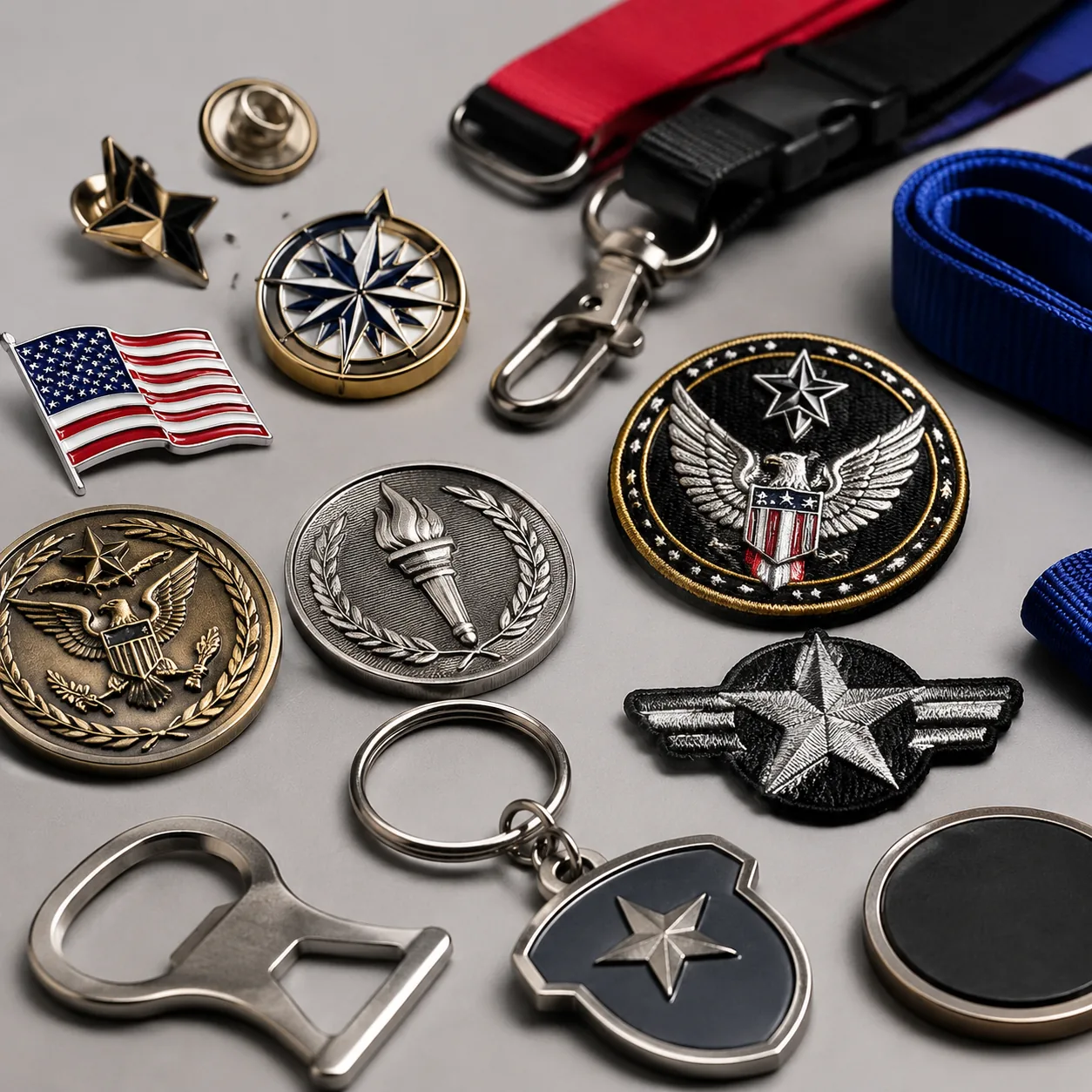
A 30 mm soft enamel pin, a 45 mm challenge coin, a 70 mm woven patch, and a 20 x 900 mm lanyard may sit in the same promotional budget, but they do not share a supply chain. Metal pins and coins require die or mold preparation, stamping or casting, plating, enamel filling if applicable, polishing, cosmetic sorting, and post or edge inspection. Textile and webbing items avoid plating, but they can still lose days to backing changes, border choices, hardware assembly, color matching, folding, or individual packing.
In 2026, the safest rush ranking for most event buyers is sublimation lanyards first, woven patches second, simple soft enamel pins third, and challenge coins fourth. That ranking changes only when the brief specifically requires metal weight, collector value, military-style recognition, or executive presentation. If the main requirement is on-time arrival, the item with fewer manual steps usually wins.
2026 rush comparison: MOQs, lead times, FOB cost
| Product type | Best rush use case | Practical MOQ | Useful MOQ price tiers | Tooling or pre-production time | Mass production time | Fastest realistic ship-ready time | Rush-safe spec | FOB at 500 pcs | Rush risk |
|---|---|---|---|---|---|---|---|---|---|
| Soft enamel pin | Giveaways, staff recognition, retail add-ons | 100 pcs | 100 / 300 / 500 / 1,000 | 1-2 working days | 5-8 working days | 7-10 working days | 25-35 mm, 1.2-1.5 mm thick, iron or zinc alloy, 2-4 enamel colors, one clutch | USD 0.48-1.10 | Medium |
| Challenge coin | Premium recognition, donor gifts, military-style events | 100 pcs | 100 / 250 / 500 / 1,000 | 2-4 working days | 8-13 working days | 11-16 working days | 38-45 mm, 2.5-3.0 mm thick, 2D relief, one antique finish | USD 1.55-3.80 | High |
| Woven patch | Uniforms, clubs, workwear, bags, tactical gear | 100 pcs | 100 / 300 / 500 / 2,000 | 1-2 working days | 4-7 working days | 6-9 working days | 60-80 mm, woven polyester, 8 colors max, merrow or heat-cut edge, one backing | USD 0.38-0.98 | Low |
| PVC patch | Outdoor brands, flexible logos, raised detail | 100 pcs | 100 / 300 / 500 / 1,000 | 2-3 working days | 7-10 working days | 9-13 working days | 50-70 mm, 2.0-3.0 mm thick, 2D PVC, standard hook backing | USD 0.78-1.85 | Medium-high |
| Sublimation lanyard | Trade shows, badges, access control, staff IDs | 100 pcs | 100 / 300 / 500 / 3,000 | 0-1 working day | 3-5 working days | 4-7 working days | 20 x 900 mm polyester, full-color print, swivel hook, optional breakaway | USD 0.42-0.95 | Very low |
| Screen-printed lanyard | Budget events with 1-2 color repeated logos | 100 pcs | 100 / 300 / 500 / 3,000 | 1 working day | 4-6 working days | 5-8 working days | 15-20 x 900 mm polyester, 1-2 spot colors, standard hook | USD 0.36-0.82 | Low |
These are factory-side ranges after artwork approval, not door-to-door delivery promises. Air freight, customs clearance, local courier delivery, and event-site receiving need their own buffer. For a hard event date, require the supplier to confirm three dates separately: final approval cutoff, ex-factory date, and expected arrival date. A promise of "7 days" is not meaningful unless it states whether it means production days, calendar days, ex-factory handoff, or delivered date.
Where rush orders actually lose days
The main forming step is rarely the only bottleneck. For pins and coins, stamping or casting can be faster than artwork cleanup, die review, plating batch scheduling, enamel drying, polishing, post soldering, and cosmetic sorting. A 30 mm soft enamel pin with six enamel fills, an internal cutout, epoxy dome, and two posts can add 2 to 3 working days compared with a two-color standard pin, even if the quoted unit price moves by only a few cents.
For patches, the common delay is a late backing or edge decision. Switching from merrow border to laser-cut edge can add about 1 working day because the cutting path and heat control need review. Adding hook-and-loop backing usually adds 1 to 2 working days, especially above 1,000 pcs, because lamination, sewing, and adhesive curing are separate operations. Iron-on backing is often faster than hook backing, but it still needs temperature and peel testing if the patch will be applied to workwear, uniforms, or washable garments.
For lanyards, hardware creep is the schedule problem. A swivel hook on a 20 mm polyester strap is routine. A breakaway, detachable buckle, badge reel, safety clip, phone loop, metal crimp, and individual insert card turn a fast print order into a manual assembly order. At 500 pcs the difference may be 1 working day; at 3,000 pcs it can reduce daily output enough to move the ex-factory date.
Packaging is another hidden source of slippage. Bulk export packing is fastest. Individual polybags, backing cards, UPC labels, paper sleeves, mixed-SKU assorting, carton-by-carton event-site labels, and split delivery instructions can add 1 to 4 working days. When the event date is fixed, simplifying packing often protects the schedule more reliably than paying a rush surcharge.
Pins vs coins: metal items under pressure
Pins are usually the safer rush metal item because they use less material, have smaller visible surfaces, and tolerate minor cosmetic variation better than coins. A rush-safe pin spec is 25 to 35 mm, 1.2 to 1.5 mm thick, iron or zinc alloy, soft enamel, one plating finish, and one butterfly or rubber clutch. Keep raised metal lines at 0.25 mm or wider, enamel cells at 0.50 mm or wider, and cutouts no narrower than 1.0 mm. Practical tolerances are usually +/-0.15 mm on width or diameter and +/-0.10 mm on thickness.
Decorative plating on promotional pins is commonly controlled around 3-8 microns for nickel or black nickel layers, with visual consistency more important than laboratory plating thickness unless the order has a written corrosion requirement. For rush work, define acceptable defects before production: tiny plating specks outside the logo face, slight enamel meniscus, minor back-side scuffing, and small post-angle variation should be classified consistently. A typical promotional inspection plan is AQL 2.5 for major defects and AQL 4.0 for minor defects.
Coins look more premium but are slower and less forgiving. A rush-safe challenge coin is 38 to 45 mm diameter, 2.5 to 3.0 mm thick, 2D relief, antique nickel or antique brass, and no dual plating. Diameter tolerance is commonly +/-0.20 mm and thickness tolerance +/-0.15 mm. Edge text below 1.2 mm character height is risky, and 3D sculpting should be avoided unless the buyer has already approved a physical reference. Coins require heavier cosmetic sorting for plating pits, weak relief, edge nicks, enamel bleed, and uneven antique wash.
At 300 to 1,000 pcs, soft enamel pins usually land around USD 0.50-1.15 FOB depending on size, color count, plating, clutch, and backing card. Challenge coins are more realistically USD 1.55-3.90 FOB before velvet pouches, acrylic capsules, numbered edges, bottle-opener tooling, or presentation boxes. If the buyer needs metal inside a 10-working-day production window, a simple pin is the lower-risk choice.
Patches vs lanyards: fast, but not interchangeable
Lanyards are the strongest option when the item must function during the event. A standard 20 x 900 mm polyester sublimation lanyard with swivel hook can usually be produced in 3 to 5 working days after art approval. Add about 1 working day for a breakaway and detachable buckle, and more if badge reels, printed badge holders, or individual inserts are required. Normal tolerances are +/-1 mm on width, +/-5 mm on finished length, and +/-2 mm on print alignment. At 500 pcs, realistic FOB is USD 0.45-0.95 depending on width, hardware, and packing.
Sublimation is usually faster than screen printing when the artwork uses gradients, photos, multiple sponsor logos, or full-bleed color. Screen printing can be cheaper for a simple one-color repeat logo, but it adds screen setup and is less forgiving if sponsor artwork changes late. For credentialing, specify the clip opening size, badge holder orientation, breakaway position, and whether metal parts must pass a basic nickel-free or low-nickel requirement for the destination market.
Woven patches are better when the item must attach to uniforms, caps, bags, tactical gear, club apparel, or workwear. Compared with embroidery, woven construction handles small lettering and fine outlines better because there is less thread build-up. A safe rush spec is 60 to 80 mm wide, woven polyester, 8-color maximum, merrow or heat-cut edge, and one backing type. Text below 2 mm cap height will soften; 2.5 to 3 mm is a better minimum for readable lettering. Common tolerances are +/-1.5 mm on overall size and +/-1 mm on border position.
The two products should not be treated as substitutes. Lanyards solve credentialing, staff identification, and day-one utility. Patches have stronger post-event retention, but only when the audience has a logical place to use them. For a general conference, a lanyard is usually safer. For a club, team, workwear, outdoor, or tactical audience, a patch may carry more long-term value.
Rush-safe specifications that reduce rejects
A fast schedule only works if the spec avoids rework. On pins, keep color count to four or fewer when production is under 10 working days. Avoid glitter, translucent enamel, sliders, spinners, chains, epoxy domes, dual posts, and mixed plating unless the brand value clearly justifies the extra handling. On coins, use 2D relief, one finish, one edge style, and no sequential numbering for urgent orders. Rope and reeded edges are manageable; custom edge lettering adds tooling review and inspection time.
On patches, keep the border consistent, avoid micro text, and choose one backing. Hook-and-loop backing is useful for tactical or uniform programs, but it adds bulk and sewing time. On lanyards, standardize the hardware set across all quantities and avoid split-color hardware unless the order is large enough to justify a separate assembly plan. If the artwork still changes daily, choose the product with the fewest custom hardware variables.
- Approve one production-ready PDF showing size, Pantone references, finish, backing, hardware, and packing on the same page
- Use bulk packing unless retail presentation is essential to the program
- Confirm inspection level in writing; AQL 2.5 major and 4.0 minor is typical for promotional merchandise
- Define critical defects separately: wrong logo, wrong color family, unsafe hardware, missing backing, broken clasp, sharp edge, or unreadable required text
- Lock carton quantity, carton dimensions, gross weight target, and shipping marks before production starts
- Keep master cartons below 12 kg when air shipment or event-site handling is likely
- Ask for ex-factory date separately from ETD, ETA, customs clearance, and delivery appointment date
- Avoid mixed-SKU assorting unless the supplier confirms the extra packing labor in working days
This discipline protects yield. Remove every non-essential customization layer first, then add back only what changes the event outcome. In rush production, the lowest-risk item is the one that can be inspected consistently and packed without special instructions.
What extra speed costs in 2026
Rush cost is not only a line called rush fee. The premium comes from factory rescheduling, smaller batch efficiency, overtime labor, priority inspection, split shipments, and dependence on air freight. A pin order that appears only USD 0.05-0.12 higher per unit can still land 8-20 percent more expensive after air freight, priority handling, packing labor, and revised carton labels are included.
Coins are the most sensitive to expediting cost because they are heavy and more likely to miss shared finishing batches. Lanyards and woven patches absorb acceleration better because they are lighter, flatter, and less dependent on plating or polishing queues. PVC patches sit in the middle: they avoid metal finishing but still require mold setup, color dispensing, curing, trimming, and backing attachment.
| Product type | Normal lead time | Rush premium on FOB | Air freight sensitivity | Best rush quantity band | Typical carton pattern |
|---|---|---|---|---|---|
| Soft enamel pin | 10-15 working days | 5%-15% | Medium | 300-1,000 pcs | Dense; backing cards increase packing time and weight |
| Challenge coin | 15-22 working days | 10%-20% | High | 100-500 pcs | High unit weight; pouches and capsules add volume |
| Woven patch | 7-12 working days | 3%-10% | Low | 300-2,000 pcs | Light and compact; backing choice drives thickness |
| PVC patch | 12-18 working days | 5%-15% | Medium | 300-1,000 pcs | Moderate weight; hook backing adds bulk |
| Sublimation lanyard | 5-9 working days | 0%-8% | Low | 300-3,000 pcs | Light but volumetric when individually packed |
| Screen-printed lanyard | 6-10 working days | 3%-10% | Low | 300-3,000 pcs | Efficient in bulk; screens favor stable artwork |
If the order is under 300 pcs and the event is inside two weeks, lanyards and woven patches usually have the best rush economics. Pins can work when artwork is clean and packing is simple. Coins become difficult to justify when freight and cosmetic sorting consume budget that could have gone into higher quantity, better badge systems, or on-site activation.
A 15-minute decision rule for events inside 30 days
Use four questions in order. First, does the item need to function during the event, or is it purely commemorative? Second, is metal weight essential to the brand, donor level, or audience expectation? Third, can the order ship in bulk without retail presentation? Fourth, how many variables are still undecided today: size, colors, finish, backing, hardware, packaging, ship marks, consignee, delivery split, or appointment time?
If day-one function matters, choose sublimation lanyards. If apparel attachment, team identity, or field use matters, choose woven patches. If the buyer needs a collectible metal item with workable timing, choose a simple soft enamel pin. Choose a challenge coin only when premium perception clearly outweighs schedule risk and there are at least 11 to 16 production days plus freight buffer after final approval.
For most B2B rush orders in 2026, the practical shortlist is sublimation lanyard first, woven patch second, simple soft enamel pin third, and challenge coin fourth. That is not a judgment of long-term product value. It is a schedule-risk ranking based on tooling burden, manual handling, inspection sensitivity, weight, and the probability that the order will arrive on time within tolerance.
Have a project? Send your artwork and target quantity and we’ll reply with a detailed quotation within 12 working hours.
Ready to get this made?
Send your sketch, target quantity and ship-date. Detailed quotation in 12 hours.



