Rush-Order Spec Sheet for Trade-Show Pins in 2026
Build the schedule from the event date backward
Rush pin sourcing fails most often because the calendar is unrealistic, not because the factory lacks technical capability. For 2026 trade-show programs, start with the in-hands date, then count backward through customs buffer, air transit, final packing, production, tooling, and approval time. A practical rush window for a new custom pin is usually 12 to 18 calendar days from deposit and approved production artwork to delivery by international air, and only when the specification is simple enough to run with minimal engineering revision.
For planning, use working assumptions instead of hopeful promises. Typical timing for a straightforward custom soft enamel pin is 0.5 to 1 day for quotation confirmation and production drawing approval, 1 to 2 days for tooling, 5 to 7 days for mass production, 1 to 2 days for packing, and 3 to 6 days for air transit depending on lane and customs. US West Coast air shipments may clear in 3 to 5 days door-to-door after ex-factory release, while EU or Middle East lanes often need 4 to 6 days. If the event opens in 21 days, that does not mean you have 21 days of factory time; after weekends and freight, usable production time may be closer to 9 to 12 days.
A rush spec sheet should open with five locked lines: required in-hands date, target ex-factory date, quantity by SKU, Incoterm and destination, and non-negotiable appearance requirements. Appearance requirements should be limited to features attendees will actually notice: exact logo size, one or two Pantone-critical colors, plating family, backing type, and whether the product is bulk-packed or carded. If the supplier still needs to ask about hardware, packaging, labels, or finish after deposit, the lead time was never truly confirmed.
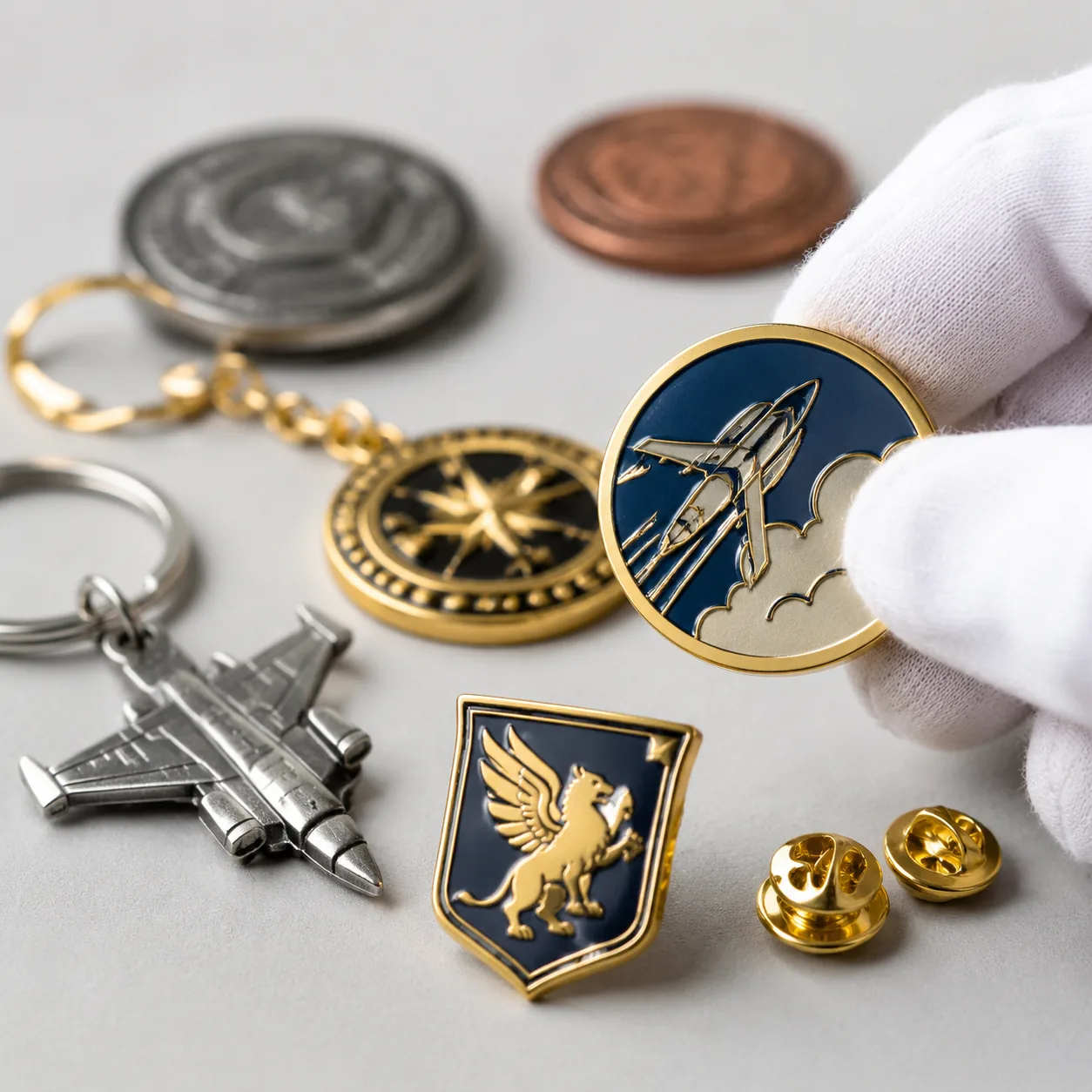
Concrete example: a 30 mm stamped iron soft enamel pin with bright nickel, 2 Pantone fills, one butterfly clutch, and bulk packing is a genuine rush candidate. A 45 mm die-cast zinc pin with two inner cutouts, antique plating, glow fill, epoxy dome, printed card, barcode labels, and retail assortment is not. Both are manufacturable, but only the first normally fits a 12 to 15 day schedule with acceptable yield.
Choose the fastest process: stamped iron first, zinc only when needed
For urgent trade-show pins, process selection should follow factory throughput rather than creative preference. The fastest standard route remains stamped iron soft enamel. Tooling is simple, die striking is fast, polishing is predictable, and most factories already have stable workflows for standard plating and 2 to 4 color fills. Copper soft enamel also works, especially when cleaner die-struck edges matter, but iron is still the most common low-cost rush base metal in 2026.
Use die-cast zinc alloy only when the design requires features stamping handles poorly: deep 3D relief, thick bodies above 2.0 mm, multiple internal cutouts, strongly curved outlines, or complex undercuts. In most factories, die-cast zinc adds 2 to 4 production days versus a simple stamped pin because mold prep, casting cleanup, and dimensional variation increase polishing and inspection time. Photo-etched brass can resolve very fine detail, but it is rarely the fastest option for event giveaways because etching, fill, and flatness control add process sensitivity.
Rush-friendly dimensions are usually 20 to 35 mm with 1.2 to 1.5 mm body thickness. Once size moves above 40 mm, the order slows for reasons that are operational, not cosmetic: larger surface area increases polishing time, enamel fill time, cure time, plating handling, and sorting for edge quality. At 2.0 mm thickness and above, or with broad metal fields and deep recessed areas, defect risk rises because plating shade, edge grind, and color-fill consistency become harder to control.
MOQ for custom soft enamel pins is typically 100 pieces per SKU, though some suppliers will quote 50 pieces if the buyer accepts higher unit cost and fewer finish options. Realistic 2026 FOB China pricing for a simple 25 to 30 mm stamped iron soft enamel pin is about USD 0.58 to 1.20 at 100 to 300 pieces, USD 0.40 to 0.78 at 500 to 1,000 pieces, and USD 0.31 to 0.58 at 3,000 to 5,000 pieces. Those ranges assume standard bright plating, 2 to 4 soft enamel colors, one standard clutch, no epoxy, and bulk packing. Common adders are USD 0.03 to 0.08 for rubber clutch upgrades, USD 0.08 to 0.18 for epoxy, USD 0.10 to 0.30 for printed card plus individual OPP bag, and roughly USD 80 to 180 for a new die depending on size and outline complexity.
| Spec line | Rush-friendly choice | Typical lead-time effect | Typical MOQ | Typical FOB USD |
|---|---|---|---|---|
| Process | Stamped iron soft enamel | Baseline: 7-10 production days after approval | 100 pcs | 0.40-1.20 |
| Alternate process | Die-cast zinc with cutouts or 3D | Usually adds 2-4 days | 100 pcs | 0.75-2.20 |
| Size | 20-35 mm | 40 mm+ often adds 1-2 days | 100 pcs | Add 0.06-0.25 |
| Thickness | 1.2-1.5 mm | 2.0 mm+ often adds 1-3 days | 100 pcs | Add 0.04-0.15 |
| Quantity | 100-1000 per SKU | 3000+ may bottleneck plating and packing | 100 pcs | Lower unit cost, not always faster |
| Tolerance | ±0.15 mm size, ±0.10 mm thickness | Tighter limits add QC and sorting time | 100 pcs | Add 0.02-0.08 if special sorting required |
Engineer the artwork to the process limits
Rush-friendly artwork is artwork that stays inside manufacturing limits on the first pass. For stamped soft enamel pins, a practical minimum metal line width is 0.30 mm, but 0.35 to 0.40 mm is safer for long borders and narrow logo strokes. Minimum recessed enamel channel width should generally be 0.35 to 0.40 mm. Minimum readable text height is about 1.2 mm for simple capitals, yet 1.5 mm or more is safer if the text must remain legible after plating and enamel fill. Details below those limits tend to trigger die correction, fill cleanup, or approval disputes after the first article.
Internal cutouts are a common cause of rush delay. They weaken bridge sections, increase burr removal time, and reduce edge consistency after plating. For stamped construction, keep bridge width at 1.0 to 1.2 mm minimum; below that, die wear increases and edge deformation becomes more likely. A design that looks acceptable on screen can easily convert a 1-day engineering review into a 3-day revision cycle when fragile sections need reinforcing.
Gradients, shadows, hairline outlines, and legal copy are poor candidates for a rush lapel pin. Convert gradients to discrete Pantone spots, enlarge critical text, and move secondary messaging to the backing card. If the logo includes a thin tagline, a practical approach is to keep the main icon on the pin and print the tagline on the card. That single simplification often saves more time than any expedited freight upgrade.
State tolerances clearly on the approved drawing. For promotional pins, ±0.15 mm on overall length and width and ±0.10 mm on thickness are realistic and widely manufacturable. For hole diameters or post locations, ±0.20 mm is typical. Demanding tighter tolerances rarely improves booth-level perceived quality, but it does increase inspection, sorting, and argument risk on a product class that is handled as a branded giveaway rather than precision hardware.
Keep plating and enamel choices standard and queue-friendly
Plating is not just a color choice; it is a queue decision. Bright nickel, bright gold, imitation gold, and black nickel are the standard decorative finishes for rush production, but actual speed depends on what the plating line is already running and whether a chemistry or rack change is required. On compressed schedules, ask which approved finish has the lowest queue risk this week, not which rendering looks best in isolation.
For decorative lapel pins, finish-layer thickness is commonly about 0.03 to 0.08 microns. That figure sounds small because the plating is decorative, not wear-resistant engineering plating. In practice, anti-tarnish performance depends more on passivation, clean handling, drying discipline, and protective packing than on specifying a thicker decorative top layer. If the pins will be handled repeatedly during a three-day exhibition, ask for a clear topcoat on bright nickel or gold if appearance retention matters more than absolute metallic feel.
Color count affects handwork time more than price. Two to four soft enamel fills are efficient and low risk. Six or more fills, transparent colors over texture, pearl powder, glitter, or glow pigment increase fill complexity, cure sensitivity, and visual inspection points. A realistic rush instruction is to designate one or two hero Pantones as exact and allow commercial visual tolerance on secondary fills when viewed under 5000K to 6500K neutral indoor lighting. Demanding perfect instrument-level color matching across tiny recessed cells is rarely practical on a fast-turn event item.
Avoid stacking premium finishes unless the attendee will clearly notice them. Epoxy dome typically adds 1 to 2 days for application, cure, and dust inspection. Antique plating can add approval time because contrast varies by base polish and bath condition. Dual plating, sandblast texture, selective polish, and transparent enamel over etched texture all produce premium results, but each adds one more place where rework can start. For rush orders, pick one visible upgrade and drop the rest.
| Finish spec | Rush impact | Visual result | Typical add-on FOB USD/pc |
|---|---|---|---|
| Bright nickel or bright gold | Usually fastest if line is already running | Clean, standard corporate look | 0.00-0.06 |
| Black nickel | Moderate; queue dependent | Darker premium finish | 0.03-0.08 |
| Antique gold or antique nickel | Often slower due to contrast approval | More depth, muted shine | 0.05-0.12 |
| Epoxy dome | Adds 1-2 days | Higher gloss, better scratch resistance | 0.08-0.20 |
| Glitter, glow, pearl, transparent | Adds handwork and QC points | Special effect, higher defect risk | 0.05-0.18 |
Define hardware, attachment strength, and QC in measurable terms
Hardware decisions should be locked before tooling begins. For trade-show handouts, the standard butterfly clutch is still the safest rush choice because component supply is stable and assembly is fast. Post diameter is commonly 0.8 to 0.9 mm, and post length is usually 8 to 10 mm depending on pin thickness and target garment. For pins larger than about 30 mm, or for asymmetrical silhouettes, specify two posts and show post-center spacing on the approved drawing. That single detail reduces rotation complaints and late-stage arguments about usability.
Rubber clutches are also rush-friendly and often preferred for lighter fabrics or youth-oriented events. Deluxe locking clutches add cost and some assembly time. Magnetic backings solve no-puncture requirements but are not a default rush option: they add meaningful cost, require matched magnet sets in packing, and can complicate air shipment documentation if packed in large volumes. Use them only when the non-piercing requirement is explicit.
Defect criteria need to be simple enough for production and QC teams to apply consistently. A practical standard for promotional pins is AQL 2.5 major and AQL 4.0 minor, using ANSI/ASQ Z1.4 single-sampling principles or the factory’s equivalent plan. Major defects should include detached posts, weak solder joints, missing clutches, sharp burrs that can scratch skin, cracked or missing enamel, obvious front-face plating exposure on raised borders, wrong plating, wrong color in a hero area, or reversed hardware orientation. Minor defects can include slight color overfill, a small dust point in epoxy, light plating haze on the back, or a tiny enamel low spot not visible from 30 to 50 cm under normal indoor lighting.
For attachment strength, avoid vague language such as strong solder. Require a random pull-and-twist check during final QC. For example: sample posts should withstand normal clutch removal and firm hand twisting without separation from the pin body. That instruction is easy for a factory to execute and more useful on a rush order than trying to impose a lab test method that the line cannot run in real time.
Simplify packaging because dispatch often slips there
Urgent orders often miss ship date after production is complete, not during metal manufacturing. The usual culprits are backing cards, barcode labels, assortment instructions, and missing carton mark approvals. A pin finished on Friday still cannot ship if the card artwork is wrong, the barcode file is missing, or outer carton text has not been approved in editable form.
For fastest dispatch, specify bulk OPP bag packing, commonly 50 or 100 pieces per master polybag, then packed into export cartons with inner labels. If backing cards are required, stay with standard formats such as 90 x 55 mm or 85 x 54 mm on 300 to 350 gsm coated stock. On small to mid volumes, digital card printing is often faster than offset because it eliminates plate-making and drying time, even when the per-card price is slightly higher.
Carton rules should be written into the spec sheet. A sensible target is under 12 kg gross weight per export carton for easier manual handling and lower risk during booth setup. Ask for inner bag labels showing SKU, PO line, quantity, and carton number. For urgent multi-SKU jobs, request one pre-shipment photo of the sealed outer carton and one photo of a representative inner bag. Those two images prevent many on-site sorting mistakes.
- Put the target ex-factory date on the PO, not just the event date
- State packing level explicitly: bulk, individual OPP bag, or carded set
- Approve carton marks in editable text, not only as screenshots
- Use standard card sizes to avoid custom die-cut delay
- Confirm whether split shipment is allowed if one SKU slips
- List barcode, regional assortment, and retail label requirements upfront
Shorten approvals without losing control
A full pre-production sample can be valuable, but on a compressed schedule it often consumes the buffer the buyer needs most. The better question is which approval point carries the highest risk. For a simple pin with standard plating and no unusual geometry, artwork approval plus a plated sample photo and first colored article image or short video is often sufficient. For a new silhouette with thin bridges, exact post placement, unusual finish, or special packaging, a physical PPS may still justify the extra 3 to 5 days because it prevents mass defects that cannot be repaired before the event.
Approval timing should be written into the spec sheet instead of negotiated by chat after PO placement. A workable rule is: production drawing approval due within 24 hours, first article image approval due within 12 hours, and production proceeds automatically if no response is received by the agreed cutoff. That may feel strict, but it reflects real rush manufacturing. Missing a same-day approval window often costs a full calendar day because plating, fill, or packing slots move to the next queue.
Keep quality expectations aligned with product class. Trade-show pins are promotional items, not luxury jewelry. If the buyer applies jewelry-level cosmetic standards to a rush giveaway order, the result is usually excessive sorting, repeated holds, and avoidable schedule loss rather than a meaningfully better booth handout. The fastest successful jobs are the ones where the spec sheet defines what matters, what does not, and who decides by when.
Use a proven rush formula and challenge every extra feature
Before paying the deposit, do one last schedule test: can the factory answer yes or no after one engineering review, or are there still unresolved questions about finish, hardware, packaging, quantity split, or destination labeling? If more than a few operational decisions remain open, the quoted lead time is provisional no matter how confident the sales reply sounds.
For most 2026 trade-show pins, the safest fast-build formula is still this: 20 to 35 mm stamped iron soft enamel, 1.2 to 1.5 mm thickness, 2 to 4 Pantone colors, bright nickel or bright gold plating, one butterfly clutch under 30 mm or two posts above 30 mm, no cutouts, no epoxy, and bulk or standard-card packing. In typical FOB terms, that configuration lands around USD 0.40 to 0.90 at 500 to 1,000 pieces and can often move from approved artwork to ex-factory in 7 to 10 production days if the packaging remains simple.
If the brand wants a more premium look, add one feature attendees will actually notice and remove hidden complexity elsewhere. Good upgrades are black nickel plating, a thicker 1.5 mm body, or a cleaner oversized 32 to 35 mm format. Poor upgrades on a rush program are multiple inner cutouts, dual plating, antique finish plus epoxy, or card assortments by region unless those details directly support the event objective.
The core rule is simple: on a rush order, every extra requirement must justify the days it consumes. The orders that ship on time are usually not the ones paying the highest rush surcharge. They are the ones with the fewest unresolved decisions, the fewest non-standard features, and the clearest measurable limits on quality, packaging, and approval timing.
Have a project? Send your artwork and target quantity and we’ll reply with a detailed quotation within 12 working hours.
Ready to get this made?
Send your sketch, target quantity and ship-date. Detailed quotation in 12 hours.



