Rush-Order Spec Sheet for Custom Pins Before a Trade Show
Start with backward scheduling, not with artwork comments
Rush custom-pin orders usually fail in preproduction, not on the plating line. The root problem is an incomplete release sheet: size still changing, finish undecided, backing card not approved, or consignee details missing. For a standard 30 mm stamped soft enamel pin, 1.5 mm thick, one mold, one bright plating finish, one center post, and bulk OPP bag packing, 3,000 pieces in 7 to 10 calendar days can be achievable at an experienced factory. The same target is usually unrealistic if the design adds deep 3D relief, transparent colors over sandblasted texture, two posts with card-slot alignment, custom gift boxes, or multiple SKU splits with separate labels.
The first line on the spec sheet should be the in-hands date at the final destination, not the factory ship date. Work backward in calendar days: delivery appointment, customs clearance, flight uplift, export release, final packing, and production completion. For courier shipments from South China to the US or EU, the quoted transit may be 3 to 5 days, but real-world buffer is larger. Pickup rollover can cost 1 day, export clearance 0.5 to 1 day, customs inspection 1 to 2 days, and venue or remote-area handoff another 1 to 2 days. A practical rule is to finish production 5 to 8 days before an office delivery or 8 to 12 days before direct-to-venue delivery.
Example: booth setup begins March 18 in Las Vegas. A supplier may quote 4-day express transit, but the safer ship window is March 10 to March 12, not March 14. That means ex-works should land around March 8 to March 10. If the vector art, Pantone references, packaging method, or ship-to contact are still open on March 3, the order is already operationally late. On rush work, the buyer’s main job is to remove spec friction before tooling starts, not to chase status after the PO is issued.
Pick a manufacturing route the schedule can actually support
Stamped soft enamel remains the safest rush process because the workflow is standardized: die making, stamping, trimming, deburring, plating, color filling, baking, post attachment, inspection, and packing. For a new mold, preproduction sample lead time is commonly 4 to 6 days; mass production is often 7 to 10 days for 500 to 3,000 pieces. If the mold already exists and artwork is unchanged, some factories can compress repeat production to 5 to 7 days. Typical MOQ is 100 pieces, though effective rush economics improve at 300 pieces and above.
Imitation hard enamel can still work under time pressure, but the flat polished face shows overfill, pits, dust, and edge defects more clearly than soft enamel, so rework rates rise. In practice it often adds 2 to 4 days versus soft enamel. True hard enamel usually needs the most schedule margin because it relies on repeated fill-and-fire cycles and stricter polishing control. Die-cast zinc alloy is better when the design has large cutouts, irregular silhouettes, or deeper sculpted relief, but very fine raised details below about 0.25 mm may soften during casting and tumbling. Photo-etched brass or stainless is useful for thin badges with sharp linework, although it will not reproduce the heavier edge profile or perceived weight of a 1.2 mm to 1.5 mm stamped pin.
| Build option | Best rush use | Typical thickness | MOQ | Sample lead time | Mass lead time | FOB unit price at 1,000 pcs |
|---|---|---|---|---|---|---|
| Stamped soft enamel | Fastest mainstream event pin; best speed-to-cost balance | 1.2 mm to 1.5 mm | 100 pcs | 4 to 6 days | 7 to 10 days | USD 0.42 to 0.95 |
| Imitation hard enamel | Flatter premium face without full hard-enamel cycle | 1.2 mm to 1.5 mm | 100 pcs | 5 to 7 days | 9 to 12 days | USD 0.55 to 1.10 |
| Die-cast zinc alloy | Large cutouts, irregular outlines, deeper relief | 2.0 mm to 3.0 mm | 100 pcs | 6 to 8 days | 10 to 14 days | USD 0.70 to 1.40 |
| Photo etched | Thin badge with fine graphic detail | 0.8 mm to 1.0 mm | 200 pcs | 4 to 6 days | 8 to 11 days | USD 0.45 to 0.90 |
| True hard enamel | Higher wear resistance when schedule allows | 1.2 mm to 1.5 mm | 100 pcs | 6 to 8 days | 11 to 15 days | USD 0.75 to 1.50 |
For rush RFQs, it is smart to pre-approve a fallback route. Example: option A stamped soft enamel in bright nickel; option B imitation hard enamel only if the ex-works date remains unchanged. That kind of conditional approval can save 24 to 48 hours if engineering finds a risk after proof review. Without a fallback, the project can stall while teams renegotiate a process that should have been decided before tooling.
Lock geometry to real process limits before tooling
Clean vector art is not the same as manufacturable metal geometry. On a 25 mm to 32 mm lapel pin, practical rush specs are usually minimum raised metal line width 0.30 mm, minimum recessed enamel channel width 0.35 mm, and minimum text stroke width 0.20 mm. For small lettering, cap height should generally be at least 1.2 mm; 1.5 mm is safer for plated-only text with no enamel contrast. Anything finer may look acceptable on screen but can close up during stamping, plating buildup, or color fill.
Standard body thicknesses are faster because factories already fixture, polish, and inspect around them. For most rush builds, 1.2 mm and 1.5 mm are the most production-friendly choices. Moving a small pin to 1.8 mm or 2.0 mm can increase edge-polish inconsistency, plating variation, and post alignment issues without adding much perceived value below about 25 mm overall size. If the design needs more visual mass, increasing to 30 mm from 25 mm is often a better choice than over-thickening the body.
Tolerance language should match the process. For stamped brass or iron pins, ±0.15 mm on overall width and height is a practical production tolerance. For die-cast zinc alloy, ±0.20 mm is more realistic. Post location is commonly held to ±0.30 mm from centerline on one-post designs and ±0.20 mm to ±0.25 mm on two-post layouts where card-slot fit matters. Decorative bright gold or bright nickel plating on promotional pins is typically around 0.03 to 0.05 micron over a 0.5 to 1.0 micron nickel undercoat; buyers should not expect jewelry-grade plating thickness on event giveaways. If the design includes cutouts, specify minimum bridge widths of at least 0.60 mm to reduce deformation during stamping and polishing.
Reducing geometry variation is one of the simplest ways to save days. One 30 mm pin using one mold and one attachment setup is much easier to run than three related sizes at 25 mm, 30 mm, and 38 mm. In practice, 5,000 pieces of one geometry often move faster and with fewer cosmetic escapes than 1,500 pieces each of three geometries because setup, inspection criteria, and packaging stay consistent.
Keep finishes, colors, and effects production-friendly
The safest finish stack for a rush order is one plating color, standard opaque enamel fills, and no extra topcoat unless the use case truly requires it. Bright gold, bright nickel, black nickel, antique silver, and dyed black are all common finishes, but they do not carry identical risk because plating tank scheduling and touch-up rates vary. One finish across the full order is almost always safer than splitting the same design into gold and nickel SKUs on a compressed timeline.
Four to six Pantone-referenced opaque fills are usually manageable once the proof is frozen. The real delay comes from special effects: glitter, glow, pearl, transparent or translucent fills over texture, swirls, and simulated gradients. Those finishes are harder to judge from a PDF and often need a physical sample under controlled lighting. If no sample review is possible, standard opaque colors are the lowest-risk option. A process-based color note is better than absolute language: Pantone 186 C within normal enamel-process variance, no visibly off-hue red at 50 cm under D65 lighting. That gives QC an actionable acceptance standard.
Epoxy dome coating can hide minor enamel waviness and improve scratch resistance during multi-day handling, but it changes the look and softens metal detail. It also adds 1 to 2 days for cure, cooling, and packing flow. For a short trade-show giveaway, many buyers are better served by skipping epoxy and preserving schedule. If epoxy is required, note dome height tolerance, for example 0.3 mm to 0.5 mm above the metal face, to avoid inconsistent appearance across lots.
Treat attachments, packaging, and cartonization as critical path items
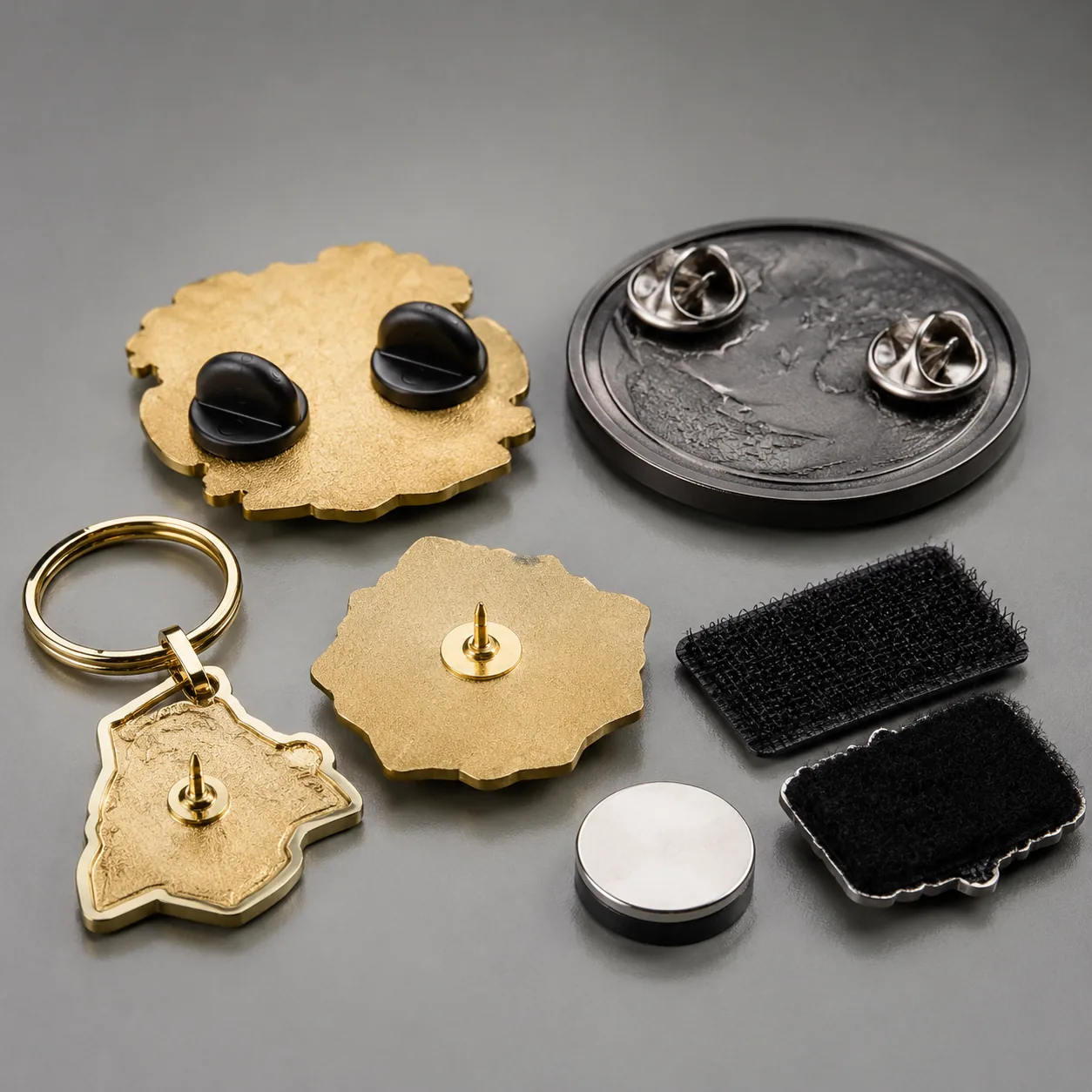
Standard butterfly clutch is usually the best rush attachment because supply is stable and assembly is routine. Rubber clutch is similarly low risk. Magnetic backs, locking clutches, safety pin bars, danglers, chains, or custom back fittings introduce either sourcing delay or tighter alignment control. For pins wider than about 35 mm, two posts may be justified to reduce rotation. Below that size, a single post is typically the safer rush option unless the shape is unusually narrow, tall, or top-heavy.
Packaging is a frequent hidden delay. One OPP bag adds little time. A flat printed backing card in 300 gsm to 350 gsm coated stock with one punch position is still manageable if the artwork is released early. Folded cards, barcode stickers on each unit, EVA inserts, rigid gift boxes, or kitted multi-piece sets can add 2 to 5 days and significant hand labor. On rush event orders, retail-style packaging often consumes the exact buffer needed for production and shipping.
Carton planning should be specified, not improvised. A workable rule is 1 pin per polybag or 1 per backing card, then 50 to 100 pieces per inner bag, with export cartons kept near 12 kg to 15 kg gross for easier courier handling. Example: 3,000 pins packed 1 per card and bag, 100 pieces per inner bag, 500 pieces per carton yields 6 cartons. If each finished piece weighs 16 g to 18 g including card and bag, each carton lands around 8 kg to 10 kg net before outer packaging, which is safer than 1,000-piece cartons that can approach 16 kg to 18 kg and become harder to move through express networks or venue receiving docks.
Freeze approvals fast and write QC rules into the PO
Rush production cannot survive open decisions. Within 24 hours of quote acceptance, freeze these items: vector artwork, final size in millimeters, thickness, plating finish, Pantone references, attachment type, quantity by SKU, packaging method, carton rule, sample-approval method, and full ship-to details. If any remain open, the supplier may prepare artwork but still delay die making, packaging purchase, capacity reservation, or freight booking.
Treat proof approval as an engineering release, not as a creative review. The proof should show overall dimensions, metal thickness, post location from centerline, Pantone references, fill versus no-fill zones, plating callout, backside mark if any, and any sandblast or texture area. If text is below 5 pt equivalent or the artwork contains ultra-fine borders, require written manufacturability confirmation instead of relying on a visual guess from a screen proof.
- Freeze artwork after proof sign-off; even minor logo edits often cost 1 to 2 days.
- Use one controlled finish term only, such as bright nickel, bright gold, or black nickel.
- State sample method in writing: waived, PDF-only, photo approval, or physical pre-production sample.
- Put inspection level in the PO, such as AQL 2.5 major and 4.0 minor at General Level II.
- Define quantity tolerance up front, commonly ±5 percent unless exact count is mandatory.
- List barcode, country-of-origin mark, and carton-mark format before packing starts.
- Confirm whether overruns ship automatically, require approval, or are not billable.
AQL language matters because it defines the acceptance threshold when there is no time for a remake. For promotional pins, AQL 2.5 major and 4.0 minor at General Inspection Level II is common. Major defects typically include wrong design, wrong finish, missing or loose post, detached clutch, incorrect color fill, hazardous sharp burrs, or front-face voids visible at about 50 cm. Minor defects usually include light backside scratches, tiny front specks outside the main artwork, or slight color variation within process limits. If the front face is the customer-critical surface, say so explicitly and require front-face cosmetic inspection under standardized lighting.
Book freight before production finishes
A pin produced on time but assigned to the wrong shipping channel is still late. Freight mode should be decided at PO stage: courier express, direct air freight with broker clearance, or consolidated air cargo. For shipments under roughly 80 kg gross or 0.4 cubic meters, courier is usually the safest option despite higher per-kilogram cost because it reduces handoffs and paperwork. For larger orders, direct air freight can lower landed cost, but it requires tighter broker coordination, more accurate carton data, and stricter document control.
Transit assumptions should be destination-specific. From South China to the US or EU, best-case courier transit may be 3 to 5 days, but weather, missed pickup cutoffs, customs inspection, remote-area surcharges, or venue receiving restrictions can add 1 to 3 days. If the event has limited dock hours or exhibitor paperwork, shipping first to a local office, 3PL, or installer is usually safer than sending cartons directly to the venue. Direct-to-show delivery often looks faster on paper than it performs in practice.
The freight line should appear on the same release sheet as the product specs. Before production starts, confirm estimated carton count, net and gross weight, chargeable weight, pickup city, Incoterm, commercial invoice value, and booking cutoff. One common rush-order failure is that production finishes with no dispatch plan, then a full day is lost correcting consignee details, recalculating weights, or reissuing documents.
Use a one-page rush release sheet to remove ambiguity
If the event date is under 21 days away, reduce variables before asking for quotes. Send one approved vector file, one size, one finish, one attachment, one packaging method, and the exact in-hands date by city and postal code. Ask suppliers to reply with standard lead time, rush lead time, sample policy, daily capacity for your SKU, and FOB pricing by quantity tier. Useful tiers for budgeting are 100, 300, 500, 1,000, 2,500, and 5,000 pieces.
For a 30 mm stamped soft enamel pin, 1.5 mm thick, one post, standard butterfly clutch, and OPP bag packing, many factories will quote about USD 0.85 to 1.40 FOB at 300 pieces, USD 0.42 to 0.95 at 1,000 pieces, and USD 0.32 to 0.70 at 5,000 pieces, depending on base metal, finish, color count, and packing. Rush surcharges often run 10 percent to 25 percent, whether shown as a separate line or folded into unit price. If the event date is under 14 days away, ask for a rush-feasibility review, not just a price. The most useful response is which spec changes recover days: moving imitation hard enamel to soft enamel, deleting gift boxes, reducing from two posts to one, simplifying SKU splits, or switching from custom backing cards to plain bags.
The cleanest approach is a one-page release sheet attached to the PO. Include in-hands date, ex-works target, build method, size, thickness, plating, Pantone colors, attachment, packaging, AQL standard, dimensional tolerances, quantity tolerance, carton rule, freight mode, and approval method. When sales, engineering, production, QC, and shipping all work from the same frozen document, rush custom-pin orders become manageable. When each team works from a different revision, delay and defect risk rise immediately.
Have a project? Send your artwork and target quantity and we’ll reply with a detailed quotation within 12 working hours.
Ready to get this made?
Send your sketch, target quantity and ship-date. Detailed quotation in 12 hours.



