Rush-Order Spec Sheet for Custom Pins and Event Giveaways
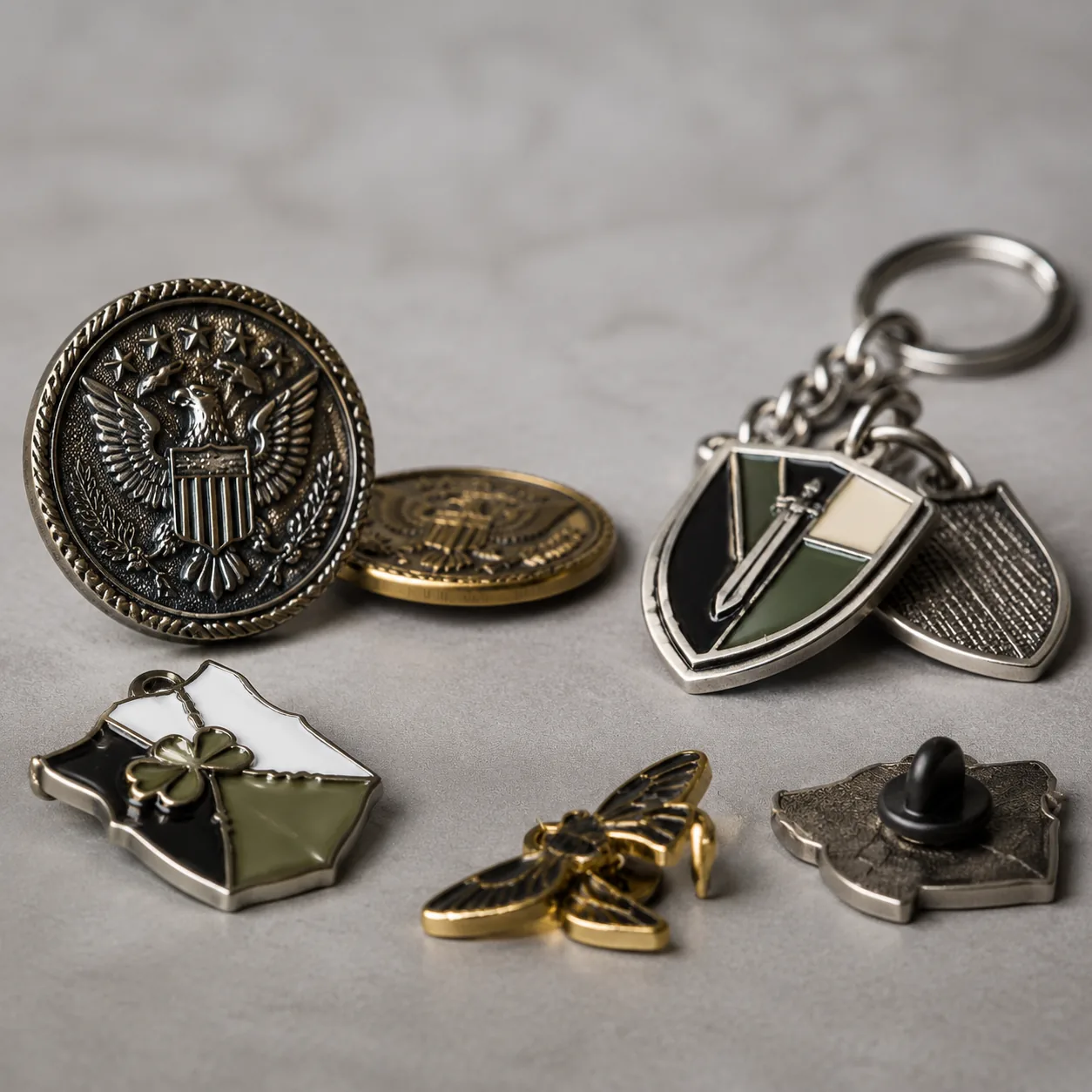
Rush orders miss dates when the specification is incomplete, not when production suddenly slows
Most failed event shipments start with an RFQ that is commercially clear but technically under-defined. "40 mm soft enamel pin, black nickel, butterfly clutch" is enough for a sales quote, but not enough for tooling release. Engineering still has to confirm finished size, base metal, thickness, relief depth, minimum line width, number of posts, post spacing, plating standard, backing orientation, card size, barcode placement, polybag count, carton split, and inspection criteria. Every open variable adds another proof round or a hold between departments.
On a genuine rush program, the spec sheet has one job: remove every decision that would otherwise come back to the buyer after artwork approval. A stable rush order is not necessarily the simplest-looking item. It is the item the factory can tool, plate, assemble, inspect, and pack without assumption. In practical terms, that means die layout can start within 24 hours of proof sign-off, raw material can be booked the same day, and packaging can be printed before metal finishing is complete.
For custom pins, challenge coins, and keychains made in standard Chinese promotional-gift supply chains, a credible rush window is usually 7 to 18 calendar days ex-factory. The short end of that range is realistic only when the product uses a standard process, 1 to 6 spot colors, standard hardware, simple packing, and no presentation box. The objective is not a perfect rendering of every artwork detail. It is a specification that can be executed predictably, inspected against agreed tolerances, and shipped before the event setup date.
1. Choose the manufacturing process by schedule risk, not by mockup appeal
The first line on a rush spec sheet should be the manufacturing method because it determines tooling complexity, defect exposure, finishing time, and real tolerance capability. For most event merchandise, stamped soft enamel remains the lowest-risk metal process. A 30 to 40 mm iron or brass pin with 1.0 to 1.2 mm base thickness and 4 colors can usually run at 100-piece MOQ, 10 to 14 calendar days after final proof approval, and around USD 0.55 to 1.20 FOB each at 100 pieces or USD 0.32 to 0.78 at 500 pieces, excluding air freight and duty.
Imitation hard enamel gives a flatter jewelry-style face, but the polish stage adds time and rework risk. A practical rush lead time for a 35 mm brass pin is 12 to 18 days. Dividers below 0.35 mm, text below 1.2 mm high, and shallow cells below about 0.20 mm frequently lose definition during polishing. Die-cast zinc alloy is the better choice for deep relief, open cutouts, thick sections, or integrated loops, but mold finishing and plating touch-up make it less predictable than a simple stamped part when the deadline is fixed.
Challenge coins usually remain rush-feasible if they stay 2D, use a standard flat or bevel edge, and avoid gift boxes. PVC key tags and patches are often fast as well, especially when the artwork has many colors but does not require metal detail. The process decision should be driven by what can be made repeatedly inside the calendar, not by which rendering looks most premium in the approval deck.
| Product and process | Best fit for rush orders | Typical MOQ | Lead time after approval | Indicative FOB price |
|---|---|---|---|---|
| Stamped soft enamel pin, iron or brass, 1.0 to 1.2 mm | 30 to 45 mm logos, 1 to 6 spot colors, standard posts and clutches | 100 pcs | 10 to 14 days | USD 0.55 to 1.20 at 100 pcs; USD 0.32 to 0.78 at 500 pcs |
| Imitation hard enamel pin, brass, 1.2 to 1.5 mm | Premium flat face where polish is required and schedule can absorb extra finishing | 100 pcs | 12 to 18 days | USD 0.75 to 1.50 at 100 pcs; USD 0.48 to 0.98 at 500 pcs |
| Die-cast zinc alloy keychain, 2.0 to 3.0 mm | Deep relief, open cutouts, custom outline, integrated loop | 100 pcs | 12 to 16 days | USD 1.10 to 2.20 at 100 pcs; USD 0.72 to 1.45 at 500 pcs |
| Stamped challenge coin, brass or iron, 2.0 to 3.5 mm | Fast 2D coins with standard edge and one- or two-sided relief | 100 pcs | 10 to 15 days | USD 1.20 to 2.80 at 100 pcs; USD 0.82 to 1.95 at 500 pcs |
| 2D PVC key tag or patch, 2.0 to 4.0 mm | High color complexity where metal detail is unnecessary | 100 pcs | 9 to 14 days | USD 0.60 to 1.50 at 100 pcs; USD 0.38 to 0.95 at 500 pcs |
If the event date is immovable, resist switching to a slower process for appearance alone. A stamped soft enamel pin that lands before booth setup has more commercial value than a hard enamel version that arrives three days late.
2. Release-ready dimensions must define size, thickness, relief, and edge condition together
A usable dimension line is not "38 mm pin." It is "finished size 38.0 x 26.5 mm, single-sided, brass, 1.2 mm base thickness before plating, raised metal 0.25 mm nominal above enamel recess, standard die-struck edge, no side engraving, one back stamp cavity." That level of definition answers the questions that usually delay proof release and tooling start.
Keep tolerances realistic for the selected process. For stamped metal items under 50 mm, finished length and width tolerance of plus or minus 0.15 mm is practical. Base material thickness is commonly controlled to plus or minus 0.10 mm before plating. Interior holes and cutouts are typically plus or minus 0.10 to 0.15 mm depending on geometry. Post placement should normally be held within plus or minus 1.0 mm from approved centerlines. Buyers who push below 0.8 mm base thickness to save cost often create higher reject rates from warpage, bent posts, oil-canning, and sharp-edge feel. At the other end, specifying more than 2.0 mm thickness on a small stamped pin slows forming and deburring with little functional benefit.
Edge style matters because it affects both time and inspectability. Standard die-struck edges are fastest. Bevel edges are still manageable. Rope, spur, reeded, and dual-edge combinations on coins add polishing steps and another cosmetic checkpoint. On a rush coin order, a custom edge commonly adds 1 to 2 calendar days and another reason for rework if continuity breaks around the circumference. Unless edge detail is part of the brand concept, keep it standard.
A concrete example helps. Instead of approving a generic 45 mm challenge coin, specify: "45.0 mm diameter x 3.0 mm thick, die-struck iron, double-sided relief, standard flat edge, antique silver, no epoxy, tolerance plus or minus 0.15 mm diameter, plus or minus 0.10 mm thickness." That line is actionable for tooling, purchasing, plating, and QC.
3. Put manufacturable detail limits into the PO before proofing begins
Rush orders should not depend on the factory to discover impossible detail after die layout starts. Put process limits directly into the specification. For stamped soft enamel, a dependable starting point is minimum raised metal line width 0.30 mm, minimum recessed gap 0.30 mm, minimum text stroke 0.20 mm, minimum text height 1.2 mm, and minimum bridge between cutout and outer edge 1.2 mm. For imitation hard enamel, increase key dividers to 0.35 mm where possible because polish loss on fine walls is one of the most common rework causes.
These values reflect actual production capability. Below about 0.25 to 0.30 mm, walls become inconsistent during stamping and plating, enamel cells are harder to fill cleanly, and small letters begin to close after metal build-up and color fill. What looks crisp on a vector file at 400 percent often becomes unreadable on a 34 mm pin viewed from one meter away under exhibition hall lighting. For staff pins, sponsor handouts, and registration gifts, legibility beats microscopic brand fidelity.
Proofing should also be specific. Request two proof types only: a dimensioned engineering proof and a production color proof. The engineering proof should show overall size, simplified die linework, cutouts, post locations, raised and recessed zones, and any no-color metal areas. The production proof should show Pantone Solid Coated references, plating finish, backing orientation, packaging notes, and any card mounting positions. Decorative 3D renders may help internal stakeholders, but they rarely accelerate tooling release.
4. Keep plating, color fill, and finish within rush-safe limits
A large share of schedule drift happens in finishing, where buyers combine attractive effects that do not process well together. For speed and repeatability, stay with standard decorative finishes such as bright gold, bright nickel, bright black nickel, antique silver, antique brass, or dyed black. On promotional metal goods, gold-tone decorative plating is commonly around 0.03 to 0.05 micron, while nickel-family finishes often run about 0.5 to 1.0 micron depending on substrate, undercoat, and line control. These are appearance finishes, not heavy corrosion barriers. If the item may be exposed to sweat, humidity, or short outdoor use, specify a clear protective lacquer rather than assuming decorative plating alone will resist tarnish.
For soft enamel, 1 to 6 spot colors remains the most rush-friendly range. Every special effect adds handling and inspection time. Transparent colors need a polished under-surface. Glitter, pearl, and glow additives show wider lot-to-lot variation and are harder to fill consistently in small cells. Epoxy dome can improve scratch resistance on broad color areas, but it usually adds 1 to 2 calendar days including cure time and often softens the visual crispness of thin metal lines. On a 30 mm pin with fine text, epoxy usually hurts definition more than it helps durability.
Matte and antique finishes hide light handling marks better than bright plating, but they also reduce contrast. Antique silver on low-relief artwork can make text difficult to read on a trade-show floor. If the buyer wants a premium look without excessive process risk, bright black nickel with soft enamel is often a better rush compromise than antique plating paired with intricate relief.
5. Standard hardware is usually the fastest path to a stable product
Attachments generate more end-user complaints than slight color drift, so the hardware callout should be exact. For pins wider than about 32 mm, one butterfly clutch is usually insufficient to prevent rotation. Specify two nail posts spaced 18 to 22 mm apart, adjusted for the part's center of mass. Standard posts are generally 0.9 to 1.0 mm in diameter and 8 to 10 mm long, suitable for shirts, lanyards, and light jackets. If the product will be worn on knitwear, outerwear, or bags, state that use case because clutch type and post length may need to change.
For keychains, the most reliable standard assembly is a 30 mm split ring with a short 4- to 5-link chain made from 1.8 to 2.0 mm wire. It is common, easy to source, and straightforward to plate consistently. Lobster clasps, swivel hooks, decorative connectors, and custom chain links add joints, assembly time, and more opportunities for contact marks or mechanical failure. If the item is for daily use, reduce moving parts.
- Pins 25 to 32 mm: one post acceptable on compact shapes; two posts preferred on landscape or soft-base shapes
- Pins over 32 mm or asymmetrical shapes: specify two posts, 18 to 22 mm spacing, anti-rotation required
- Keychains for daily use: 30 mm split ring, 4 to 5-link short chain, wire diameter 1.8 to 2.0 mm
- Coins in capsule, acrylic case, or velvet box: confirm final packed dimensions before approving carton plan
- Magnets: state magnet quantity, magnet size, adhesive type if bonded, and placement tolerance of plus or minus 1.0 mm
- Mixed accessories: approve hardware finish as part of the plating standard so ring, chain, and body do not mismatch visibly
Magnets, brooch bars, and premium fittings need the same discipline. Magnetic badge backs can be cleaner for garments, but they are slower to source in mixed custom programs and may complicate pack-out. Brooch bars and safety pins can work on larger souvenir pieces, but on thin stamped items below about 1.0 mm they often require reinforcement or cause back-face distortion. In a rush scenario, use the most common fitting that still fits the actual end use.
6. Packaging and inspection standards often decide whether the order actually ships
Production time is only part of the schedule. Final pack-out often consumes the last 1 to 3 days, which is where many event programs become exposed. A pin in a plain OPP bag is simple. A pin mounted on a custom card, inserted into a printed bag with barcode label, sorted by SKU into retailer packs, is not. If presentation matters, include it in the first PO. Late changes to card copy, euro-hole position, barcode size, or insert orientation regularly miss courier cutoff even when the metal parts are already finished.
Write unit pack, inner pack, and master carton limits explicitly. A workable example is: "each pin mounted on 300 gsm C1S backing card, card size 90 x 55 mm, CMYK both sides, euro hole centered 8 mm from top edge, inserted into clear OPP bag, 50 units per inner bag, 500 units per master carton, maximum gross weight 12 kg, outer carton not over 44 x 32 x 26 cm." If mixed SKUs are involved, define carton ratio by SKU and exact shipping marks for the receiving warehouse.
Inspection criteria should fit the economics of the item. AQL 2.5 for major defects and 4.0 for minor defects is common for promotional merchandise. Premium programs sometimes specify AQL 1.5 major and 2.5 minor, but tighter limits increase sorting time and may push the ship date. Major defects typically include wrong plating, wrong attachment, unreadable logo, wrong color family, missing unit, broken hardware, or gross deformation. Minor defects usually include small pits, light scratches visible at 30 cm under normal room light, slight color spread, or edge roughness within the agreed limit. If the unit FOB target is below roughly USD 0.80 for a metal pin, demanding zero micro-scratches under high-angle lighting is usually inconsistent with both process capability and cost.
7. Write milestone dates, approval rules, and fallback options directly into the PO
Many rush orders still rely on vague terms such as "ASAP" or "urgent." Those are not schedules. Use milestone dates the supplier can plan around: artwork approval by March 3, engineering proof sign-off by March 4, pre-production photo approval by March 6, ex-factory no later than March 14, courier pickup on March 15, event setup on March 21. Once those dates are explicit, the factory can state immediately whether hard enamel, custom gift boxes, or special fill effects still fit the calendar.
Also define what may be approved by photo and what requires a physical sample. For many trade-show orders below 500 pieces, a physical pre-production sample is the wrong control point because courier transit alone can consume 3 to 5 days. In most cases, a dimensioned proof, plating and color sample photos, and reference to a previously approved construction are enough. Reserve physical samples for licensed programs, regulated claims, or unusually high brand risk.
Finally, build contingency into the PO. If black nickel plating slips, is bright nickel pre-approved as backup? If the printed backing card misses the print cutoff, may units ship in plain OPP bags? If the velvet box supplier goes late, can coins ship in PVC sleeves or capsules? Those fallback lines are often what prevent a rush order from becoming a complete miss. Before requesting quotes, convert the concept into a release-ready one-page specification covering process, exact dimensions, thickness, plating, Pantone references, detail limits, hardware, pack-out, AQL level, ex-factory date, and approved fallbacks. Then require each supplier to reply line by line and flag any item that adds more than one calendar day to lead time. That is how you compare suppliers on engineering reality rather than sales optimism.
Have a project? Send your artwork and target quantity and we’ll reply with a detailed quotation within 12 working hours.
Ready to get this made?
Send your sketch, target quantity and ship-date. Detailed quotation in 12 hours.



