Rush-Order Failure Modes for Custom Pins Before Trade Shows
Rush pin orders fail when the schedule has no recovery time
The biggest risk in a rush custom pin program is not simply missing the courier cutoff. It is approving a build that only works if artwork, tooling, plating, enamel filling, assembly, packaging, inspection, and dispatch all pass on the first attempt. In real production, one rejected pre-production photo, one Pantone correction, one post-location change, or one missing barcode panel can consume 1-3 working days immediately.
For trade-show deadlines, separate three clocks from the start: buyer approval time, factory production time, and logistics time. A realistic fast-track path for a standard 25-30 mm soft enamel pin is usually 1-2 working days for proof approval, 7-10 working days for production after final sign-off, and 3-6 calendar days for export packing plus courier or air transit. Add another 1-2 calendar days if delivery goes to a convention center, hotel, stand builder, or event warehouse, because receiving windows, carton marking rules, and dock handoff delays are common.
Rush instability is often highest on small, feature-heavy orders rather than large simple ones. A 300-piece run with black nickel plating, six enamel colors, two cutouts, epoxy, custom backing cards, barcode labels, and individual polybags is usually less stable than a 3,000-piece soft enamel run with shiny nickel plating and bulk packing. Small runs leave less room to absorb startup scrap, hand polishing delays, overspray rework, or carding errors. If the event date is fixed, the practical target is not maximum speed at every step. It is minimum process variation before production starts.
1. Artwork approved for looks, not for tooling and enamel flow
The earliest failure mode is artwork that looks clean on screen but does not survive die striking or die casting. Typical rush-order danger zones are raised metal lines below 0.25 mm, recessed gaps below 0.20 mm, enamel cells too narrow to fill consistently, counters inside letters that close after plating, and text that drops below roughly 5 pt at final size. Every redraw loop costs time because vectors must be rechecked against metal retention, plating borders, enamel containment, and hardware clearance.
For a rush-safe build under 30 mm, a practical baseline is 0.30 mm minimum raised metal line width, 0.25 mm minimum recessed gap, 0.60-0.80 mm minimum enamel cell width, and 0.80-1.00 mm minimum capital letter height for simple sans-serif type. Standard thickness for die-struck iron or brass soft enamel is typically 1.2-1.5 mm, with dimensional tolerance of about +/-0.20 mm on overall size and +/-0.15 mm on thickness. If the design includes cutouts, keep metal bridges at stress points at 1.0-1.2 mm minimum. Below that, bending risk rises and enamel edges become less stable after polishing and plating.
Pin size changes what is manufacturable at speed. A 25 mm round logo pin can usually carry 3-4 colors and simple shapes with low risk. At 35-40 mm, more detail is possible, but long narrow arms, flags, or open-frame silhouettes can warp if thickness stays too low. Zinc alloy die-cast pins can hold more organic outlines and deeper relief than die-struck iron, but they do not remove rush risk if the design still contains many tiny recesses, fine textures, or multiple cut-through areas that slow mold finishing and deburring.
The fastest approval path is a production-spec proof, not a beauty render. The approved proof should state final size in mm, material, thickness, plating, Pantone references, raised and recessed areas, cutouts, rear logo or serial marks, post quantity and position, backing type, and packaging method. Ask the factory to flag any non-manufacturable feature before tooling release. Recutting a die after approval can easily cost 2-4 working days, and on a trade-show program that is usually the difference between on-time and missed.
2. Finish choices that add hidden process steps and reject risk
Under deadline pressure, not all finishes behave the same. Standard shiny nickel, shiny gold, shiny copper, and black nickel are usually the fastest and most stable plating options. Higher-risk choices include antique finishes that require extra wiping and hand polish control, dual or selective plating with tighter masking, transparent colors over textured metal, and decorative fills such as pearl, glow, or glitter. Imitation hard enamel also lengthens production because the fill-bake-grind-polish cycle is slower than standard soft enamel.
On promotional pins, decorative plating is generally thin, often around 0.03-0.08 microns depending on substrate, color, and line setup. That is normal for event use, but buyers should not expect jewelry-grade wear resistance or flawless mirror finish at rush speeds. For most B2B show giveaways, a sensible inspection baseline is AQL 2.5 for major defects and AQL 4.0 for minor defects, with front-face cosmetic review at roughly 30 cm under neutral white light. Reverse-side rack marks, light hairlines, or minor handling marks are usually acceptable if they do not affect function.
Epoxy is often treated as a shortcut because it can smooth the surface and hide slight enamel level variation. It is useful over printed detail, glitter, or areas that will be heavily handled. But it also adds a dispensing and curing step, dust-control risk, possible edge overflow, and another inspection point for trapped particles, bubbles, or orange-peel texture. If the design is a standard soft enamel pin with solid fills only, skipping epoxy is usually the lower-risk choice for a fixed event date.
| Build option | Typical lead time | Typical MOQ | FOB price at 1,000 pcs | Rush risk | Best use case |
|---|---|---|---|---|---|
| Soft enamel, standard plating, bulk pack | 7-10 working days | 100 pcs | USD 0.45-0.85 each for 25-30 mm | Low | Fast giveaways, staff pins, repeat logos |
| Soft enamel + epoxy | 8-12 working days | 100 pcs | USD 0.55-0.98 each | Medium | Printed accents, glitter, added surface protection |
| Imitation hard enamel | 10-14 working days | 100 pcs | USD 0.60-1.05 each | Medium | Premium look when schedule has margin |
| Antique finish + hand polish | 9-14 working days | 100 pcs | USD 0.55-0.95 each | Medium to high | Vintage relief-heavy designs |
| Dual/selective plating | 10-15 working days | 300 pcs common for efficiency | USD 0.75-1.20 each | High | Brand-critical metal contrast only |
| Glow, pearl, glitter, transparent fills | 9-13 working days | 100 pcs | USD 0.60-1.10 each | Medium | Only when the special effect is central to the design |
3. Hardware and rear layout mistakes that cause rotation, weak joints, or assembly delay
Rush projects often spend all review time on the front face and leave hardware to the end. That is a common error because attachment choice affects wearability, solder yield, card layout, packing speed, and field failure rate. A 35-40 mm horizontal pin with one butterfly clutch will often rotate on fabric. The same pin with two posts spaced about 18-24 mm apart will sit flatter, present better on a backing card, and generate fewer complaints from booth staff who actually wear it for 8-10 hours.
A practical rule is one post for pins under 25 mm, and two posts for most pins above 25 mm wide or for shapes that are long, top-heavy, or asymmetrical. Standard post diameter is usually 0.8-1.0 mm, with post length around 8-10 mm. Post-position tolerance is commonly held within +/-1.0 mm, but only if the rear surface provides enough flat land for soldering. If the back is crowded with deep relief, serial text, or a large stamped logo, the solder joint becomes less stable. Weak post placement often passes visual inspection but fails during carding, vibration in transit, or actual use.
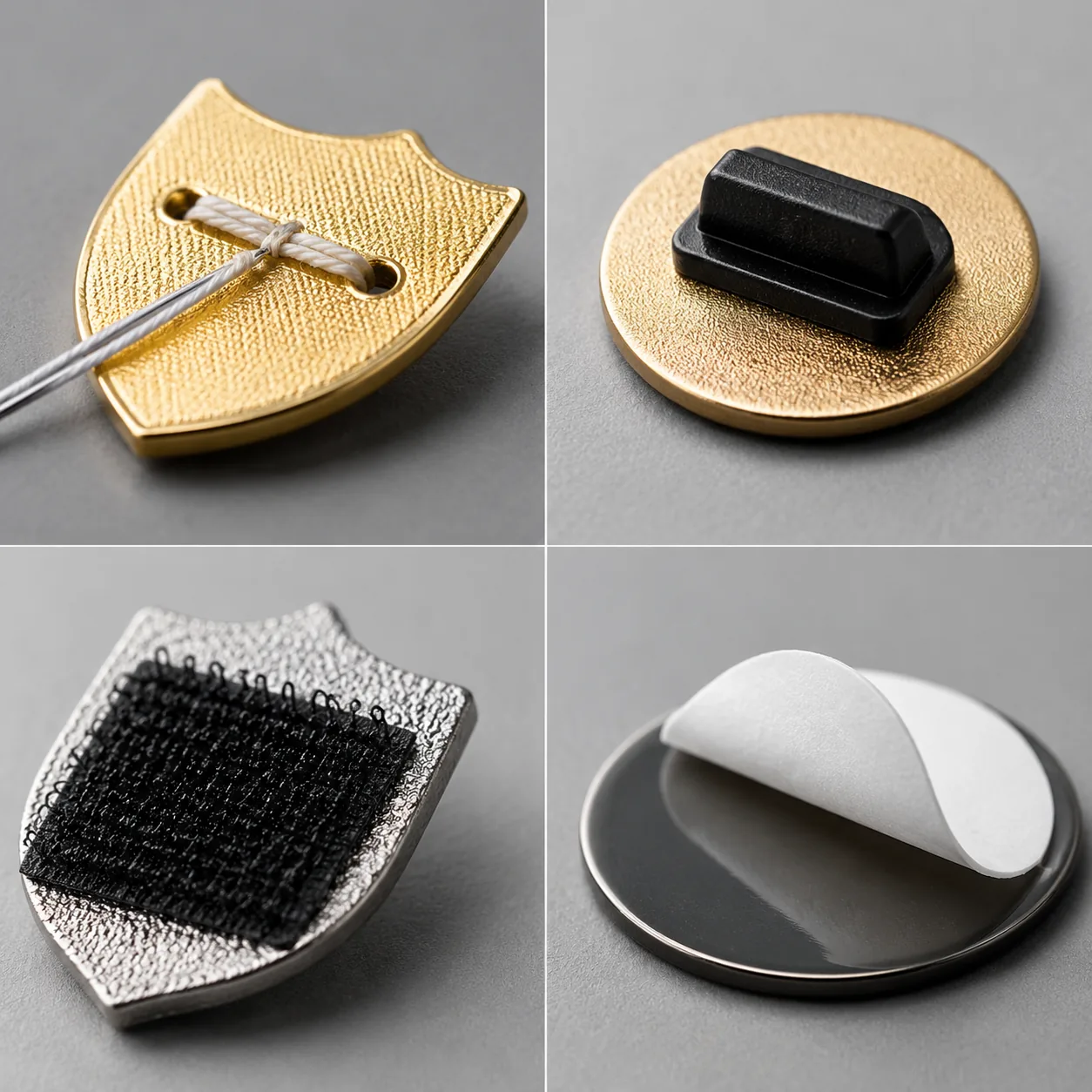
Butterfly clutches remain the fastest and safest default for most B2B event orders. Rubber clutches reduce scratch risk and are more comfortable against skin, but retention consistency varies by grade. Deluxe locking clutches improve retention but add unit cost and assembly time. Magnetic backs avoid puncturing garments, yet they increase material cost and can complicate packing, carton declarations, or carrier acceptance depending on magnet strength and format. If the deadline is tight, stay with standard metal posts and butterfly clutches unless the use case clearly requires something else.
Rear-layout review must happen together with packaging review. If the pin mounts on a 55 x 85 mm or 60 x 90 mm card, post locations should avoid logos, QR codes, barcodes, and variable-data zones. A rear-view proof is not optional. Many rush delays occur because the metal is finished correctly but the posts hit a barcode panel, tear the card during insertion, or make the product sit crooked in retail presentation.
4. Packaging added too late creates avoidable delay
A factory can finish the pins on schedule and still miss the event because packaging was never frozen. Custom backing cards, retail polybags, suffocation warnings, barcode labels, assortment splits, and inner-pack count labels all require separate proofing, material prep, and packing labor. Switching from bulk pack to individually carded units after metal production starts can add 1-3 working days even if the pins themselves are complete.
For booth giveaways, bulk packing is usually the safest option: for example, 50 or 100 pieces per PE bag, then into export cartons with outer count labels. If carding is necessary, lock the card size, material, board thickness, hole positions, finish, and barcode placement before tooling release. Typical backing card stock is 250-350 gsm SBS or C1S board. Die-cut tolerance is commonly around +/-0.5 mm, but post-hole clearance still needs to be generous enough to avoid tearing during insertion, especially when hand-assembling at speed.
Carton planning matters because metal pins are dense and freight cost can swing on either gross weight or volumetric weight. A common export carton for bulk-packed pins might be around 38 x 28 x 22 cm or 45 x 30 x 30 cm depending on quantity and pack style. If the goods ship direct to a venue, carton labels often need an exact receiver name, booth number, hall number, mobile contact, event date, and delivery window. Missing even one of those fields can strand completed goods at the final mile.
- Decide at RFQ stage whether custom backing cards are truly required or whether bulk packing will do the job.
- If carding is required, approve card dimensions, board gsm, hole spacing, finish, and barcode position before tooling release.
- Confirm inner-pack counts such as 50, 100, or exact assortment ratios by SKU before mass packing starts.
- Request estimated carton dimensions, gross weight, and volumetric weight early for freight booking.
- If shipping to a venue, hotel, or stand builder, provide the exact carton marking format and receiver contact in writing.
5. Vague QC standards trigger oversorting, disputes, and rework
One of the most expensive late-stage mistakes is writing quality must be good in the purchase order. That is not an inspection standard. Inspectors need measurable tolerances and clear defect definitions covering dimensions, enamel fill, plating coverage, burrs, post security, count accuracy, and packaging execution. Without that, the factory may ship what it considers normal promotional-grade product while the buyer rejects it for issues never defined at approval stage.
For event-grade custom pins, a workable baseline is overall size tolerance of +/-0.20 mm for pins under 40 mm, thickness tolerance of +/-0.15 mm, post-position tolerance of +/-1.0 mm, and backing-card die-cut tolerance of +/-0.5 mm. Enamel fill should be complete with no major voids or exposed base metal on the front face. Slight enamel level variation is normal in soft enamel and should not be treated as a defect unless fill is visibly missing, chipped, contaminated, or bleeding over the metal line.
Cosmetic review also needs a defined viewing method. A practical standard is front-side inspection at about 30 cm under 500-1000 lux neutral white light. Major defects include wrong plating color, major Pantone mismatch versus approved sample, missing enamel, exposed front-side base metal, sharp burrs, loose posts, wrong clutch, or wrong quantity per pack. Minor defects generally include small reverse-side hairlines, light rack marks, or handling marks not visible in normal use. This distinction matters because oversorting for hidden cosmetic flaws can consume a full extra day on a rush order.
For orders in the 500-5,000 piece range, AQL 2.5 major and 4.0 minor is a realistic default. If the program is for executive gifting or paid retail, tighten only the criteria that affect the actual use case: front cosmetics, color consistency, and hardware pull strength. Do not demand luxury-grade sorting on every hidden area if the order is for show-floor distribution. The fastest stable process is the one where acceptance criteria match how the product will be seen and used.
6. Freight planning mistakes after production is complete
Many trade-show failures happen after factory completion. Buyers approve a 10-day build but underestimate export packing, pickup booking, customs paperwork, airline cutoffs, destination processing, and final-mile delivery. Even a simple pin order can still require 4-8 calendar days after ex-factory date depending on destination, season, and service level. During exhibition peaks, courier and air channels become less predictable, especially when delivering to hotels, convention docks, or temporary event warehouses.
For standard metal pins with butterfly clutches, transport is usually straightforward. If the order includes magnetic backs, confirm carrier requirements early because some forwarders or couriers may ask for additional declarations, test references, or specific outer-pack labeling. More often, the actual problem is destination accuracy rather than transit speed. Deliveries fail because the receiver name, booth code, hall number, or delivery slot was never confirmed before dispatch.
A safer planning rule is to target factory completion at least 10 calendar days before the date the goods must be physically in hand, not 10 days before the exhibition opens. If that buffer does not exist, simplify the build instead of assuming the factory can compress every process without consequence. Removing epoxy, deleting custom carding, switching from selective plating to standard plating, or reducing color count usually protects the date better than trying to force another 5 percent speed from every department.
Rush-ready RFQ: the spec set that protects the deadline
If the event date cannot move, strip the product down to the minimum specification that still meets the brand objective. In most cases that means soft enamel, standard shiny nickel, shiny gold, or black nickel plating, 1.2-1.5 mm thickness, one or two posts based on size, no decorative effects unless essential, and either bulk packing or very simple pre-approved backing cards. Keep the artwork above manufacturable minimums: 0.30 mm lines, 0.25 mm gaps, sensible text size, and limited color count.
Your RFQ should include volume tiers because MOQ, setup efficiency, and FOB pricing change with quantity. For a standard 25-30 mm soft enamel pin, a typical MOQ is 100 pieces, but the more stable pricing bands are usually 300, 500, 1,000, and 3,000 pieces. Typical FOB ranges for standard plating and simple packing are about USD 0.85-1.60 each at 300 pieces, USD 0.60-1.05 at 500 pieces, USD 0.45-0.85 at 1,000 pieces, and USD 0.32-0.60 at 3,000 pieces. Adding custom carding, epoxy, glitter, premium backings, or selective plating increases both unit cost and lead-time risk.
- Final size in mm, shape, base material, and thickness
- Vector artwork with Pantone references, bleed, and all cutouts clearly marked
- Plating finish, enamel type, and whether epoxy is required or explicitly excluded
- Attachment type, number of posts, clutch type, and exact rear placement
- Packaging method: bulk, carded, polybagged, or assorted inner packs
- Inspection standard including AQL level, tolerances, and cosmetic viewing criteria
- Target proof-approval date, ex-factory date, ship date, and final in-hand date
- Complete ship-to details if goods go direct to a venue, hotel, or stand builder
The most useful supplier question is not can you rush this. It is what should we remove to make this safer by the date. A capable factory will answer with manufacturing specifics: widen fine lines to 0.30 mm or more, reduce enamel cells below 0.60 mm, switch to standard plating, remove epoxy, simplify carding, or move from two decorative processes to one proven process. That is usually the point where a rushed order stops being merely possible and becomes operationally controllable.
Have a project? Send your artwork and target quantity and we’ll reply with a detailed quotation within 12 working hours.
Ready to get this made?
Send your sketch, target quantity and ship-date. Detailed quotation in 12 hours.



