Rush Order Failure Modes for Custom Pins Before Trade Shows
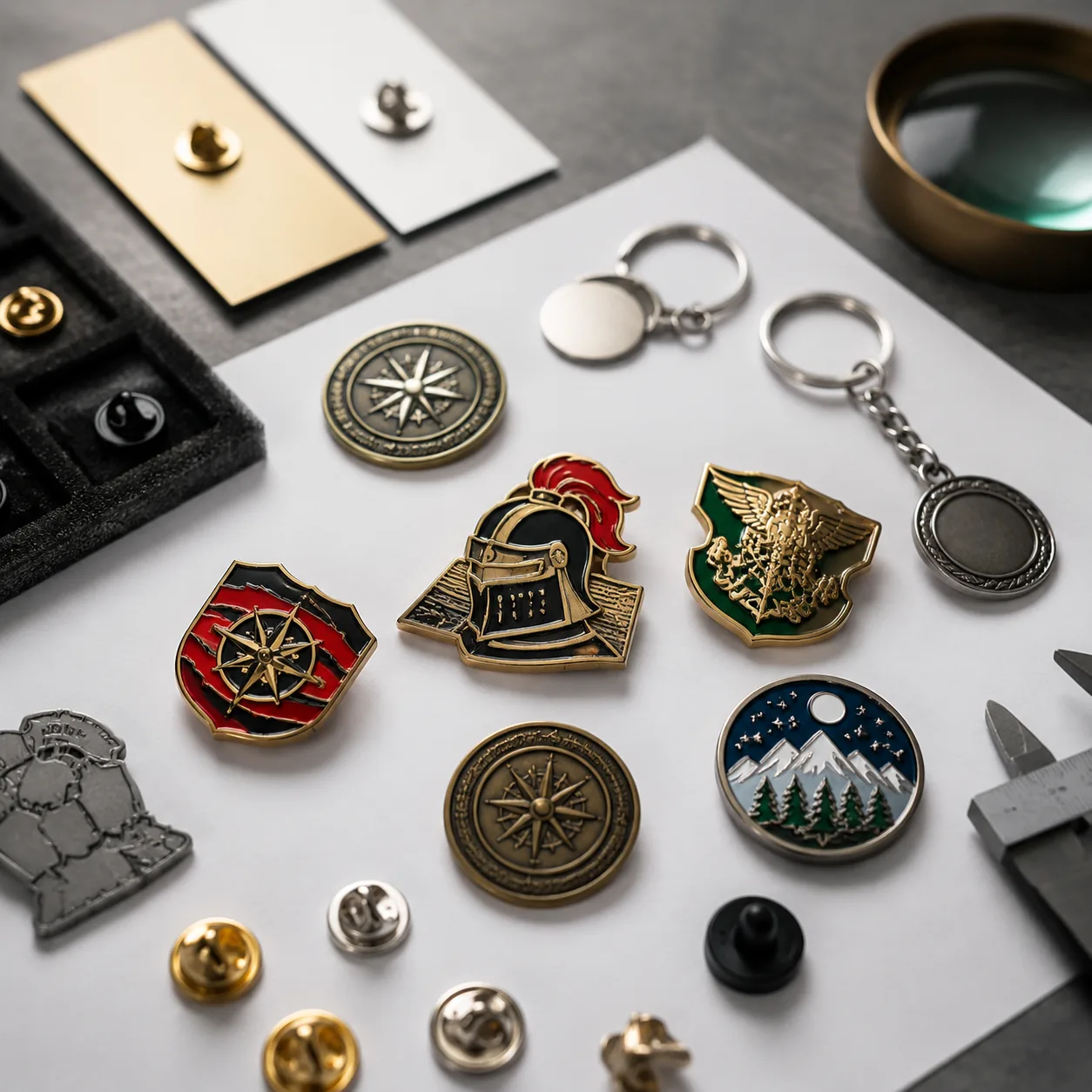
Rush pin orders fail when the time buffer disappears upstream
Most trade-show pin failures are not caused by a factory being unable to stamp, plate and fill metal fast enough. They happen because a normal 18 to 28 calendar day program is compressed into 9 to 14 calendar days while the specification still assumes multiple proof rounds, decorative finishes, custom cards, and no logistics disruption. In practice, the lost buffer disappears before mass production starts: artwork correction, tooling approval, finish confirmation, first-off review, packaging sign-off and courier booking are where rushed schedules usually break.
For a typical 30 mm soft enamel pin with 4 colors, iron base, 1.2 to 1.5 mm thickness, one butterfly clutch and individual polybag packing, standard production is usually 10 to 15 working days after final proof approval. Add 2 to 5 calendar days for express courier delivery to North America, Europe or Southeast Asia, plus 1 day for export handoff. A credible rush window is usually 7 to 9 working days only when the art is toolable on first pass, plating is standard bright nickel, bright gold or black nickel, color count stays moderate, and packaging is simple. Below 7 production days, buyers should expect feature reductions, overtime surcharge, or both.
The useful question is not whether the order can be rushed. The better question is which failure modes become likely once sample time, rework capacity, QC depth and transit contingency are reduced. Buyers who define those risks in the RFQ and purchase order usually receive a pin that is event-usable even if it is not collector-grade. Buyers who approve only a sales rendering often receive a pin that is technically manufacturable but still fails at the booth because the date is wrong, text is unreadable, the pin rotates on fabric, the front scratches in transit, or cartons arrive after advance warehouse receiving closes.
| Order type | Typical MOQ | Production lead time | Indicative FOB unit price |
|---|---|---|---|
| 30 mm soft enamel pin, 4 colors, iron, butterfly clutch, polybag | 100 to 300 pcs | 10 to 15 working days | USD 0.32 to 0.75 |
| Rush-safe version, same size, standard plating only | 100 to 500 pcs | 7 to 9 working days | USD 0.40 to 0.90 |
| 30 to 35 mm zinc alloy cutout pin, 5 to 6 colors | 300 to 500 pcs | 12 to 18 working days | USD 0.65 to 1.40 |
| Pin with glitter, glow, transparent enamel or epoxy dome | 300 pcs+ | 13 to 20 working days | USD 0.55 to 1.50 |
| Backing card, barcode label and retail polybag | Add-on to above | add 1 to 3 working days | USD 0.06 to 0.25 add-on |
Failure mode 1: approved artwork looks correct on screen but is not toolable
Rush programs commonly lose 1 to 2 full days because the approved file is a presentation proof rather than a manufacturing drawing. The layout may look clean at enlarged scale, but minimum metal lines are too fine for die striking, color wells are too narrow to fill consistently, copy drops below readable size, or post locations interfere with cutouts and backstamp position. The supplier then has to redraw borders, open enclosed shapes, move posts, thicken bridges or request a waiver. Under a show deadline, that delay is usually more damaging than accepting a small visual compromise at the start.
A rush-safe proof needs measurable limits, not general comments such as make it neat or match artwork exactly. For soft enamel pins, practical rush-safe geometry is minimum raised metal line width 0.30 mm, minimum recessed enamel area 0.35 to 0.40 mm, minimum gap between raised borders 0.30 mm, and minimum raised text height 1.2 mm, with 1.5 mm preferred for dates, booth numbers and URLs. Internal cutouts should keep bridge width at 0.8 mm or above. Thinner bridges can deform during stamping or bend during polishing, which increases scrap. Overall size tolerance should be called at plus or minus 0.20 mm on the longest dimension. Critical back details such as post spacing, date stamp placement or locking-back alignment should be controlled to plus or minus 0.50 mm.
Proof discipline matters as much as geometry. In a genuine rush program, one proof revision round within 12 hours is realistic. After tooling release, only corrections affecting manufacturability, legal compliance, brand protection or event accuracy should reopen the file. If the buyer continues adjusting small curves, spacing or contour style after die engraving begins, the rush schedule is usually no longer recoverable.
| Spec item | Standard target | Rush-safe target |
|---|---|---|
| Minimum raised metal line | 0.25 mm | 0.30 mm |
| Minimum recessed fill area | 0.30 mm | 0.35 to 0.40 mm |
| Minimum raised text height | 1.0 mm | 1.2 to 1.5 mm |
| Internal cutout bridge | 0.6 mm | 0.8 mm or above |
| Overall size tolerance | ±0.15 to 0.20 mm | ±0.20 mm |
| Proof revisions before tooling | 2 to 3 rounds | 1 round maximum |
| Buyer response time to proof | 24 hours | 12 hours |
Failure mode 2: finish and color choices are stable in normal production but fragile under rush
Not all finishes rush equally well. Standard bright nickel, bright gold and black nickel are usually the safest because those plating baths run frequently and inspectors know the target appearance. Antique silver, antique copper, dual plating, dyed black effects, pearl, glitter, glow powder and transparent enamel over texture add process steps or widen visual variation. In a standard lead-time program, that variation can be sorted or touched up. In a compressed schedule, the same variation becomes a shipment risk because plating, color fill, curing and packout are scheduled with little recovery time between operations.
For low-cost event pins, visible decorative plating thickness is commonly around 0.03 to 0.08 micron over the functional plated layer. Buyers should focus less on inflated micron claims and more on acceptance criteria that can actually be inspected: even coverage, no exposed base metal on front-facing surfaces when viewed at 30 cm under 5000 to 6500K neutral light, no blistering, and no peeling along visible edges after normal clutch assembly. If scratch visibility is a concern, an epoxy dome can help, but it usually adds about 1 working day for curing and another QC checkpoint. Epoxy also slightly softens fine metal definition, which should be considered before using small text.
Color count is another hidden delay. On a 30 mm pin, more than 5 enamel fills increases hand-fill time and raises the chance of underfill, spillover or shade inconsistency, especially with pale colors, adjacent light colors or isolated micro-cells. Under rush conditions, reserve strict Pantone matching for 1 or 2 brand-critical colors and allow close visual match on secondary fills. A practical control is first-off photos under white light with an approved Pantone chip or swatch in frame. Warm phone photos under mixed factory lighting regularly create avoidable disputes because they make gold plating look redder and light blues look grayer than the actual part.
- Use bright nickel, bright gold or black nickel for 7 to 9 working day programs.
- Add 2 to 4 working days for antique finishes, dual plating, glitter, pearl, glow or transparent enamel.
- Limit strict Pantone approval to 1 or 2 critical brand colors.
- Add about 1 working day if epoxy coating is required.
- State cosmetic acceptance clearly: no exposed front-side base metal, no plating peel, and no visible front scratch at 30 cm inspection distance.
Failure mode 3: hardware is easy to assemble but wrong for event use
Trade-show pins are handled differently from collector pins. They are attached to thin shirts, lanyards, tote bags and lightweight jackets, removed quickly, and often reattached several times in one day. That use pattern exposes weak hardware decisions immediately. Common failures are single-post rotation on wider shapes, posts placed too high so the pin tips forward, butterfly clutches that loosen during wear, and sharp post ends that snag light fabric or backing cards.
For rush jobs, simplify hardware while protecting function. A 25 to 32 mm irregular pin should usually use two posts once width exceeds about 28 mm, when the silhouette is tall and narrow, or when mass is off-center because of large cutouts. Post location tolerance should stay within plus or minus 0.8 mm so the finished pin sits square. Standard post diameter is commonly 0.8 to 1.0 mm. If the pin mounts through a printed backing card, the card hole spacing tolerance should stay within plus or minus 1.0 mm of actual post center distance, or carding slows down and tearing increases.
Butterfly clutch remains the fastest and lowest-cost option for most giveaway programs, but rubber clutch is often better for wearer comfort, retention and transit security. Deluxe locking backs, magnetic attachments and brooch bars are available, but they add cost, assembly time or user limitations. Once the format moves above roughly 40 to 45 mm, becomes materially heavier, or uses 1.8 mm zinc alloy with epoxy, the product should be specified as a badge rather than treated as a standard lapel pin. Copying a one-post 30 mm pin layout onto a heavier badge is a common cause of field failure.
| Pin format | Recommended hardware | Rush note |
|---|---|---|
| 20 to 28 mm round or regular shape | 1 post plus butterfly or rubber clutch | Lowest assembly risk |
| 28 to 35 mm irregular or tall shape | 2 posts plus butterfly or rubber clutch | Reduces rotation during wear |
| 40 mm+ badge style | Brooch bar or 2-pin layout | Do not default to 1 post |
| Heavy zinc alloy with cutouts | 2 posts minimum | Check balance before tooling |
| Retail presentation pin | Rubber clutch often safer than butterfly | Reduces loose-back complaints in transit |
Failure mode 4: the physical sample is skipped and no compressed QC gate replaces it
Skipping a mailed pre-production sample can be reasonable on a trade-show order. Skipping the control point entirely is not. When the buyer says no sample, proceed, the first production batch effectively becomes the sample. By the time visible defects are found, the supplier may already have plated, filled or packed most of the quantity. Under rush conditions, that usually leaves three bad options: accept defects, pay for a partial remake, or miss the event.
The practical replacement is a compressed approval ladder with four gates: toolable artwork sign-off, first-off bench photos, a short function video, and a pre-shipment AQL inspection or at minimum an internal QC report with actual defect counts. The first-off set should show front, back, side profile, post positions, clutch fit and a close-up of the smallest date or text element. Production should not move to full quantity until first-off approval is released, even if the buyer has only a 2 to 4 hour response window.
Inspection criteria should be concrete. For trade-show giveaways, light backside marks may be acceptable. Unreadable text, wrong event date, missing hardware and front-side plating damage are not. A practical standard is ANSI/ASQ Z1.4 single sampling, general inspection level II, with AQL 2.5 for major defects and 4.0 for minor defects. For a lot size of 501 to 1,200 pieces, that typically means sample code letter J and 80 pieces inspected under normal single sampling. In the purchase order, define major defects as wrong plating, wrong logo or date, missing post or clutch, plating peel, exposed base metal on the front, front scratch longer than 3 mm, or text unreadable at 30 cm. Minor defects can include light backside marks, slight non-critical color variation, or small edge roughness that does not affect wear.
| QC gate | Primary purpose | Typical time cost |
|---|---|---|
| Toolable artwork sign-off | Catch unbuildable lines, wrong dimensions and unsafe cutouts | Same day |
| First-off photo approval | Check plating look, enamel color, text clarity and post placement | 2 to 4 hours |
| First-off function video | Confirm clutch fit, pin closure and any moving parts | Less than 1 hour |
| Inline spot check during fill or assembly | Catch scratches, underfill, mixed hardware or wrong backs | 0.5 working day |
| Pre-shipment AQL inspection | Validate batch defect rate before dispatch | 0.5 to 1 working day |
Failure mode 5: packaging becomes the hidden critical path
Pins are often completed on schedule and still miss dispatch because packaging was left vague or approved late. The metal component may fit a 7 to 9 working day window, but backing cards, barcode labels, barcode verification, polybagging, foam inserts, gift boxes and mixed-SKU collation can add 1 to 4 more working days. The risk rises when card artwork starts late, pin orientation on the card is strict, or several designs must be combined into one set.
For a fixed event deadline, the lowest-risk packout is bulk count by inner bag or individual polybag with carton marks locked at PO stage. If backing cards are required, use a standard rectangle card in about 300 to 350 gsm coated paper or matte art card, keep print to 1 or 2 spot colors or straightforward CMYK, and avoid custom die-cut card shapes unless merchandising value clearly justifies the delay. Card hole spacing should match actual post spacing within plus or minus 1 mm. Misaligned holes slow assembly, crease the card face and increase reject sorting at packout.
Mixed event kits are where schedules often collapse. If 5 designs must be packed together, specify ratio, orientation, inner pack quantity and carton configuration before production starts. An instruction such as 100 sets per export carton, each set containing 1 each of designs A through E, verified by count and carton gross-weight tolerance within plus or minus 2 percent, is much more reliable than asking the factory to mix evenly. If retail UPCs, Amazon labels or venue-specific barcodes are required, final files should be approved before metal production ends, not after the assembly line has started.
Failure mode 6: logistics are planned to ex-factory date instead of booth-ready date
Factories usually commit to ex-factory timing. Event teams care about in-hand timing at the warehouse, hotel or convention center. That gap is where rushed projects fail. A carton completed on Friday in Guangdong does not help if courier pickup slips to Monday, customs requests value clarification, or the venue requires receipt at the advance warehouse 3 business days before exhibitor move-in. For rush jobs, logistics should be planned backward from the final receiving deadline, not forward from production release.
A practical back-scheduling model is simple: booth-ready date minus venue receiving cutoff, minus domestic transfer if using an advance warehouse, minus 2 to 5 calendar days for express courier transit, minus 1 day for export handoff, minus actual factory production days, minus at least 1 day of approval contingency. Example: if booth move-in is Thursday, advance warehouse closes Monday, domestic transfer takes 1 day, courier transit is estimated at 3 days, and production is 8 working days, the factory should finish no later than the prior Wednesday. If the chain is already impossible on paper, the right response is to simplify the build immediately rather than pay rush fees for a specification that still cannot arrive on time.
For quantities such as 300 to 1,000 pins, express courier is usually more reliable than airport-to-airport freight plus local forwarding, even if freight cost per unit is higher. Final carton dimensions and gross weight should be confirmed before assembly finishes. As a planning reference, 1,000 pieces of a 30 mm pin in polybags often ship in one export carton at roughly 12 to 15 kg gross weight. The same order on backing cards or in gift boxes may trigger volumetric billing and sharply increase courier cost. That matters when premium packaging is approved late and freight suddenly doubles.
Cutoff rules and RFQ controls keep the order from collapsing under last-minute changes
A workable rush order needs a clear priority ladder. Event usefulness usually ranks in this order: logo and event-date legibility first, hardware function second, front cosmetic acceptability third, exact match of non-critical colors fourth and premium packaging last. If every feature is labeled critical, the supplier may spend scarce hours chasing a slight Pantone nuance while a hardware, plating or dispatch issue goes unresolved.
MOQ and split-order strategy also matter. If the full design is too complex for the available time, buyers can place an event-safe version now and a premium reorder later. For example, instead of forcing 1,000 pieces of a 6-color zinc alloy cutout pin with dual plating, glitter and custom card into a 9-day program, it is often smarter to run 500 to 1,000 pieces of a 4-color iron soft enamel pin with bright nickel and polybag packing for the show, then reorder the premium version after the event. The simplified version may ship 2 to 4 working days earlier, reduce cosmetic risk, and cut both unit cost and freight exposure.
Use hard cutoffs in writing. No art changes after tooling release. No packaging changes after 30 percent of production is complete. No hardware substitutions without written approval. No ship-date commitment based on missing barcode files, pending card artwork or unapproved proofs. A strong rush RFQ should lock quantity, booth-ready date, latest acceptable ex-factory date, destination country or ZIP code, pin size in millimeters, base metal, thickness, finish, number of colors, attachment type, packing method, carton marks and QC controls. It should also limit proof revisions to one round, require first-off photo and video approval, specify AQL 2.5 major and 4.0 minor, and identify the 1 or 2 colors that require strict Pantone control.
- Set the schedule from booth-ready date and venue receiving cutoff, not only from requested ship date.
- Approve a toolable drawing within 12 hours and limit revisions to one round before tooling.
- Use rush-safe geometry: 0.30 mm minimum raised lines, 0.35 mm+ fill areas and 1.2 mm+ text.
- Choose standard plating and simple packaging if production must stay within 7 to 9 working days.
- Require first-off photos, close-ups and a function video if a shipped pre-production sample is skipped.
- Write major defects into the PO, including wrong date, unreadable text, missing hardware and front-side plating failure.
- Confirm courier method, carton dimensions, gross weight and final commercial invoice details before completion.
- Freeze art, hardware and packout changes once production starts to protect lead time and yield.
Have a project? Send your artwork and target quantity and we’ll reply with a detailed quotation within 12 working hours.
Ready to get this made?
Send your sketch, target quantity and ship-date. Detailed quotation in 12 hours.



