Rush Custom Pins for Trade Shows: What to Cut, What to Keep
Start from the real in-hand date, not the show opening
Rush pin programs usually fail because buyers count only factory production days. The actual path also includes artwork cleanup, proof approval, die engraving, stamping or casting, trimming, polishing, plating queue, enamel fill, oven cure, attachment assembly, counting, export packing, flight booking, customs clearance, and final delivery to an office, hotel, 3PL, or convention venue. On a compressed schedule, every handoff consumes time, and one missed approval can cost more than a day of production.
For trade shows, work backward from the date cartons must be physically received, opened, and checked. If booth setup starts Monday morning, a safer in-hand target is the prior Wednesday or Thursday. That leaves 2 to 4 calendar days for carton sorting, shortage checks, internal distribution, bad-address corrections, and venue dock delays. For cross-border shipments into the US, EU, UK, or GCC markets, a 5 to 7 day buffer is more realistic during peak exhibition seasons because customs exams, airline rollover, and broker document holds are common.
A workable baseline for a standard stamped custom pin is 2 to 4 working days for tooling and pre-production review, 7 to 10 working days for bulk production after approval, and 1 to 2 working days for final pack-out and dispatch. Express courier is commonly 3 to 5 transit days door-to-door; standard air freight with brokerage is more often 5 to 9 days after departure. If the real in-hand deadline is under 20 calendar days, treat the order as a managed rush project, not a normal PO.
A practical rule: if the event opens on Day 28 and booth setup begins on Day 26, the shipment should usually leave the factory around Day 17 to Day 19 for moderate customs risk, or Day 15 to Day 17 if destination paperwork is complex. That means artwork, plating, colors, attachment, and packaging often need to be frozen by Day 5 to Day 7. Once the calendar is mapped this way, the tradeoff becomes clear: simplify the build now or accept a materially higher risk of missing the show.
Screen the design for rush feasibility before you request pricing
The fastest pins are not just small pins. They are designs that pass through standard tooling, standard plating, standard color fill, and standard packing with minimal handwork and minimal approval loops. The slowest designs are usually the ones with fine geometry, extra assembly, unstable text, or premium presentation requirements.
Rush-capable builds are typically stamped iron or brass at 1.2 mm to 1.5 mm base thickness before plating, soft enamel or imitation hard enamel, 1 to 4 fill colors, no moving parts, stock butterfly clutch or black rubber clutch, and bulk packing. Common MOQ starts at 100 pieces, but the most stable rush range is usually 300 to 1,000 pieces. At 100 to 200 pieces, tooling and setup dominate cost and make overtime expensive per unit. Above 1,500 pieces, rush is still feasible, but plating capacity, curing trays, and final counting require tighter line scheduling.
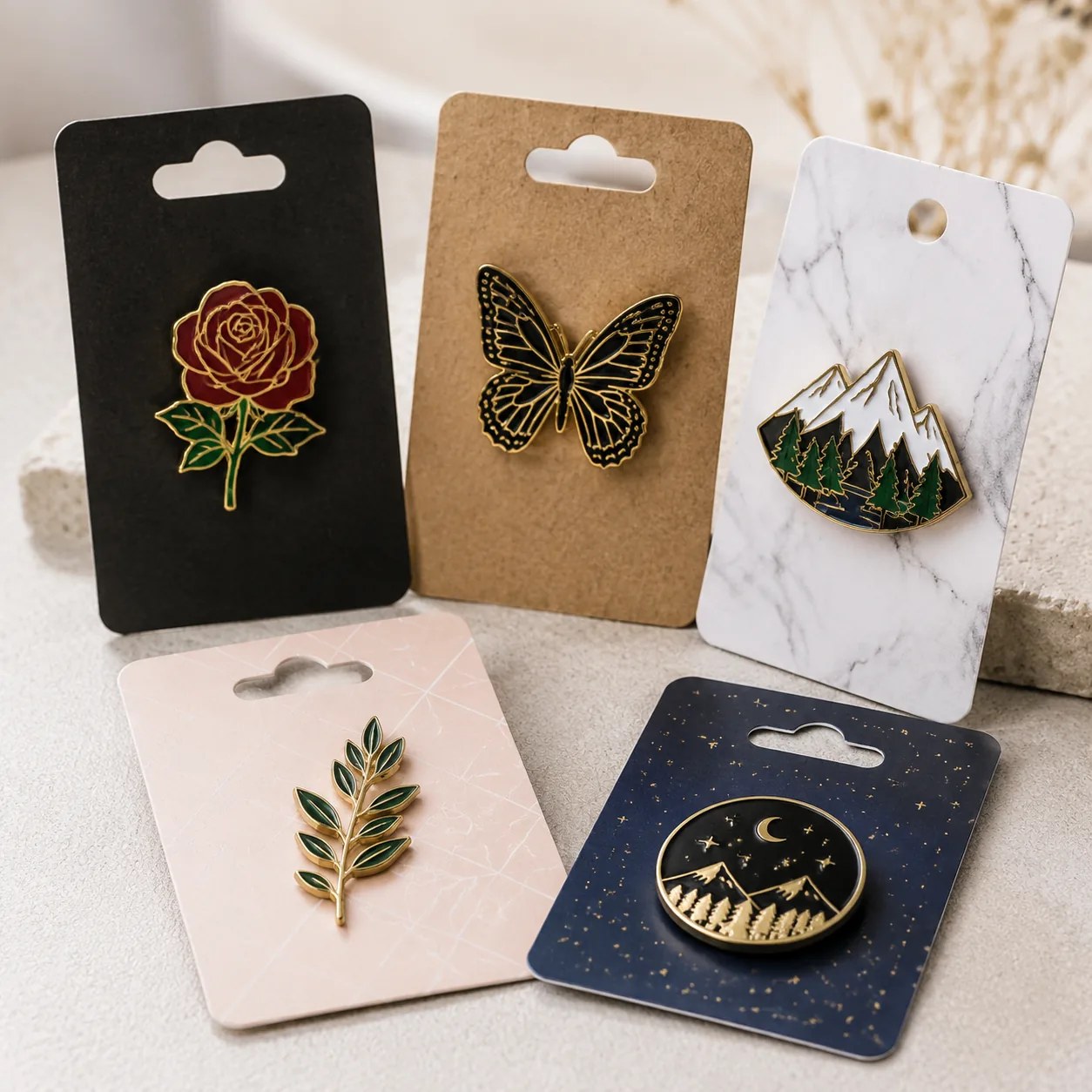
High-risk rush features include 6 or more colors, transparent or glow enamel, offset print with epoxy dome, mixed plating on one piece, spinners, danglers, deep 3D cast relief, cutouts below 1.2 mm, text strokes below 0.20 to 0.25 mm, custom backing cards, gift boxes, barcode-by-piece pack-out, and physical samples couriered internationally before mass production approval. Each feature adds either queue time, manual labor, or rework risk.
| Decision Point | Rush-Capable Spec | High-Risk Spec for Rush | Typical Time Impact |
|---|---|---|---|
| Base construction | Stamped iron or brass, 1.2 mm ±0.10 mm | Cast zinc alloy with deep 3D relief | 2 to 4 extra working days |
| Color count | 1 to 4 Pantone-referenced fills | 6+ colors with fills or separations under 0.30 mm | 1 to 3 extra working days |
| Edges and cutouts | Simple outline, cutouts at least 1.5 mm | Fine openwork below 1.2 mm | 1 to 2 extra working days |
| Attachment | Stock butterfly or rubber clutch | Magnet, screw back, brooch pin, safety pin | 1 to 2 extra working days |
| Finish | Bright gold, bright nickel, black nickel | Antique hand-rub, dual plating, selective finish | 1 to 3 extra working days |
| Packaging | Bulk pack or plain OPP bag | Custom card, EVA insert, gift box, barcode set packing | 2 to 5 extra working days |
| Approval route | Digital proof plus photo or video sample | Physical sample couriered internationally | 3 to 6 extra working days |
Protect the three specifications you should rarely cut
Under deadline pressure, buyers often cut the wrong things. They remove the second post, leave plating vague, or weaken QC language. The result is predictable: pins rotate on garments, plating shifts under exhibit lighting, or too many units arrive with fill voids, scratches, or loose clutches. In a rush order, three items should usually stay protected even if you simplify elsewhere: attachment stability, plating definition, and inspection standard.
First, protect attachment stability. Pins wider than 32 mm, taller than 28 mm with an uneven silhouette, or heavier than about 8 to 10 g should normally use two posts. One post on a wide shape often rotates on polo knit, tote straps, and lanyard fabric. Post location should be held to about ±1.0 mm from approved artwork. Typical post diameter is 0.9 to 1.1 mm, and the clutch should resist normal handout handling without accidental release. For magnets, confirm pull force and packaging orientation, because magnetized sets can slow assembly and create freight complications.
Second, protect plating definition. Do not specify only gold or silver. State the exact finish: bright gold, bright nickel, black nickel, antique brass, or antique copper. Promotional pin plating is commonly a decorative flash layer around 0.03 to 0.08 micron, sometimes up to roughly 0.10 micron depending on finish and supplier. That is adequate for event merchandise, but it is not jewelry-grade wear resistance. If pins will be handled repeatedly in sales kits or executive meetings, ask whether the supplier can add a clear protective topcoat compatible with the finish. Also define whether raised metal must be mirror polished, whether recessed lines should remain dark, and whether edge polishing is part of the acceptance standard.
Third, protect inspection discipline. Rush should never mean ship without QC. A practical commercial standard is AQL 2.5 for major defects and 4.0 for minor defects. For premium small-lot programs, AQL 1.5 major and 2.5 minor is reasonable but may add release time. Missing fill, detached hardware, wrong plating, wrong revision, and wrong count should remain zero-tolerance shipment blockers. Visual inspection should be performed under daylight-equivalent lighting around 5000 K to 6500 K at roughly 30 to 40 cm viewing distance, because defects invisible at one meter can still look poor at handout distance.
Remove low-value process steps instead of gambling on quality
The safest way to cut lead time is to remove operational steps, not technical safeguards. Every custom backing card, individual barcode, mixed hardware pack, insert, or extra approval loop creates another queue in the factory. A touch that takes only 5 seconds per unit becomes almost 42 labor minutes per 500 pieces and more than 2 hours at 1,500 pieces before recounts, bagging errors, and carton relabeling are considered.
The biggest time savings are usually operational rather than visual. Replacing a custom printed backing card with bulk packing or a plain stock card often saves 1 to 3 working days. Removing piece-level barcode labels can save another 1 to 2 days if manual matching is required. Standardizing one clutch style across the order avoids hardware shortages and assembly changeovers. Packing 50 or 100 pieces per OPP bag instead of individual retail units reduces labor, carton count, and dimensional freight cost.
At factory level, a simplified job moves faster through striking, trimming, polishing, plating, fill, bake, assembly, and counting because there are fewer hold points. The difference between an 11-day production cycle and a late 15-day cycle is often not the metalwork. It is the accumulation of special pack-out instructions, proof revisions, and exceptions that force the order to leave the normal line flow.
- Keep one plating finish across the entire order
- Use stock butterfly or rubber clutches only
- Approve proof and sample photos the same day
- Pack 50 or 100 pieces per bag instead of individual retail packs
- Ship to one destination with one carton mark if possible
- Freeze artwork before tooling and avoid post-proof edits
A concrete comparison: a 500-piece, 30 mm soft enamel iron pin in bright nickel with two posts and bulk packing may complete in about 10 to 13 working days after approval. The same face design with a printed backing card, individual polybag, barcode label, and mixed clutch hardware can easily stretch to 13 to 17 working days without any visible improvement to the pin itself.
Price rush work on landed cost, MOQ tier, and failure risk
Rush surcharges make sense only when they buy real priority in constrained operations such as die slot allocation, plating queue access, weekend fill, overtime assembly, or same-day export handoff. They waste money when the specification itself remains slow. Paying 20% more will not fix a bottleneck created by dual plating, gift-box packing, or repeated artwork changes.
For 2026 buying, moderate acceleration often adds 10% to 25% over standard production. Severe acceleration can reach 30% to 40%, especially below 300 pieces or when custom packaging remains in scope. Typical FOB pricing for promotional quality still depends mainly on size, metal, process, finish, and quantity tier. A 25 mm soft enamel iron pin often runs around USD 0.45 to 0.80 FOB at 300 pieces, USD 0.35 to 0.65 at 500 pieces, and USD 0.26 to 0.48 at 1,000 pieces. A 30 mm imitation hard enamel brass pin is more often USD 0.90 to 1.50 FOB at 300 pieces, USD 0.72 to 1.20 at 500 pieces, and USD 0.55 to 0.95 at 1,000 pieces. Tooling is commonly USD 50 to 120 for simple stamped dies and can be higher for large or irregular shapes.
Freight can erase any factory-side savings. A 1 to 2 carton express shipment may cost more than the rush surcharge itself, especially when inserts or gift boxes increase dimensional weight. Compare full scenarios: standard production plus express courier, accelerated production plus standard air freight, or a split shipment with 200 to 300 VIP units rushed first and the balance shipped on a lower-cost mode. The cheapest FOB quote has no value if customs release misses the move-in window.
Also ask for rush economics by MOQ tier, not one headline number. A 300-piece order may carry a much higher premium per unit than 1,000 pieces because setup and overtime are spread over fewer units. At 2,500 pieces, the premium may narrow on a per-unit basis but the lead-time advantage can shrink because plating bath capacity, fill balancing, and final counting become the bottleneck. A competent supplier should explain exactly where the constraint sits.
Use a two-tier approval method when the calendar is tight
The traditional sequence of digital proof, physical sample, revision, bulk production, and shipment is often too slow for event recovery. A better method for rush pins is two-tier approval. First, lock every measurable specification before tooling begins. Second, approve photo or video samples against that specification unless the design contains a known technical risk.
This works only when the RFQ and PO are precise. The document should state finished size in millimeters, metal type, nominal thickness, process type, plating finish, Pantone references or approved color targets, post count, clutch type, packaging method, carton quantity, destination country, tolerances, and inspection standard. For a stamped pin, outline dimensions are commonly controlled at about ±0.15 mm to ±0.25 mm depending on contour complexity. Finished thickness after polishing is often around ±0.10 mm. Soft enamel fill should be reasonably level within recesses, while imitation hard enamel should present a flatter polished face. Text below 0.25 mm stroke width and gaps below 0.30 mm should be flagged as high risk before tooling, not debated after receipt.
Photo approval usually saves 3 to 6 days versus couriering a physical sample internationally. It suits standard soft enamel or imitation hard enamel pins with uncomplicated outlines. Physical samples remain advisable when the design uses transparent enamel, glow fill, printed graphics, epoxy dome, premium presentation packaging, or highly detailed text and openwork. The goal is not to skip approval. It is to shift approval onto measurable data and clear close-up visuals when the design is technically stable.
A strong same-day approval pack should include a dimensioned proof, Pantone callouts, plating callout, post-placement drawing, front and back close-up photos, estimated piece weight, packaging photos, and a ship-date confirmation tied to the approved spec. That shortens feedback cycles because the buyer can approve against named criteria instead of making vague comments such as cleaner or more premium.
Match the build level to the event objective, then lock the RFQ
Not every trade-show pin needs the same bill of materials. A 5,000-piece aisle giveaway follows a different economic logic from a 300-piece distributor gift or a 150-piece staff-recognition item at the same event. The most reliable rush decision is usually the one that matches construction quality to audience value instead of forcing one premium specification across all uses.
For high-volume booth traffic, a 25 to 30 mm soft enamel iron pin with bright nickel or black nickel plating, one post for compact round shapes or two posts for wider silhouettes, and bulk packing is usually the best balance of cost, speed, and acceptable appearance. For partner gifts, sponsor meetings, or paid attendee kits, brass with imitation hard enamel offers a flatter face, better polish, and sharper edge definition, but usually adds cost and about 1 to 3 working days compared with a simpler soft enamel build. Multi-part assemblies, patch-and-pin sets, challenge coins, and gift-box presentations are poor rescue products when the deadline is already tight.
If the event is only three weeks away, split the program instead of forcing one high-spec build across the total quantity. A practical structure is 300 brass imitation hard enamel pins for VIP meetings and 2,000 soft enamel iron pins for general distribution. The VIP quantity justifies the higher unit cost and tighter review, while the larger promotional quantity stays within a rush-capable manufacturing window. This reduces line congestion, protects visual quality where it matters most, and lowers the risk that one complex spec delays everything.
Before asking for final quotations, lock these RFQ fields: quantity tiers such as 300, 500, and 1,000 pieces; finished size in mm; metal and nominal thickness; process type; plating finish; Pantone colors; post count and clutch type; packaging method; approval method; target ship date; destination country; whether partial shipment is acceptable; standard and rush lead times in working days; and FOB pricing by tier. Also ask which exact changes save 1 day, 2 days, or 3 days. The fastest successful order is usually not the one with the most pressure. It is the one with the clearest specification, the fewest unnecessary process steps, and the right compromises made early enough for the factory, forwarder, and customs chain to execute without rework.
Have a project? Send your artwork and target quantity and we’ll reply with a detailed quotation within 12 working hours.
Ready to get this made?
Send your sketch, target quantity and ship-date. Detailed quotation in 12 hours.



