Rigid Gift Boxes for Custom Coins and Pins: Buyer Specs
Start With the Distribution Job, Not the Box Photo
Rigid gift boxes solve a presentation problem, not every packaging problem. They are appropriate when a custom coin, anniversary pin, brooch or VIP badge will be handed to a recipient, placed on a boardroom table, sold as a retail set or photographed as part of a recognition program. They are often the wrong choice for bulk trade-show distribution, low-cost mailers or giveaways packed into thin envelopes, where a backing card, OPP bag, paper envelope or small tin may reduce freight, labor and damage risk.
The common failure is not the metal item. The plating can pass inspection, the enamel can match the approved sample, and the epoxy can be clean, while the presentation still fails because the box corners crush, the insert cavity is too loose, the lid rubs a mirror-polished face, or the export carton collapses in courier handling. For buyers paying an additional USD 0.65 to USD 4.80 FOB per unit for presentation packaging, these are not minor cosmetic issues.
Treat the packaging as a second engineered product. The box structure, greyboard thickness, wrap paper, insert material, sleeve, label, desiccant and export carton should all have dimensions, tolerances and inspection criteria. A quote that only says “premium gift box” is not a specification. It leaves too much room for substitutions after the metal goods are already finished.
Select the Rigid Box Structure and Board Grade
Most rigid boxes for custom coins and pins use greyboard wrapped with coated paper, textured paper, specialty paper or printed art paper. For small pin boxes below 80 x 80 mm, 1.2 mm greyboard can be acceptable for hand delivery, but it dents more easily in courier shipments. For 45 mm to 50 mm challenge coins, 1.8 mm greyboard is a safer baseline. For 60 mm coins, medal-style pieces or multi-pin sets weighing 70 g to 150 g before packaging, 2.0 mm to 2.5 mm greyboard is more appropriate.
Wrap paper is usually 120 gsm to 157 gsm for coated or printed paper, and 120 gsm to 180 gsm for textured or specialty stock. Heavy textured paper hides small handling marks, but it can weaken fine foil detail. Soft-touch lamination feels premium but shows oil marks and scuffs more easily during packing. If the program ships by air courier, durability should rank above showroom feel.
The main structures are two-piece lid-and-base boxes, magnetic clamshell boxes, book-style boxes with ribbon, sliding drawer boxes and paperboard window boxes. Two-piece boxes are cost-effective and stack well, but lid fit must be controlled. Magnetic boxes feel premium but add weight, labor and possible magnet declaration requirements for air shipment. Drawer boxes work well for retail-style pin sets, although tight sleeves can be frustrating if users need quick access at an event.
| Box type | Typical use | Common finished size | Typical FOB add-on | Key specification risk |
|---|---|---|---|---|
| Two-piece rigid box | Single coins, brooches, premium pins | 60 x 60 x 20 mm to 110 x 110 x 30 mm | USD 0.65 to 1.90 | Loose lid, crushed corners, weak board below 1.5 mm |
| Magnetic clamshell box | VIP coins, award badges, executive gifts | 80 x 80 x 25 mm to 150 x 120 x 40 mm | USD 1.60 to 4.80 | Higher freight volume, magnet declaration, poor recyclability |
| Sliding drawer box | Retail pin sets, keychain sets, coin-and-card packs | 70 x 70 x 20 mm to 180 x 100 x 35 mm | USD 0.90 to 2.80 | Drawer too tight after wrapping or too loose after transit |
| Book-style rigid box | Commemorative sets, medals, certificates with pins | 120 x 90 x 25 mm to 220 x 160 x 45 mm | USD 1.80 to 5.50 | Hinge cracking, ribbon placement, lid not closing flat |
| Paperboard window box | Retail display where product visibility matters | 60 x 80 x 18 mm to 180 x 120 x 35 mm | USD 0.45 to 1.60 | PVC/PET window scratching polished plating |
Engineer the Insert Around the Finished Product
The insert causes many packaging complaints because it is often designed from artwork instead of a finished sample. A 50 mm coin in a generic 52 mm cavity can rotate, rattle and abrade against the lid during air shipment. A brooch with a 35 mm safety clasp needs more depth than a flat lapel pin with butterfly clutches. A spinner coin, chain pin or dangling charm needs clearance for moving parts, not only the main metal outline.
For coins, specify EVA thickness, cavity diameter, cavity depth and product removal method. A typical 45 mm to 50 mm coin at 3.0 mm thickness works with 7 mm EVA and a cavity 0.3 mm to 0.8 mm larger than the coin diameter. A 60 mm coin, 4.0 mm thick coin or spinner coin should use 10 mm EVA or a layered insert, so the edge is supported without pressure on raised relief. For heavy medals above 90 g, consider a denser EVA grade or a paperboard support layer beneath the EVA to prevent sagging.
For pins and brooches, measure the full product after posts, clutches, clasps, chains and epoxy are installed. Irregular pins typically need cavity clearance of plus 0.5 mm to plus 1.5 mm depending on shape complexity. Pin posts may need rear relief holes or a stepped insert; otherwise the insert bulges and the lid will not close evenly. If the pin ships with rubber clutches attached, test the final clutch material because silicone, PVC and metal clutches have different heights.
Velvet-covered EVA looks premium but can shed fibers onto high-polish gold, silver, black nickel and epoxy surfaces. Flocked EVA, suede paper and microfiber liners should be checked against actual plated samples. For mirror plating, add a thin protective PET film or tissue interleaf if the lid or insert can touch the product face. Do not rely on a clean empty box sample to approve insert performance.
- Confirm finished product size, thickness and weight, including posts, clasps, clutches, jump rings, chains and epoxy.
- Set coin cavity clearance at plus 0.3 mm to plus 0.8 mm; set irregular pin clearance at plus 0.5 mm to plus 1.5 mm.
- Specify EVA thickness: 5 mm for light pins, 7 mm for most 45 mm to 50 mm coins, and 10 mm or layered EVA for large coins.
- Add a finger notch, ribbon pull tab or lift gap when the product sits tightly in the cavity.
- Test lint, rubbing and lid clearance with the final plated sample, not only a raw metal blank.
Control Decoration, Color and Registration
Rigid box decoration normally uses offset print, screen print, foil stamping, debossing, embossing, spot UV, lamination or a printed sleeve. The right method depends on logo size, paper texture and brand tolerance. Fine foil stamping on rough paper is a frequent risk: as a practical minimum, keep foil lines at 0.25 mm or wider and gaps at 0.3 mm or wider. For very small text below 5 pt, use print instead of foil unless the supplier confirms a successful strike on the selected paper.
Pantone matching on paper is less exact than enamel color on a metal pin. Coated paper, uncoated paper, black dyed paper and textured paper absorb ink differently, and lamination shifts color again. A realistic packaging color tolerance is Delta E 3 to 5 against an approved paper proof for standard commercial work. Premium retail projects may specify Delta E 2 to 3, but that usually requires press proofing, tighter stock control and higher cost.
Foil color should be approved from a physical foil swatch, not a screen image. Metallic gold, champagne gold, rose gold and antique gold can look similar in a PDF but different under office lighting. If the packaging must coordinate with enamel pins, coins, lanyards and printed cards, define each material target separately. Pantone 186 C enamel, offset-printed red paper and sublimated red fabric will not be visually identical under all light sources.
| Decoration method | Minimum practical detail | Typical tolerance | Cost impact | Inspection focus |
|---|---|---|---|---|
| Offset print | 0.15 mm line on coated paper | Delta E 3 to 5 versus approved proof | Low to medium | Color shift, ink setoff, lamination scuffing |
| Foil stamping | 0.25 mm line, 0.3 mm gap | Position plus or minus 0.5 mm | Medium | Broken foil, filled small gaps, weak strike on texture |
| Debossing or embossing | 0.4 mm line, 0.5 mm gap | Depth about 0.2 mm to 0.5 mm | Medium | Uneven pressure, cracked wrap paper |
| Spot UV | 0.25 mm line, 0.4 mm gap | Registration plus or minus 0.5 mm | Medium | Visible misregistration on tight logos |
| Printed sleeve | 0.15 mm line on coated stock | Finished sleeve fit plus or minus 1.0 mm | Low to medium | Sleeve too tight, barcode scan failure |
Set Dimensions, Fit Tests and AQL Criteria
A usable box drawing should show external size, internal usable space, board thickness, insert thickness, lid depth, cavity size, product orientation, finger notch position and sleeve or label placement. For small rigid boxes, finished size tolerance of plus or minus 1.0 mm is practical. For boxes above 150 mm in length, plus or minus 1.5 mm is more realistic because wrap paper, glue, board swelling and hand assembly all add variation.
Define lid fit as a functional test. A two-piece lid should lift smoothly but should not fall off when the closed box is turned 90 degrees for one second, unless a loose retail-style lid is intentionally specified. A magnetic lid should close flush within 0.8 mm with the product installed and should not pop open under light hand shaking. A drawer box should slide open without tearing the sleeve, but should not drift open when held vertically for one second.
Inspection should use measurable defects, not phrases such as “nice finish” or “premium quality.” For normal promotional packaging, AQL 2.5 for major defects and AQL 4.0 for minor defects is a practical baseline, with critical defects at zero tolerance. Retail programs may tighten to AQL 1.5 major and 2.5 minor, but that should be priced because it increases sorting and rejection risk.
Major defects include wrong logo, wrong box size, wrong color family, crushed corners visible on the presentation face, insert cavity that fails to hold the item, lid that will not close, glue stains over 3 mm on the front or top face, exposed greyboard on visible edges, and product movement that causes scratching. Minor defects include small paper wrinkles under 5 mm on non-front surfaces, slight corner softness, removable dust marks and lid fit slightly tighter than the approved sample but still functional.
Plan MOQ, Tooling, Lead Time and Assembly Labor
MOQ depends on structure, size, decoration and insert customization. Standard two-piece rigid boxes can sometimes start at 300 to 500 pieces if the buyer accepts existing dimensions, stock paper and a simple one-color logo. Custom size, custom EVA cutting, printed wrap or foil stamping usually makes 500 pieces the practical floor. Magnetic clamshell, drawer and book-style boxes are more economical from 1,000 pieces because setup, handwork and reject control are heavier.
Sampling time should be separated from mass production time. A plain stock-size sample may take 5 to 8 days. A custom printed or foil-stamped sample usually takes 7 to 12 days after confirmed artwork. A new structure with custom insert, sleeve and carton test can take 10 to 14 days. Mass production for 500 to 5,000 rigid boxes commonly takes 12 to 22 days; 10,000 pieces with custom inserts and sleeves may need 20 to 30 days before final assembly.
Do not ignore loading labor. Placing coins, pins or brooches into gift boxes is slower than bulk bagging, especially when workers must remove protective film, align logos, attach clutches, add desiccant, apply barcode labels or inspect each face. A realistic manual packing rate is 300 to 800 finished sets per worker per day. Tight cavities, microfiber cleaning and retail label placement push the rate toward the low end.
| Quantity | MOQ reality | Sample time | Mass box lead time | Practical buying note |
|---|---|---|---|---|
| 300 to 499 pcs | Possible for standard two-piece boxes only | 5 to 10 days | 10 to 15 days | Best for small awards or executive gifts with limited customization |
| 500 to 999 pcs | Good for custom two-piece boxes and EVA inserts | 7 to 12 days | 12 to 18 days | Balanced tier for corporate coin and pin programs |
| 1,000 to 4,999 pcs | Good for magnetic, drawer or printed sleeve formats | 7 to 14 days | 15 to 22 days | Better unit cost, but carton volume must be quoted early |
| 5,000 to 9,999 pcs | Efficient for repeatable custom packaging | 10 to 14 days | 18 to 26 days | Use a pre-production sample and retained master set |
| 10,000 pcs and above | Best unit cost, highest logistics exposure | 10 to 16 days | 20 to 30 days | Confirm carton count, assembly labor and freight before approval |
Quote Freight and Export Cartons Before Approval
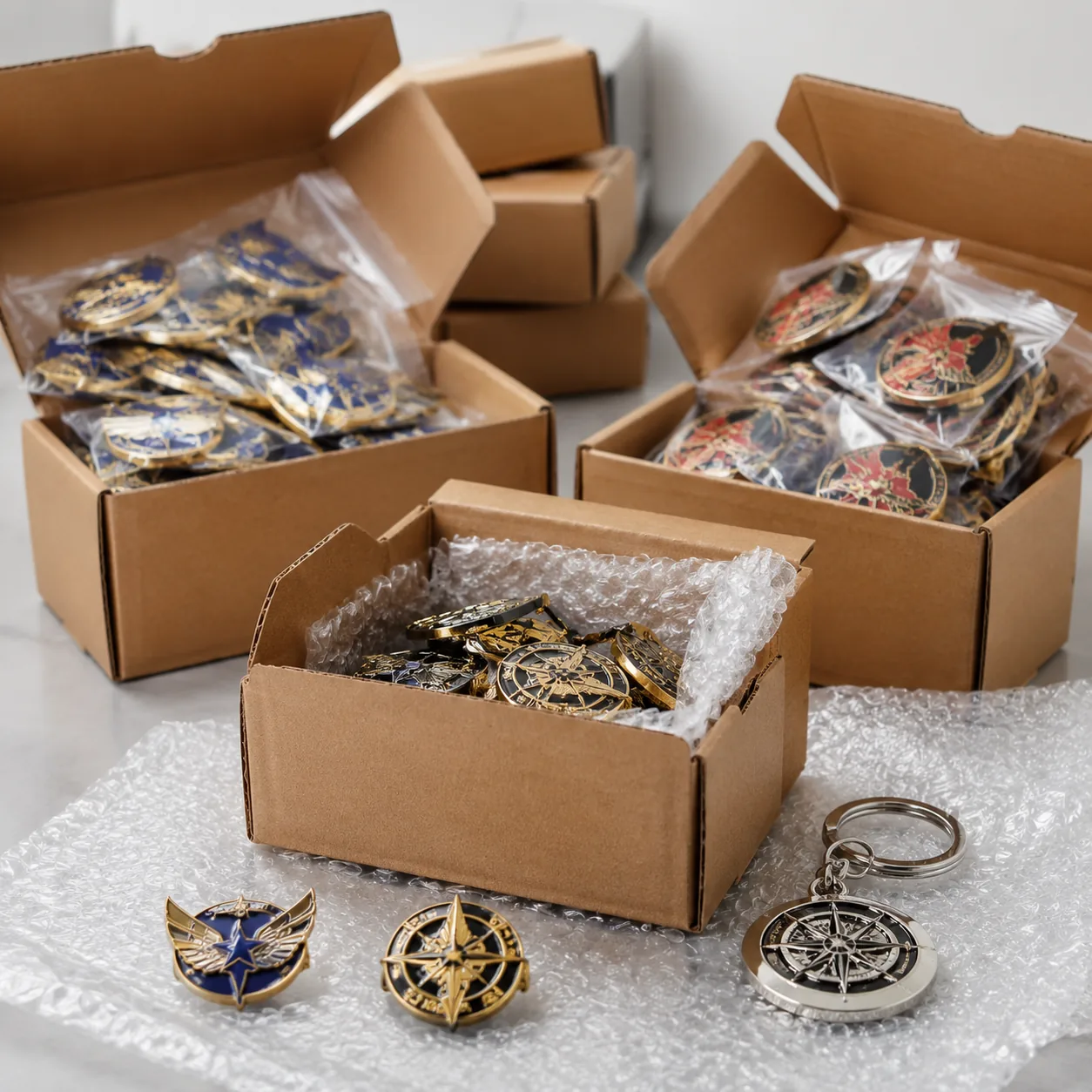
Rigid boxes can add more cost through volume than through factory price. A 50 mm coin in an OPP bag may pack 500 to 800 pieces per export carton. The same coin in an 85 x 85 x 25 mm rigid box may only pack 100 to 160 pieces per carton, depending on dividers and carton strength. Air and express freight are commonly charged by the higher of actual weight and dimensional weight, so a light but bulky gift box can change the delivered cost quickly.
For gift-boxed metal products, five-ply corrugated export cartons are usually the safer baseline, with gross weight held below 15 kg to 18 kg for manual handling. If boxes use soft-touch paper, foil surfaces or sharp square corners, add paper dividers, layer pads or inner cartons. These protections reduce pieces per carton but prevent rub marks, crushed corners and edge whitening.
Ask the supplier to quote packed carton data with the unit price: carton size, pieces per carton, gross weight, net weight, CBM and estimated dimensional weight. A box that adds USD 0.80 FOB per unit can add another USD 0.20 to USD 0.80 per unit by air depending on route, carton density and shipment size. Ocean freight reduces the per-unit penalty, but storage space, carton count and handling damage still matter.
For courier or air shipments, require a simple transit check before release. A practical factory test is one fully packed export carton dropped from 60 cm on one corner, three edges and one face, then opened to inspect box corners, lid movement and product scuffing. This is not a substitute for formal ISTA testing, but it catches weak cartons, loose inserts and poor layer packing before goods leave the factory.
Build the RFQ and Approval Package
Before requesting a quote, define whether the packaging is for presentation, retail display, mailing protection or executive gifting. These are different jobs. A buyer who asks only for a “premium box” will receive quotes that look comparable but may use different board thickness, insert density, paper grade, decoration method and carton packing.
A complete RFQ should include finished product drawings, actual thickness and weight, attachment type, target box structure, maximum external size, insert preference, decoration method, logo files, carton quantity target, barcode or label needs, shipment method and inspection level. If the metal item has already been sampled, provide photos of the front, back and side profile. The supplier can then check cavity support, lid clearance and packing density before pricing.
For cost comparison, request three options: an economical two-piece rigid box, a mid-range drawer or printed-sleeve box, and a premium magnetic or book-style box. Compare FOB unit price, MOQ, sample time, mass lead time, assembly labor, carton CBM and likely freight effect. ZheCraft can quote packaging together with custom pins, coins, brooches, keychains or magnets, which keeps product fit, insertion method, quality inspection and export packing under one control plan.
- Approve one complete golden sample, including product, insert, box, sleeve, label, desiccant and export carton method.
- Retain two factory samples for reorder control and dispute comparison.
- Confirm AQL level, defect definitions and carton drop check before mass production starts.
- Compare FOB price together with carton CBM and dimensional weight, not as a standalone box price.
- Do not approve mass packaging until the final plated product with attachments fits the insert and lid.
Have a project? Send your artwork and target quantity and we’ll reply with a detailed quotation within 12 working hours.
Ready to get this made?
Send your sketch, target quantity and ship-date. Detailed quotation in 12 hours.



