RFQ to Bulk: A Step-by-Step Sourcing Workflow
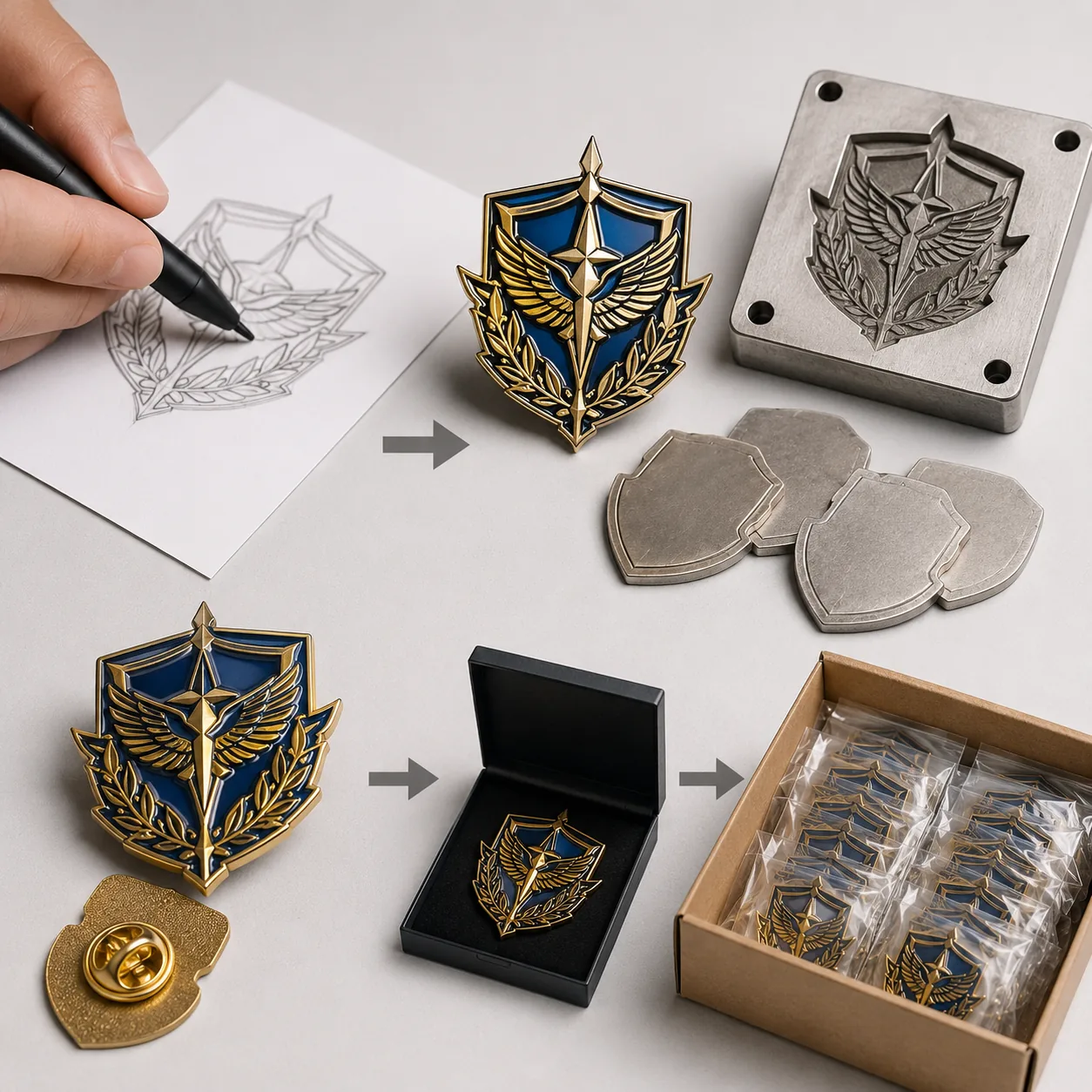
Start With The Failure Mode, Not The Product
Most sourcing failures do not begin on the production line; they begin in the RFQ. A supplier can quote a pin, coin, badge, or keychain from a one-line brief, but that quote usually bakes in assumptions about thickness, finish, fill depth, tolerances, packaging, and inspection level. If those assumptions differ from the buyer’s intent, the first sample looks “wrong” even when the factory produced exactly what was requested.
The fastest way to source custom metal promo products is to work backward from the defect you want to prevent: color drift, weak attachments, plating wear, warped edges, poor fit, or late delivery. In practice, projects move smoothly when the buyer arrives with a complete RFQ package, a single approval owner, and a clear definition of what is acceptable. The slowest jobs are usually not technically difficult; they are simply under-specified.
- Define the product family first: pin, badge, coin, keychain, magnet, patch, or lanyard.
- State the use case: giveaway, retail, award, membership, or event pass.
- Name the top three risks to control: color, durability, timeline, or cost.
- Assign who approves artwork, sample, and bulk before the quote goes out.
Build An RFQ That Suppliers Can Price Cleanly
An RFQ is not a design brief; it is a manufacturing instruction set. At minimum, include vector artwork, finished size in mm, material preference, plating finish, attachment type, packaging, target quantity, and required date. If you want a quote that reflects the real job, add whether the design is 2D or 3D, whether it uses soft enamel, hard enamel, die-struck metal, UV print, epoxy dome, or stamping only, and whether the reverse needs branding, numbering, or a logo mark.
For custom pins and similar metal promotional products, thickness and process change the economics quickly. A 1.2 mm soft enamel pin is a different build from a 1.8 mm hard enamel badge or a 2.5 mm challenge coin. Typical MOQ tiers are often 100-300 pcs for simple repeatable items, 300-500 pcs for more custom builds, and 1,000+ pcs for the lowest unit cost on optimized bulk runs. Decorative items with multiple colors, layered cutouts, or special packaging may start higher because setup and manual assembly dominate the cost.
| RFQ Item | What To Specify | Why It Matters |
|---|---|---|
| Artwork | AI, PDF, SVG, or vector EPS; final size in mm | Prevents redraw delays and scale errors |
| Material | Zinc alloy, brass, iron, stainless steel, PVC, embroidery | Affects tooling, weight, finish, and unit cost |
| Plating | Nickel, black nickel, gold, antique brass; target finish tone | Controls appearance, wear, and batch consistency |
| Thickness | Example: 1.2 mm, 1.5 mm, 2.0 mm, or 2.5 mm | Changes durability, feel, and quote structure |
| Attachment | Butterfly clutch, rubber clutch, magnet, pin back, safety pin | Affects function, comfort, and complaint rate |
| Packaging | Polybag, backing card, OPP, box, tray | Impacts presentation and landed cost |
| Quantity and date | Target order qty and in-hands deadline | Determines production route and freight choice |
Shortlist Suppliers By Capability, Not By Quote
The cheapest quote often comes from a factory that is missing one of the processes your item needs. A metal pin factory may be excellent at die-struck products but weak on printed gradients; a patch supplier may be strong on embroidery but not on plated metal accessories. The right comparison is not just price per unit, but whether the supplier controls tooling, plating, polishing, assembly, inspection, and packing in-house or through stable, repeatable partners.
Separate direct factory pricing from trading-company pricing, then compare the assumptions behind each offer. Ask whether tooling is included, whether mold ownership transfers to you, whether sample fees are refundable, and whether the quoted lead time is calendar days or working days. For most standard custom metal products, realistic lead times are about 7-12 days for sampling and 15-25 days for bulk after approval. Complex structures, multi-step plating, or special packaging can push bulk production into the 25-35 day range before freight.
- Ask for photos of recent work that matches your build method, not just any product.
- Confirm whether plating thickness is controlled to a target, such as 0.1-0.3 micron decorative flash or 3-5 microns on heavier wear finishes, rather than only a visual grade.
- Check whether the factory offers AQL inspection on bulk goods; common buyer targets are AQL 2.5 for major defects and AQL 4.0 for minor defects.
- Request the same quote basis from every supplier so freight, tooling, and packaging are comparable.
- If a quote is much lower, ask what was removed: plating steps, polish passes, QC, or packaging.
Lock The Sample Criteria Before You Approve Anything
A sample is only useful if the approval criteria are written before it is made. Otherwise, the sample becomes a moving target: the buyer sees one thing, the supplier sees another, and the bulk order starts with a dispute instead of a standard. The sample stage should freeze dimensions, line width, fill depth, color references, back-stamp text, attachment style, and packaging presentation.
For enamel items, specify what may vary and what cannot. A practical spec might read: overall size tolerance ±0.3 mm for pins under 30 mm, ±0.5 mm for larger items; color match to a Pantone reference or approved physical chip; plating tone consistent across the batch; and no burrs, sharp edges, or exposed flash on the reverse. For brooches, keychains, and badges, also state the acceptable swing, rotation, and pull performance if the item will be worn or handled often.
| Sample Check | Typical Spec | Pass/Fail Focus |
|---|---|---|
| Size tolerance | ±0.3 mm to ±0.5 mm depending on product size | Prevents fit and layout problems |
| Line width | About 0.2 mm minimum for reliable metal separation | Stops fill breakage and poor definition |
| Color match | Pantone reference or approved master sample | Reduces shade disputes |
| Plating finish | Visual match plus agreed wear standard | Keeps the look consistent |
| Attachment pull | Defined by product type and use case | Avoids backs falling off or twisting |
Use The Pre-Production Sample To Find Hidden Risk
A pre-production sample should be treated as a production rehearsal, not a souvenir. This is the stage where the factory proves that the approved look can survive normal manufacturing variation. If you need glitter enamel, transparent fill, glow pigment, epoxy dome, laser engraving, mixed finishes, or a plated-and-printed hybrid, this is where compatibility issues usually surface.
Review the sample practically, not emotionally. Put it beside the artwork, measure critical dimensions with calipers, inspect plating uniformity under bright light, and check whether the reverse side creates snag risk or fabric damage. For items with moving parts, magnets, or layered assemblies, test motion, alignment, and closure force before authorizing bulk. A badge that closes cleanly in a sample room but scratches clothing in use is not an acceptable pre-production result.
- Inspect edge quality for burrs, sharp points, or uneven polishing.
- Check whether recessed areas hold color evenly or trap air bubbles.
- Verify that print layers align to the metal outline within the agreed tolerance.
- Confirm packaging fit so the product does not rattle, scratch, or bend.
- Record every approved change in writing before mass production starts.
Convert The Approved Sample Into A Bulk Control Sheet
Once the sample is approved, do not rely on memory or chat screenshots. Turn the approved sample into a control sheet listing final size, thickness, color codes, plating, attachment, packing, carton count, and allowed tolerance. This matters even more when multiple SKUs share one visual system, because a small spec drift can make the set look inconsistent even if each item passes individually.
Bulk control is where buyer discipline saves money. If you lock the spec early, the factory can optimize polishing, plating batches, and assembly flow without repeated clarification. The bulk order should also define inspection level, rework rules, and whether substandard pieces may be reworked or must be scrapped. A common practice for higher-risk orders is to require pre-shipment inspection at AQL 2.5 major and 4.0 minor, with critical defects at zero tolerance.
| Control Point | Recommended Lock | Typical Buyer Rule |
|---|---|---|
| Artwork version | Single final file | No changes after sample approval unless re-approved |
| Color reference | Pantone or physical master | Use one reference across all repeat orders |
| Plating | Exact finish name and tone | No mix of bright and antique finish in one batch |
| Packing | Unit pack and carton pack count | Packing must match retail or distribution method |
| Inspection | AQL target and defect classes | Major defects reject; minor defects within agreed limit |
Manage Timeline, Freight, And Inspection Together
Many delays come from treating production, inspection, and shipping as separate decisions. In practice, they are one schedule. If your in-hands date is fixed, the supplier needs the sample approval date, bulk start date, inspection window, and freight method before quoting. Air freight can rescue a tight launch, but it raises landed cost sharply; sea freight is cheaper but only works when the timeline is forgiving.
A clean schedule for a straightforward custom metal order often looks like this: 3-5 days for artwork confirmation, 7-12 days for sample, 15-25 days for bulk after approval, and 3-10 days for freight depending on mode and destination. For a more complex order with multiple molds, mixed materials, or retail packaging, a better plan is to add 5-10 days of buffer rather than compressing the manufacturing window. A factory that rushes setup usually creates more risk than a factory given a realistic schedule.
- Book QC before bulk finishes so the shipment does not wait for an inspector.
- Tell the supplier whether partial shipment is allowed.
- Confirm carton marks, HS code handling, and consignee details early.
- Ask for production photos at key milestones if you cannot visit the factory.
- Keep one internal owner responsible for approvals to avoid mixed instructions.
What To Do Next
If you are starting a new order, prepare one RFQ packet with artwork, size, quantity, deadline, finish, attachment, and packaging in one file set. Then ask each supplier to quote on the same basis, sample to the same approval standard, and bulk to the same inspection rule. That is the fastest way to compare factories fairly and avoid hidden rework.
If you want a lower-risk path, start with one sample round, lock the sample as the master, and only then place bulk. ZheCraft can support that workflow across custom pins, badges, coins, keychains, magnets, patches, and lanyards, especially when buyers need one supplier to keep specs consistent from sample to shipment. For repeat orders, the best outcome is not just a lower unit price; it is a stable spec that reproduces cleanly on the next run.
Have a project? Send your artwork and target quantity and we’ll reply with a detailed quotation within 12 working hours.
Ready to get this made?
Send your sketch, target quantity and ship-date. Detailed quotation in 12 hours.



