RFQ to Bulk: A Step-by-Step Sourcing Playbook for Promo Products
Start With the Buying Decision, Not the Artwork
Most rework starts before a supplier opens the file. Buyers send a logo and ask for a price, but the factory still has to infer product type, size, construction, finish, attachment, and packaging. A useful RFQ starts with the commercial use case: resale, campaign giveaway, event badge, premium gift, or retail pack-in. If you skip that step, you get quotes that are technically valid but commercially useless.
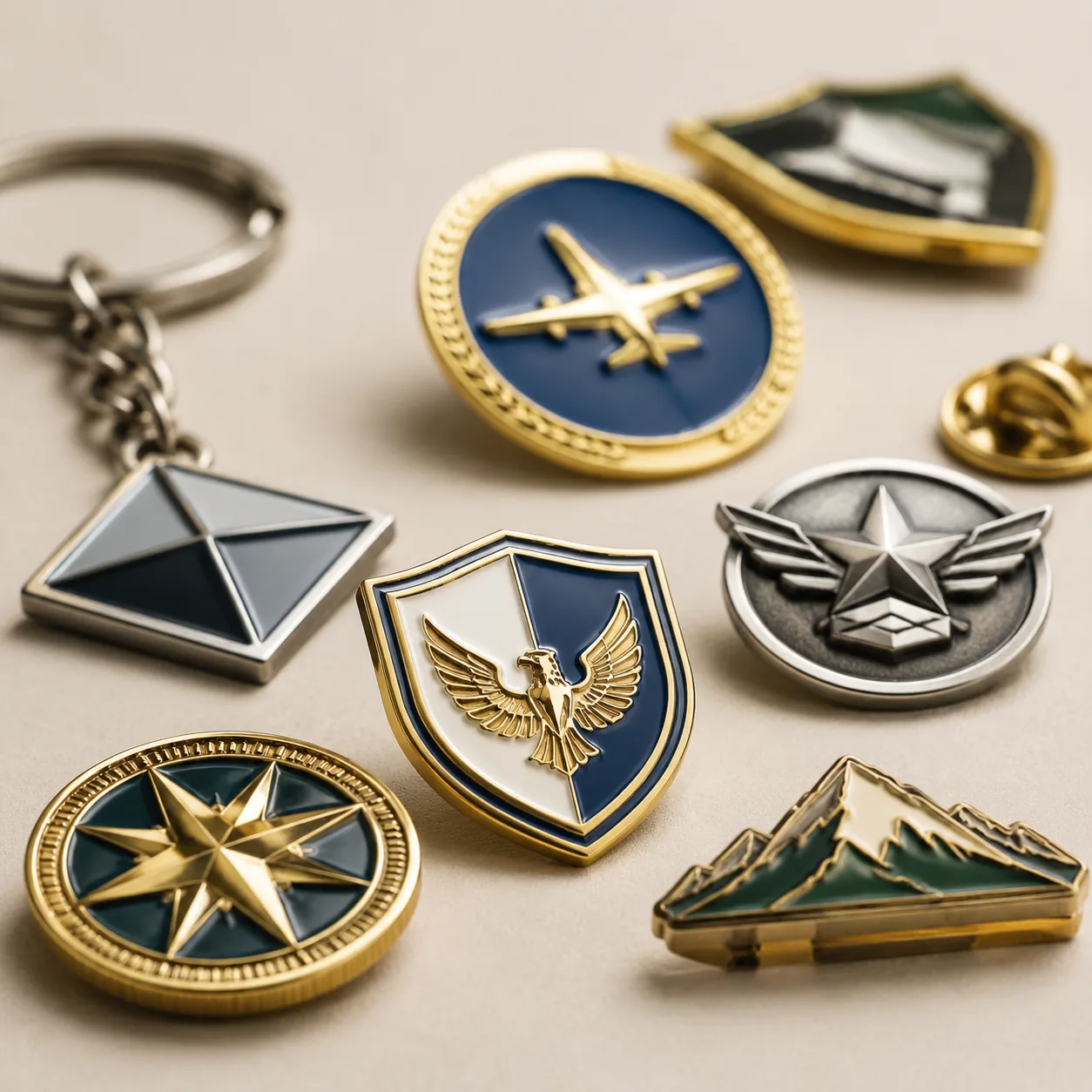
A 25 mm soft enamel pin with black nickel plating and a butterfly clutch is not the same order as a 35 mm hard enamel pin with epoxy dome and magnetic backing. The first usually supports lower cost and faster sampling; the second needs tighter polishing, cleaner line control, and more careful finish approval. The same logic applies to challenge coins, which may look similar but diverge sharply in relief depth, edge treatment, and plating cost. A 1.8 mm coin with recessed enamel is a different process from a 3.0 mm deep-relief coin with antique silver and diamond-cut edges.
- State the item family first: pin, coin, badge, keychain, magnet, patch, or lanyard.
- Define the end use: event giveaway, retail, corporate gift, or outdoor use.
- Give a size range if final dimensions are not fixed yet.
- Separate sample quantity, pilot quantity, and bulk quantity.
- Call out must-have compliance needs such as nickel-free hardware, lead-free plating, or child-safe closures.
Write an RFQ a Factory Can Price Without Guesswork
A usable RFQ is a manufacturing brief, not a mood board. The factory needs the artwork file, but also the construction method, dimensions, thickness, plating finish, color count, and packing method. When those are missing, suppliers either pad the quote or assume the cheapest route. That is how buyers approve a sample that cannot be scaled to the intended spec.
For custom metal products, the best RFQ format is a short table plus attachments. Include a vector file, a marked-up reference image, and a line item summary for each variation. If you are comparing pins and coins in the same project, keep them separate; a blended request makes unit pricing impossible to compare fairly. In practice, this cuts clarification loops by one to two rounds and reduces avoidable revision charges.
| RFQ field | What to specify | Typical range / note |
|---|---|---|
| Item | Pin / coin / badge / keychain / magnet / patch / lanyard | Do not mix families in one line item |
| Finished size | Width and height in mm | Pins commonly 20-40 mm; coins often 38-45 mm |
| Thickness | Base thickness in mm | Pins 1.0-1.5 mm; coins 2.0-3.5 mm |
| Plating | Nickel / black nickel / gold / antique finishes | Decorative plating is often 0.08-0.12 μm; wear layers may be specified separately |
| Color | Pantone, CMYK, or reference sample | State matte, glossy, soft enamel, hard enamel, or epoxy top coat |
| Attachment | Butterfly clutch, rubber clutch, magnet, safety pin, split ring, etc. | Choose by fabric, weight, and reuse needs |
| Packing | Bulk bag, backing card, polybag, gift box | Packing can change labor, carton count, and lead time |
Separate Pilot Specs From Bulk Specs
A common mistake is treating the sample as a miniature bulk order. Pilot production exists to verify shape, color, assembly, and handling before the factory commits full tooling and full scheduling. The sample should prove the hard parts: fine lines, cutouts, attachment strength, and finish consistency. If the sample is approved on vague wording, bulk production will simply repeat the same ambiguity at a larger cost.
Be explicit about what may change after sample approval. For example, you may accept a sample at 1.2 mm thickness but want bulk at 1.5 mm for better hand feel, or approve black nickel but later shift to antique silver for better contrast. State whether those are acceptable deltas or fixed requirements. The cleaner your separation, the fewer disputes over what was actually approved. For first articles, ask for one physical sample per SKU and one retained master sample at the factory for reference.
- Mark sample-only allowances, such as hand-polished edges or manual color touch-up.
- State whether prototype tooling is refundable, reusable, or amortized into bulk.
- Set the approval standard: visual match, dimensional match, or both.
- Ask for one golden sample per SKU, not one shared sample for multiple SKUs.
- Confirm whether bulk production uses the same plating bath, ink batch, and packing method as the sample.
Compare Quotes on the Right Spec Sheet
Price per piece is not enough. One supplier may quote a lower unit price because they omitted backing cards, chose a thinner base metal, or used a simpler attachment. Another may quote higher because they included polishing, protective coating, or tighter inspection. If you compare only the headline number, you usually choose the quote with the most hidden risk.
A useful comparison sheet forces every factory to answer the same way. Ask for material grade, plating type and thickness, tooling ownership, sample fee, bulk lead time, packing configuration, and inspection standard. For mixed promo orders, this matters even more because pins, coins, and keychains can have very different labor structures even when they look similar in a photo. A normalized quote sheet usually makes the real price gap obvious within one review cycle.
| Quote item | Low-quote trap | Better comparison method |
|---|---|---|
| Base price | Excludes key hardware or packing | Require a landed factory spec line |
| Plating | Uses a generic finish name only | Ask for finish type and thickness |
| Tooling | Hidden inside unit price | Separate mold or die cost from part cost |
| Lead time | Quoted from approval date only | Ask for calendar days from deposit |
| Inspection | No AQL stated | Request AQL 2.5 major / 4.0 minor or an agreed equivalent |
| Sample fee | Non-refundable but unclear | Confirm whether it is deductible from bulk |
Lock the Sample With a Clear Approval Rule
A sample is only useful if everyone agrees what it proves. The best approval rule combines visual checks, dimensional checks, and function checks. For pins and badges, that usually means overall size within tolerance, clean edges, secure attachment, correct plating tone, and enamel or print coverage without overflow. For lanyards and patches, it means color, weave or print clarity, cut-edge quality, and attachment consistency.
This is where many orders fail on detail. A buyer may approve a sample because the logo looks right, then discover bulk has wider lines, duller plating, or a looser clutch. If the supplier does not know what was measured, they will assume the sample was approved as a visual reference only. Put the approval rule in writing before you say yes, including which measurements are mandatory and which are cosmetic.
- Use the same reference file for sample and bulk approval.
- Measure critical dimensions with calipers or a ruler, not just by eye.
- Check edge burrs, pin alignment, magnet polarity, and clasp fit.
- Require written sign-off on color, plating, and packing.
- Record whether the approved sample is the physical master or a photo reference.
Use a Sample-to-Bulk Table Before You Release Production
The cleanest way to prevent disputes is a short transition table after sample approval. It should show what stays fixed, what can vary within limits, and what must be re-confirmed. This works especially well for repeat orders, because buyers often forget which details were locked on the last job and which were only sample-stage decisions. A supplier can build faster when the rules are unambiguous.
For example, a 30 mm hard enamel pin may keep the same mold, size, and clutch but change packaging from polybag to backing card. Or a challenge coin may keep its diameter and relief depth but switch from antique brass to antique silver. That is acceptable only if the buyer knows the unit price and lead-time impact before bulk starts. Use a written matrix for any order with more than one SKU or more than one finish.
| Spec | Sample status | Bulk status |
|---|---|---|
| Dimensions | Approved at 30 x 30 mm | Lock at 30 x 30 mm, ±0.3 mm |
| Plating | Antique silver approved | No finish change without written approval |
| Attachment | Butterfly clutch tested | Bulk must use the same clutch model |
| Color | Pantone match approved | Color delta to stay within agreed reference |
| Packing | Loose bag for sample | Backing card and polybag in bulk |
| Inspection | Visual approval only | AQL 2.5 major / 4.0 minor or an agreed equivalent |
Confirm Bulk Readiness Before You Pay the Deposit
Bulk readiness is a production question, not a sales promise. Before deposit, ask the supplier to confirm material stock, machine capacity, plating line availability, and packing labor. If the order includes several SKUs, check whether they can be combined into one run or must be scheduled separately. A factory that cannot answer those questions clearly is not ready to commit your shipment date.
This matters most when your order includes mixed products. Pins and keychains may share metal finishing but diverge in attachment assembly; patches and lanyards may be faster to sew or weave but require separate color control. Lead time is usually measured in calendar days, and even small changes in packaging can add labor at the end. Buyers who confirm readiness upfront are much less likely to be surprised by a rush fee or split shipment.
| Item | Typical MOQ | Typical sample lead time | Typical bulk lead time | Indicative FOB price range |
|---|---|---|---|---|
| Soft enamel pins | 100-300 pcs | 7-10 days | 12-18 days | USD 0.65-1.60/pc at 500-1,000 pcs |
| Hard enamel pins | 100-300 pcs | 8-12 days | 15-22 days | USD 0.85-2.40/pc at 500-1,000 pcs |
| Challenge coins | 100-300 pcs | 10-14 days | 18-28 days | USD 1.20-4.80/pc at 300-1,000 pcs |
| Keychains | 100-300 pcs | 7-10 days | 12-20 days | USD 0.70-2.50/pc at 500-1,000 pcs |
| Woven patches | 100-500 pcs | 5-8 days | 10-16 days | USD 0.35-1.20/pc at 1,000+ pcs |
| Printed lanyards | 100-500 pcs | 5-8 days | 8-14 days | USD 0.20-0.85/pc at 1,000+ pcs |
Set Inspection and Tolerance Rules Before Shipment
Inspection should not be an afterthought. For mass promo items, the usual control point is final inspection against an agreed AQL, commonly AQL 2.5 for major defects and AQL 4.0 for minor defects, though some buyers tighten this for premium retail programs. The inspection standard should define what counts as major versus minor: plating skips, broken attachments, missing parts, and color mismatch are typically major; tiny dust specks or slight card-print drift may be minor if they stay within the agreed tolerance.
Tolerances need to match the product. A pin or coin usually needs a finished size tolerance around ±0.3 mm to ±0.5 mm on standard runs, while lanyards can be controlled by width tolerance of about ±1 mm depending on the fabric and print method. If the order includes enamel fill, buyers should also define acceptable recess depth, color overflow limits, and line width on thin details. Without those numbers, inspection becomes subjective and the dispute shows up after the goods ship. For premium runs, ask the supplier to state the rejection threshold for burrs, print misregistration, and plating blotches before production starts.
- State AQL by defect class, not as a single general number.
- Define dimensional tolerance for size, thickness, and hole position.
- Set packaging rules: count per bag, card insertion, and carton label format.
- Require photo or video evidence for any lot hold or rework.
- Confirm whether shipment can move only after final QC sign-off.
What to Do Next
If you are sourcing custom pins, coins, keychains, magnets, patches, or lanyards, build the next RFQ as a two-part document: commercial terms on one page and production specs on one page. Keep sample approval separate from bulk approval, and require a written sample-to-bulk table before deposit. That single habit prevents most of the rework we see in first-time factory orders.
If you want, I can also turn this into a buyer-ready RFQ template for one product family, such as enamel pins, challenge coins, or lanyards, with the exact fields procurement teams can send to suppliers.
Have a project? Send your artwork and target quantity and we’ll reply with a detailed quotation within 12 working hours.
Ready to get this made?
Send your sketch, target quantity and ship-date. Detailed quotation in 12 hours.



