RFQ to Bulk: A Step-by-Step Custom Pin Sourcing Process
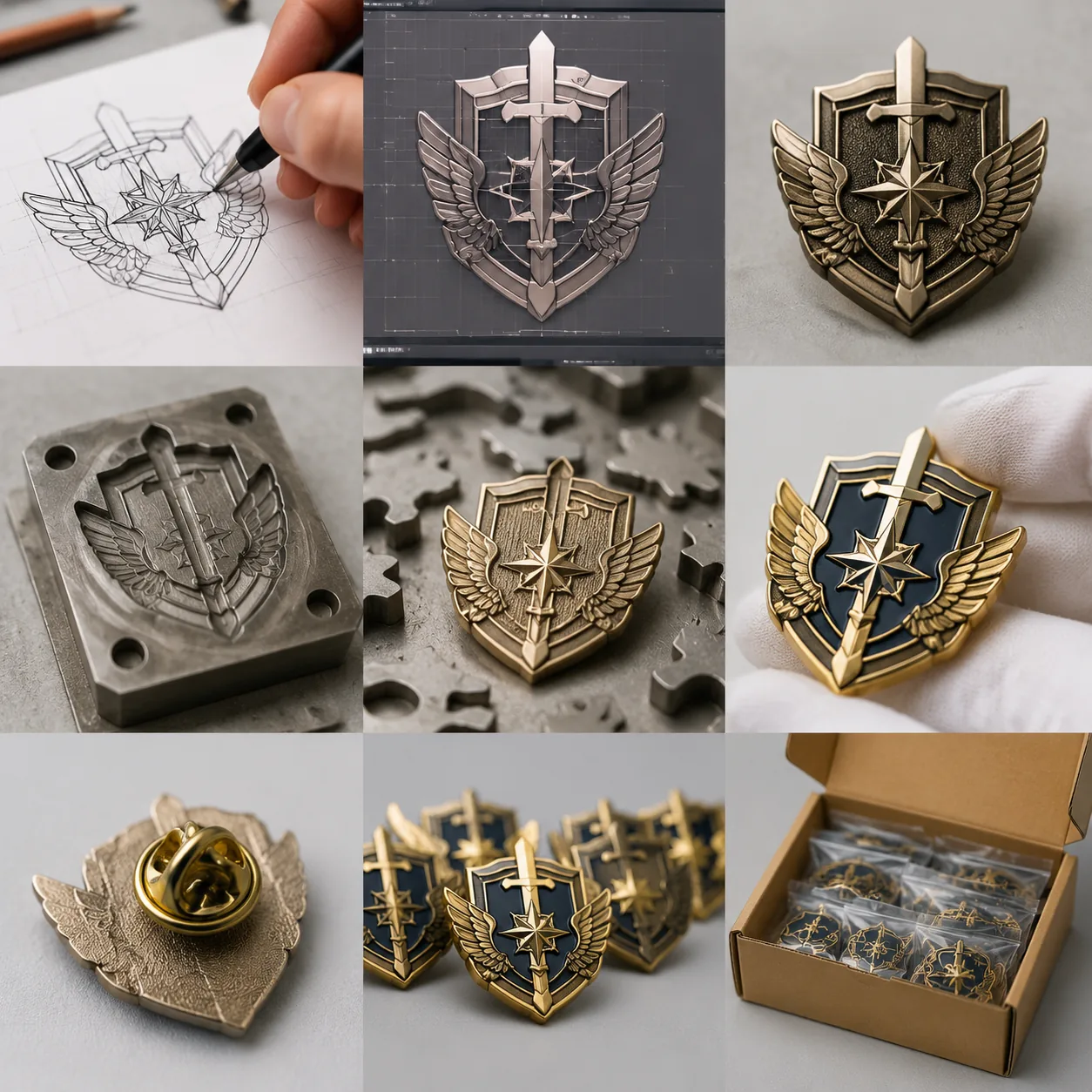
Start With The End Use, Not The Artwork
Most custom pin sourcing failures start before the RFQ is sent. Buyers often ask for a unit price first, but a factory can only quote accurately if it knows how the pin will be used, handled, and inspected. A 25 mm lapel pin for an internal event badge is not the same product as a retail collectible, a staff uniform pin, or a blind-bag promotional item. Each use case changes the acceptable tolerance, attachment choice, finish durability, packaging, and cost structure.
Start by defining the build class: soft enamel, hard enamel, die struck, printed, 3D cast, or a hybrid. Then lock the technical limits that affect tooling and yield: target size, thickness, minimum line width, color count, metal base, back treatment, and whether the item must survive repeated handling, outdoor exposure, or long storage. As a rule of thumb, fine lines below 0.20 mm, recessed areas below 0.25 mm, and sharp internal corners all raise mold risk and sample revision probability. For premium hard enamel, many factories prefer line weights of 0.25 to 0.30 mm or higher to keep fill and polish stable at production scale.
This is also the point to decide what can vary and what cannot. If a minor back stamp change is acceptable but color drift is not, state that clearly. If the pin must stay under 8 g to protect delicate fabric, or if it must not scratch knitwear, include that in the brief before artwork is finalized. The more explicitly you define the failure mode, the less time you spend debating cosmetic details that do not affect performance.
Write An RFQ That A Factory Can Price Properly
A usable RFQ is short, but it must be specific enough to remove guesswork. Include the artwork file, exact dimensions in millimeters, thickness, quantity tiers, desired plating, color references, packaging, destination country or port, and the required ship date. If you omit the closure type, metal base, or packaging format, the supplier will either guess or pad the quote. Either way, comparison gets weak fast.
The best RFQs separate must-have requirements from preferred options. Must-have items might include a size tolerance of ±0.3 mm for a flat pin, a minimum visible line width of 0.25 mm, and nickel-free plating if the item is intended for a regulated market or sensitive wear. Preferred items might include a printed backing card, individual polybagging, or a matte rather than glossy topcoat. Factories quote faster when they know which items are fixed and which can flex without affecting approval.
If you are sourcing from China, also state whether the supplier is expected to own the mold or whether you need a customer-owned tool arrangement. That changes the commercial structure, reorder risk, and pricing logic. The same artwork can generate very different quotes depending on metal base, cutouts, polish level, and special effects such as glitter enamel, translucent fill, soft-touch epoxy, or glow-in-the-dark pigment.
Compare Quotes On The Same Spec Basis
A quote comparison is only useful if every supplier priced the same object. One factory may quote a 30 mm zinc alloy hard enamel pin with nickel plating and butterfly clutch, while another quotes brass with black nickel and rubber clutch. Those are not equivalent products, even if the drawings look similar. Standardize the RFQ pack so each bidder responds to the same line items and the same assumptions.
Compare more than unit price. Tooling, sample fee, plating, packaging, mold ownership, and lead time all affect landed cost. A low unit price can hide a high mold charge, a nonrefundable sample fee, or expensive revision terms after approval. Ask each supplier to identify whether the sample fee is credited back on bulk, whether mold cost is amortized into production, and whether any design changes after sample sign-off trigger a new tool charge.
| Quote Item | Typical Range Or Checkpoint | Why It Matters |
|---|---|---|
| Tooling / mold | USD 40-120 for simple pins; USD 120-300+ for complex 3D, cutouts, or multiple levels | Affects startup cost and reorder economics |
| Sample lead time | 5-8 days for standard builds; 8-15 days for complex finishes | Shows how quickly you can validate artwork and construction |
| Bulk lead time | 12-20 days after sample approval for standard orders; 20-30 days for complex plating or packaging | Critical for event dates and campaign launches |
| MOQ tiers | 50-100 pieces for simple runs; price breaks commonly improve at 300, 500, and 1000 pieces | Signals whether the supplier is optimized for prototypes or production |
| Packaging add-on | USD 0.03-0.20 per unit depending on card, polybag, or gift box | Can move total landed cost more than expected |
| Tolerance target | ±0.3 mm on standard flat pins; ±0.5 mm is more realistic for multi-layer or 3D builds | Prevents fit and presentation issues |
| AQL target | AQL 2.5 for major defects, AQL 4.0 for minor defects is common for accessory goods | Gives both sides a measurable inspection standard |
If two quotes differ by more than 20% to 30%, do not assume the cheapest is wrong. Sometimes one supplier has a simpler process route, better yield, or a different base metal. But if the low quote is also vague on plating thickness, attachment type, or finish, treat it as incomplete until proven otherwise. A better rule is to evaluate the quote on price, specificity, and risk together, not on any single number. For common hard enamel orders, USD FOB pricing often lands around USD 0.60-1.40 per piece at 300-500 pcs, USD 0.35-0.90 at 1,000 pcs, and USD 0.20-0.55 at 5,000 pcs, depending on size, metal, and finish. 3D cast or mixed-metal builds usually price higher because polishing and yield loss rise quickly.
Lock The Sample Before You Talk About Bulk
A sample is not just a visual check. It is the point where you confirm that the factory understood the brief, that the process route is workable, and that the product still looks right at actual size. Review the sample for line sharpness, enamel fill consistency, edge polish, back-side finish, plating color, and attachment alignment. If the front looks good but the clutch is loose or the edge is rough, that is a process warning, not a cosmetic footnote.
For buyers with multiple stakeholders, the sample should be approved against a fixed checklist instead of general comments like “looks good” or “make it nicer.” Define what must match the approved sample exactly and what may vary within normal production tolerance. This matters most when the item will be reordered months later, because vague approvals make future disputes hard to resolve. The approved sample should become the control reference for the bulk run, including plating tone, fill level, and back treatment.
Special effects need even tighter sample discipline. Translucent enamel, glitter fill, sandblasted backgrounds, printed details, and partial epoxy can vary from batch to batch if the process is not locked. Approve the exact effect, not only the base artwork, and retain one approved sample for every reorder. That one habit prevents the common “same design, different look” dispute. If the decoration includes UV print or epoxy doming, ask for gloss level and cure behavior to be stated in writing; otherwise the final surface can differ noticeably between lots.
Set Bulk Acceptance Rules Before Production Starts
Bulk acceptance should be written before mass production begins, not after problems appear. Define which defects are acceptable, which are reworkable, and which are rejectable. For custom pins, common checkpoints include plating coverage, enamel smoothness, attachment strength, logo placement, and back-side finishing. Without written criteria, every shipment becomes a negotiation.
A practical quality framework usually covers dimensions, appearance, function, and packing. Dimensions can often be held to ±0.3 mm on simpler flat pins and ±0.5 mm on more complex builds. Appearance should cover plating color, fill level, and clean edges. Function should cover closure retention, swing rotation, and whether the pin sits flat when worn. Packing should cover unit protection, inner carton counts, master carton labels, and whether the shipping marks match the PO.
| Control Point | Typical Spec Target | Common Failure If Not Locked |
|---|---|---|
| Size tolerance | ±0.3 to ±0.5 mm depending on design complexity | Pins that no longer fit the backing card or artwork layout |
| Color match | Pantone reference or approved sample match within an agreed visual standard | Brand mismatch across reorders or split shipments |
| Attachment fit | Firm closure with no easy slip-off | Loss in use or customer complaints |
| Edge finish | No sharp burrs, flashing, or exposed plating gaps | Fabric damage and poor perceived quality |
| Carton packing | Fixed count per inner and outer carton | Short-shipment disputes and warehouse confusion |
| Surface defect limit | AQL 2.5 major / AQL 4.0 minor is common for accessory orders | Inspection disagreements after goods are ready |
If the order is for a campaign, event, or retail launch, ask for pre-shipment photos and carton markings before goods leave the factory. That is often more useful than discovering a label error after arrival. For larger runs, an AQL-based inspection plan is sensible, but only if defect categories are written clearly. A number without a defect definition is not a quality standard. A common inspection setup is AQL 2.5 for major defects, AQL 4.0 for minor defects, and 0 tolerance for critical defects such as missing attachments, wrong artwork, or incorrect plating on a branded order.
Match The Commercial Terms To The Risk
The sourcing process is not complete until the commercial terms match the production plan. Decide who pays for samples, who owns tooling, what triggers a re-quote, and how revision rounds are handled. If the first sample is approved but the order quantity changes materially, the factory may need to re-price because setup cost and yield assumptions change. That is normal and should be anticipated.
For most B2B buyers, the safest structure is to freeze artwork, finish, and size before bulk, then negotiate quantity breaks after the sample is approved. Typical MOQ tiers for custom pins can start at 50 to 100 pieces for straightforward soft enamel or die-struck runs, but price efficiency usually improves at 300, 500, and 1000 pieces. For premium hard enamel or 3D cast styles, the most efficient tier may not appear until 500 pieces because polishing and setup labor are harder to spread across a small lot. At 100 pieces, many suppliers will still quote, but the per-unit cost can be 30% to 80% higher than at 500 pieces.
Lead time also depends on repeat status. A first order may need 5 to 8 days for sample approval and 12 to 20 days for bulk production. A repeat order can often ship in 10 to 15 days if the mold, plating route, and packing standard are already on file. That only works if the retained sample and spec sheet are clean. If reorder speed matters, make sure the supplier keeps a production record rather than relying on memory. For FOB sourcing, ask whether the quote includes export cartonization and origin documentation, because those omissions can create avoidable delays at handoff.
Do not choose a supplier only because they promise the shortest timeline. Fast production is useful only if the job is technically stable. If your artwork is complex, color matching is critical, or the finish must look premium under close inspection, a slightly longer sample phase usually prevents a much more expensive bulk failure. The real trade-off is speed versus certainty, and the right answer depends on how visible the item is and how costly rework would be.
A Practical RFQ Checklist For Custom Pins
Use this checklist before sending the brief so you can compare suppliers on equal terms and avoid back-and-forth that delays quoting.
- Artwork is supplied in vector format with text outlined or fonts named
- Size, thickness, and weight target are stated in mm and grams
- Metal base, plating finish, and color standard are clearly defined
- MOQ tiers, sample fee, and lead time are requested in writing
- Attachment type, backing card, and packaging are specified
- Tolerances and AQL targets are set before the sample is approved
- Destination, Incoterms, and target ship date are included
If any of these items is missing, the quote is likely to be incomplete. The goal is not the lowest line item; it is the lowest-risk unit that still meets the brief. A clean RFQ also reduces revision cycles: one complete pack usually shortens quoting by several days and cuts sample changes from multiple rounds to one.
What To Do Next
If you are ready to source, prepare one RFQ pack with artwork, exact size, quantity tiers, finish choice, packaging, and must-have specs. Send the same brief to every supplier so you can compare pricing on equal terms. Then require a physical or photographed sample approval before any bulk release.
If you want the lowest-risk route, keep the process simple: lock the drawing, approve one sample against written criteria, and freeze the reorder record before the first shipment leaves. That sequence saves time later because every production step has a reference point. It is also the easiest way to separate a capable factory from a supplier that is only good at quoting. For buyers working across pins, coins, magnets, or keychains, ZheCraft can usually consolidate those specs into one consistent sourcing format so the handoff from RFQ to sample to bulk stays clean.
Have a project? Send your artwork and target quantity and we’ll reply with a detailed quotation within 12 working hours.
Ready to get this made?
Send your sketch, target quantity and ship-date. Detailed quotation in 12 hours.



