RFQ to Bulk: A Sourcing Workflow for Custom Pins
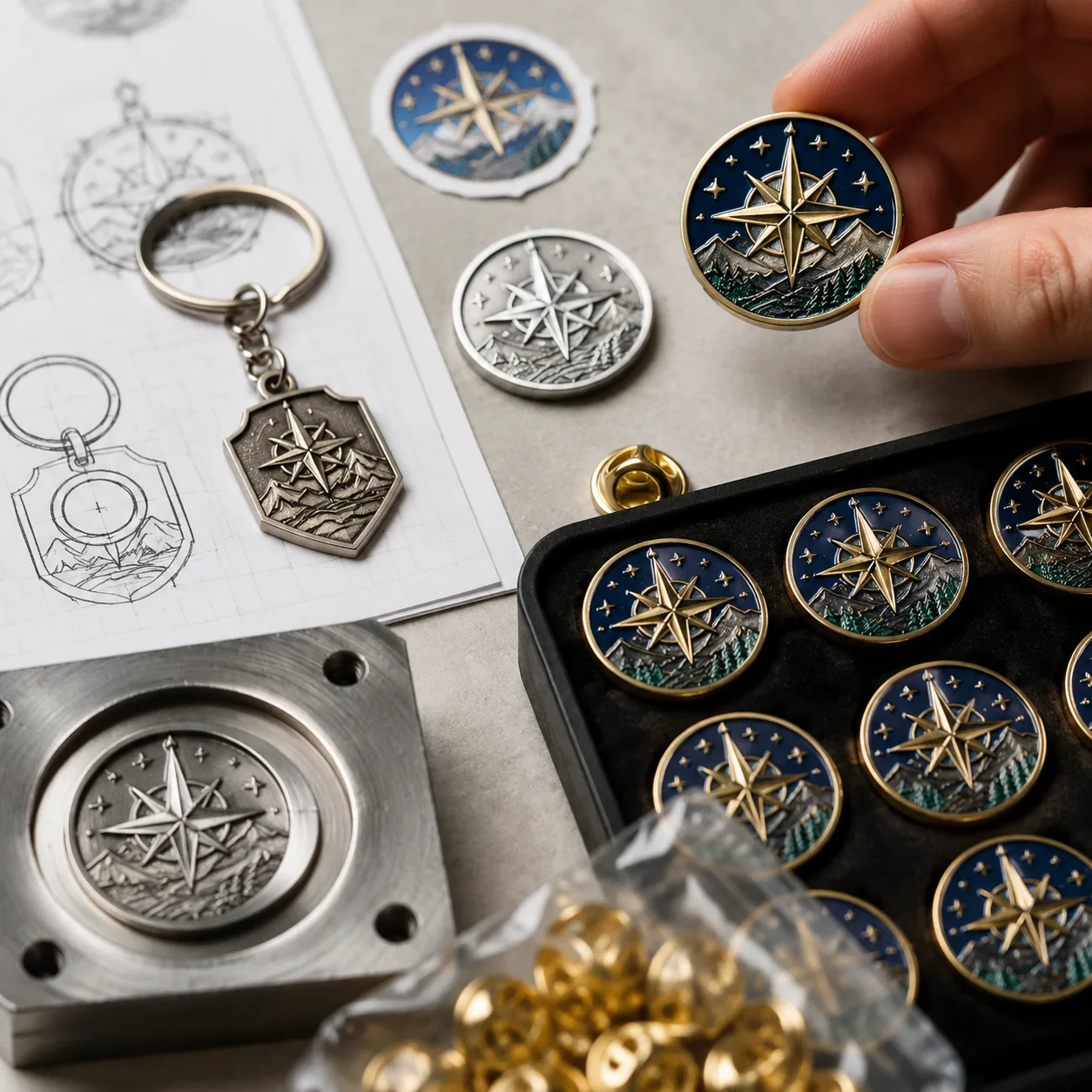
1) Start with the RFQ fields that actually move price and risk
Most pin sourcing errors start before a supplier opens the file. If the RFQ is vague, factories will quote different assumptions: one prices 1.2 mm iron, another 1.5 mm brass; one includes standard nickel plating, another black nickel; one assumes two enamel colors, another five. The result is a low-looking quote that gets repriced after sampling or, worse, a batch that misses the intended finish.
For custom enamel pins, the RFQ should define product type, finished size, thickness, base metal, plating, enamel type, attachment, quantity tiers, artwork format, packing, and end use. If the pin will be worn on a lapel, bag, hat, or uniform panel, say so. Backing choice, pin length, and clutch type can change depending on fabric thickness and wear angle. Also state acceptance targets up front: size tolerance, minimum line width, color tolerance, and defect standard.
A good RFQ is short but not vague. The goal is to remove guesswork before tooling. For example, a 25 mm hard enamel lapel pin with 1.5 mm thickness, gold plating, butterfly clutch, and 300/500/1,000-piece tiers is a different job from a 25 mm printed pin with rubber clutch and backing card. Those differences affect mold cost, polishing time, plating complexity, and the final FOB number.
| RFQ field | Recommended spec level | Why it changes the quote |
|---|---|---|
| Product type | Hard enamel, soft enamel, die-struck, 3D cast, printed, or mixed finish | Determines tooling, filling, polishing, and inspection steps |
| Size | Measured at the widest point; tolerance such as ±0.2 mm under 30 mm and ±0.3 mm above 30 mm | Impacts tooling precision and packaging fit |
| Thickness | Commonly 1.2 mm, 1.5 mm, or 2.0 mm | Affects feel, weight, relief depth, and plating time |
| Plating | Nickel, black nickel, gold, antique brass, antique silver, matte black, or custom antique tone | Changes bath process, surface tone, and cost |
| Attachment | Butterfly clutch, rubber clutch, safety pin, magnetic back, brooch pin, or deluxe clutch | Affects hardware cost and function |
| Artwork files | Vector AI, EPS, or PDF with locked outlines and Pantone references | Reduces interpretation errors before tooling |
| Quantity tiers | For example 100, 300, 500, 1,000, and 3,000 pieces | Lets the buyer see true scale pricing |
| Packing | Bulk pack, individual polybag, backing card, or retail box | Can add labor, materials, and carton volume |
2) Convert the artwork into manufacturable pin specs
Artwork and manufacturability are not the same thing. A design that looks clean on screen may fail in metal if recessed areas are too narrow, enamel cells are too small, or the border is too thin to hold plating. Before RFQ release, translate the concept into production language: line width, recess depth, number of colors, cutouts, 3D relief, and any moving or layered elements.
For enamel pins, a minimum line width of about 0.25-0.3 mm is a practical floor for reliable stamping or casting. Small text should be checked at final size, not only on a monitor. As a rule, lettering below roughly 1.2-1.5 mm cap height is risky unless it is very bold and the design is enlarged. Thin separators, tiny icons, and hairline borders often look acceptable in CAD but weaken after plating and fill.
If the artwork uses gradients, halftones, shadows, or photo detail, consider a printed pin or epoxy dome instead of hard enamel. Hard enamel is best for bold shapes and clearly separated cells. Printed processes can reproduce finer detail, but they change the surface feel and wear behavior, so they should be quoted as a separate specification rather than treated as a substitute after the fact.
| Design feature | Safer RFQ spec | Typical risk if ignored |
|---|---|---|
| Fine text | Minimum stroke 0.25-0.3 mm; letters verified at final size | Unreadable lettering or fill loss |
| Small color cells | Enlarge cells or simplify artwork | Bleed, skipped fills, or uneven enamel |
| Cutouts | State minimum cutout width and bridge points | Weak structure or breakage |
| 3D relief | Specify relief depth and direction | Unexpected flatness or higher tooling cost |
| Printed detail | Use digital print or offset print | Loss of image clarity in enamel |
A concrete example helps: a 28 mm logo pin with a 0.15 mm script font and three micro cutouts will almost always need simplification. The safer revision is to thicken the script, enlarge the logo by 10-15%, and set a minimum bridge width of 0.4-0.5 mm. That one change can eliminate two rounds of tooling correction.
3) Compare factories on the same pricing basis
A useful quote comparison is not unit price alone. It is the same material, same finish, same size, same attachment, same packing, same sample policy, and same inspection basis. Without that discipline, a lower FOB number often hides thinner plating, a different alloy, or a missing sample allowance.
For pin sourcing, always ask the factory to break out tooling, sample fee, unit price by tier, and packing separately. Tooling for a simple stamped pin is usually lower than for a 3D cast design. Sample lead time is typically 5-10 days after artwork approval; bulk lead time is commonly 10-18 days after sample approval, depending on complexity, plating queue, and packing requirements. Add 3-7 days for courier transit if the sample travels internationally.
As a working benchmark, simple 25 mm custom pins in 1.2-1.5 mm iron or brass often land around USD 0.35-1.20 FOB each at mid-volume quantities. More complex hard enamel, antique finishes, or 3D cast pieces can move materially higher, especially if they require extra polishing, multiple plating steps, or special effects such as glitter, glow, or transparent enamel. At very low volumes, the unit price can be several times higher because tooling and setup are spread across fewer pieces.
| Quote item | What to confirm | Common buyer mistake |
|---|---|---|
| Tooling | Does the buyer own the mold after payment? | Assuming ownership without written confirmation |
| Sample fee | Is it deductible from the bulk order? | Paying twice for the same approval step |
| Unit price | Same size, thickness, plating, enamel type, and attachment? | Comparing mismatched specs |
| Packaging | Individually polybagged, backing card, or bulk packed? | Ignoring packing cost until the final invoice |
| Lead time | Starts after artwork approval or after sample approval? | Counting days from inquiry instead of approval |
When comparing quotes, ask each supplier to state the price at the same tier break. For example, a 100/300/500/1,000-piece ladder can reveal whether the factory is realigning for a small run or offering true scale savings. Typical FOB ranges for standard metal pins at higher volumes may start around USD 0.30-0.60, while hard enamel, multi-plated, or 3D items can move into USD 0.80-2.50+ depending on complexity and finish.
4) Use a sample plan that tests the risky details first
A sample is only useful if it proves the parts most likely to fail in production. For pins, that usually means plating color, enamel fill, border sharpness, attachment grip, and surface defects. If the design includes a magnetic back, spinner, chain, or other moving part, the sample must also test pull strength, rotation, and alignment.
Treat the first sample as a technical sample, not a sales sample. Ask for clear photos under neutral light before shipment, then inspect the physical sample against a written checklist when it arrives. If the product is part of a gift set or promotional kit, compare the pin with the other components at the same time so plated tone, logo placement, and packaging dimensions stay consistent across the set.
For functional hardware, do not approve a visual match alone. A butterfly clutch that looks correct may still sit too loose on fabric. A magnet may look centered but fail pull expectations. For a standard lapel pin, ask the supplier to confirm clutch fit on actual fabric or a representative backing board, not only on paper. For heavy badges, request a stronger clutch or dual-post layout if the finished piece exceeds about 20-25 g.
- Check enamel fill level: flush for hard enamel, slightly recessed for soft enamel
- Inspect plating edges for pits, burn marks, cloudy spots, or uneven color
- Measure finished size against the approved drawing
- Test clutch fit on actual fabric or a representative backing board
- Check front-facing orientation for brooches, magnets, and moving parts
- Confirm carton count, label accuracy, and packing method
- Verify spare clutches or accessory parts if they were quoted
If the sample is off on a noncritical point, decide whether it is a cosmetic accept, a minor correction, or a tooling reset. A weak clutch or wrong plating color is usually a correction item. A wrong mold size, wrong pin type, or incorrect cell structure usually means the tool must be reworked before bulk release.
5) Lock the sample against measurable acceptance criteria
A sample approval should never read “looks good.” It should read like a specification sheet another inspector can repeat. Set acceptance points for color, finish, dimensions, attachment performance, and packaging, because factories work faster and disputes are fewer when the golden sample is unambiguous.
For quality control, a common target for general promo pin orders is AQL 2.5 for major defects and 4.0 for minor defects. Premium corporate gifts often require tighter cosmetic control, while low-cost event giveaways may accept broader variation. If brand color is critical, define the acceptable Pantone range and say whether visible scratches through plating are rejects. If the product is nickel-free for compliance or sensitivity reasons, specify that in the RFQ; otherwise do not assume the factory will choose a higher-cost finish by default.
The point of the approval step is to freeze what matters before mass production begins. Once the sample is signed off, the supplier should not change alloy, plating bath, enamel formula, backing type, or dimensions without written approval. If a change is unavoidable, require photos, a revised spec sheet, and a new golden sample before release.
| Spec area | Example acceptance language | Why it matters |
|---|---|---|
| Color | Pantone match within one shade step | Keeps brand tone stable across lots |
| Size | 25 mm finished, ±0.2 mm | Prevents badge board or packaging mismatch |
| Thickness | 1.5 mm finished, ±0.1 mm | Controls feel and weight |
| Surface | No pits visible at 30 cm under normal light | Avoids obvious cosmetic rejects |
| Attachment | Clutch holds without slip under repeated pull | Reduces returns and lost pins |
For plating, it helps to define the cosmetic standard in practical terms: no heavy bubbles, no bare spots, no plating peel, and no obvious tarnish on receipt. If the pin has enamel, define the fill standard by type: hard enamel should finish flush to the metal border; soft enamel should sit slightly recessed, typically around 0.2-0.4 mm below the top edge.
6) Decide what must be frozen before bulk, and what can wait
Not every detail should be locked at the same moment. Anything expensive to change in tooling or plating should be approved early. Minor pack, label, or carton details can usually be finalized later. Changing a back type from butterfly to rubber is simple; changing soft enamel to hard enamel after tooling is not.
Bulk order specs should include carton pack count, individual protection, backing card artwork, and whether spare clutches are included. If the order is going to retail or event distribution, state the final assortment count per box and whether overage or underage is acceptable. For most pin runs, a tolerance of plus or minus 2-5 percent is common, depending on batch size and how the factory nests parts in production.
If you are buying mixed promo kits, define the packing sequence so matched sets are not separated. This matters when pins must stay paired with cards, coins, or keychains. Re-sorting after packing adds labor and creates avoidable errors. For retail pack-outs, ask the factory to confirm carton drop test or outer carton strength if the shipment will move through multiple hubs.
- Lock in the approved plating and enamel combination before release to mass production
- Confirm unit price at each quantity tier: 100, 300, 500, 1,000, 3,000
- Define acceptable overage or shortage, usually 2-5% depending on batch size
- State whether sample approvals carry over to reorders
- Specify packaging method: bulk, polybag, backing card, or gift box
- Confirm which defects are major, minor, or acceptable
- Write whether spare components are included in the unit price
A practical rule: freeze mold, size, plating, enamel type, and attachment before production; leave retail labels, carton markings, and overpack configuration for the last confirmation step. That keeps the factory moving without letting late-stage changes trigger a price reset.
7) Manage lead time, freight, and reorders without losing the spec
A strong sourcing process ends with repeatability. Once the sample is approved, save the final drawing, material callout, plating code, backing type, carton spec, and inspection standard in one file set. If the supplier changes a variable later, you should be able to tell immediately whether it is a permitted reorder adjustment or a hidden deviation.
For planning, use a realistic working timeline: RFQ and quote review, 3-7 days; sample production, 5-10 days; sample transit, 3-7 days by courier; bulk production, 10-18 days after approval; packing and export booking, 2-5 days. If the pin has complex cutouts, 3D relief, or special finishes, add time for extra polishing and plating queue capacity. In practice, a highly detailed order can take longer than a simple one even if both are the same size.
For procurement budgeting, keep a simple FOB reference range in mind: standard metal pins often start around USD 0.30-0.60 at higher volumes, while hard enamel, multi-plated, or 3D items can move into the higher end of the market quickly. The best way to protect a reorder is to freeze the “reorder master” so the next batch uses the same mold, same plating bath, same Pantone reference, and same packing instructions.
If the supplier offers storage of the mold, confirm that in writing. Also confirm whether repeat orders inherit the last approved sample automatically or require a fresh sign-off after any design revision. For long-running programs, ask for a retained sample from each lot so future disputes can be compared against a physical reference, not memory.
| Timeline step | Typical range | Decision point |
|---|---|---|
| RFQ to quote review | 3-7 days | Is the quote on the same spec basis? |
| Sample production | 5-10 days | Does the technical sample match the drawing? |
| Sample transit | 3-7 days | Can the buyer inspect before production slotting? |
| Bulk production | 10-18 days | Is the golden sample approved with no open comments? |
| Packing and booking | 2-5 days | Are carton labels and pack counts final? |
8) Before you send the first RFQ, build the control package
Before contacting suppliers, build one clean RFQ package: a dimensioned drawing, a Pantone callout, the attachment choice, the quantity ladder, the packing requirement, and your acceptance checklist. Then ask every factory to quote on the same basis and to confirm sample lead time, bulk lead time, tooling ownership, and defect handling in writing.
If you are sourcing multiple items such as pins, coins, keychains, or magnets, align the specs now so the final set does not drift in color or scale. That is especially important when the items will be sold together in one retail box or handed out at one event. The fewer assumptions in the RFQ, the fewer surprises at sample and bulk stages.
If you want the process to move quickly, send the factory both the clean vector file and the details most likely to fail, such as tiny text, narrow cutouts, or dense color cells. That gives the engineer a chance to simplify the design before tooling instead of discovering the issue at sample stage. For a design with multiple enamel zones, ask the factory to mark every cell and note any that are below the practical fill threshold.
Before release, use this quick checklist:
- Dimensioned artwork is final and exported in vector format
- Pantone colors are called out by code, not by screen image
- Thickness, plating, and attachment are specified in writing
- Quantity tiers and target FOB range are listed
- Sample approval criteria are measurable, not subjective
- Packaging and carton instructions are included
- Tooling ownership and sample fee terms are confirmed in writing
Have a project? Send your artwork and target quantity and we’ll reply with a detailed quotation within 12 working hours.
Ready to get this made?
Send your sketch, target quantity and ship-date. Detailed quotation in 12 hours.



