RFQ to Bulk: A Sourcing Process for Custom Metal Giveaways
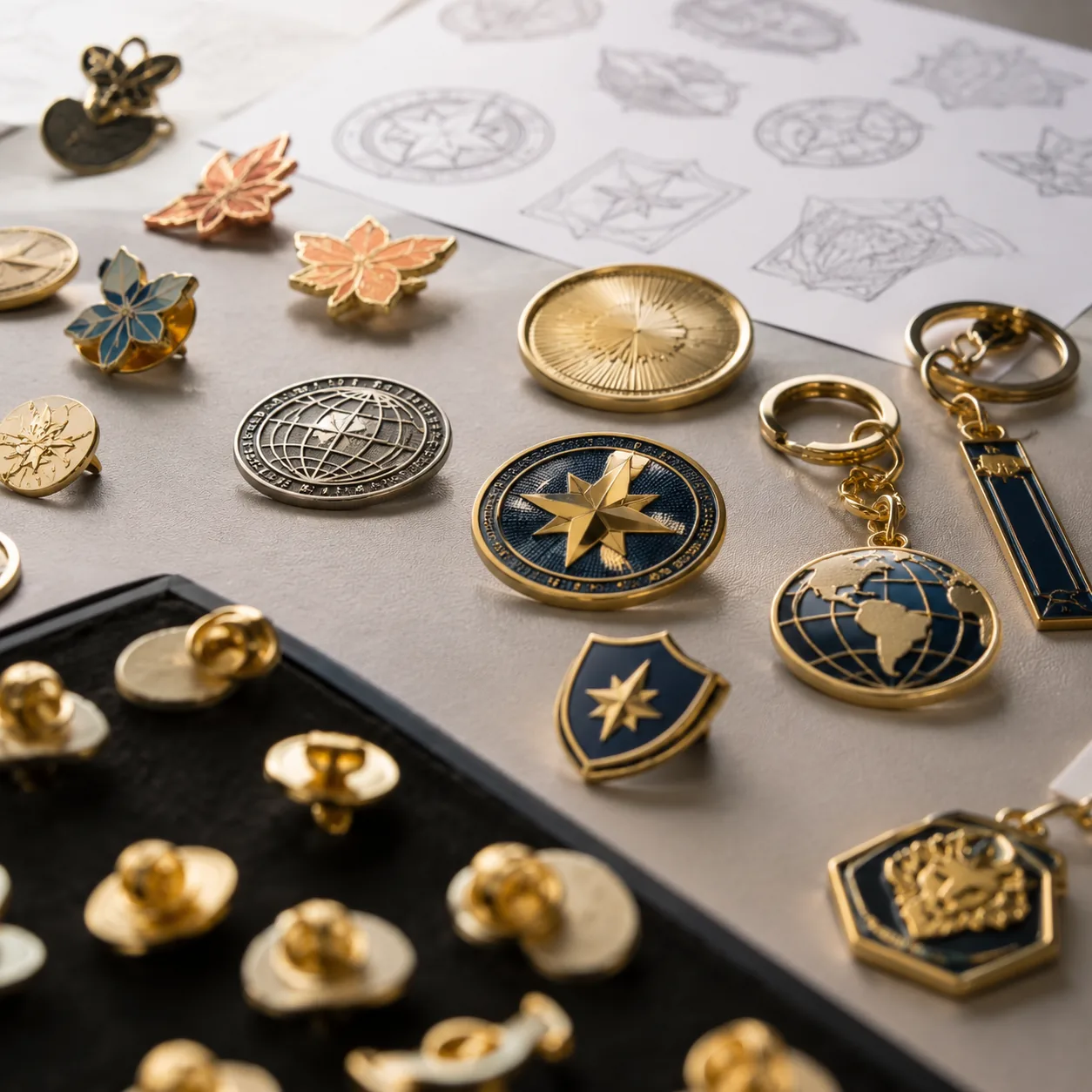
Start With the Use Case, Not the Artwork
Most sourcing mistakes happen before the RFQ leaves your inbox. Buyers often send a logo and ask for price, but the factory still has to infer wear conditions, target lifespan, finish level, and acceptable cost. A lapel pin for a two-day trade show, a coin for executive gifting, and a badge for daily uniform wear can share the same artwork while needing very different metals, thicknesses, plating, and attachment hardware. If you skip the end use, you usually get quotes that are cheap for the wrong construction or expensive for a build you do not need.
A strong RFQ starts with the product role: event giveaway, retail merch, staff uniform, collector item, or packaging insert. Then define quantity band, delivery date, destination country, and any hard requirements such as nickel-free plating, outdoor corrosion resistance, child-safe edges, or matte rather than glossy finish. For metal products, state whether the piece is 2D stamped or 3D sculpted, whether it uses soft enamel, hard enamel, no-color metal, or printed detail, and whether it must survive daily handling or only short-term display. That framing helps the factory choose a realistic process instead of guessing from the artwork alone.
- State the product type: pin, coin, keychain, badge, patch, or lanyard.
- Define the use case: retail, event, uniform, mailer, or resale.
- Give the order tier: sample, pilot run, or bulk.
- Flag compliance needs: nickel-free, anti-rust, outdoor use, or soft-touch finish.
Write an RFQ the Factory Can Quote Without Chasing You
A quote is only useful if every supplier is pricing the same spec. The best RFQs are short but measurable: size in millimeters, finished thickness, metal type, plating, enamel style, attachment, packing method, and shipping term. Avoid vague phrases like premium quality or heavy feel. Instead, write something like 32 mm round, 1.5 mm thick, zinc alloy, antique nickel plating, soft enamel, butterfly clutch, individual OPP bag, FOB Ningbo. That level of detail gives the supplier a direct path from drawing to cost.
Quote accuracy improves when tolerances are stated up front. A practical starting point is ±0.3 mm for overall size on pins and badges, ±0.5 mm for coins and keychains, and thickness tolerance of ±0.2 mm to ±0.3 mm depending on build. For plated finishes, ask the supplier to specify the target metal layer or at least the finish family; decorative plating on promotional items is commonly quoted around 0.05 to 0.2 μm for standard color finishes, while heavier antique or enhanced wear specs may be quoted higher depending on the base metal and process. If your design has cutouts, micro text, or multiple enamel zones, say so explicitly because those details change die cost and reject risk.
Ask for price separation. The factory should show unit price, die or mold cost, sample cost, and any rush or color-match surcharge. If the supplier only gives one all-in number, it becomes difficult to compare vendors or understand where cost moves when you change size, finish, or packing.
| RFQ Field | Good Spec Example | Why It Matters |
|---|---|---|
| Size | 32 mm round | Sets die size and plating cost |
| Thickness | 1.5 mm | Controls weight and perceived quality |
| Plating | Antique gold, 0.1–0.2 μm | Defines finish and tarnish risk |
| Attachment | Two butterfly clutches | Affects wear, safety, and packaging |
| Packing | 1 pc/OPP bag, 500 pcs/carton | Impacts labor, freight, and damage rate |
Compare Quotes by Build, Not Just Unit Price
The lowest quote is often the one that leaves out something important. One supplier may be pricing a stamped zinc alloy pin with thin plating and standard polishing, while another is quoting a heavier brass piece with cleaner edges, tighter color fill, and better plating consistency. Those are not equivalent offers, even if the headline unit price looks close. Compare only like-for-like builds: same size, same base metal, same thickness, same plating class, same packaging, and same defect standard.
For low-volume custom giveaways, realistic FOB ranges depend on process complexity and finish. Simple soft enamel pins often land around USD 0.35 to 1.20 each at common promotional quantities. Metal keychains typically sit around USD 0.70 to 2.50. Challenge coins usually run USD 1.20 to 4.50, and can go higher when both sides use deep relief, cut edges, or dual plating. Woven patches and sublimated lanyards are usually lower on unit price, but setup, thread count, backing, and print coverage can move the price quickly. MOQ also changes the math: many factories quote 100 to 300 pcs for standard pins and keychains, 100 to 200 pcs for coins, and 100 to 500 pcs for patches or lanyards depending on decoration method.
| Option | Typical MOQ | Typical FOB Range | Best For |
|---|---|---|---|
| Simple soft enamel pin | 100-300 pcs | USD 0.35-1.20 | Events, merch drops, reseller test orders |
| Metal keychain | 100-300 pcs | USD 0.70-2.50 | Retail gifts, corporate giveaways |
| Challenge coin | 100-200 pcs | USD 1.20-4.50 | Recognition programs, executive gifting |
| Woven patch | 100-500 pcs | USD 0.25-1.10 | Apparel branding, uniforms |
| Sublimated lanyard | 100-500 pcs | USD 0.30-0.90 | Events, ID use, conference packs |
Approve the Sample Like a Production Engineer
A sample is not just a nice object to sign off. It is the first proof that the design can be manufactured repeatably at the target quality. Inspect it with tools, not by eye alone. Measure overall diameter or length with calipers, confirm thickness, check back findings, verify the attachment geometry, and inspect edges for burrs or sharp points. For colored metal products, check that enamel stays within the metal partitions and that fill is level enough for the intended finish. On printed items, confirm registration, ink density, and whether small text remains legible at the final size.
Sample approval should be based on a written standard. State what is acceptable for scratch depth, plating variation, alignment, backstamp legibility, and color match. For most promo metal goods, a workable visual acceptance rule is no visible dents, no missing enamel, no exposed base metal in visible areas, and no loose attachments. If the item will be worn on fabric, test the backing for pull strength and rotation before approving bulk. A sample that looks good in a photo but fails under handling usually turns into expensive rework later.
- Measure overall size, thickness, and hole placement against the drawing.
- Confirm plating color under daylight and indoor light.
- Check for sharp edges, loose parts, and weak attachment pull.
- Compare the sample against the approved artwork and written RFQ.
- Record every deviation in one approval note before bulk release.
Lock the Pilot Run Before You Commit to Bulk
A pilot run is useful when the order is too large to risk on one sample but too custom to release straight into mass production. This matters for new dies, mixed finishes, multi-piece sets, moving parts, glow enamel, epoxy dome, or orders that combine different processes. A pilot of 100 to 300 pieces can expose trimming issues, polishing inconsistencies, plating drift, enamel shrinkage, and packing errors without forcing a full schedule reset. It also gives procurement a better read on fallout rate and rework time.
The right pilot size depends on complexity. A simple stamped pin may move from sample to bulk with no pilot, but a coin with edge lettering, a keychain with a swivel ring, or a layered badge with printed detail deserves one because the failure modes are harder to see on a single sample. If a supplier refuses a pilot, ask why. Sometimes the answer is a legitimate setup limitation, but sometimes it means the factory is not confident in process control. Pilot runs are especially useful when multiple SKUs share one concept but differ in size, backing, or finish.
| Release Stage | Suggested Quantity | Main Check | Go/No-Go Signal |
|---|---|---|---|
| Golden sample | 1-3 pcs | Appearance and spec match | Visual acceptance only |
| Pilot run | 100-300 pcs | Process stability | Less than agreed defect threshold |
| Bulk production | 500 pcs+ | Repeatability and packing | Pilot issues closed and documented |
Control the Production Lot, Not Just the Artwork
Bulk production is where hidden inconsistencies become expensive. The factory should use the same plated batch, same enamel mix, same backing hardware, and same packing instruction approved in the pilot. If the order spans multiple cartons or multiple days, request lot separation so you can trace any defect to a specific run instead of arguing over the whole shipment. For higher-risk items, ask for in-process checks at polishing, plating, coloring, assembly, and final packing. That is especially important when the order includes small text, thin borders, or multiple color breaks.
AQL inspection works only when defect definitions are agreed in advance. For general cosmetic and assembly control, many buyers use AQL 2.5 for major defects and AQL 4.0 for minor defects, while premium gifting programs may tighten that to AQL 1.5 or a custom acceptance plan. Define major defects clearly: wrong artwork, broken clasp, missing part, severe plating peel, or unreadable logo. Define minor defects too: tiny scratch in a hidden area, slight color shade variation within tolerance, or a non-visible mold mark. Keep the inspection tied to the approved sample, not a verbal promise.
- Require final carton count, carton weight, and packing format.
- Ask for in-process photos if the order has multiple finishing steps.
- Set a defect-definition sheet before inspection starts.
- Confirm whether rejects will be reworked or replaced at supplier cost.
- Trace batches by date, lot, or line when volume is high.
Match the Product to Shipping and Reorder Timing
A sourcing plan is incomplete until logistics and reorders are built in. If the item is lightweight but high value, individual packing and carton partitioning may be worth the labor because freight damage is more expensive than packing cost. If the order is tied to an event date, build in time for sample approval, one round of correction, and possible rework. For straightforward custom metal giveaways, lead times commonly run 12 to 20 days after sample approval. More complex or multi-process jobs usually take 20 to 35 days after approval. Freight is separate and can dominate the calendar if you wait too long to book it.
Reorders are where locked specs matter. Keep the approved drawing, color references, plating code, attachment type, and packing method in one file so the next order can be repeated without reinterpretation. For recurring programs, the best suppliers maintain a reorder sheet with tooling ownership, die size, thickness, finish, and packaging note. That reduces the risk of receiving a close-looking but not identical batch six months later. It also shortens future quoting because the factory can reference a known production history instead of starting from scratch.
| Logistics Choice | When to Use | Trade-Off |
|---|---|---|
| Individual OPP bag | Retail, gifting, mailers | More labor and packing cost |
| Bulk inner pack | Large promo runs | Lower cost, higher scuff risk |
| Insert card + bag | Brand presentation | Better display, more setup |
| Unit cartons | Fragile or premium items | Best protection, highest freight volume |
What to Do Next
If you are sourcing a new custom item, start by locking the use case and exact build spec in writing. Then send one RFQ to multiple suppliers with the same drawing, same size, same thickness, same plating, and same packing request so the quotes are comparable. After you choose the supplier, approve the sample against a short defect standard, run a pilot if the design is complex, and only then release bulk production. That sequence is slower than asking for a quick price, but it is usually the cheapest way to avoid rework, delays, and inconsistent quality.
The most practical next step is to turn your product idea into a factory-ready RFQ template with fields for dimensions, finish, tolerances, MOQ, lead time, and inspection criteria. Once that document is consistent, you can source pins, coins, keychains, patches, and lanyards with far less back-and-forth and far better quote comparability.
Have a project? Send your artwork and target quantity and we’ll reply with a detailed quotation within 12 working hours.
Ready to get this made?
Send your sketch, target quantity and ship-date. Detailed quotation in 12 hours.



