RFQ to Bulk: A Practical Sourcing Workflow for Custom Metal Giveaways
Start with the use case, not the artwork
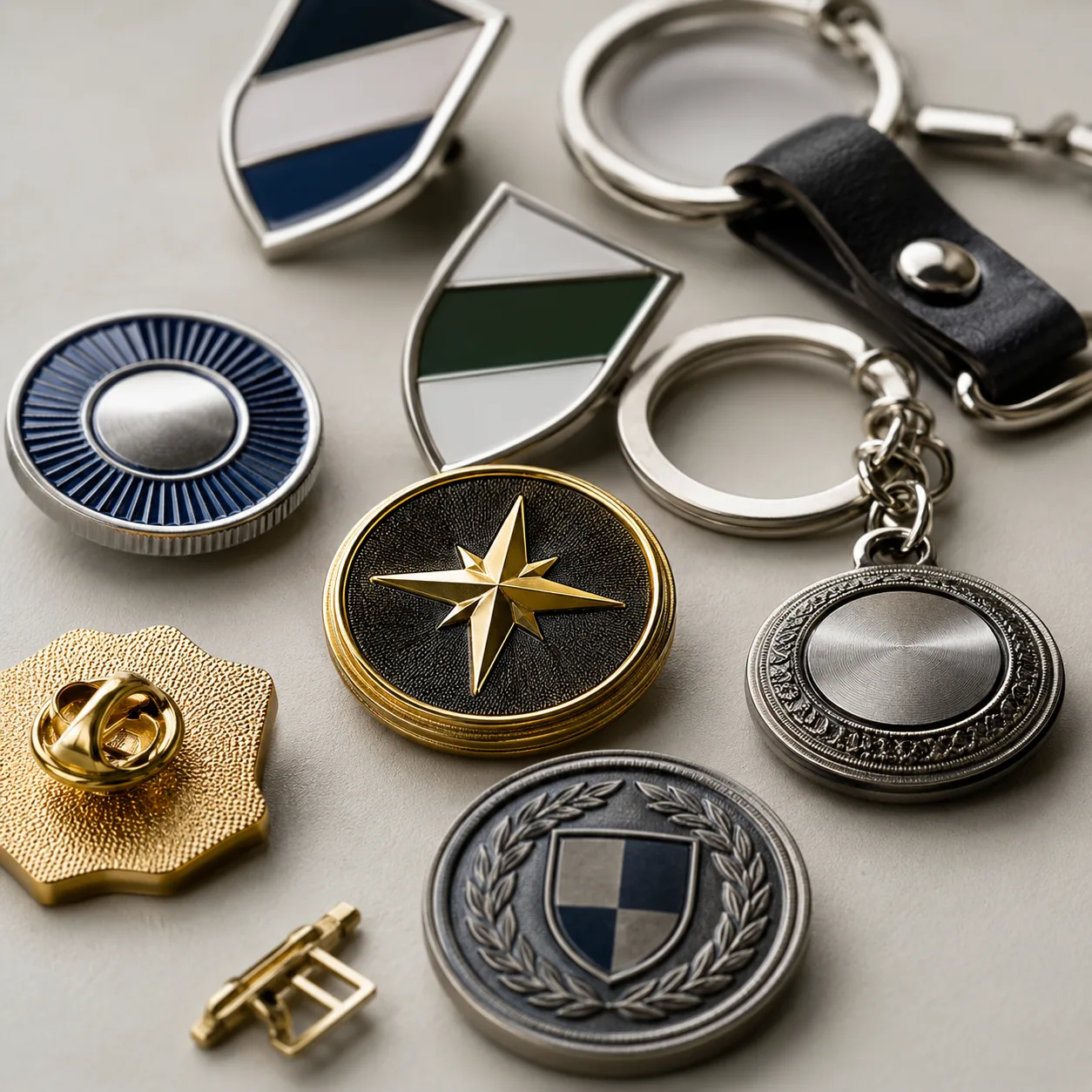
Most sourcing mistakes start when buyers ask for a quote before they know how the item will be used. A logo file is only the starting point; the real buying decision is whether the product will live on a blazer, sit in a mailer, hang from a zipper, or ship as part of a kit. Those uses determine thickness, attachment type, finish, packing, and how much cosmetic variation is acceptable.
A soft enamel pin for retail display can tolerate deeper recesses and more visible texture, while a conference badge may need a flatter profile, lighter weight, and a stronger backing. A keychain that will be handled daily needs more wear resistance than a coin that will live in a presentation box. Define the item by function first: who uses it, how often, and what failure looks like.
- Event giveaways: prioritize cost, short lead time, and low breakage risk.
- Retail or brand merch: prioritize plating consistency, color accuracy, and presentation.
- Long-wear items: prioritize edge smoothness, plating thickness, and backing security.
- Mail-order kits: prioritize pack size, carton efficiency, and transit protection.
Write the RFQ around measurable specs
A usable RFQ removes guesswork. At minimum, include product type, finished size in millimeters, thickness, base metal, plating finish, enamel type, attachment, and packing method. If you leave those open, suppliers will default to their standard build, which is usually the fastest way to get a quote that looks fine on paper but misses the real requirement.
For metal promo items, the RFQ should also state the tolerance standard and the cosmetic limit. Typical dimensional tolerance is plus or minus 0.3 mm for small items up to about 40 mm and plus or minus 0.5 mm for larger pieces, with hole position held within plus or minus 0.2 mm when the attachment alignment matters. For plated parts, ask for plating thickness in microns, not just a finish name. Common targets are 0.08 to 0.12 micron for decorative flash plating, 0.25 to 0.5 micron for standard nickel or black nickel, and 0.5 to 1.0 micron for higher wear resistance on keychains, badges, or retail items.
A good RFQ also tells the factory what matters most. For example, a company logo coin may prioritize sharp relief and edge cleanliness, while an enamel pin may prioritize cell fill, color match, and backing security. If you are quoting a set, specify whether the items must match by finish family, Pantone reference, and carton labeling logic.
| RFQ field | Typical target | Why it matters |
|---|---|---|
| Finished size and thickness | Example: 30 mm x 2.0 mm | Controls tooling, weight, and comfort |
| Base metal | Zinc alloy, brass, iron, or stainless steel | Affects cost, hardness, and surface detail |
| Plating type and microns | Nickel 0.3 micron or gold 0.5 micron | Drives appearance and wear resistance |
| Enamel type | Soft enamel or hard enamel | Affects texture, polishing, and price |
| Attachment and backing | Butterfly clutch, rubber clutch, safety pin, magnet, split ring | Controls usability and return risk |
| Packing format | Bulk, OPP bag, backing card, gift box | Affects freight volume and presentation |
Ask for quotes that can be compared
A quote is only useful when every supplier is pricing the same build. If one factory quotes zinc alloy with soft enamel and another quotes iron with hard enamel, the lower price is not a better price; it is a different product. Standardize the request, then separate optional upgrades into their own line items so you can compare like for like.
Use at least three volume bands for comparison: 100 to 300 pcs, 500 to 1,000 pcs, and 3,000 pcs plus. For custom pins and badges, many Chinese factories quote FOB pricing that drops sharply after the tooling cost is absorbed. A simple 25 to 30 mm soft enamel pin may land around USD 0.45 to 1.20 FOB at mid-volume, while hard enamel, cut-out shapes, or multi-plating effects often rise to USD 0.90 to 2.20 FOB. Small zinc-alloy coins typically sit around USD 1.10 to 3.50 FOB depending on relief, edge finishing, and packaging; premium executive pieces can run higher.
Lead times should also be quoted in days, not “fast” or “urgent.” A practical schedule is 3 to 5 days for artwork confirmation, 7 to 12 days for sampling or first articles, and 15 to 25 days for bulk production after approval. If the design uses multiple processes, uncommon plating, or individual gift packaging, expect the bulk window to extend by 5 to 10 days. For repeat orders with locked tooling, many factories can shorten bulk to 12 to 18 days.
Do not compare unit price alone. Compare mold charge, sample charge, plating upcharge, epoxy coating, individual bagging, backing card printing, and carton pack-out. A factory with a slightly higher unit price but lower scrap rate and clearer approval process may still be cheaper once total landed cost is counted.
Use the first sample to test risk, not perfection
The first sample should answer three questions: does the geometry match the drawing, does the finish match the approved reference, and does the item work in hand. Treat it as a risk check, not a beauty contest. If you wait until bulk production to discover a loose clasp, low enamel fill, or a magnet that slides under load, you have already paid for avoidable rework.
Evaluate the sample against a written checklist and the actual end-use. Measure overall size, check the edge cut, confirm attachment position, and test the item on the real garment, card, surface, or packaging it will ship with. For plated items, inspect under daylight and indoor light, and look for color drift, burn marks on high points, pits, and flash-through on sharp edges. For enamel items, verify that color fill is even and that recessed cells are not underfilled or overfilled beyond the product standard.
- Match artwork against the approved CAD or proof, not against memory.
- Test the attachment on the real substrate or package.
- Check plating under daylight and indoor light.
- Verify that enamel fill is flush to the right height for the product type.
- Confirm packaging fit before approving bulk production.
Set approval rules before the sample arrives
Factories move faster when they know what counts as acceptance. Define pass/fail rules before production starts: which dimensions are critical, what color variation is acceptable, whether tiny scratches are allowed on the back side, and whether the sample must be signed and sealed before bulk can begin. Without that definition, approval becomes subjective and every small difference creates delay.
If you are managing a product family, lock the shared standards too. That includes plating family, Pantone references where relevant, backing style, carton marking, and how the goods should be grouped by SKU. For a mixed promo program, it is often smarter to standardize all items to one metal color and one packaging style so reorders remain consistent and the warehouse can kit them faster.
| Approval item | Suggested rule | Practical limit |
|---|---|---|
| Critical dimensions | Must meet drawing tolerance | Plus or minus 0.3 mm small parts; plus or minus 0.5 mm larger parts |
| Color match | Approved against reference under standard light | Delta should stay within one approved sample or Pantone target |
| Plating defects | No visible pits, stains, or exposed base metal on the front face | Back-side marks only if pre-approved |
| Attachment security | Must pass manual pull and rotation check | No loosening after repeated handling |
| Packing | Must close without deforming item or backing card | No crushed corners or scuffed front faces |
Control bulk production with checkpoints
Bulk production should not begin with a blind jump from sample to shipment. A mature workflow uses checkpoints: tooling confirmation, pre-production sample or golden sample, in-process inspection, and final packing audit. The more processes are combined on one item, the more useful those checkpoints become. A die-cast, enamel-filled, dual-plated keychain needs more control than a simple stamped badge.
For cosmetic promo items, many buyers specify AQL 2.5 for major defects and AQL 4.0 for minor defects, with tighter internal checks on critical points like attachment strength, plating adhesion, and logo clarity. For higher-value retail items, some programs tighten to AQL 1.5 major and AQL 2.5 minor. Ask for stage photos and a carton count before shipment if the order is time-sensitive or part of a launch.
Set allowable variance up front. A slight difference in enamel level between cavities may be normal, but outline shift is not. Plating tone should remain within the same finish family, and any batch-to-batch color drift should be rejected if the item is sold as a set. For items that will be worn, insist on rounded edges and burr removal criteria; a burr tolerance of zero on the front face and no sharp edges on contact points is a reasonable standard.
A practical batch record should include tooling number, cavity count, production date, inspection lot size, defect count, and packing date. That gives you a traceable record if a later reorder needs correction or if one carton is out of spec.
Choose the right build method for the product
Different build methods solve different sourcing problems. Cast items give stronger 3D relief, stamped items are usually cleaner for sharp outlines and lower cost, and etched parts work when you need fine linework without heavy depth. If you choose the wrong method at RFQ stage, the factory may still be able to make the part, but it may fail on wear, budget, or lead time.
| Build option | Best when | Trade-off |
|---|---|---|
| Stamped metal | Clean logos, moderate detail, lower cost | Less depth than casting |
| Die-cast zinc alloy | 3D shapes, relief, sculpted edges | Heavier and often higher mold cost |
| Etched metal | Fine lines and shallow branding | Lower tactile depth, flatter appearance |
| Soft enamel fill | Visible color separation and lower cost | Recesses are not fully level |
| Hard enamel | Smooth premium finish and wear resistance | Higher process cost and longer polishing time |
As a practical rule, use stamped brass or iron for flat logos and simple shapes, die-cast zinc alloy for raised detail and sculpted edges, and hard enamel when the buyer wants a smoother premium face. For keychains, check whether the hardware or chain is the weak point; for coins, check whether the edge and relief depth justify the added weight. A good supplier will tell you when a design is asking a process to do more than it can reliably hold.
Turn the RFQ into a repeatable sourcing system
The fastest path from RFQ to bulk is a controlled brief: define the use case, choose one build method, lock dimensions and plating, and state how the sample will be approved. If the item is part of a mixed promo set, align the specs across every component before asking for prices. That single step prevents most of the mismatches that show up later in packing, presentation, and reorder stages.
When buying custom pins, badges, keychains, magnets, coins, patches, or lanyards, a structured RFQ followed by the same acceptance checklist on every line item usually reduces back-and-forth and protects margin. Vertically integrated factories can simplify the workflow because tooling, plating, color filling, inspection, and packing stay under one production chain. The result is not just a faster quote, but a cleaner handoff from sample to bulk and fewer surprises at shipment.
If you are building a recurring program, store the approved CAD, plated finish code, Pantone reference, attachment spec, AQL target, and packaging spec in one document. That becomes the sourcing baseline for the next reorder and keeps the next round from starting from zero.
Have a project? Send your artwork and target quantity and we’ll reply with a detailed quotation within 12 working hours.
Ready to get this made?
Send your sketch, target quantity and ship-date. Detailed quotation in 12 hours.



