RFQ Spec Matrix for Custom Metal Promo Products
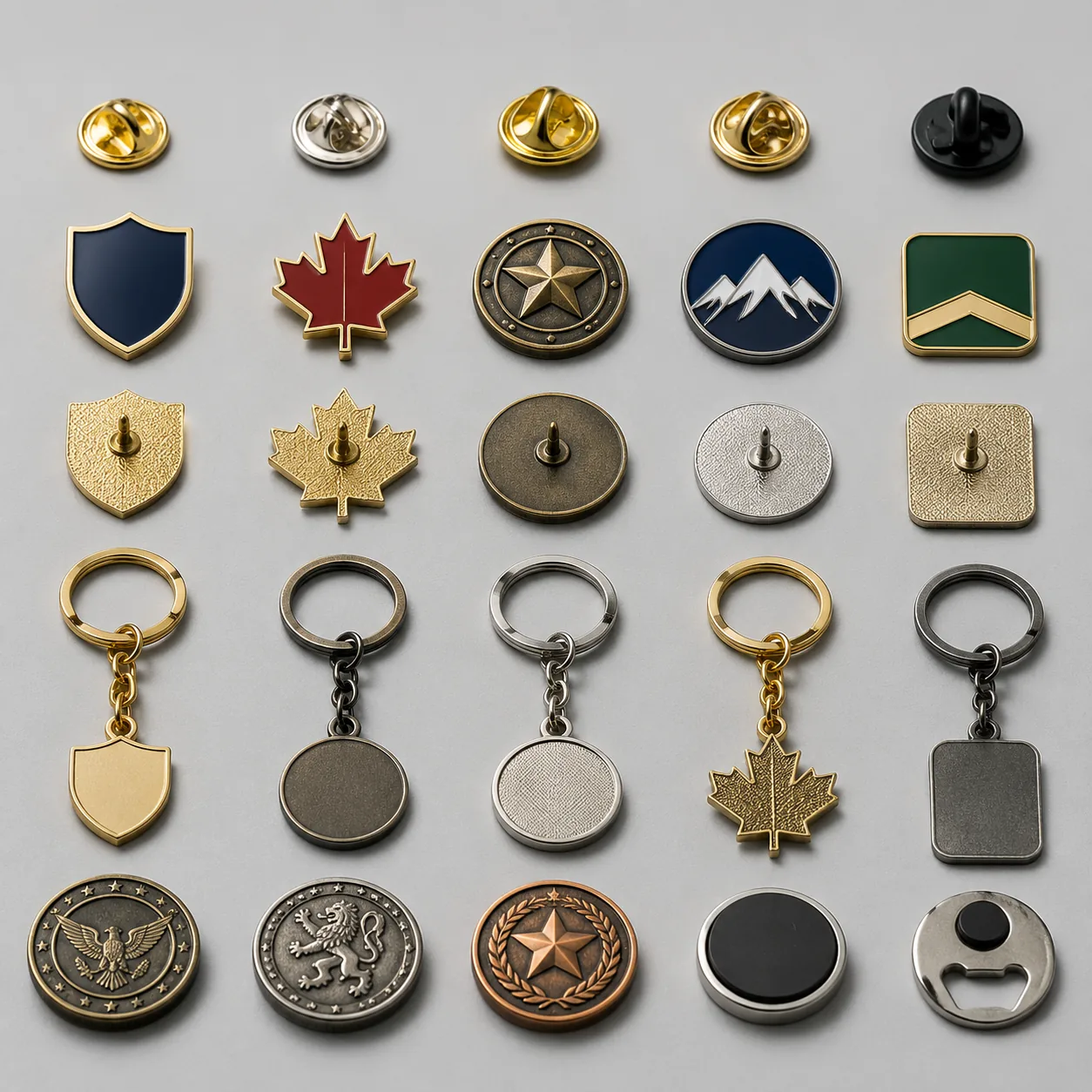
Why Quote Comparisons Fail
Most buyers compare custom promo quotes line by line and still end up with different products. One factory prices a 30 mm lapel pin at 1.2 mm thickness, another assumes 1.5 mm; one includes polished soft enamel, another quotes a satin finish; one uses AQL 2.5, another gives no inspection standard at all. The result is not a cheap win, but a spec mismatch that shows up as color drift, weak attachments, poor wear resistance, or a reorder that no longer matches the first batch.
The root problem is that many RFQs describe the item, not the acceptance standard. If you ask for a “custom lapel pin” or “metal keychain,” suppliers will fill in their own assumptions on alloy, plating, backing, packaging, and tolerances. A quote comparison only works when every supplier is pricing the same material grade, same decoration method, same test method, and same packing format.
For promo buyers, the real objective is usually repeatability: consistent reorders, fewer disputes, and fewer samples. That means building a spec matrix before asking for numbers. Once the matrix is fixed, you can compare true deltas in tooling, plating thickness, labor, and inspection instead of arguing over vague descriptions.
Build The Spec Matrix Before You Ask For Price
A spec matrix is a one-page sheet that freezes all critical variables before the factory quotes. For metal promo goods, the core fields are product type, size, thickness, base metal, plating finish, color system, attachment, packaging, and inspection level. If a supplier needs more than one clarification to quote, the matrix is not complete yet.
Keep the matrix tight enough that a factory engineer can price it without follow-up, but detailed enough that a second factory would arrive at the same product. Instead of “gold finish,” specify brass or iron base, nickel-free if required, and decorative flash gold at 0.1 to 0.3 micron, or 0.5 micron or above if abrasion resistance matters. Instead of “standard back,” specify butterfly clutch, rubber clutch, safety pin, magnetic backing, or swivel lobster clasp with the exact hardware size.
A good matrix also captures what is intentionally flexible. If your campaign can tolerate ±1 to 2 mm on size, say so. If packaging can be a simple polybag on the first order but a printed backing card is required on reorders, state that the card is optional for sampling but locked for production pricing. If artwork may shift slightly, define the allowed shift in millimeters instead of saying “close enough.”
The best RFQs also separate artwork control from manufacturing control. Artwork control covers logo shape, Pantone reference, and text spelling. Manufacturing control covers thickness, finish, plating, attachment, packaging, and inspection. That split keeps a quote readable and prevents a supplier from assuming that a visually acceptable sample is enough to authorize mass production.
What To Lock By Product Type
Not every promo item needs the same level of control. A challenge coin needs rim width, edge treatment, and relief height locked down, while a lanyard needs width, print method, and safety-breakaway spec. The mistake is to reuse one generic template across every category and assume the supplier will interpret it correctly.
For enamel pins and badges, lock size, thickness, plating, fill level, line width, and backing. Typical production is 25 to 50 mm across, 1.0 to 1.5 mm thick, with line widths no thinner than 0.2 to 0.3 mm for reliable enamel fill. For soft enamel, a 0.3 mm recessed border is common; for hard enamel, ask whether polishing is included and whether the surface is level with the metal walls.
For challenge coins, lock diameter, rim style, relief height, edge treatment, and number of strikes or colors. A 40 mm coin commonly uses 2.0 to 3.0 mm thickness, with relief around 0.3 to 0.8 mm depending on artwork depth. If you want antique plating, state whether the darkening is in recessed areas only or overall antique wash. The quote changes materially if the edge is reeded, smooth, rope-style, or laser-engraved.
For keychains, lock metal thickness, ring type, connector, and whether epoxy doming is included. A 35 to 45 mm body at 1.2 to 1.8 mm thickness is typical, but split-ring size matters as much as the charm. Ask for the ring diameter, wire gauge, and plating finish separately, because a thicker ring often reduces breakage but adds cost and visible bulk.
For patches, lock size, border type, backing type, and stitch density. Embroidered patches commonly use 75 to 100% merrowed borders on standard shapes and hot-cut edges on complex outlines. For clean logo edges, specify stitch density or thread count where relevant and ask for a heat-seal or iron-on backing thickness range if the patch must survive repeated washing.
For magnets and fridge magnets, the most important fields are magnet grade, backing material, and usable pull force. A 0.8 to 1.5 mm flexible magnet sheet is common for souvenir magnets, while stronger assembly may need ferrite or neodymium inserts. If the magnet is expected to hold paper on a metal board, ask for pull force in grams rather than relying on a photo sample.
For lanyards, the quote changes materially if you specify 15 mm, 20 mm, or 25 mm width, single-sided versus double-sided printing, and metal hook versus plastic clip. Most promotional lanyards use polyester webbing at about 0.5 to 0.8 mm thickness; woven or jacquard styles cost more and have longer lead times. Add breakaway buckle, safety clip, and card holder size if the final user will wear it daily.
Comparison Matrix: Fields That Change Price And Risk
Use this matrix as a quoting filter. If two suppliers are not pricing the same row in the same way, their numbers are not directly comparable. The point is not to over-spec every detail; it is to freeze the variables that change cost, appearance, or failure rate.
| Spec field | Why it changes quote quality | Typical buyer risk if omitted |
|---|---|---|
| Base metal or fabric grade | Affects corrosion resistance, finish quality, and breakage rate | Factory substitutes cheaper stock and the sample still looks acceptable |
| Thickness or width | Drives weight, feel, and material cost | Final product looks too thin or feels lighter than approved sample |
| Plating thickness or print method | Changes wear life and appearance consistency | Finish wears faster than expected or color looks inconsistent |
| Attachment or hardware | Impacts retention and user safety | Products detach, rotate, or damage clothing and bags |
| Tolerance and inspection level | Controls acceptance standard | Factory ships parts that are visually close but out of spec |
| Packing format | Affects unit cost and retail readiness | Goods arrive without the agreed retail presentation or carton protection |
If you want a practical rule, compare quotes only after you have locked the lowest common denominator of all critical fields. If one quote includes individual polybags and another does not, separate packaging as its own line item. If one factory quotes 100 pieces and another quotes 1,000 pieces, do not compare unit price without normalizing setup, scrap, and amortized tooling.
For multi-SKU buyers, the matrix becomes a repeat-order control tool. Once the first order is approved, the same matrix can be attached to all reorders so the supplier does not quietly alter plating tone, buckle type, or backing card thickness. That discipline is often worth more than a small unit-price discount.
Price Bands, MOQ Tiers, And Lead Times
Quote quality improves when the RFQ includes realistic commercial ranges. Most factories price custom promo products by MOQ tier, because setup dominates low-volume orders. As a rule, 100 to 300 pcs is the sample or pilot tier, 500 to 1,000 pcs is the standard small-batch tier, and 3,000+ pcs is where tooling and setup amortize enough to lower the unit price materially.
Typical FOB pricing for simple custom metal promo products can vary widely by finish and artwork complexity, but the ranges below are useful as a screening tool. Soft enamel pins at 25 to 30 mm often land around USD 0.45 to 1.20 FOB at 500 to 1,000 pcs, while hard enamel versions often run USD 0.80 to 2.20 FOB. Challenge coins at 40 mm commonly fall around USD 1.20 to 3.80 FOB depending on thickness, edge, and plating. Die-cut keychains usually land around USD 0.70 to 2.50 FOB. Basic embroidered patches may range from USD 0.35 to 1.50 FOB, and printed lanyards from USD 0.28 to 1.10 FOB at mid-volume.
Lead times also need to be written into the matrix. For most custom metal promo products, expect 5 to 10 days for samples once artwork is approved, and 12 to 25 days for mass production after deposit and sample sign-off. Complex coins, multi-color hard enamel, or mixed-material assemblies can push production to 25 to 35 days. If the order needs printed backing cards, molded boxes, or retail inserts, add 3 to 7 days.
A low MOQ can look attractive but distort price. At 100 to 300 pcs, setup cost dominates and unit price will be much higher than at 1,000 pcs or 3,000 pcs. That is normal; what matters is whether the quoted setup fee is transparent, whether tooling ownership is clear, and whether the mold or plate charge is reusable on reorder. Ask whether the tooling fee is a one-time charge, refundable, or credited against the next order.
A Practical Spec Table For Buyers
If you need a starting point for RFQs, use a simple spec table and keep every line measurable. The table below shows the fields that matter most for common promo products and the language that reduces ambiguity.
| Product | Key specs to freeze | Common acceptance range |
|---|---|---|
| Enamel pins and badges | Size, thickness, plating, fill level, backing | Size ±0.5 to 1 mm; thickness ±0.2 mm; backing centered within 0.5 mm |
| Challenge coins | Diameter, rim style, relief height, edge finish | Diameter ±0.3 to 0.5 mm; relief height matched to golden sample |
| Keychains | Metal thickness, ring type, connector, epoxy or none | Thickness ±0.2 mm; hardware matched to approved sample |
| Fridge magnets | Magnet grade, substrate, adhesion method, print finish | Pull force and visual match to golden sample |
| Patches | Size, border type, backing, stitch density | Size ±1 to 2 mm; border and color matched to sample |
| Lanyards | Width, print method, clip, safety breakaway | Width ±1 mm; print and hardware matched to approved sample |
The acceptance range should be realistic for the category. Do not demand jewelry-level tolerances on a budget giveaway, but do specify tight enough control where it affects fit or function. A pin post that is off by even a small amount can create rotation or snagging, while a 1 mm size drift on a large patch may be acceptable if the shape still reads correctly.
A useful spec matrix also distinguishes cosmetic from functional requirements. Cosmetics include plating tone, print registration, and surface gloss. Function includes pull strength, clasp retention, stitch integrity, and breakaway release. If the product must survive daily use, functional requirements should never be implied; they should be written with numbers.
Inspection Rules That Belong In The RFQ
If you do not define inspection, the factory may still inspect, but on its own terms. For low-risk promotional items, AQL 2.5 for major defects and AQL 4.0 for minor defects is a common commercial baseline. If you want tighter screening for retail or brand-critical orders, say so explicitly and define which defects are non-negotiable.
Your inspection rules should name the defect classes. Major defects might include wrong color, plating peel, broken attachment, missing components, loose stitching, or incorrect logo placement. Minor defects might include tiny surface specks, slight print edge blur, or packaging wrinkles that do not affect function. If a visual issue would cause a retail return, treat it as major, not minor.
Also state the sample hierarchy. A golden sample should outrank all written descriptions if there is any conflict, and the pre-production sample should match the golden sample before mass production starts. If you want to avoid arguments later, say that color is judged under neutral daylight or D65 lighting, and that metal finish is compared against the approved sample under standard factory lighting.
Inspection should cover packaging if packaging is customer-facing. If the order includes backing cards, polybags, label stickers, or outer cartons, specify whether the factory must check print alignment, barcode legibility, carton count, and shipping marks. A perfect product in damaged retail packaging is still a rejected order.
- Define major and minor defect examples for each item type.
- State the AQL level or visual acceptance rule.
- Require golden sample precedence over email descriptions.
- Specify who signs off on the pre-production sample.
- Confirm whether cartons, inserts, and outer boxes are inspected too.
How To Compare Suppliers Fairly
Once the matrix is complete, compare suppliers on the same basis: same drawing, same material, same finish, same hardware, same packing, same inspection. If one supplier includes a plated backstamp and another does not, either add the backstamp to the cheaper quote or remove it from both. Otherwise you are comparing scope, not price.
Use a two-step review. First, compare technical compliance: can the supplier hit the dimensions, finish, and attachment spec without warning signs? Second, compare commercial terms: tooling ownership, lead time, payment terms, sample cost, and MOQ tier. A quote that looks slightly higher may still be cheaper if it reduces repeat sampling or allows faster reorder with locked tooling.
For buyers managing multiple SKUs, ask for a quote table that breaks out tooling, unit price, sample cost, packaging cost, and freight readiness. That makes it easier to see where a factory is strong and where it is stretching. It also gives procurement a clean record when internal teams ask why one line item is higher than another.
Normalize pricing before approving anything. Convert all quotes to the same quantity, the same plating finish, the same packing format, and the same Incoterm. If one supplier quotes FOB and another quotes EXW, the unit price is not comparable until you add inland handling, export docs, and pickup costs. If one supplier includes 1 free revision and another charges for every revision, include that service value in the comparison.
What To Do Next
Take your next RFQ and turn it into a spec matrix before sending it to suppliers. Lock the fields that affect function or brand perception first: dimensions, thickness, base material, finish, attachment, packaging, and inspection standard. Then attach a golden sample photo or approved physical sample reference so the factory understands what “correct” means.
If you already have quotes in hand, normalize them against the same matrix and strip out any missing scope. Separate one-time tooling from recurring unit price, check whether the approved sample is actually the same build as the mass order, and confirm that the quoted lead time includes sampling, production, and packing. If you want, ZheCraft can help convert a loose inquiry into a factory-ready RFQ sheet for pins, coins, magnets, patches, lanyards, or keychains before the next round of pricing.
Have a project? Send your artwork and target quantity and we’ll reply with a detailed quotation within 12 working hours.
Ready to get this made?
Send your sketch, target quantity and ship-date. Detailed quotation in 12 hours.



