Retail-Ready Custom Pins: A Buyer Walkthrough From SKU to Carton
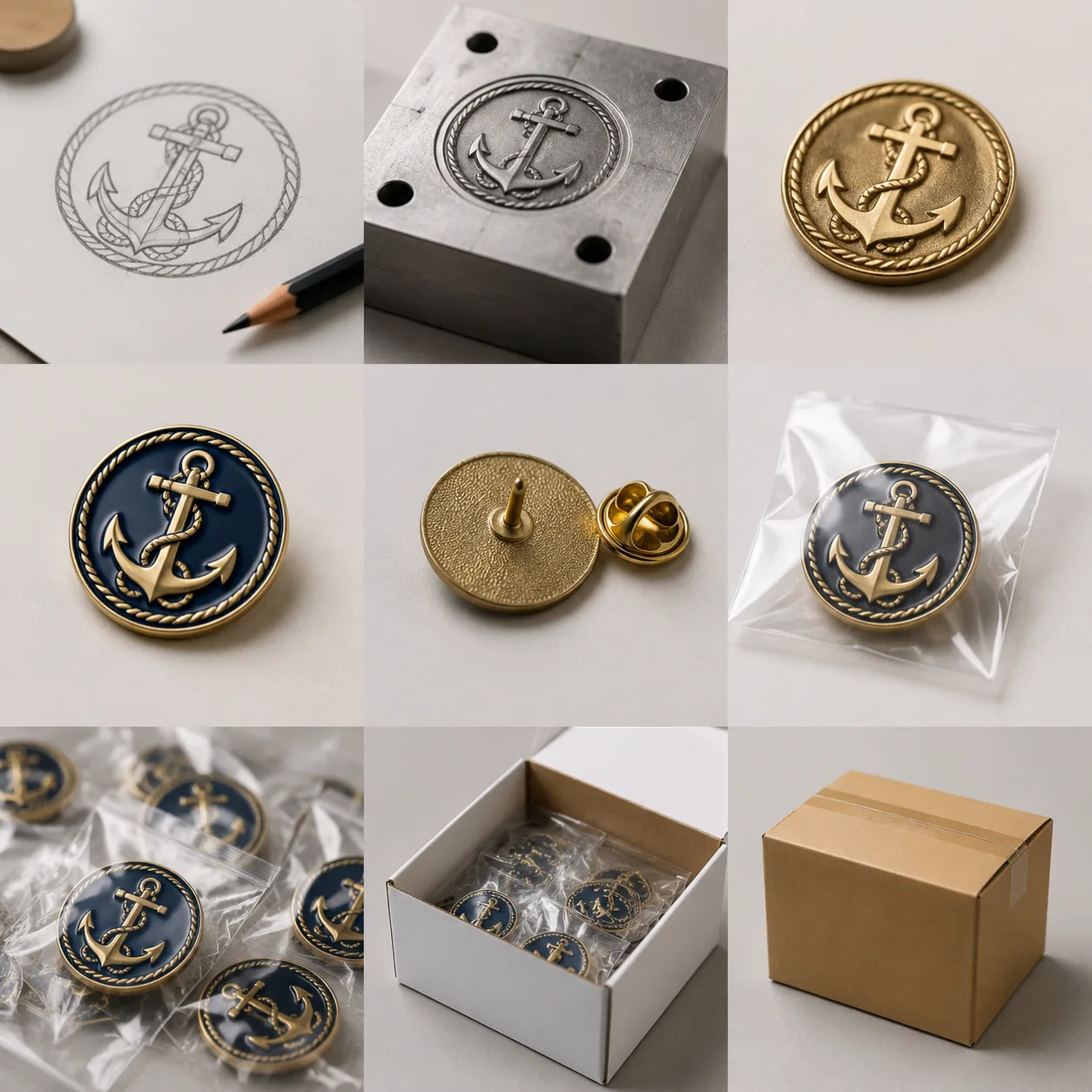
Order Case: 18 Pin Designs, 42 Stores, One Receiving Window
A museum retail buyer is launching 18 enamel pin designs for a seasonal exhibition. Each design is an individual SKU sold through 42 stores, with replenishment moving through a retailer distribution center before store allocation. The warehouse will reject, quarantine, or charge back cartons if the purchase order, SKU count, barcode, inner pack, carton label, or advance shipping notice does not match. In this order, the main production risk is not whether the factory can make an attractive pin. It is whether every sellable unit and carton can be received without manual sorting or relabeling.
Retail-ready pins are controlled assemblies, not loose metal accessories. The pin, backing card, barcode, warning text, country-of-origin line, attachment, bag, inner carton, master carton, and shipping label must be specified as one system. A visually correct pin can still fail at receiving if SKU MUSE-PIN-004 is mounted on MUSE-PIN-014 cards, if the UPC is reduced below scanner tolerance, or if mixed designs are packed in unmarked inner boxes.
For ZheCraft, a complete RFQ file for this order includes vector pin artwork, Pantone references, metal finish, pin size, card dieline, UPC or EAN data, SKU master list, attachment type, packing matrix, carton label template, target delivery date, and inspection requirements. If these inputs are missing at quotation stage, the first price may exclude the labor, scan checks, and paper control needed for retail compliance.
Define the Retail Pack Before Pin Tooling
Buyers often approve pin size first and choose the card later. For retail programs, the pack should come first. The backing card must fit peg hooks, spinner racks, shelf trays, or planogram limits before the pin diameter is locked. Common card formats are 55 x 85 mm, 60 x 90 mm, 70 x 100 mm, and 76 x 114 mm. A practical trim tolerance is ±1.0 mm; tighter trimming increases paper waste but rarely improves store performance.
A 25 to 32 mm pin can sit comfortably on a 55 x 85 mm card if the copy is short. A 38 to 45 mm pin normally needs a 70 x 100 mm card to leave room for brand mark, legal text, barcode, price zone, and origin line. A 50 mm pin can be carded, but it should use 350 gsm stock or thicker, with the pin mounted in the upper third so the card does not pitch forward on a hook.
For the museum order, a strong standard is a 32 mm hard enamel pin on a 70 x 100 mm card. Typical stamped iron or zinc alloy thickness is 1.2 to 1.5 mm. Decorative plating should be defined clearly: gold or black nickel flash may be 0.05 to 0.15 micron on top, while a nickel underlayer for better corrosion resistance is commonly 3 to 5 microns when specified. For cards, 300 gsm C1S is acceptable for light pins, while 350 gsm C2S with matte lamination gives better stiffness, corner strength, and barcode readability.
| Retail pack choice | Typical spec | Best use | Main control point |
|---|---|---|---|
| 55 x 85 mm card | 300 gsm C1S or C2S, 5 mm euro slot, ±1.0 mm trim | 25 to 32 mm pins with short copy | Barcode and quiet zone can become crowded |
| 70 x 100 mm card | 300 to 350 gsm, matte lamination, optional 0.03 to 0.05 mm OPP bag | 32 to 45 mm museum, gift, and boutique SKUs | Balance card stiffness against freight volume |
| 76 x 114 mm card | 350 gsm C2S, reinforced hang hole optional | Large pins, bilingual cards, premium displays | Needs tight inner packing to prevent bent corners |
| Tray pack | PET or paperboard tray, 12 to 24 pcs per tray | Counter display or wholesale set programs | Weak for individual barcode receiving unless each unit is labeled |
Lock SKU and Barcode Data Before Sampling
SKU discipline should start before the first sample card is printed. With 18 designs, names such as “Blue Bird” and “Bird Blue” are easy to reverse. A retail SKU should be short, stable, and usable on invoices, carton labels, and warehouse systems. A workable format is MUSE-PIN-001 through MUSE-PIN-018, with the design name kept as a separate human-readable field.
UPC-A and EAN-13 barcodes should be supplied as vector PDF, AI, EPS, or high-resolution one-color artwork. On a 70 x 100 mm card, the printed barcode field should usually be at least 30 mm wide for UPC-A at practical magnification, with 3 mm or more quiet zone on both sides. Bars should print in solid black on a white or high-contrast background. Avoid printing barcodes over metallic ink, heavy texture, or dark artwork. Matte lamination is safer than gloss when the barcode is printed directly on the card.
Mass card printing should not begin until barcode numbers are final. If placeholder codes are used for sampling, mark them as non-production on the proof. Reprinting 18 card versions after a barcode correction can add 4 to 7 production days and USD 80 to 250 in paper, plate, setup, and handling cost at moderate quantities. Barcode stickers can rescue a small error, but they weaken the retail presentation and add hand application labor of roughly USD 0.02 to 0.05 per unit.
- Create one SKU master file with design name, SKU, barcode number, pin size, plating, enamel colors, card version, attachment, inner pack, and master carton quantity.
- Use one row per finished retail unit, not one row per artwork file.
- Keep barcode, price zone, and origin text clear of the hang hole, pin posts, clutch area, and card fold lines.
- Request a scanned proof of every card and a live barcode scan result before mass card printing.
- Freeze SKU names, barcode data, warning copy, and origin marking before approving the pre-production sample.
Approve a Full Pre-Production Assembly
A loose pin sample is not enough for a retail-ready order. The buyer should approve a complete assembly: pin, clutch or safety backing, backing card, barcode, safety copy, OPP bag if used, inner carton label, and master carton label. For a stamped hard enamel pin with printed card, sampling normally takes 7 to 10 calendar days after final artwork, Pantone references, and deposit. Soft enamel with epoxy is similar; complex cutouts, glitter enamel, screen printing, glow enamel, offset insert printing, or special plating can add 2 to 5 days.
Mold charges for custom enamel pins are commonly USD 50 to 120 per design for 25 to 45 mm sizes, depending on cutouts, relief depth, and cavity count. Physical card proofing may add USD 20 to 60 if offset printing, lamination, die-cutting, or reinforced hang holes are sampled. On an 18-design order, many buyers approve 2 or 3 representative physical assemblies, then approve the remaining designs by high-resolution photos, dieline proofs, and barcode scan reports to control cost and schedule.
Approval tolerances should be written into the spec sheet. For a 32 mm pin, outer dimension tolerance of ±0.2 mm is realistic. Post position tolerance of ±0.5 mm is normally acceptable if the pin hangs straight on the card. Enamel fill should be complete, without exposed recessed metal in color areas. Pantone references should be checked under D65 lighting, but enamel is not offset ink; polishing, plating reflection, and enamel depth can create a small visual shift. Card trim tolerance of ±1.0 mm and hang-hole position tolerance of ±0.8 mm are practical for most retail cards.
Cost the Assembly, Not Only the Pin
The buyer may have a target landed cost of USD 3.20 per unit, but the factory quote should separate pin cost, mold, card, lamination, bag, assembly, barcode checking, inner cartons, and master cartons. At 500 pcs per design, a 32 mm hard enamel pin with 4 to 6 enamel colors, 1.2 to 1.5 mm metal thickness, standard plating, and one rubber clutch commonly falls around USD 0.75 to 1.35 FOB China, excluding mold. At 1,000 pcs per design, the same spec may fall to USD 0.55 to 1.05 FOB.
Retail packaging adds small but important costs. A 70 x 100 mm 300 gsm printed card is commonly USD 0.04 to 0.10 per unit, depending on print method and quantity. Matte or gloss lamination adds about USD 0.01 to 0.03. A 0.03 to 0.05 mm OPP bag adds USD 0.01 to 0.03. Hand assembly, SKU separation, barcode scan checks, and carton labeling can add USD 0.03 to 0.08 per unit; the high end is common when many SKUs require separate inner cartons or 100 percent label verification.
MOQ should be defined by design, not only by total order quantity. For custom retail pins, a practical pilot MOQ is 300 pcs per design, stable production pricing usually starts at 500 pcs per design, and stronger unit cost appears at 1,000 pcs per design. A total order of 9,000 pcs across 18 designs is easier to control than the same total split unevenly with several designs below 100 pcs, because low-count SKUs still require molds, card versions, labels, and separate packing.
| Cost element | Typical FOB range | Notes |
|---|---|---|
| 32 mm hard enamel pin | USD 0.55 to 1.35 per unit | Varies by quantity, metal, enamel colors, cutouts, and plating |
| Mold charge | USD 50 to 120 per design | Usually one-time if size and artwork remain unchanged |
| 70 x 100 mm backing card | USD 0.04 to 0.10 per unit | 300 gsm, one- or two-sided print |
| Matte or gloss lamination | USD 0.01 to 0.03 per unit | Matte is safer for barcode scanning |
| OPP individual bag | USD 0.01 to 0.03 per unit | Good for dust control; less premium if visible in store |
| Assembly and SKU packing | USD 0.03 to 0.08 per unit | Higher for many SKUs, scan checks, and separated cartons |
Pack SKUs for Warehouse Receiving
The cleanest method is one SKU per inner carton and one SKU per master carton unless the buyer requires store-level kitting. Mixed-SKU cartons save space but create receiving disputes unless every inner box has a clear label and the packing matrix lists the contents. For the museum order, SKU-level separation is safer than store kits unless the retailer has supplied exact store allocations, kit labels, and ASN rules.
A standard pack for retail pins is 50 pcs per inner carton and 500 pcs per master carton. For heavier 45 to 50 mm pins, thick 350 gsm cards, or premium gift packaging, 25 pcs per inner carton and 250 pcs per master carton reduces bent cards, crushed hang holes, and corner abrasion. Master cartons should remain below 15 kg gross for courier and air shipments where possible, and below 18 kg for sea freight handling. Five-ply export cartons are preferred for sea freight or any route with multiple warehouse touches.
Carton labels should show PO number, SKU, design name, quantity, carton number, gross weight, net weight, carton dimensions, and country of origin if required by the importer. Common label sizes are 100 x 75 mm and A6. If the retailer requires FNSKU, GS1-128, SSCC, UCC-128, or routing-specific labels, the template must be supplied before packing begins. Relabeling sealed cartons after inspection is slow, increases error risk, and can weaken carton integrity.
- Use one SKU per inner carton unless a written store-kit matrix is supplied.
- Set inner packs at 25 or 50 pcs and master cartons at 250 or 500 pcs based on card stiffness and pin weight.
- Keep master cartons below 15 kg gross for air and courier shipments where possible.
- Require a packing matrix listing carton number, SKU, inner quantity, total quantity, gross weight, and dimensions.
- Request photos of open inner cartons, sealed master cartons, and readable carton labels before shipment.
Inspect Retail Failure Modes, Not Only Cosmetics
Inspection should cover product quality and receiving accuracy. A normal final inspection baseline is ANSI/ASQ Z1.4 general inspection level II, with AQL 2.5 for major defects and AQL 4.0 for minor defects unless the retailer specifies stricter criteria. Critical defects should be zero tolerance: wrong barcode, mixed SKU, exposed sharp point, missing clutch, detached post, wrong mold, severe plating peel, incorrect warning text, or incorrect country-of-origin marking.
Cosmetic grading should focus on what the customer and warehouse see. Small polishing marks on the back of a pin may be minor. A scuffed front card, unreadable barcode, missing enamel fill, plating pit on the visible face, wrong enamel color, dust under epoxy, bent hang hole, or loose pin post is more serious. Barcode scanning should cover every SKU, not only one representative design. For high-risk launches, scan a statistically significant sample per SKU and verify 100 percent of carton labels against the packing matrix.
For small orders, inspection should pull cartons across the full SKU range, not only the first cartons packed. For third-party inspection, provide the SKU master file, approved sample photos, AQL level, carton label format, and packing matrix. ZheCraft can run internal checks before shipment, but buyers selling into strict museum, department store, marketplace, or chain retail channels should consider independent final inspection before balance payment.
| Inspection point | Recommended tolerance or level | Reason |
|---|---|---|
| Pin outer size | ±0.2 mm for most 25 to 45 mm pins | Keeps the range visually consistent |
| Post position | ±0.5 mm from approved sample | Helps pins hang straight on cards |
| Card trim size | ±1.0 mm | Prevents uneven display rows |
| Hang hole position | ±0.8 mm | Keeps peg display alignment consistent |
| Barcode scan | Every SKU verified; carton labels checked 100 percent | Wrong or unreadable codes cause receiving failure |
| AQL level | 2.5 major, 4.0 minor, critical zero tolerance | Balances inspection cost and retail risk |
Schedule Backward From the Launch Date
The production clock should start only when final artwork, SKU file, barcode data, card proof, packing instructions, and deposit are complete. For 18 designs, a realistic schedule is 7 to 10 days for sampling, 2 to 3 days for buyer review, 15 to 22 days for mass pin production, 4 to 6 days for card printing and lamination, and 3 to 5 days for assembly, carton labeling, internal inspection, and export preparation. Some steps can overlap, but final assembly cannot finish until printed cards and barcode data are correct.
Transit time depends on destination and service. Courier or air freight commonly adds 4 to 8 days after pickup. Sea freight usually adds 25 to 40 days port to port, plus customs clearance and domestic delivery. For a fixed retail launch, build in at least a 7-day buffer after factory completion for inspection, document correction, pickup booking, and customs paperwork. If the retailer requires routing approval, add another 2 to 5 days before cargo handover.
If the launch is less than 30 days away, reduce variables. Use one card size, standard rubber clutches, standard plating, no custom epoxy unless required, one master carton format, and fewer card versions. If the launch is 60 to 90 days away, the buyer can support SKU-specific cards, premium lamination, safety backings, independent inspection, and sea freight without forcing emergency air cost.
RFQ Package Before Final Quoting
Before requesting a final quote, prepare the job as a retail receiving project. The factory should receive pin artwork, Pantone list, card dieline, barcode files, SKU master table, attachment choice, target MOQ by design, card finish, packing matrix, carton label template, inspection standard, and delivery deadline. Without those inputs, the quote will likely miss labor for SKU separation, barcode checking, card reprints, carton labels, or retailer routing.
For a first retail-ready pin program, a controlled pilot is safer than launching all designs at full volume. Start with 3 to 5 designs at 300 to 500 pcs per design. That quantity is enough to test card stiffness, barcode scanning, carton labels, warehouse intake, and store presentation, while still small enough to correct mistakes before scaling to 18 or 30 SKUs. For repeat programs, create a master spec sheet so reorders only need quantity, SKU status, and required delivery date.
A strong next step is to send one complete design and one finished SKU line as a template, then ask ZheCraft to confirm manufacturability, card size, barcode placement, pin weight, MOQ tier, lead time, inspection plan, and carton plan before quoting the full range. The goal is simple: a retail unit that scans correctly, hangs straight, stays sorted by SKU, and reaches the sales floor without warehouse rework.
Have a project? Send your artwork and target quantity and we’ll reply with a detailed quotation within 12 working hours.
Ready to get this made?
Send your sketch, target quantity and ship-date. Detailed quotation in 12 hours.



