Retail-Ready Barcodes and Labels for Custom Promo Products
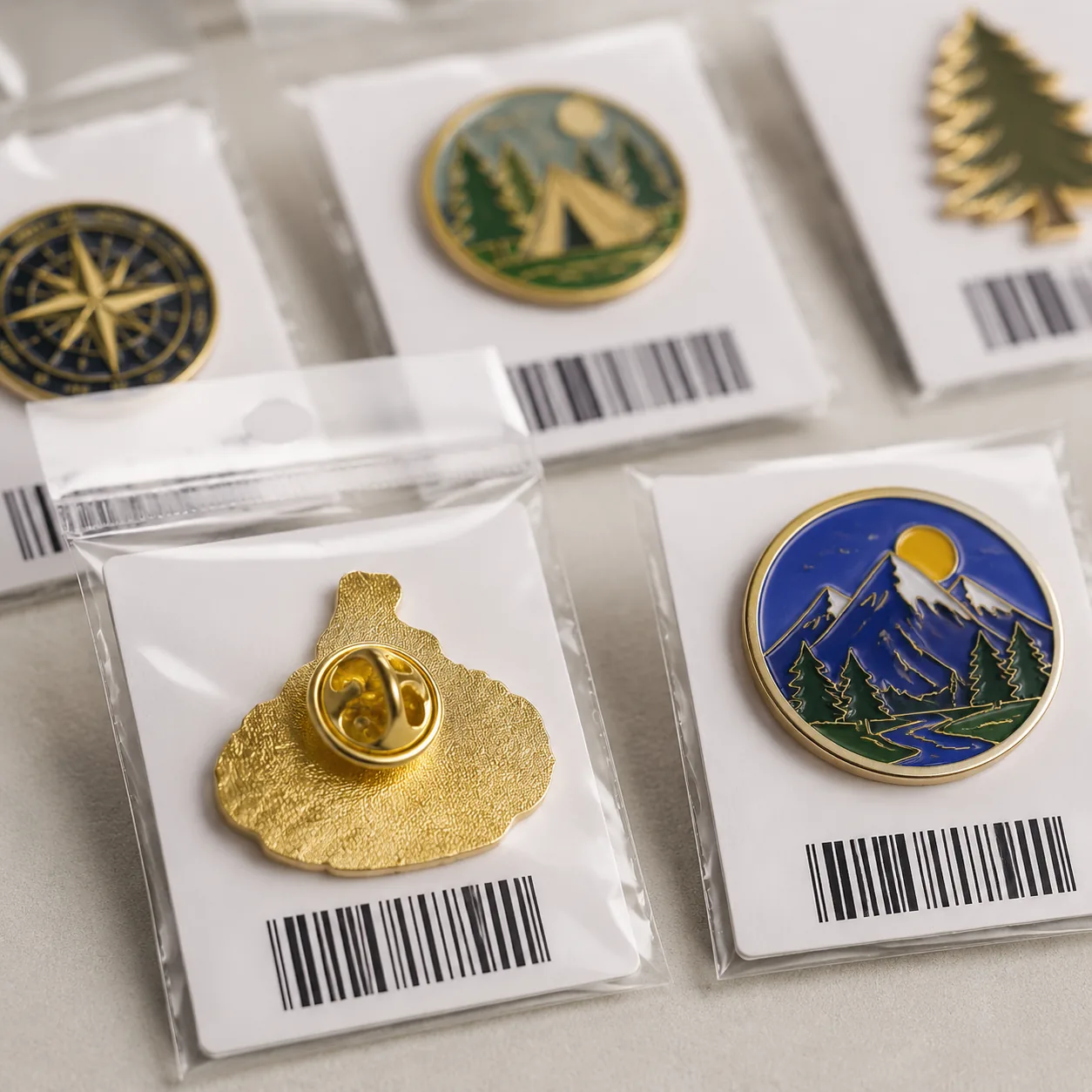
Why Good Products Still Fail Receiving
A custom enamel pin, challenge coin, keychain or embroidered patch can pass product inspection and still be refused by a retailer, 3PL or marketplace warehouse. The usual failure is not plating thickness, enamel fill or stitching. It is the pack-out: unreadable barcodes, missing country-of-origin text, mismatched SKUs, unapproved carton labels, or cartons that do not reconcile with the purchase order.
These problems appear late because the label rules often sit with a retailer operations team, Amazon-style marketplace portal, museum shop, event distributor or corporate warehouse rather than the brand buyer. If the factory receives label requirements only after mass production is packed, the order may need to be opened, sorted, relabeled and recounted. A 5,000-piece order can lose 1 to 2 working days; a 50,000-piece multi-SKU campaign can lose 5 to 8 working days, especially when each design has its own barcode, warning line and carton mark.
Treat retail labeling as part of the packaging specification, not an optional finishing step. For custom pins, brooches, coins, patches, magnets, lanyards and metal keychains, the safest point to lock label rules is before pre-production sample approval. Barcode printing may happen during final packing, but the label level, size, data source, carton quantity and inspection criteria should be fixed before the factory quotes the final pack-out.
Lock the Label Level Before Quoting
The first technical decision is where the scannable code must live. A barcode printed on a backing card is different from an adhesive label on an outer OPP bag. Both are different from an inner box label or a 100 x 150 mm master carton shipping label. Each level changes artwork layout, labor time, carton dimensions and the risk profile at receiving.
A common retail-ready structure for small metal items is one piece per OPP bag, one printed backing card inside the bag, one adhesive barcode label on the back of the bag or card, 50 to 100 pieces per inner carton, and 500 to 1,000 pieces per master carton. For challenge coins, boxed medals and bottle-opener keychains, carton quantity is often limited by weight instead of volume. Keep master cartons at 10 to 15 kg gross weight where possible; many warehouses allow 18 kg, but manual handling complaints rise above that.
| Label level | Typical use | Recommended spec | Risk if missed |
|---|---|---|---|
| Unit barcode | Retail POS, 3PL pick-pack, marketplace intake | 25 x 50 mm or 30 x 60 mm label; UPC-A, EAN-13 or Code 128; 300 dpi thermal print | Unit cannot be received, scanned or picked correctly |
| Backing card barcode | Museum shops, brand stores, peg display | Vector barcode at 80-120% magnification; minimum 3 mm quiet zone; no varnish over bars | Scanner failure from gloss, dot gain or low contrast |
| Inner carton label | SKU control inside master cartons | 60 x 40 mm minimum; SKU, PO, quantity, batch, design number and destination market | Mixed SKUs, recounts and wrong replenishment |
| Master carton label | Retail DC, 3PL, export handling | 100 x 150 mm label on two adjacent sides; carton 1 of X, GW, NW and dimensions | Warehouse rejection, chargeback or relabeling fee |
| Origin and compliance text | Import clarity and retail compliance | Made in China on unit pack, card or carton; 1.5 mm minimum text height on small packs | Compliance hold or destination repack request |
Barcode Artwork That Scans in Production
Barcode artwork should be supplied as live vector data or high-resolution black-only raster. For thermal adhesive labels, 300 dpi is normally acceptable. For barcodes printed directly on backing cards, vector files are safer because paper stock, ink coverage and dot gain can narrow quiet zones or thicken bars. Avoid screenshots, compressed JPGs and codes copied from a PDF proof without verifying scale.
For EAN-13 and UPC-A, keep the barcode at 80% to 120% of standard magnification unless the retailer specifies a fixed size. For Code 128 SKU labels, do not shrink the printed code below about 25 mm wide for short numeric strings or 38 mm wide for longer alphanumeric codes. A quiet zone of at least 3 mm on the left and right sides is a practical minimum for small promotional products; 5 mm is safer when space allows.
Color is not a branding area. Use black bars on white or very light stock with strong contrast. Transparent labels over dark backing cards, metallic silver labels, kraft labels with low contrast, glossy lamination over the bars and colored bars on colored backgrounds all increase scan failures. If the retail design needs a colored label, place the barcode inside a white box and keep the code itself black.
- Supply barcode numbers in a spreadsheet with SKU, product name, colorway and destination market.
- Confirm symbology before artwork: UPC-A, EAN-13, Code 128, QR code or retailer-specific SSCC label.
- Keep barcode orientation consistent across SKUs; horizontal is safest for small bags and backing cards.
- Keep hang holes, staples, zip seams, pin posts and bag seals outside the barcode quiet zone.
- Request a scan test using the printed production label, not only a digital proof on screen.
- Freeze SKU naming before packing so carton labels, unit labels and invoices use the same logic.
Unit Packaging: Bags, Cards and Warning Text
OPP bags remain the lowest-cost unit pack for pins, patches, magnets and keychains. Typical film thickness is 30 to 50 microns, with 40 microns giving a good balance of cost and handling strength. For sharp brooch pins, heavy coins or keychains with bottle-opener edges, specify 50 to 60 microns or switch to a small kraft box, PVC pouch or blister-style insert to reduce punctures during courier handling.
Many buyers require suffocation warnings when the bag opening is 127 mm or wider, and some retailers require warnings on smaller bags as a blanket policy. The exact wording depends on destination and channel, so the buyer should provide approved copy. From a production standpoint, warning text should be at least 2.5 mm high on small bags, printed in one high-contrast color, and kept away from the barcode.
Backing cards need enough flat area for product presentation and scanning. A 30 mm enamel pin usually fits a 55 x 85 mm card. A 45 mm pin, large brooch or dual-post badge often needs 70 x 100 mm. For keychains and heavier pins, use 300 to 350 gsm card rather than 250 gsm because the hang hole can tear on peg display. If the barcode is printed on the card, leave a flat white barcode panel and avoid textured paper in that area.
| Unit pack option | Typical FOB add-on | MOQ guidance | Lead-time impact | Best use |
|---|---|---|---|---|
| Plain OPP bag | USD 0.01-0.03 per piece | 100 pieces per SKU | +0-1 day | Bulk events and internal handouts |
| OPP bag plus barcode label | USD 0.03-0.07 per piece | 300 pieces per SKU | +1-3 days after data approval | 3PL intake and online fulfillment |
| Printed backing card plus bag | USD 0.08-0.18 per piece | 500 pieces per artwork | +3-6 days for proofing, print and die cut | Retail pegs and brand presentation |
| Kraft box with barcode label | USD 0.18-0.45 per piece | 300-500 pieces per size | +2-5 days depending on box stock | Coins, premium keychains and brooches |
| Velvet pouch plus hangtag | USD 0.12-0.35 per piece | 300 pieces per color | +2-4 days | Gift programs and VIP coin packs |
Inner Cartons Prevent Mixed-SKU Errors
Retail-ready does not mean all units should be loose in one export carton. For campaigns with many SKUs, inner cartons are the main control point. A practical inner carton for pins and patches is about 20 x 15 x 10 cm, holding 50 to 100 carded pieces depending on card size, pin thickness and bag seal. Heavier coins may need 25 or 50 pieces per inner carton to keep handling safe.
Each inner carton label should show SKU, product name, design number, colorway, quantity, PO number, batch date and destination market if country-specific packaging is used. For serialized coins, QR-coded collectibles or limited-edition pins, add the serial range, such as 0001-0050, to both the inner label and packing list.
Mixed master cartons can reduce freight on small orders but increase receiving risk. If a retailer requires one SKU per master carton, follow the rule even when a carton is not full. If mixed cartons are approved, use one SKU per inner carton, add a carton-level packing list, and photograph the open carton before sealing. Do not mix visually similar gold, antique gold and rose-gold designs in the same inner carton unless labels are very clear.
- Use one SKU per inner carton whenever quantity allows.
- Keep standard inner quantities fixed, such as 50 pieces, except the final short carton.
- Mark short cartons with the actual quantity, not the standard quantity.
- Separate country-specific labels, warning texts and barcode formats by destination market.
- Photograph open inner cartons and sealed master cartons for traceability.
- Match inner carton totals to the commercial invoice and final packing list before booking shipment.
Master Carton Marks for Retail DC Intake
Master cartons must be strong enough for export handling and light enough for safe receiving. For pins, patches and light keychains, five-ply corrugated cartons with 44 ECT or comparable burst strength are normally sufficient. For challenge coins, medals, metal bottle openers and boxed magnets, specify stronger board or smaller cartons so the gross weight remains near 10 to 15 kg. Avoid exceeding 18 kg unless the receiving warehouse has approved the limit.
Common carton sizes for carded pins are 40 x 30 x 25 cm and 45 x 35 x 30 cm. Oversized cartons may look efficient but can crush lower layers if the contents are dense. For palletized sea freight, check carton dimensions against the pallet plan. A carton that wastes 10% to 15% of pallet footprint can cost more than a slightly smaller carton that stacks cleanly.
Place master carton labels on two adjacent sides, not only on the top. If the retailer or 3PL provides a template, use it exactly and do not add extra fields that interfere with scanning. If no template is provided, include supplier name, buyer code, PO number, SKU, product description, carton number, total cartons, unit quantity, net weight, gross weight, carton dimensions and country of origin. Print carton marks at 10 pt or larger for text fields and 300 dpi for barcode fields.
QC Standards for Labels and Cartons
Label inspection should be part of final random inspection, not a casual packing-line check. For standard promotional orders, AQL General Inspection Level II with critical defects at 0, major defects at 2.5 and minor defects at 4.0 is a practical baseline. For retailer-direct shipments, classify wrong SKU mapping, unreadable barcodes and incorrect carton counts as critical or major because one label error can block the entire receipt.
Hand-applied adhesive labels need realistic tolerances. A placement tolerance of plus or minus 3 mm is achievable at normal packing speed. If the label must align exactly with printed card artwork, use pre-printed cards or machine-applied labels instead of expecting manual workers to hold a 1 mm visual tolerance across thousands of units.
The factory should scan samples from each SKU and from each label printer roll. Thermal printers can drift, ribbon density can fade, and label stock can change mid-run. For a 10,000-piece order with 20 SKUs, a sensible control plan is first-piece label approval for every SKU, in-line scan checks during packing, final random inspection, and a sealed-carton photo set before shipment.
| QC item | Recommended acceptance | Defect class | Typical tolerance |
|---|---|---|---|
| Barcode scan | Scans on first or second pass with standard handheld scanner | Major or critical | No unreadable barcode in inspected sample |
| SKU mapping | Barcode, product, card, inner label and carton label match | Critical | Zero mismatch |
| Label placement | Flat, readable and not covering product view, warning or hang hole | Minor or major | +/- 3 mm for hand-applied labels |
| Carton mark | PO, SKU, quantity and carton count match packing list | Major | Zero wrong carton count |
| Origin mark | Correct country-of-origin text on required pack level | Major | 1.5 mm minimum text height on small packs |
| Polybag warning | Approved wording present and legible where required | Major | 2.5 mm text height typical minimum |
Cost, MOQ and Lead-Time Planning
Retail labeling is inexpensive compared with destination rework, but it is not free. A plain adhesive barcode label normally adds USD 0.02 to 0.06 per unit including application for small metal promotional products. Printed backing cards usually add USD 0.08 to 0.18 per unit depending on card size, gsm, print sides, hang hole, coating and order quantity. Kraft boxes can add USD 0.18 to 0.45 per unit and also increase freight volume.
MOQ matters because setup time is fixed. Adhesive labels are workable at 100 to 300 pieces per SKU, though low quantities carry higher unit labor. Printed cards become more efficient at 500 pieces per artwork; below that, digital print is possible, but color consistency across repeat orders is weaker than offset. If a campaign has 40 SKUs at 100 pieces each, adhesive labels on standard bags may be more reliable than 40 separate printed card artworks.
Lead-time impact is usually 1 to 3 working days for simple barcode labels after final data approval. Printed cards add 3 to 6 working days for proofing, printing, drying and die cutting. Custom boxes add 5 to 10 working days if a new die line or special paper stock is needed. Retailer portal approval is separate; a factory can prepare the label, but it cannot control whether a 3PL approves the PDF in one day or one week.
Packing Brief to Send With the RFQ
Before requesting a final quote, prepare a packing brief with the same discipline as the product specification. Include the unit pack type, barcode level, label size, barcode symbology, SKU list, country-of-origin wording, warning text, inner carton quantity, master carton label template and whether mixed cartons are permitted. This prevents a common pricing gap: the metal product is quoted correctly, but the retail-ready pack-out is missing.
Send live barcode data early, even if final artwork is not finished. The factory can test size, quiet zone, print method and label placement before mass packing starts. For programs covering pins, patches, coins, lanyards and keychains, use one SKU naming structure so unit labels, carton labels, invoices and packing lists follow the same logic.
For ZheCraft orders, the clean workflow is product artwork approval, unit packaging layout approval, printed label or card sample approval, then mass packing. For retailer-direct shipments from Yiwu or other China export hubs, request carton label photos, a SKU-level packing list, barcode scan evidence and gross-weight confirmation before goods leave the factory. That documentation is a small step, but it is often the difference between smooth receiving and an expensive relabeling job at destination.
Have a project? Send your artwork and target quantity and we’ll reply with a detailed quotation within 12 working hours.
Ready to get this made?
Send your sketch, target quantity and ship-date. Detailed quotation in 12 hours.



