Retail Pin Assortments: Shelf-Ready Specs, Costs, and QC Controls
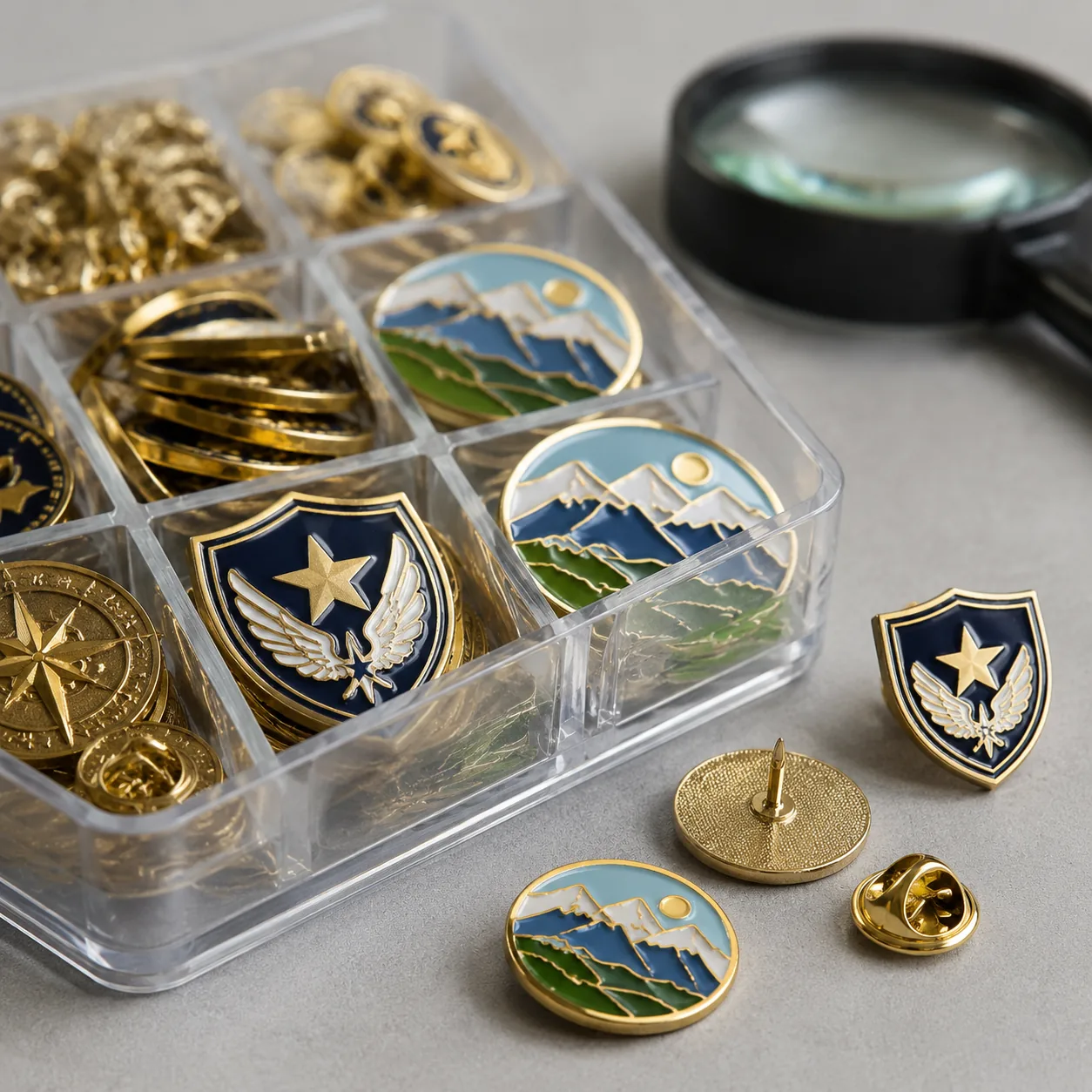
Launch Scenario: 12 Designs, 6,000 Units, One Retail Deadline
A museum shop buyer is preparing 12 enamel pin designs for an exhibition launch. Each pin is 28 to 35 mm wide, mounted on a branded backing card, barcode-ready, and packed by theme for counter display. The order is 500 pieces per design, or 6,000 packed units total. Capacity is not the main risk. SKU control is.
One wrong carton label can put 500 landscape pins under a portrait SKU. One mismatched barcode can block the item at point of sale. One plating batch that runs warmer than the others can make the assortment look inconsistent even if each individual pin is saleable. Retail assortment work needs a controlled production matrix, not scattered email approvals.
For this type of launch, ZheCraft treats the project as one assortment with 12 controlled line items. The die line, plating finish, enamel type, card size, barcode placement, bagging method, inner-box quantity, master carton marks, and inspection sampling are managed under one master production sheet. Each SKU remains separate from tooling through final packing.
Control the Assortment With a Master SKU Sheet
The first working file should be a spreadsheet with one row per SKU. Required fields include SKU code, design name, finished pin size, base metal, metal thickness, plating finish, enamel type, Pantone colors, attachment, card artwork file name, barcode number, bagging method, inner quantity, carton quantity, and required delivery date. File names should match the SKU exactly, such as MS-EXH-001-pin.ai and MS-EXH-001-card.pdf.
Use SKU codes rather than informal descriptions. Names such as “blue bird final,” “bluebird new,” and “bird revised” invite packing errors. Factory operators, print vendors, and QC inspectors can follow a 10-character SKU faster than a long English description, especially when multiple designs share colors or themes.
Tolerance rules belong in the same sheet. For stamped iron or brass pins from 25 to 40 mm, a practical finished-size tolerance is ±0.30 mm, with metal thickness at ±0.15 mm. For zinc alloy cast pins, allow ±0.40 mm on irregular outer profiles unless a critical fit is involved. For backing cards, specify cut-size tolerance at ±1.0 mm and pin-hole position at ±1.5 mm because paper punching and stacking movement are less precise than metal stamping.
| Control Item | Recommended Spec | Commercial Reason |
|---|---|---|
| SKU code | 8 to 14 characters on PO, proof, bag label, inner box, and carton | Prevents mixed designs during packing and receiving |
| Artwork version | One approved AI/PDF per SKU with date and revision code | Stops obsolete pin or card art entering production |
| Barcode | EAN-13, UPC-A, or buyer code at 80% to 100% magnification | Improves scanning reliability on small backing cards |
| Backing card | 55 x 85 mm or 60 x 90 mm, 350 to 400 gsm C1S/art card | Fits peg hooks and keeps the range visually consistent |
| Inner packing | 50 or 100 pieces per inner box, one SKU only | Supports store allocation, cycle counting, and returns control |
Prototype the Hardest SKU Before Sampling All Designs
Sampling all 12 designs at once is rarely the fastest route. Choose the most difficult design as the pilot: smallest lettering, narrowest metal bridges, highest color count, tightest cutouts, or most visible plated border. If the hard SKU works, the simpler SKUs can follow the same construction standard. If it fails, the buyer learns before paying for 12 tooling sets.
For a 30 mm retail enamel pin, common specs are 1.2 to 1.5 mm stamped iron, 1.5 to 1.8 mm brass, or 1.8 to 2.0 mm zinc alloy for heavier sculpted styles. Soft enamel gives recessed color and stronger texture at lower cost. Hard enamel requires polishing after color fill, giving a smoother premium surface but increasing labor and reject risk on fine details.
Normal indoor retail plating targets are 8 to 12 microns for nickel, black nickel, imitation gold, or antique finishes. Premium gold, rose gold, or corrosion-sensitive programs may call for 12 to 20 microns, confirmed by XRF testing. For low-cost promotional pins, thinner plating is common, but it is not ideal for retail products handled repeatedly by shoppers.
Pilot sampling usually takes 7 to 10 days after artwork approval for soft enamel and 10 to 14 days for hard enamel. Add 3 to 5 days if the pilot must include printed backing cards, barcode scanning, bag fit, and display-tray mockup. For a retail launch, the card sample is not optional; the product must hang straight, scan correctly, and look finished before mass production starts.
- Select the pilot SKU for technical difficulty, not personal preference.
- Approve metal color, enamel gloss, card stock, attachment, and bag fit from one sample pack.
- Keep one signed golden sample set at the factory and one with the buyer.
- Do not change plating, card finish, or clutch type after pilot approval without re-costing.
- Tag the pilot sample with SKU, date, revision number, and approved Pantone references.
Quote by SKU, Then Average the Retail Budget
A single average price is useful for internal budgeting, but the factory must still quote each SKU. A two-color round pin and a 12-color irregular pin do not require the same enamel filling, polishing, plating control, or reject allowance. If all designs are forced into one price without checking the extremes, the most complex designs are the first to be simplified, delayed, or under-inspected.
For 500 pieces per SKU, realistic FOB China ranges for packed 25 to 35 mm pins are USD 0.58 to 1.35 for soft enamel iron, USD 0.72 to 1.65 for hard enamel iron, and USD 0.90 to 2.10 for zinc alloy or heavier 3D detail. Individual die charges commonly run USD 35 to 90 for simple stamped iron, USD 50 to 120 for brass, and USD 80 to 180 for zinc alloy molds. Backing cards, OPP bags, barcode labels, and packing labor normally add USD 0.04 to 0.18 per unit depending on paper weight, lamination, print coverage, and labeling method.
MOQ should be agreed at both assortment level and SKU level. Many factories can make 100 pieces per design, but the unit cost rises because tooling, color setup, plating racks, card printing, and packing changeovers repeat for every SKU. For retail, 300 pieces per SKU is a workable test tier, 500 pieces is the most balanced launch tier, and 1,000 pieces improves unit price when sales history supports the inventory risk.
| Order Tier | Best Use | Typical FOB Per Packed Pin | Main Trade-Off |
|---|---|---|---|
| 100 to 299 pcs/SKU | Artist trial, pop-up, limited event | USD 1.25 to 2.80 | High unit cost and manual handling |
| 300 to 499 pcs/SKU | Small museum or boutique launch | USD 0.85 to 1.95 | Lower risk, but reorders may arrive late |
| 500 to 999 pcs/SKU | Balanced retail assortment | USD 0.58 to 1.65 | Good cost with manageable inventory |
| 1,000+ pcs/SKU | Proven bestseller reorder | USD 0.42 to 1.25 | Best unit cost but higher stock exposure |
Design Packaging for Store Handling, Not Factory Convenience
The backing card must work on the sales floor. A common retail format is a 55 x 85 mm card in 350 to 400 gsm stock with matte or satin lamination, one Euro slot or 6 to 8 mm round hang hole, and the pin centered 28 to 32 mm below the top edge. The barcode should sit at least 8 mm from trim edges and away from the pin clutch so scanners can read it without glare or obstruction.
For two-post pins, the post spacing should match the design width and prevent rotation. A 30 mm pin normally uses posts spaced 12 to 18 mm apart. Card hole position tolerance should be ±1.5 mm, and the hole diameter should leave enough clearance for manual assembly without tearing the card. One-post pins are cheaper and faster to assemble, but they rotate more easily on the card unless the clutch is tight and the artwork is visually forgiving.
Attachment choice affects retail durability. Butterfly clutches are economical and familiar, often adding USD 0.015 to 0.035 per unit. Black rubber clutches usually add USD 0.025 to 0.055, grip better during handling, and feel cleaner on a premium card. Locking clutches cost more and are usually unnecessary for standard museum shop pins unless the pin is heavy or high-priced.
Decide early whether each carded pin is individually bagged. OPP bags reduce scratches and fingerprints and add about USD 0.015 to 0.04 per unit, but they create plastic waste and glare under shop lighting. For premium stores, an unbagged card inside a covered inner box can look better, but the master carton needs stronger dividers and tighter packing to prevent rubbed corners.
Inspect by SKU and by Assortment Appearance
Standard QC checks whether each piece matches the approved sample. Retail assortments need a second review: do all 12 SKUs look like one family when placed together? Inspectors should compare plating tone, enamel gloss, card background color, logo position, barcode density, pin alignment, bag clarity, and tray presentation before cartons are sealed.
For enamel pin retail orders, AQL 2.5 for major defects and AQL 4.0 for minor defects is a practical baseline. Critical defects should be set at 0 acceptance. Major defects include wrong SKU, wrong card, unreadable barcode, missing post, loose post, wrong plating, wrong enamel color, sharp burrs, mixed inner boxes, or broken clutches. Minor defects include small dust under enamel, slight polishing waves, tiny card scuffs, light bag wrinkles, or minor plating shade variation within the approved limit.
Functional checks should be measured. Post pull strength should meet 5 to 8 kgf for standard retail pins, depending on post diameter and solder area. Plating thickness should be checked by XRF when a micron target is stated or when corrosion resistance matters. Barcode scans should be tested on at least 5 finished packed pieces per SKU, not only from the artwork PDF. For export cartons around 8 to 12 kg, a practical drop test is one drop on each face, edge, and corner from 60 cm, with no loose pins, crushed cards, or opened inner boxes.
- Inspect and count each SKU separately before palletizing mixed assortment cartons.
- Scan finished packed pieces from every SKU using the buyer’s barcode format.
- Reject any carton containing two SKUs unless mixed inners are approved in writing.
- Photograph the first sealed inner box and master carton label for every SKU.
- Record plating, post strength, card alignment, and carton count in the final QC report.
Build the Calendar Backward From the Launch Date
The retail date is usually fixed by an exhibition, holiday, or campaign, so the production calendar must work backward. For a 12-SKU assortment at 500 pieces per SKU, a normal schedule is 2 to 4 days for artwork engineering, 7 to 14 days for pilot sampling, 2 to 5 days for approval or revision, 18 to 28 days for mass production, 3 to 5 days for packing and final inspection, then freight.
Air freight usually takes 5 to 10 days airport-to-door after export documents are ready. Sea freight plus local delivery normally takes 28 to 45 days, depending on port pair, customs clearance, and inland delivery. A safe buyer calendar allows 45 to 60 days from final artwork approval for air shipment and 70 to 90 days for sea shipment. If the launch is inside those windows, reduce SKU count, simplify packaging, or approve partial air shipment for bestsellers rather than compress every factory step.
| Stage | Normal Lead Time | Buyer Decision Required |
|---|---|---|
| Artwork engineering | 2 to 4 days | Confirm size, metal borders, Pantone colors, and SKU names |
| Pilot sample | 7 to 14 days | Approve pin, card, barcode, attachment, and bagging |
| Mass production | 18 to 28 days | Freeze tooling, plating, enamel, and card artwork |
| Packing and QC | 3 to 5 days | Approve carton marks, AQL level, and final photos |
| Air freight | 5 to 10 days | Pay higher freight for launch certainty |
| Sea freight | 28 to 45 days | Accept longer transit for lower landed cost |
Parallel work helps but does not remove approval risk. Metal tooling, card printing, and packing preparation can overlap once the pilot standard is locked. The common delay is buyer-side: barcode confirmation, legal text approval, nonprofit logo clearance, or internal brand sign-off. Set a 24 to 48 hour approval rule before sampling starts.
Protect Reorders Without Freezing Weak SKUs
After launch, sales will not be equal across all 12 designs. Reorder from sell-through data, not from the original assortment ratio. A practical plan is to reorder bestsellers at 1,000 pieces per SKU, keep steady mid-range designs at 500 pieces, and retire or test slow movers at 300 pieces if the factory accepts that tier. This preserves the retail range without tying budget to weak inventory.
Reorder consistency depends on production records. The factory should retain die numbers, plating standard, enamel color formula, card paper spec, print file, barcode file, inspection report, and packed sample photos. The buyer should keep a golden sample set and compare reorders under neutral D65 lighting. Pantone references are useful, but enamel is not ink; a small Delta E shift can be visible because color is filled into metal recesses and polished.
Tooling ownership should be written into the PO. If the buyer pays tooling and wants exclusive use, the PO should state that molds are restricted to the buyer’s SKUs and cannot be used for other customers. Stamped pin dies can support many reorders, but fine raised lines and narrow borders should be reviewed after large cumulative volumes, especially above 30,000 to 50,000 strikes per design.
Before placing the first order, convert the project into a controlled production package: master SKU sheet, named pin artwork, named card artwork, barcode data, packing instructions, carton marks, QC standard, target delivery date, and reorder assumptions. Ask the supplier to return a production confirmation showing MOQ per SKU, FOB unit price, tooling charge, sample charge, lead time in days, plating micron target, material thickness, attachment type, card stock, bagging method, AQL level, carton quantity, and gross weight estimate. If a field is blank, it is not controlled.
Have a project? Send your artwork and target quantity and we’ll reply with a detailed quotation within 12 working hours.
Ready to get this made?
Send your sketch, target quantity and ship-date. Detailed quotation in 12 hours.



